NordenBladet – It is a priority for the Danish government to ensure an effective international environmental cooperation. UN assesses that especially on the environmental part of the Sustainable Development Goals there is a lack of progress. Therefore, the Danish government has chosen to increase its contribution to UN Environment in 2019.
Denmark has long had a good working relationship with UN Environment, and with the appointment of Inger Andersen as executive director for UN Environment, there is confidence in that UN Environment will create even better results in future. She has been Director General for the International Union for Conservation of Nature (IUCN) since 2015 and has more than 30 years of experience in development economics and sustainable environment and has the ability to create effective results.
The Danish minister for Development Cooperation Ulla Tørnæs says:
“It is with great pleasure that we increase the Danish contribution to UN Environment to 30 million Danish kroner in 2019. Denmark supports the promotion of sustainable initiatives in the developing countries and, not least, the Sustainable Development Goals. There is a lot of focus on the fight against climate change, which is crucial, but we must not forget the other environmental issues. Therefore, we now want to give an additional contribution to UN Environment. With Inger Andersen as executive director I am sure that the cooperation with UN Environment will develop even more positively in the coming years.”
The Danish minister for Environment and Food Jakob Ellemann-Jensen is currently participating in the UN Environment Assembly in Nairobi, where he focuses on the need for global solutions:
“It is crucial that we have a strong international environmental program that can help us solve global environmental problems and protect nature. We are in Nairobi to fight for less deforestation, less plastic in our oceans, safe handling of chemicals and generally more sustainable consumption and production patterns. When the UN member states agree on new initiatives, it is often UN Environment that plays the leading role in the execution. Therefore, it makes good sense to strengthen UN Environment,” says Jakob Ellemann-Jensen.
NordenBladet – Norway Police Intelligence Service (PST) has charged Laila Anita Bertheussen, the partner of the Norwegian Minister of Justice and Public Security, with the accusation of faking an attack on their family car.
PST wrote on its website today that the arrest is related to violation of section 225 letter b of the Penal Code – for having done something to raise suspicion that criminal act has been committed, when it has not.
The charges concern the fire that started on the night between Saturday and Sunday 10 March in the family car, which was parked outside the family´s residence in Oslo.
“We suspect the charged person to have started the fire, thus giving the impression that the fire was started by one or more unknown perpetrators”, wrote PST.
This incident is seen in connection with previously alleged threats against the Minister of Justice and his partner, where the charged person may have caused the police to investigate this incident, as an escalation of the previous threats. PST will continue to investigate these former incidents as violations of section 115 and 263 of the Penal Code.
The investigation is in a preliminary phase, and Laila Bertheussen is currently being questioned by PST. The offence can, under the circumstances, be punishable under several other penal provisions.
Today, Oslo District Court issued a warrant to search the the justice minister’s residence. The court thus finds that there are reasonable grounds to suspect Berhetussen of the offence with which she is charged.
Section 225 – Accusation of a fictitious criminal act
A penalty of a fine or imprisonment for a term not exceeding 1 year shall be applied to any person who
a) reports a criminal act which has not been committed to the courts, the prosecuting authority or another public authority, or
b) raises suspicion that a criminal act has been committed, when it has not.
The incident was the fifth known “threat” associated with Wara’s home since December last year. In addition, there have been several incidents that have so far been kept secret by the police and PST.
Thursday afternoon, PST chief Benedicte Bjørnland held a press conference where they informed about the charge against the cohabitant.
Bertheussen is not charged with any of the previous incident at the residence, but PST does not rule out that they can have a connection.
The penalty for the charge is one year’s imprisonment.
About the incident
The house and car shared by Justice Minister Tor Mikkel Wara and Bertheussen have been vandalised at least five times in recent months after a theatre targeting the right wing politician and Justice Minister Benedicte Bjørnland. They have included tagging that seemed to accuse Wara of being racist, and two bomb threats.
Since some of the tagging included misspellings of the Norwegian word for racist, others have speculated that it could have been made to look as if non-Norwegians were behind it. PST now investigates the tagging and the earlier incidents also in relation to the recent accusations against the partner of the justice minister.
NordenBladet – The UN Secretary-General has requested Denmark to take up a leading position towards the UN Climate Action Summit in New York, 23 September 2019. Specifically, Denmark is due to lead the energy transition track in order to advance sustainable energy. A particular focus will be on clean energy investments in emerging economies and least developed countries.
An accelerated global energy transition is urgent, if the world is to live up to the ambitious targets of the Paris Agreement. To reach our common goals, developed countries, major emerging economies as well as developing countries must carry out significant transformations of their energy sectors. Particularly the world’s poorest countries can benefit from cooperation and exchange of best practice in order to improve a sustainable development.
At the UN Climate Action Summit, 23 September 2019, the nation states, multilateral development banks, private companies and investors as well as the civil society will exchange best practices and solutions to ensure a focus on increasing climate ambitions and accelerating the green transition. Denmark has been requested to lead the track on promoting the transition of the energy sector towards sustainable energy at a global level. This is recognition of the Danish global climate engagement and development cooperation as well as our front-runner position within green transition.
The energy transition track will be co-led with Ethiopia and the organisation Sustainable Energy for All (SEforALL). Together, we will focus on the sharing of best practice, concrete solutions and partnerships within renewable energy, energy efficiency, access to energy and sustainable development.
With the Danish engagement in the summit, we build on last year’s successful P4G Summit in Copenhagen as well as many years of experience with development cooperation, including efforts to support reorganisation and improvement of energy sectors in both emerging economies and least developed countries – thus improving global climate and the development of these countries.
“In Denmark, we are proud to take up this leading role and proud to promote our ideas and concrete solutions that has the potential to scale up and increase benefits within energy transformation. We need faster action through innovation, public-private partnerships – as experienced at P4G – and private investments to reach the Paris Agreement. Especially, we need this innovation in the developing countries, where we see the greatest challenges. Denmark is a frontrunner in this area”, says Minister for Development Cooperation, Ulla Tørnæs.
The energy sector is responsible for approximately 80 pct. of the global CO2 emissions. Therefore, a green transition of the energy sector is essential. This is an area, where Denmark has significant experience, including with mobilisation of private investments. Denmark has initiated a Clean Energy Investment Coalition to ensure ambitious commitments in clean energy from governments, international organisations and the private sector.
“The urgent need to address climate change requires a global transition of the energy sector. Therefore, we need massively increased investments in modern and green technology. In this area, we can draw on many years of Danish experience with securing a cost efficient transition towards a sustainable energy system”, says Minister for Energy, Utilities and Climate Lars Chr. Lilleholt (V).
In the months to come, the Danish government, with support from Denmark’s Special Envoy for Climate and Energy Ditlev Engel, will work to engage countries, international organizations, investors and civil society in the Danish energy track towards the UN Climate Action Summit 2019.
Facts
Denmark has been appointed to lead the track on “Energy Transition” at the “Climate Action Summit 2019” in New York, 23 September 2019.
The energy sector is responsible for approximately 80 pct. of the global CO2 emissions. Therefore, a green transition of the energy sector is essential to achieve the targets of the Paris Agreement.
Through the Clean Energy Investment Coalition, Denmark is working towards securing better framework conditions for investments in clean energy. This is essential for the green transition to succeed.
P4G is a global, trade-oriented initiative aimed at accelerating green transition and implementation of the Sustainable Development Goals in growth and development economies by bringing together the private sector, public sector and civil society to create public-private partnerships. Focus is on finding solutions to be scaled up and thereby contribute to systematic changes.
NordenBladet —At today’s sitting of the Riigikogu, deliberation of the matter of significant national importance “Information security and the associated threats to democracy and the rule of law” was held at the initiative of the Estonian Free Party Faction. Andres Herkel, Chairman of the Estonian Free Party Faction, Ilmar Raag, strategic communication expert, Helen Eenmaa-Dimitrieva, Research Fellow in IT Law at the School of Law of the University of Tartu, and Ivo Juurvee, Research Fellow at the International Centre for Defence and Security, made reports.
To introduce the deliberation, Andres Herkel spoke of the concept of information security. He said that the list of the problems linked to the field was much more extensive than interpretation of the information spreading via social media. Herkel pointed out that the security of large databases, the security of Internet communication and data transmission, and human rights on the Internet were also information security. He added that inasmuch as the strategic infrastructure and services such as transport and banking were operated on the basis of the Internet, the security of these sectors was also information security. “Very big security threats may be involved here. And last of all, the protection of our statehood and the democratic institutions of the state against cyber attacks and other information attacks,” Herkel said.
In his report, Ilmar Raag said that, when analysing information, the state should ask about its potential impact on the behaviour of the people and the constitutional order. He pointed out that, according to European experts’ assessment, in the case of certain criteria, the Member States had the right to define for themselves what kind of speech or influencing activity could be criminalised or repressed in another way. “The first of them is about whether the messages or activities contain a clear call to violence, and the other one is about whether it contains operations for introducing lies into public space, carried out knowingly,” Raag explained.
Helen Eenmaa-Dimitrieva spoke of the influence of technology on legal systems. She stated that little research had been done on how datafication could serve the interests of being a citizen, and freedom and social justice, but it was indispensable. “Within the context of information security, what we need is more substantive combination of mechanisms and competition – that would be of much use. It is good to use all opportunities to develop the cooperation capacity of society and the decision-making processes,” Eenmaa-Dimitrieva said.
Ivo Juurvee spoke of the influencing activities of special services in the past and today. He said that influencing activities did not include only manipulation of big data, but influencing agents had not disappeared anywhere either, and it was simpler to use them thanks to technological development. He suggested that the problem of influence agents could be reduced to a certain extent with Acts against money laundering and Acts against defamation. “And finally, more specific regulation of lobbying is also a question that the next Riigikogu could perhaps consider,” Juurvee said.
During the debate, Erki Savisaar (Centre Party), Andres Herkel (Estonian Free Party), Keit Pentus-Rosimannus (Reform Party) and Tanel Talve (Social Democratic Party) took the floor on behalf of the factions.
Erki Savisaar said that the information analysis skill was paramount for ensuring security. When reading news and documents, people should think critically why and in whose interests they have been written. He added that innovative solutions should be found how to protect people against fake news and how to offer even better and more human-centered national services.
In his speech, Andres Herkel also called on to critically evaluate information sources, and stressed the importance of digital education. He extended a call to all political parties to conclude an agreement of goodwill to the effect that politicians do not write anonymous comments or use fake accounts.
Keit Pentus-Rosimannus said that greater unity was needed to counter extensive information and influencing operations of foreign countries. For that, she said, a coordinating unit should be designated who would address the issue, and where the know-how and experience of the field would be collected.
Tanel Talve noted in his speech that, when developing new e-services, more attention should be paid to security. He found that cross-party cooperation was possible in that issue, and called on the following Riigikogu to address it.
Three Bills passed the second reading:
The Bill on Amendments to the Estonian Defence League Act (786 SE), initiated by Member of the Riigikogu Ants Laaneots, will specify the co-operation of the Defence League with the Defence Forces in reservist trainings, in the military defence of the country and in the preparation for the collective self-defence, and upon participation in international military cooperation. Where necessary, the Government will establish additional duties for the Defence League by an order.
The Bill will also extend the entitlement of an active member of the Defence League to unpaid holidays for up to 30 days from his or her employer upon participation in military training or involvement in the activities of the Defence Forces or law enforcement. The Defence League may pay compensation for such a holiday. Under the current Act, compensation is paid to the extent of up to five days.
The Bill on Amendments to the Police and Border Guard Act and the Rescue Service Act (768 SE), initiated by the Government, provides for a more flexible organisation of the employment in service of the Deputy Director General of the Police and Border Guard Board, and the promotion in the service rank of a police officer, and specifies the grant of the state old-age pension of rescue service workers.
Under the current procedure, old-age pension is granted to rescue service workers on the basis of the State Pension Insurance Act. In addition, the Rescue Service Act provides for an increase of 10-15 per cent in old-age pension, depending on the length of service of rescue service worker (starting from the tenth year). In practice the question has arisen as to whether a person who has the required length of rescue service but who attains pension age after 1 March 2023 would not benefit from an increase in their pension. According to the Bill, the person would retain the entitlement to the increase in old-age pension.
The Bill also provides for the entitlement to an increase in the old-age pension of rescue service worker also for persons who were in rescue service at the time of entry into force of the Act (on 1 March 2008) but who have left the service after that and are not retiring from rescue service. Under the current procedure, the state old-age pension of rescue service worker is granted and paid after termination of employment in the position of rescue service worker. Until the end of 2017, the Act was interpreted to mean that only rescue service workers retiring immediately from rescue service benefited from an increase in the old-age pension of rescue service worker. Under the Bill, rescue service workers who do not retire immediately from rescue service will also benefit from an increase in the old-age pension of rescue service worker if the conditions for receiving the pension are met. This concerns the persons who were in rescue service at the time of entry into force of the Act and who have the length of rescue service required for an increase in old-age pension. The increase will be paid retroactively also to the persons for whom no increase in old-age pension was calculated earlier.
The general objective of the Bill on Amendments to the Penal Code and Amendments to Other Associated Acts (658 SE), initiated by the Government, is to reduce recidivism and to increase social security.
The Bill will create the possibility to impose life imprisonment on persons with recidivist past who commit manslaughter or a sexual offence again. Victims of serious crimes will be given an opportunity to express their opinion on the release of an offender on parole. The amendment aims to pay more attention to the rights of the victim and the liability of criminals.
In addition, the Bill will organise the regulation of life imprisonment. Under the current law, a person can be released on parole in the case of life imprisonment after he or she has served thirty years of imprisonment. The Bill will allow for a person serving life imprisonment to be placed in an open prison if he or she has served at least 23 years of imprisonment. The Bill will create the possibility to release on parole a prisoner serving life imprisonment if he or she has served at least 25 years of imprisonment. A person who is released on parole in the case of life imprisonment will undertake to be subjected to supervision of conduct in order that his or her coping in society would be secure.
The Bill will also create the possibility to enter into an agreement for leaving the country with an alien within the framework of settlement proceedings (except with regard to a person accused of a serious crime), which will involve prohibition on entry.
NordenBladet —The Chairman of the Foreign Affairs Committee Marko Mihkelson is taking part in the meeting of the Chairmen of the Foreign Affairs Committees of the Nordic and Baltic parliaments (NB8) in Bergen, Norway, to discuss various problems of international security, ranging from the situation in Afghanistan to food security and condition of the oceans.
Mihkelson cites the situation in Afghanistan as the first topic to be discussed. “The US and allied forces have kept the Afghanistan crisis under control for a long time, barred the spreading of terrorism, and have trained and supported the Afghan security forces,” Mihkelson said. “However, the supposed plan of the US President to leave Afghanistan can now lead to unforeseeable consequences. We will try to shape a common understanding about the further activities with our Nordic and Baltic colleagues.”
The host country Norway also presented its foreign policy goals to the guests yesterday. Another topic was global food security and sustainable management of oceans. Mihkelson said that global food security would keep increasing in importance because the world population is growing, and even now, food security is precarious in certain regions.
“It is critical for every country to remain self-sufficient in strategic food sectors like dairy, meat, fish, and grains, but we must work together to ensure food supplies in countries that suffer from crop failures or military and economic crises,” Mihkelson said.
On the topic of sustainable management of oceans, Mihkelson listed illegal fishing, piracy, climate changes, and marine pollution, all of which put the condition of the oceans at risk. “At the meeting in Bergen, we were looking for ways to ensure safe, secure, clean and fertile seas and oceans worldwide; these regulate our climate, supply us with food and clean air, but also drive our economic growth,” Mihkelson said.
Today, the programme will continue with a visit to the Institute of Marine Reasearch in Austevoll.
NordenBladet —A new assessment of threatened species indicates an increasing loss of biodiversity in Finnish nature. Of the 22 000 species evaluated, 11.9% were classified as threatened, compared to 10.5% in the previous assessment. All species groups include threatened species, and the highest proportion can be found among birds and bryophytes (mosses). The primary cause of threat is the decline and deterioration of natural habitat. Much can be done to stop this development, but urgent action is needed.
Largest proportion of threatened species among birds and bryophytes
Approximately one third of Finnish bird and bryophyte species are under threat. The proportion of threatened species is also large among lichens, vascular plants, butterflies and moths, and hymenopterans. The situation has deteriorated in all of these groups since the previous evaluation. Almost one third of vertebrate animals are endangered. Critically endangered species include, for example, the Arctic fox (Vulpes lagopus), Landlocked salmon (Salmon salar m. sebago) and Ortolan bunting (Emberiza hortulana), among twenty other species.
Approximately 10% of Finnish insect species are threatened. For some insects, the situation has improved, as many of the southern species have benefited from climate warming. On the other hand, over 200 butterfly and moth species are even more endangered than before, even if the situation has improved for 152 species.
Species becoming more threatened in all habitats
Species are becoming threatened the fastest in fell areas, mires, aquatic habitats and rock outcrops. Only some improvements have occurred among species living in such areas. The threatened species in fell areas include particularly butterflies, moths and vascular plants suffering from, for example, the effects of climate change.
The majority of threatened species live in forests and rural biotopes, as well as other environments established as a result of human activity. Part of the species in such habitats have become threatened, but at the same time, the situation has improved for other species. As a whole, species in such habitats are declining at a slower pace than in fell areas and mires. The forests and rural biotopes are home to the largest number of species, which partly explains the large number of threatened species.
The biggest threat is the decline and degradation of habitat
Changes in the forest environment are the most significant cause of threat to species, as is the case with 733 threatened species. These changes include forest management activities, as well as the reduction of old-growth forests and large trees, as well as decreasing amounts of dead and decaying wood.
The second most common threat to species is the overgrowing of open habitats, which is the primary cause of threat to 639 species. Climate change poses a threat to, in particular, species in fell areas.
Concrete actions to improve the situation for species
Much can be done to stop the decline of species. In the Red List of Finnish Species, both broad and targeted measures are presented to improve the living conditions of species. Conservation areas alone cannot ensure the protection of species. Instead, biodiversity must be taken into account in all use of natural resources and areas.
Active conservation, restoration and management measures should be significantly increased, in particular, to protect species in mires and bird wetlands. In addition, more information about the occurrence of species and observations on their way of life are also required. Also the availability and usability of information should be improved.
The fifth assessment of threatened species in Finland
The assessment of threatened species in Finland was carried out for the fifth time. The work was coordinated by the Finnish Environment Institute (SYKE), and it involved 180 experts from universities, museums of natural history, Natural Resources Institute Finland, Finnish Environment Institute (SYKE), Metsähallitus and the Finnish Mammalogical Society. In addition, expert enthusiasts and retired natural scientists gave their valuable contribution to the assessment. A steering group appointed by the Ministry of the Environment guided the work and approved the assessments.
Further information:
Senior Ministerial Adviser Esko Hyvärinen, Ministry of the Environment, tel. +358 400 143 876, firstname.o.lastname@ym.fi
Senior Researcher Ulla-Maija Liukko, Finnish Environment Institute (SYKE), tel. +358 295 251 387, firstname.lastname@ymparisto.fi
Unit Director Aino Juslén, Finnish Museum of Natural History, tel. +358 50 310 9703, firstname.lastname@helsinki.fi
Biodiversity & Communication Expert Riku Lumiaro, Finnish Environment Institute (SYKE), tel. +358 40 509 8654, firstname.lastname@ymparisto.fi
A new assessment of threatened species indicates an increasing loss of biodiversity in Finnish nature. Of the 22 000 species evaluated, 11.9% were classified as threatened, compared to 10.5% in the previous assessment. All species groups include threatened species, and the highest proportion can be found among birds and bryophytes (mosses). The primary cause of threat is the decline and deterioration of natural habitat. Much can be done to stop this development, but urgent action is needed.
NordenBladet – On 22-26 February, The King and Queen visited Seefeld in Austria to watch the Swedish team compete in the Nordic World Ski Championships.
The Nordic World Ski Championships are arranged every other year, and include the ski jumping, cross-country skiing and Nordic combined events.
The 41st FIS Nordic World Ski Championships were held from 20 February to 3 March 2019 in Seefeld in Tirol, Tyrol, Austria. It was the second time Seefeld in Tirol hosted the world championships, the event having been hosted there previously in 1985.
Host selection
Championships was awarded to Seefeld in Tirol in Tyrol in Austria during the FIS Congress from 1–6 June 2014 in Barcelona, Spain.
Finalist applicants were Seefeld in Tirol (Austria), Oberstdorf (Germany), Planica (Slovenia) and Almaty (Kazakhstan). Oberstdorf had already applied for 2013, 2015 and 2017, Planica for 2017. Seefeld submitted its candidacy shortly before the deadline.
The Austrian winter sports resort had hosted the Championships in 1985, the German resort of Oberstdorf in 1987 and 2005.
Detailed application concepts were to be submitted by 1 September 2013.
Venues
The cross-country skiing events took place at the Seefeld Nordic Competence Centre. The ski jumping large hill events were held in the Bergisel Ski Jump in Innsbruck. The Bergisel Ski Jump is a large ski jumping hill with a hill size of 130 and a construction point (K-spot) of 120. It has a spectator capacity of 26,000. The current structure dates from 2003. The normal hill competitions were held in the Toni-Seelos-Olympiaschanze normal hill with a hill size of 109 and a K-point of 99.
Medal ceremonies were held at the Medal Plaza, a square in the town center.
NordenBladet —Perseverance in the voluntary restoration of the urban brook of Longinoja in the Malmi suburb of Helsinki won the Finnish Biodiversity Award 2017-2018. The winner was chosen by the National Committee of Finland of IUCN, International Union for Conservation of Nature. The award was given out in Helsinki on 25 February 2019 by Minister of the Environment, Energy and Housing Kimmo Tiilikainen.
Together with other countries in the world, Finland is committed to halting the loss of natural diversity by 2020. The Finnish Biodiversity Award was created to find innovative solutions that help reach the national and international goals.
The Biodiversity Award 2017-2018 goes to Mr Juha Salonen, the focal character in Longinoja Brook restoration, and the active brook restauration volunteers. Situated next to a major railroad, the urban Longinoja Brook was restored by a group of volunteers working together with many other actors, during a period of over 15 years.
“Thanks to active restoration work, the brook has now revived, and large numbers of threatened sea trout come again to spawn in the Longinoja Brook. This kind of hands-on work is important in the conservation of species. The volunteer work has opened the eyes of many city dwellers to the importance of urban nature areas,” says Minister of the Environment, Energy and Housing Kimmo Tiilikainen.
Visitors to Longinoja Brook can enjoy the diverse stream landscape because of the volunteer efforts. The restoration work has increased the knowledge of the participants on streams and the importance of the whole stream ecosystem. Longinoja’s nature trail with information boards was opened in late 2018, and thousands of people have already visited the stream nature trail. Information on Longinoja Brook is easily available on a website and in social media. Longinoja has also been able to get lots of media attention.
The Finnish Biodiversity Award was given out now for the seventh time. This time the competition attracted twenty-one high-level proposals. Two years ago, the award went to the Wolf Ambassadors of the Finnish Nature League – Luonto-Liitto for dispelling the fear of wolves among children and youngsters by disseminating science-based information.
International Union for Conservation of Nature (IUCN) is the oldest and largest environmental organisation and network in the world. The Finnish IUCN member organisations include the Finnish Government (represented by the Ministry of the Environment), the Finnish Association of Nature Conservation, WWF Finland, the Finnish Society for Nature and Environment (Natur och Miljö), BirdLife Finland, the Finnish Wildlife Agency and the Helsinki Zoo. Next to these members, the IUCN National Committee of Finland also includes the Ministry for Foreign Affairs, the Ministry of Agriculture and Forestry, the Finnish Environment Institute and Metsähallitus Parks & Wildlife Finland. A total of over 60 Finns volunteer in IUCN Commission work.
More information:
Senior Ministerial Adviser Marina von Weissenberg, Ministry of the Environment, tel. +358 50 307 0806, firstname.lastname@ym.fi
Senior Advisor Liisa Nikula, IUCN National Committee of Finland, tel. +358 40 528 8467, firstname.lastname@metsa.fi
Perseverance in the voluntary restoration of the urban brook of Longinoja in the Malmi suburb of Helsinki won the Finnish Biodiversity Award 2017-2018. The winner was chosen by the National Committee of Finland of IUCN, International Union for Conservation of Nature. The award was given out in Helsinki on 25 February 2019 by Minister of the Environment, Energy and Housing Kimmo Tiilikainen.
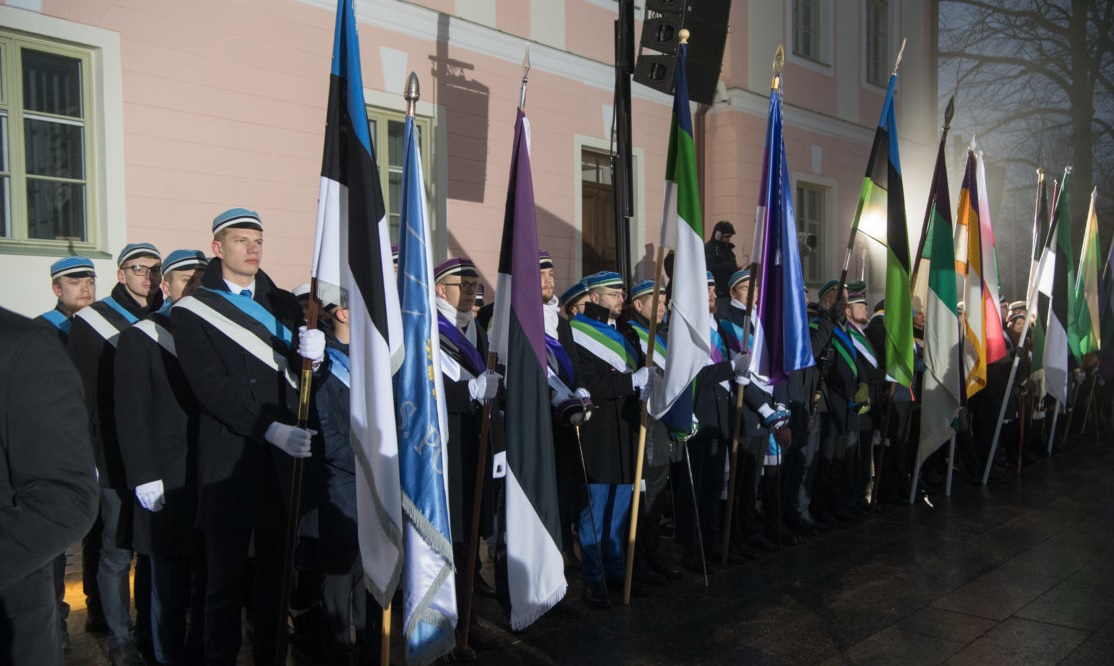
NordenBladet —Speech by the President of the Riigikogu Eiki Nestor at the flag hoisting ceremony in the Governor’s Garden on 24 February 2019.
Good morning and a happy day of celebration to everyone who has come to hoist the flag here on Toompea hillside, as well as to those at home. Today, our country is 101 years old. This 101 is in itself a jolly nice number, but today we can also be happy that exactly 30 years ago on February 24, the anniversary of the Republic of Estonia, the flag returned on top of the Tall Hermann tower. And it is here to stay.
Compatriots,
Estonia is a strong country if we believe in it. We need to believe like the thousands of singers, dancers and audience members who will touch us with their art during the anniversary Song Celebration this summer. Or like the participants of the ESTO festival who will travel here this year from every corner of our beloved round planet Earth. They know that the Republic of Estonia is not a fragment from their granny’s memories or a fairy tale from childhood, but a place that cherishes and appreciates them. And if some of them have not found the time to visit their Estonian home for many years, we should not be surprised if they are sincerely happy about what they see. They believe in Estonia.
But also believe in Estonia like the boys and girls who have come here this morning with their moms and dads to hoist the flag and sing the anthem. And believe in Estonia like those grannies and grandpas who are struggling to sing the anthem together with their grandchildren because they are getting teary-eyed and their voice cracks with emotion. Singing might not work, but the heart is brimming over with joy, because you see that your life has had a purpose. It is impossible to give your children anything more than freedom.
Believe in Estonia that is full of laughter and consideration of others. Understanding and creation. Freedom and respectful language. Care and determination. The thrill of Christmas and the excitement of Midsummer Night. Which unfortunately includes sad memories, but also merry expectations. The fun of doing things together, and love. Where we hear the beautiful sound of the Estonian language and where everyone feels at home. Believe in Estonia where everyone can be who they want to be. A free human being in a free country.
I wish you happy homes filled with joy. I believe in you, Estonia. Long live the Republic of Estonia!
NordenBladet – On Thursday 21 February, The Crown Princess Couple visited Fryshuset for an update on the centre’s activities.
Fryshuset is a politically and religiously independent voluntary international organisation. Fryshuset gives young people the opportunity to take part in their passions, and to create and participate in youth-driven activities, training and work.
On arrival, The Crown Princess Couple were welcomed by CEO Johan Oljequist, Manager of Fryshuset in Stockholm Anja Frey and Senior Consultant Martin Dworén. In the foyer of Fryshuset, The Crown Princess Couple watched a dance display by school pupils and spoke to some of the young people.
During their visit, The Crown Princess Couple learnt more about Fryshuset’s work with young people in vulnerable areas and a project whereby the organisation helps people who want to end a criminal lifestyle.
They also learnt about the new ungdomar.se and We Change projects, as well as Fryshuset’s international work with Peace Leaders.