NordenBladet – On Thursday 14 February, Prince Carl Philip opened Rally Sweden at Färjestad Trotting Course. The Prince is patron of Rally Sweden.
This year’s rally, which ran from 14 to 17 February, began in Karlstad and continued via Torsby across the Norwegian border, before returning to Sweden and then heading east to Hagfors and ending in Torsby.
During Thursday evening’s opening ceremony, Prince Carl Philip gave a speech in which he spoke about his fascination for Rally Sweden: Standing outside in the wintery Värmland forest, with thousands of other spectators, where quietness, the cold and the snow meet speed, energy and skilfulness.
“This is what Rally Sweden is all about,” said The Prince.
On the Friday, The Prince watched the SS Historic competition stage. The Prince also had the opportunity to test drive a car fitted with technology for the FIA Smart Driving Challenge.
_____________________________________
Rally Sweden
Rally Sweden is one of fourteen competitions within the World Rally Championship (WRC), and is the only specific winter rally.
The competitions are held in Karlstad and northern Värmland, and sections have also taken place on the Norwegian side of the border for the last few years. The competition has run since 1950, and has been a winter rally since 1965.
NordenBladet – Swedish business magazine Veckans Affärer each year compiles a list of the country’s billionaires in Swedish krona (1 billion SEK equals roughly $120 million USD). There was a record 187 Swedish billionaires in 2018 – double the amount since 2002 – of which around 40 have amassed fortunes exceeding a billion dollars.
However, the very top largely belongs to the founding families of iconic Swedish companies like Stena Group, Ikea, H&M and Tetra Laval – all founded between 1939 and 1951.
Here are the top ten richest people of Sweden and how they made their money.
1. IKEA founder Ingvar Kamprad ($73 billion) is unmatched
Net Worth: 620 billion SEK ($73 billion)
Company: IKEA (furniture giant)
Residence: Älmhult, Sweden
Ikea’s 91-year old founder Ingvar Kamprad has topped the Swedish rich list for the last decades. He’s worth more than the seven people behind him, combined. Kamprad – known for driving a two-decade old Volvo and flying coach – started with nothing back in 1943 and is now considered Sweden’s most successful entrepreneur of all time.
2. Stefan Persson
Net Worth: 186 billion SEK ($22 billion)
Company: H&M (clothing retailer)
Residence: Stockholm
Global retail chain H&M’s family patriarch Stefan Persson is Sweden’s second-richest. Before growing H&M into a global fashion empire, his father, Erling Persson, opened the first store in 1947, expanded in Sweden, and took the company public. Stefan Persson estimated net worth is US $ 22 billion and he is ranked second in the list of top 10 richest people of Sweden.
3. Hans Rausing
Net Worth: 101 billion SEK ($12 billion)
Company: Tetra Laval, packaging
Residence: Wadhurst, UK
Hans Rausing’s is the inherited billionaire and the owner of the packaging giant Tetra Laval which is established by his father in 1944. He moved to UK in the early 1980s to avoid the penalizing of Swedish taxes and sold his share to his brother Gad for an estimated worth of US $ 7 billion in 1995. He now resides in the 900 acre estate in the village of Wadhurst in East Sussex where he breeds deer and wild boar. He also owns the property in New Zealand and homes in London and Barbados, and has venture in “Ecolean” which is the producer of environmentally friendly packaging material. Hans Rausing estimated net worth is US $ 12 billion and he is ranked third in the list of top 10 richest people of Sweden.
4. Frederik Paulsen
Net Worth: 60 billion SEK ($7,1 bn)
Company: Ferring Pharma
Residence: Lausanne, Switzerland
Frederick Paulsen is inherited of the small drug maker “Ferring Pharmaceuticals” which is founded by his father and when he takes charge of the business in 1983, it generated US $ 15 million in annual revenues. Today his biotech unit produces the obstetrics, infertility, gastroenterology, urology and endocrinology products and has estimated sales of more than US $ 1.75 billion. He is also structured the fecundity clinics in Russia to help reverse its drastic population decline. He also donates US $ 3 million to the kingdom of Bhutan for the big collection of textile to bolster its new Royal Textile Academy. Frederik Paulsen estimated net worth is US $ 7.1 billion and he is ranked at No. 4 in the list of top 10 richest people of Sweden.
5. Jörn Rausing
Net Worth: 59 billion SEK ($7 bn)
Company: Tetra Laval (packaging)
Residence: Surrey, UK
Jorn Rausing is the owner of the “Tetra Laval” the company behinds the packaging technology of tetra pack that makes it possible to store beverages like Juice, milk and other liquid flavors in cartons instead of glass bottles. Jorn with his two siblings Kirsten and Finn shared the family business and sit on the board of “Tetra Laval” which is the parent company established by their grandfather. He also owns the stakes in online grocery vendor “Ocado”. Jorn Rausing estimated net worth is US $ 7 billion and he is ranked at No. 5 in the list of top 10 richest people of Sweden.
6. Melker Schorling
Net Worth: 59 billion SEK ($7 bn)
Company: MSAB (investments)
Residence: Stockholm
Melker Schorling set the foundation for his wealth by negotiating with his associate billionaire Gustaf Douglas and receives the stakes in troubled security services giant “Securitas” in return for accepting the job of CEO in 1987. Later he established the “Melker Schorling AB” as the holding company for his investments which is now publicly traded and holds the stakes in precision and measuring tools manufacturing “Hexagon” and security device manufacturer “Assa Abloy” and counts H&M billionaires Stefan Persson and his sister Lottie Tham are the shareholders of his empire. Melker Schorling estimated net worth is US $ 7 billion and he is ranked at No. 6 in the list of top 10 richest people of Sweden.
7. Antonia Johnson
Net Worth: 57 billion SEK ($6,75 bn)
Residence: Upplands Väsby, Sweden
Company: Axel Johnson AB which fully owns Kicks, Martin & Servera, Åhléns and hold shares in Axfood and Sweden’s largest e-commerce company, Dustin.
Antonia Johnson is the Sweden’s richest woman and she is the fourth generation to run the family conglomerate and preparing her daughter Carina Berg to take over the family business in future. She is elected to the board and then becomes the chairman of the privately owned diversified trading company in 1982 and keeps both seats on the board, and all of the ownership. The family conglomerate has interests in telecom, security, energy, real estate and in industrial products. She also holds 50 percent stakes in the Axfood AB which is the largest food companies in Scandinavia. Antonia Johnson estimated net worth is US $ 6.75 billion and she is ranked at No. 7 in the list of top 10 richest people of Sweden.
8. Finn Rausing
Net Worth: 57 billion SEK ($6,75 bn)
Residence: Stockholm
Company: Tetra Laval
Finn Rausing is sits on the board of packaging company Tetra Laval with his billionaire siblings Kirsten and Jorn which is established by their grandfather and invented the packaging technology that makes it possible to store beverages like milk and juice without refrigeration. His father Gad bought out his brother Hans shares of Tetra Laval and becomes the single owner of the tetra packing empire. Finn Rausing estimated net worth is US $ 6.75 billion and he is ranked at No. 8 in the list of top 10 richest people of Sweden.
9. Kirsten Rausing
Net Worth: 60 billion SEK ($7,1 bn)
Company: Tetra Laval
Residence: Newmarket, UK
Kristen Rausing is the third partner of the packaging company “Tetra Laval” and sits on the board with her two brothers Finn and Jorn. Their grandfather established the Tetra Laval which invented the aseptic packaging technology that makes it possible to store beverages like milk and juice in tetra pack bags instead of glass bottles. Their late father Gad runs the company for 46 years together with his brother Hans and later he bought it all in 1995. Kirsten Rausing estimated net worth is US $ 7.1 billion and she is ranked at No. 9 in the list of top 10 richest people of Sweden.
10. Ane Uggla ($6,5 bn): Heir to a Danish shipping empire
Net Worth: 55 billion SEK ($6,5 bn)
Residence: Stockholm
Source of wealth: A.P. Møller-Mærsk (shipping)
Heir to Denmark’s largest company, shipping giant A.P. Møller-Mærsk. The 69-year old’s son, Robert Maersk Uggla, is nowadays in charge of the Maersk’s holding company. Ane Uggla, who’s lived in Stockholm since the 1970s is today Sweden’s second-richest woman. Ane Uggla estimated net worth is US $ 6.5 billion and she is ranked at No. 10 in the list of top 10 richest people of Sweden.
FULL LIST of Sweden´s 184 billionaires in 2017
1. Ingvar Kamprad
2. Stefan Persson
3. Hans Rausing
4. Frederik Paulsen
5. Jörn Rausing
6. Melker Schörling
7. Antonia Ax:son Johnson
8. Finn Rausing
9. Kirsten Rausing
10. Ane Uggla
11. Dan Sten Olsson
12. Fredrik Lundberg
13. Bertil Hult
14. Gustaf Douglas
15. Carl Bennet
16. Liselott Tham
17. Stefan Olsson
18. Markus Persson
19. Torbjörn Törnqvist
20. Karl-Johan Persson
21. Tom Persson
22. Charlotte Söderström
23. Daniel Ek
24. Martin Lorentzon
25. Madeleine Olsson-Eriksson
26. Erik Selin
27. Eric Douglas
28. Carl Douglas
29. Thomas Sandell
30. Niklas Zennström
31. Sten Åke Lindholm
32. Katarina Martinson
33. Louise Lindh
34. Erik Paulsson
35. Rune Andersson
36. Mathias Kamprad
37. Jonas Kamprad
38. Peter Kamprad
39. Elisabeth Douglas
40. Ian Lundin
41. Hans Wallenstam
42. Karl-Johan Blank
43. Sven-Olof Johansson
44. Christer Gardell
45. Lukas Lundin
46. Nico Mordasini
47. Mona Hamilton
48. Eva Lundin
49. Cristina Stenbeck
50. Johan Eliasch
51. Rutger Arnhult
52. Rolf Lundström
53. Jonas af Jochnick
54. Robert Weil
55. Sven Norfeldt
56. Margareta Wallenius-Kleberg
57. David Mindus
58. Sten Mörtstedt
59. Jakob Porsér
60. Jenny Lindén Urnes
61. Dan Olofsson
62. Christer Brandberg
63. Johan Claesson
64. Lars-Magnus Claesson
65. Björn Savén
66. Patrik Brummer
67. Bengt Ågerup
68. Bengt Bengtsson
69. Gerald Engström
70. Fredrik Wester
71. Fredrik Paulsson
72. Stina Von Der Esch
73. Felix Hagnö
74. Mikael Ståhl
75. Bicky Chakraborty
76. Sebastian Knutsson
77. Lars Wingefors
78. Erik Penser
79. Sven Hagströmer
80. Robert af Jochnick
81. Martin Gren
82. Gerard de Geer
83. Martin Andersson
84. Sophie Stenbeck
85. Hugo Stenbeck
86. Fredrik Rapp
87. Eva Hamrén
88. Hans-Kristian Rausing
89. Sigrid Rausing
90. Per Josefsson
91. Peter Thelin
92. Annika Bootsman Kleberg
93. Jonas Kleberg
94. Jan Bengtsson
95. Lisbet Rausing
96. Per Sandberg
97. Lars Markgren
98. Mats Qviberg
99. Staffan Salén
100. Karl Perlhagen
101. Karl Hedin
102. Nils Tham
103. Carl Tham
104. Lina Tham von Heidenstam
105. Rikard Svensson
106. Fredrik Svensson
107. Max Martin
108. Anders Bodin
109. Erik Ryd
110. Torbjörn Bäck
111. Thomas Karlsson
112. Patrik Hannell
113. Laurent Leksell
114. Jens von Bahr
115. Fredrik Österberg
116. Victor Jacobsson
117. Sebastian Siemiatkowski
118. Niklas Adalberth
119. Åke Bonnier
120. Gösta Welandson
121. Gert-Erik Lindquist
122. Nils-Olov Jönsson
123. Ulf Eklöf
124. Stefan Bengtsson
125. Pontus Bonnier
126. Agneta Wallenstam
127. Harald Mix
128. Joakim Alm
129. Robert Andreen
130. Bo Larsson
131. Carl Manneh
132. Bo Göransson
133. Conni Jonsson
134. Michael Knutsson
135. Fredrik Palmstierna
136. Anders Berntsson
137. Benny Andersson
138. Pär Sandå
139. Leif Gustavsson
140. Ludvig Strigeus
141 Dag Landvik
142. Anders Ström
143. Bengt Hjelm
144. Peter Lindell
145. Anders Forsgren
146. Bengt-Olov Forssell
147. Per Hamberg
148. Filip Engelbert
149. Jonas Nordlander
150. Anna Benjamin
151. Björn Ulvaeus
152. Fabienne Gustafsson
153. Hampus Ericsson
154. Sven Philip-Sörensen
155. Martin Nordin
156. Karl Otto Bonnier
157. Carl-Henric Svanberg
158. Patrik Wahlén
159. Torsten Jansson
160. Claes Mellgren
161. Per Olof Andersson
162. Anita Paulsson
163. Henrik Persson Ekdahl
164. Thomas Eldered
165. Petter Fägersten
166. Zlatan Ibrahimovic
167. Patrik Stymne
168. Staffan Persson
169. Johan Löf
170. Mats Paulsson
171. Helena Ek Tidstrand
172. Eva Bonnier
173. Jan Erik Ragnar Söderberg
174. Per-Olof Söderberg
175. Bo Jesper Hansen
176. Johan Edlund
177. Thomas Hartwig
178. Filip Tysander
179. Elisabeth Jancke Brandberg
180. Leif Kristensson
181. Lennart Grebelius
182. Henric Wiman
183. Gun Boström
184. Max Hansson
Look also Forbes List of Swedes billionaires by net worth (2017, Forbes)
_______________________________
* A business magnate or industrialist is an entrepreneur of great influence, importance, or standing in a particular enterprise or field of business. The term characteristically refers to a wealthy entrepreneur or investor who controls, through personal business ownership or dominant shareholding position, a firm or industry whose goods or services are widely consumed. Such individuals may also be called czars, moguls, proprietors, tycoons, taipans, barons, or oligarchs.
Read also:
Helena-Reet Ennet: MY JOURNEY TOWARDS BECOMING A BILLIONAIRE or How to join the world’s most elite group of people?
In the world people are desiring the status of a billionaire instead of that of a millionaire – in order to belong to the top notch you must be a billionaire. There is one billionaire for every million people in the world. In 2014 the number of billionaires increased 7% and the elite list embraced 2325 people, in 2017 according to Forbes there were 2043 billionaires. How can you become one? Lets have a wider look and dig into statistics – what does one need to become a billionaire?
WHO ARE rich in Scandinavia? List of Nordic dollar billionaires (Forbes’ 2017-edition of the world’s billionaires)
According to Forbes’ 2017-edition of the world’s billionaires the world’s richest person is still Bill Gates, with a combined wealth of almost $87 billion dollars. Biggest gainer was Amazon founder Jeff Bezos, who grew his wealth by almost $3 bn in a year. But who are wealthy in Scandinavia? The list also contains 58 people from the Nordics, more than half of them from Sweden. Meanwhile, Norway, with 14 billionaires, has one more than Finland and Denmark combined.
Swedish billionaires: Stefan Persson (magnate), net worth 19.6 billion (2017)
Carl Stefan Erling Persson (born 4 October 1947 in Bromma, Stockholm) is a Swedish business magnate*. 71-year-old Persson is the chairman and main shareholder in fashion company H&M (Hennes & Mauritz), which was founded by his father Erling Persson in 1947. Persson took over the company from his father in 1982 and served as its manager until 1998. Persson also owns a substantial stake in the Swedish technology company Hexagon AB. Through his privately held real estate company Ramsbury Invest (Drottninggatan 50, 111 21 Stockholm, Sweden), Persson owns a large number of properties in London, Paris and Stockholm.
Swedish billionaires: Hans Rausing (magnate), net worth 12.5 billion (2017)
Sir Hans Rausing, KBE (born 25 March 1926) is a Swedish businessman based in the United Kingdom. He made his fortune from his co-inheritance of Tetra Pak, a company founded by his father Ruben Rausing and currently the largest food packaging company in the world. In 1995 he sold his share of the company to his brother, Gad.
Swedish billionaires: Frederik Paulsen Jr, net worth 6.8 billion (2017)
Frederik Paulsen is a Swedish billionaire and businessman, chairman of Ferring Pharmaceuticals. Frederik Dag Arfst Paulsen was born on 30 October 1950 in Stockholm, Sweden. His father was Frederik Paulsen Sr, the founder of Ferring Pharmaceuticals. Frederik Paulsen grew up in Sweden, with his father and his father’s second wife, Eva Wolf Frandsen – one of the founding researchers at Ferring. He attended school in Sweden and then went on to study chemistry at the Christian Albrecht University in Kiel, Germany and business administration at Lund University in Sweden.
Swedish billionaires: Melker Schörling, net worth 6.8 billion (2017)
Melker Schörling (born 1947) is a Swedish billionaire businessman. His investment company Melker Schörling AB (MSAB) has large interests in Securitas AB, Assa Abloy, Hexagon AB, Loomis and more. Schörling formed a partnership with fellow billionaire Gustaf Douglas, who is also a major shareholder in Securitas and Assa Abloy.
Tags: Who is, Who are rich in Sweden?, source of wealth, Sweden, Swedish, billionaire, billionaires, Scandinavia, rich, wealth, wealthy, affluence, entrepreneur, influencer, czar, mogul, tycoon, oligarch, Nordic countries, Ingvar Kamprad, Stefan Persson, Hans Rausing, Frederik Paulsen, Jörn Rausing, Melker Schorling, Antonia Johnson, Finn Rausing, Kirsten Rausing, Ane Uggla, Norden Bladet
Featured image: Antonia Ax:son Johnson is chairman of Axel Johnson AB and Sweden’s richest woman with a net worth of 57 billion Swedish crowns ($6.75 billion). (NordenBladet)
NordenBladet – Melker Schörling (born 1947) is a Swedish billionaire businessman. His investment company Melker Schörling AB (MSAB) has large interests in Securitas AB, Assa Abloy, Hexagon AB, Loomis and more. Schörling formed a partnership with fellow billionaire Gustaf Douglas, who is also a major shareholder in Securitas and Assa Abloy.
Early life
Melker Schörling is a graduate of the School of Business, Economics and Law, Gothenburg.
Career
Today 71-year-old Schörling made a name for himself as the CEO of Securitas in 1987 before moving on to Skanska, when Percy Barnevik was chair. Schörling later left his executive career to focus on his own investments.
In August 2006, Schörling revealed that he would take MSAB public, listing it on the Stockholm Stock Exchange. He also unveiled a new board of directors. The new board, one of the most high-profile in the Swedish business world, includes Stefan Persson, Carl-Henric Svanberg, and Schörling’s daughter.
As of January 2015, he is worth $6.5 billion according to Forbes and by September 2017 6.8 billion.
Personal life
He is married to Kerstin Schörling, has two children (Sofia Schorling Hogberg, Marta Schorling), and lives in Stockholm.
Swedish billionaires: Frederik Paulsen Jr, net worth 6.8 billion (2017)
List of Swedes billionaires by net worth (2017, Forbes)
Read also:
Helena-Reet Ennet: MY JOURNEY TOWARDS BECOMING A BILLIONAIRE or How to join the world’s most elite group of people?
In the world people are desiring the status of a billionaire instead of that of a millionaire – in order to belong to the top notch you must be a billionaire. There is one billionaire for every million people in the world. In 2014 the number of billionaires increased 7% and the elite list embraced 2325 people, in 2017 according to Forbes there were 2043 billionaires. How can you become one? Lets have a wider look and dig into statistics – what does one need to become a billionaire?
WHO ARE rich in Scandinavia? List of Nordic dollar billionaires (Forbes’ 2017-edition of the world’s billionaires)
According to Forbes’ 2017-edition of the world’s billionaires the world’s richest person is still Bill Gates, with a combined wealth of almost $87 billion dollars. Biggest gainer was Amazon founder Jeff Bezos, who grew his wealth by almost $3 bn in a year. But who are wealthy in Scandinavia? The list also contains 58 people from the Nordics, more than half of them from Sweden. Meanwhile, Norway, with 14 billionaires, has one more than Finland and Denmark combined.
Swedish billionaires: Stefan Persson (magnate), net worth 19.6 billion (2017)
Carl Stefan Erling Persson (born 4 October 1947 in Bromma, Stockholm) is a Swedish business magnate*. 71-year-old Persson is the chairman and main shareholder in fashion company H&M (Hennes & Mauritz), which was founded by his father Erling Persson in 1947. Persson took over the company from his father in 1982 and served as its manager until 1998. Persson also owns a substantial stake in the Swedish technology company Hexagon AB. Through his privately held real estate company Ramsbury Invest (Drottninggatan 50, 111 21 Stockholm, Sweden), Persson owns a large number of properties in London, Paris and Stockholm.
Swedish billionaires: Hans Rausing (magnate), net worth 12.5 billion (2017)
Sir Hans Rausing, KBE (born 25 March 1926) is a Swedish businessman based in the United Kingdom. He made his fortune from his co-inheritance of Tetra Pak, a company founded by his father Ruben Rausing and currently the largest food packaging company in the world. In 1995 he sold his share of the company to his brother, Gad.
Swedish billionaires: Frederik Paulsen Jr, net worth 6.8 billion (2017)
Frederik Paulsen is a Swedish billionaire and businessman, chairman of Ferring Pharmaceuticals. Frederik Dag Arfst Paulsen was born on 30 October 1950 in Stockholm, Sweden. His father was Frederik Paulsen Sr, the founder of Ferring Pharmaceuticals. Frederik Paulsen grew up in Sweden, with his father and his father’s second wife, Eva Wolf Frandsen – one of the founding researchers at Ferring. He attended school in Sweden and then went on to study chemistry at the Christian Albrecht University in Kiel, Germany and business administration at Lund University in Sweden.
Tags: Who is Melker Schörling, source of wealth, Securitas AB, Assa Abloy, Hexagon AB, Loomis, Sweden, Swedish, billionaire, billionaires, Scandinavia, rich, wealth, wealthy, affluence, entrepreneur, influencer, czar, mogul, tycoon, oligarch, Nordic countries
NordenBladet – Frederik Paulsen is a Swedish billionaire and businessman, chairman of Ferring Pharmaceuticals. Frederik Dag Arfst Paulsen was born on 30 October 1950 in Stockholm, Sweden. His father was Frederik Paulsen Sr, the founder of Ferring Pharmaceuticals. Frederik Paulsen grew up in Sweden, with his father and his father’s second wife, Eva Wolf Frandsen – one of the founding researchers at Ferring. He attended school in Sweden and then went on to study chemistry at the Christian Albrecht University in Kiel, Germany and business administration at Lund University in Sweden.
Career
Frederik Paulsen is now based in Switzerland, where he benefits from lump-sum taxation. His business interests focus mainly on the Ferring Pharmaceuticals Group where he has worked since 1976 and has been the chairman since 1988.
During this period he established the company his father founded in Malmö, Sweden as an international operation. Today, Ferring has operations in over 50 countries and sells its products in more than 100 countries around the globe. Ferring specialized from the outset in peptide drugs and has continued in its commitment to their development.
Paulsen’s business activities extend into other pharmaceutical and life science areas and publishing. Paulsen’s other business interests include:
Polypeptide Laboratories BV
Nordic Group BV
Euro-Diagnostica AB
Editions Paulsen
In addition, he has interests in real estate and viticulture. Frederik Paulsen also holds several board memberships. He is for instance member of the board of directors of the tobacco company Philip Morris International.
Since 2009, Frederik Paulsen also has held the position of honorary consul general of the Russian Federation, a form of pro-Russian soft power.
Paulsen is the recipient of numerous national honours and holds many and varied positions. Some of these are listed here:
Honours
Doctorate honoris causa, Swiss Federal Institute of Technology in Lausanne, Switzerland
Doctorate honoris causa, Technology, Lund University, Lund, Sweden
Doctorate honoris causa, Faculty of Medicine, Christian Albrecht University, Kiel, Germany
Doctorate honoris causa, Politics, Moscow State Institute of International Relations, Moscow, Russian Federation
Professor honoris causa, University of Dundee, Scotland, United Kingdom
Honorary director, The Explorers Club, New York, USA
Honorary fellowship, Royal Scottish Geographical Society, Scotland, United Kingdom
Doctorate honoris causa, Kazan National Research Technological University, Kazan, Respublika Tatarstan, Russian Federation
Honorary director, Save Venice Inc., New York, USA
Awards
Ehrenbürgerschaft, Honorary Citizenship, awarded by the Christian Albrecht University, Kiel, Germany.
Chevalier de la Légion d’Honneur, Knight of the Legion of Honour, granted by President Nicolas Sarkozy of the French Republic.
Орден Дружбы, Order of Friendship presented by President Vladimir Putin of the Russian Federation.
Ridder af Dannebrogordenen, Cross of the Order of Chivalry granted by Her Majesty Queen Margrethe II of Denmark.
Bundesverdienstkreuz I. Klasse, Order of Merit Class I awarded by President Horst Köhler of the Federal Republic of Germany.
Нагрудный знак «Почетному полярнику», Honorary Polar Explorer Medal, Aspol, Moscow, Russian Federation.
Nga Dap Pel Gi Khorlo, The Order of the Druk Gyalpo, presented by King Jigme Khesar Namgyel Wangchuck of Bhutan.
Нагрудный знак Министерства Иностранных Дел Российской Федерации «За вклад в Международное сотрудничество», Decoration for Contribution to International Cooperation presented by the Foreign Ministry of the Russian Federation.
ღირსების ორდენი, The Order of Honor, awarded by President Mikheil Saakashvili of Georgia.
Officer of the Most Excellent Order of the British Empire (OBE), granted by Her Majesty The Queen Elizabeth II.
Order of St John Service Medal, awarded by Her Majesty the Queen Elizabeth II.
Freeman of the City of London, United Kingdom.
Companion of The Royal Aero Club of the United Kingdom, awarded by the Council of The Royal Aero Club of the United Kingdom.
Vilkitsky Decoration, granted by the Polar Research Fund of the Russian Federation.
Silver Medal of Russian Geographic Society, awarded by Mr.Shoygu of RGS, Russia.
Climber of Russia, awarded by the Alpinist Federation of Russia.
Lowell Thomas Medal, awarded by The Explorers Club, New York, USA.
Scottish Geographical Medal, awarded by Royal Scottish Geographical Society, United Kingdom.
Medal of Honour, granted by the Granada Dance and Music International Festival, Spain.
Patron of Exploration, granted by The Explorers Club, New York, USA.
Paulsen holds the following memberships among others:
Member of the Board of MGIMO University, Moscow, Russian Federation.
Member of the Kuratorium Pro Universitate of the Christian Albrechts University, Kiel, Germany.
Trustee of the Salk Institute of Biological Research, La Jolla, California, USA.
Trustee of the South Georgia Heritage Trust, Dundee, Scotland.
Trustee of the Royal Textile Academy of Bhutan, Thimphu, Bhutan.
Life member of The Explorers Club, New York City, USA.
Honorary Member of the Polar Explorers Association, Moscow, Russian Federation.
Director of the Board of the Museum Kunst der Westküste, Alkersum, Germany.
Member of the Advisory Board, Smithsonian Center for Folklife and Cultural Heritage, Washington, DC, USA.
Member of the Advisory Board, Arctic Circle
Member of the Advisory Council for the All-Party Parliamentary Group (APPG) for the Polar Regions in Westminster, United Kingdom
Member of the Vladivostok Maritime Assembly
Member of the Board of Trustees, Lausanne Opera Foundation Council, Lausanne, Switzerland
Founding member of the Swiss Polar Institute (SPI), Berne, Switzerland
List of Swedes billionaires by net worth (2017, Forbes)
Read also:
Helena-Reet Ennet: MY JOURNEY TOWARDS BECOMING A BILLIONAIRE or How to join the world’s most elite group of people?
In the world people are desiring the status of a billionaire instead of that of a millionaire – in order to belong to the top notch you must be a billionaire. There is one billionaire for every million people in the world. In 2014 the number of billionaires increased 7% and the elite list embraced 2325 people, in 2017 according to Forbes there were 2043 billionaires. How can you become one? Lets have a wider look and dig into statistics – what does one need to become a billionaire?
WHO ARE rich in Scandinavia? List of Nordic dollar billionaires (Forbes’ 2017-edition of the world’s billionaires)
According to Forbes’ 2017-edition of the world’s billionaires the world’s richest person is still Bill Gates, with a combined wealth of almost $87 billion dollars. Biggest gainer was Amazon founder Jeff Bezos, who grew his wealth by almost $3 bn in a year. But who are wealthy in Scandinavia? The list also contains 58 people from the Nordics, more than half of them from Sweden. Meanwhile, Norway, with 14 billionaires, has one more than Finland and Denmark combined.
Swedish billionaires: Stefan Persson (magnate), net worth 19.6 billion (2017)
Carl Stefan Erling Persson (born 4 October 1947 in Bromma, Stockholm) is a Swedish business magnate*. 71-year-old Persson is the chairman and main shareholder in fashion company H&M (Hennes & Mauritz), which was founded by his father Erling Persson in 1947. Persson took over the company from his father in 1982 and served as its manager until 1998. Persson also owns a substantial stake in the Swedish technology company Hexagon AB. Through his privately held real estate company Ramsbury Invest (Drottninggatan 50, 111 21 Stockholm, Sweden), Persson owns a large number of properties in London, Paris and Stockholm.
Swedish billionaires: Hans Rausing (magnate), net worth 12.5 billion (2017)
Sir Hans Rausing, KBE (born 25 March 1926) is a Swedish businessman based in the United Kingdom. He made his fortune from his co-inheritance of Tetra Pak, a company founded by his father Ruben Rausing and currently the largest food packaging company in the world. In 1995 he sold his share of the company to his brother, Gad.
NordenBladet – Sir Hans Rausing, KBE (born 25 March 1926) is a Swedish businessman based in the United Kingdom. He made his fortune from his co-inheritance of Tetra Pak, a company founded by his father Ruben Rausing and currently the largest food packaging company in the world. In 1995 he sold his share of the company to his brother, Gad.
In the Forbes world fortune ranking, Rausing was placed at number 83 with an estimated fortune of $US10 billion in 2011. According to Forbes, he was the second richest Swedish billionaire in 2013. As of July 2017, Forbes reported his net worth as $12.5 billion. As of 17 May 2013, Bloomberg Billionaires Index estimated Rausing’s net worth to be $13.3 billion.
Early life
Rausing was born in Gothenburg in 1926 as the second son to industrialist Ruben Rausing and his wife Elisabeth (née Varenius). Rausing had two brothers, Gad and Sven.
Career
Hans Rausing studied Economics, Statistics and Russian at Lund University, graduating in 1948. In 1954 Rausing was appointed Managing Director of Tetra Pak and his brother Gad Deputy Managing Director. Rausing became Chairman of the Tetra Pak board in 1985. He left the company in 1993 and sold his 50% share of the company to Gad in 1995.
Tetra Pak’s success in the 1970s and 1980s has been credited to the leadership of Hans and Gad Rausing, who turned the six-person family business into a multi-national company. Over the course of his career, Rausing became a specialist in Russian affairs and has made many investments in Russia and Ukraine. He was responsible for the Tetra Pak’s Russian market, and negotiated the first Tetra Pak machine export to the Soviet Union in 1959, eventually making Tetra Pak the largest foreign employer in Russia.
Patronage
Hans Rausing (92-year-old today) and his wife Märit have donated large sums to charities and research in the UK and Sweden, among others to large medical research projects at Karolinska Institutet and Lund University. Through the Märit and Hans Rausing Fund, they support local community projects in their home county of Sussex.
Through her fund Arcadia, Rausing’s daughter Lisbet is financing the Hans Rausing Endangered Languages Project at the School of Oriental and African Studies (SOAS) at the University of London, the Hans Rausing Scholarship in the History of Science at King’s College London, and the Hans Rausing Chair in the History of Science at Uppsala University, which is also hosting an annual Hans Rausing Lecture in the History of Science. The University of Cambridge Department of History and Philosophy of Science hosts an Annual Hans Rausing Lecture.
Honors
Hans Rausing has been appointed Doctor Honoris Causa in Medicine and Economics at Lund University. He is a visiting professor at Mälardalens Högskola, Sweden, and honorary professor at the University of Dubna, Russia. He was made a Knight Commander of the Order of the British Empire (KBE) in 2006. He is an Honorary Fellow of the Isaac Newton Institute, Cambridge, and in 2011 he was awarded the title Honorary Freeman and Liveryman at The Worshipful Company of Stationers and Newspaper Makers, London.
Personal life
Hans Rausing and his wife Märit Rausing have two daughters, Anna Lisbet Kristina Rausing (born 9 June 1960) and Sigrid Maria Elisabet Rausing (born 29 January 1962), and one son, Hans Kristian Rausing (born 15 June 1963).
Rausing has been a resident of the UK since 1982. He lives in Wadhurst, East Sussex.
List of Swedes billionaires by net worth (2017, Forbes)
_______________________________
* A business magnate or industrialist is an entrepreneur of great influence, importance, or standing in a particular enterprise or field of business. The term characteristically refers to a wealthy entrepreneur or investor who controls, through personal business ownership or dominant shareholding position, a firm or industry whose goods or services are widely consumed. Such individuals may also be called czars, moguls, proprietors, tycoons, taipans, barons, or oligarchs.
Read also:
Helena-Reet Ennet: MY JOURNEY TOWARDS BECOMING A BILLIONAIRE or How to join the world’s most elite group of people?
In the world people are desiring the status of a billionaire instead of that of a millionaire – in order to belong to the top notch you must be a billionaire. There is one billionaire for every million people in the world. In 2014 the number of billionaires increased 7% and the elite list embraced 2325 people, in 2017 according to Forbes there were 2043 billionaires. How can you become one? Lets have a wider look and dig into statistics – what does one need to become a billionaire?
WHO ARE rich in Scandinavia? List of Nordic dollar billionaires (Forbes’ 2017-edition of the world’s billionaires)
According to Forbes’ 2017-edition of the world’s billionaires the world’s richest person is still Bill Gates, with a combined wealth of almost $87 billion dollars. Biggest gainer was Amazon founder Jeff Bezos, who grew his wealth by almost $3 bn in a year. But who are wealthy in Scandinavia? The list also contains 58 people from the Nordics, more than half of them from Sweden. Meanwhile, Norway, with 14 billionaires, has one more than Finland and Denmark combined.
Swedish billionaires: Stefan Persson (magnate), net worth 19.6 billion (2017)
Carl Stefan Erling Persson (born 4 October 1947 in Bromma, Stockholm) is a Swedish business magnate*. 71-year-old Persson is the chairman and main shareholder in fashion company H&M (Hennes & Mauritz), which was founded by his father Erling Persson in 1947. Persson took over the company from his father in 1982 and served as its manager until 1998. Persson also owns a substantial stake in the Swedish technology company Hexagon AB. Through his privately held real estate company Ramsbury Invest (Drottninggatan 50, 111 21 Stockholm, Sweden), Persson owns a large number of properties in London, Paris and Stockholm.
Tags: Who is Hans Rausing, Tetra Pak, source of wealth, packaging, Ruben Rausing, Andersson, Sweden, Swedish, billionaire, billionaires, Scandinavia, rich, wealth, wealthy, affluence, entrepreneur, influencer, czar, mogul, tycoon, oligarch, Nordic countries
NordenBladet – Carl Stefan Erling Persson (born 4 October 1947 in Bromma, Stockholm) is a Swedish business magnate*. 71-year-old Persson is the chairman and main shareholder in fashion company H&M (Hennes & Mauritz), which was founded by his father Erling Persson in 1947. Persson took over the company from his father in 1982 and served as its manager until 1998. Persson also owns a substantial stake in the Swedish technology company Hexagon AB. Through his privately held real estate company Ramsbury Invest (Drottninggatan 50, 111 21 Stockholm, Sweden), Persson owns a large number of properties in London, Paris and Stockholm.
In March 2013, Forbes reported Persson’s net worth as $28 billion and in 2017 Persson´s net worth was 19.6 billion making him the richest of Sweden’s 31 billionaires and the 43th richest person in the world. According to the Bloomberg Billionaires Index, Persson had a net worth of US $31.9 billion in 2014, making him the 17th richest person in the world at the time.
Early life:
Stefan Persson is the son of Erling Persson (21 January 1917 – 28 October 2002) and Margrit Helga Andersson and half brother to Lottie Tham. He attended the University of Stockholm.
Personal life
Stefan Persson is a founder of the Mentor Foundation, a nonprofit organisation that aims to combat substance abuse among young people. He is a supporter of Djurgårdens IF and is co-funding a foundation for the club. Persson enjoys downhill skiing, tennis and golf. He owns properties in London, Paris and Stockholm and, in 2009, acquired the 21-cottage village of Linkenholt in Hampshire, England.
Persson lives in Stockholm, Sweden, with his second wife, Carolyn Denise Persson. They have three children. In 2009, his son, Karl-Johan Persson (now 43 year-old), took over as president and chief executive of H&M. Their other two children, Tom Persson (33) and Charlotte Söderström (41) are also billionaires.
List of Swedes billionaires by net worth (2017, Forbes)
_______________________________
* A business magnate or industrialist is an entrepreneur of great influence, importance, or standing in a particular enterprise or field of business. The term characteristically refers to a wealthy entrepreneur or investor who controls, through personal business ownership or dominant shareholding position, a firm or industry whose goods or services are widely consumed. Such individuals may also be called czars, moguls, proprietors, tycoons, taipans, barons, or oligarchs.
Read also:
Helena-Reet Ennet: MY JOURNEY TOWARDS BECOMING A BILLIONAIRE or How to join the world’s most elite group of people?
In the world people are desiring the status of a billionaire instead of that of a millionaire – in order to belong to the top notch you must be a billionaire. There is one billionaire for every million people in the world. In 2014 the number of billionaires increased 7% and the elite list embraced 2325 people, in 2017 according to Forbes there were 2043 billionaires. How can you become one? Lets have a wider look and dig into statistics – what does one need to become a billionaire?
WHO ARE rich in Scandinavia? List of Nordic dollar billionaires (Forbes’ 2017-edition of the world’s billionaires)
According to Forbes’ 2017-edition of the world’s billionaires the world’s richest person is still Bill Gates, with a combined wealth of almost $87 billion dollars. Biggest gainer was Amazon founder Jeff Bezos, who grew his wealth by almost $3 bn in a year. But who are wealthy in Scandinavia? The list also contains 58 people from the Nordics, more than half of them from Sweden. Meanwhile, Norway, with 14 billionaires, has one more than Finland and Denmark combined.
Tags: Who is Carl Stefan Erling Persson, Sweden, Swedish, billionaire, billionaires, Scandinavia, H&M, Hennes & Mauritz, Erling Persson, Hexagon AB, rich, wealth, wealthy, affluence, entrepreneur, influencer, czar, mogul, tycoon, oligarch, Ramsbury Invest, real estate, Karl-Johan Persson, Tom Persson, Charlotte Söderström
NordenBladet – The Swedish royal jewellery that was stolen in July last year has been recovered. The two crowns and an orb were found in a bin in a suburb north of Stockholm with the word “BOMB” written on it.
A security guard who spotted the bin found the funeral regalia of King Karl IX. The regalia was taken in a smash-and-grab attack on 31 July 2018 from the cathedral in Strängnäs, which gained worldwide media attention. The discovery has stopped the trial of a 22-year-old man who was arrested on 12 September and has been in custody for several months. The suspect has admitted to stealing the bicycle and boat used in the theft but denies any involvement in stealing the treasures.
The trial will resume on Friday 15 February with new investigative measures, including a technical examination of the returned regalia. Authorities will also try to determine how the jewellery ended up in the bin and who put them there.
Featured image is illustrative: Sweden (NordenBladet)
NordenBladet – An aurora (plural: auroras or aurorae), sometimes referred to as polar lights, northern lights (aurora borealis) or southern lights (aurora australis), is a natural light display in the Earth’s sky, predominantly seen in the high-latitude regions (around the Arctic and Antarctic).
Auroras are produced when the magnetosphere is sufficiently disturbed by the solar wind that the trajectories of charged particles in both solar wind and magnetospheric plasma, mainly in the form of electrons and protons, precipitate them into the upper atmosphere (thermosphere/exosphere) due to Earth’s magnetic field, where their energy is lost.
The resulting ionization and excitation of atmospheric constituents emits light of varying color and complexity. The form of the aurora, occurring within bands around both polar regions, is also dependent on the amount of acceleration imparted to the precipitating particles. Precipitating protons generally produce optical emissions as incident hydrogen atoms after gaining electrons from the atmosphere. Proton auroras are usually observed at lower latitudes.
Etymology
The word “aurora” comes from the Latin word for “dawn, morning light”, since auroras were formerly thought to be the first light of dawn.
Occurrence of terrestrial auroras
Most auroras occur in a band known as the “auroral zone”, which is typically 3° to 6° wide in latitude and between 10° and 20° from the geomagnetic poles at all local times (or longitudes), most clearly seen at night against a dark sky. A region that currently displays an aurora is called the “auroral oval”, a band displaced towards the night side of the Earth. Early evidence for a geomagnetic connection comes from the statistics of auroral observations. Elias Loomis (1860), and later Hermann Fritz (1881) and S. Tromholt (1882) in more detail, established that the aurora appeared mainly in the auroral zone. Day-to-day positions of the auroral ovals are posted on the Internet.
In northern latitudes, the effect is known as the aurora borealis or the northern lights. The former term was coined by Galileo in 1619, from the Roman goddess of the dawn and the Greek name for the north wind. The southern counterpart, the aurora australis or the southern lights, has features almost identical to the aurora borealis and changes simultaneously with changes in the northern auroral zone. The Aurora Australis is visible from high southern latitudes in Antarctica, Chile, Argentina, New Zealand, and Australia.
A geomagnetic storm causes the auroral ovals (north and south) to expand, and bring the aurora to lower latitudes. The instantaneous distribution of auroras (“auroral oval”) is slightly different, being centered about 3–5° nightward of the magnetic pole, so that auroral arcs reach furthest toward the equator when the magnetic pole in question is in between the observer and the Sun. The aurora can be seen best at this time, which is called magnetic midnight.
Auroras seen within the auroral oval may be directly overhead, but from farther away, they illuminate the poleward horizon as a greenish glow, or sometimes a faint red, as if the Sun were rising from an unusual direction. Auroras also occur pole ward of the auroral zone as either diffuse patches or arcs, which can be sub visual.
Auroras are occasionally seen in latitudes below the auroral zone, when a geomagnetic storm temporarily enlarges the auroral oval. Large geomagnetic storms are most common during the peak of the 11-year sunspot cycle or during the three years after the peak. An aurora may appear overhead as a “corona” of rays, radiating from a distant and apparent central location, which results from perspective. An electron spirals (gyrates) about a field line at an angle that is determined by its velocity vectors, parallel and perpendicular, respectively, to the local geomagnetic field vector B. This angle is known as the “pitch angle” of the particle. The distance, or radius, of the electron from the field line at any time is known as its Larmor radius. The pitch angle increases as the electron travels to a region of greater field strength nearer to the atmosphere. Thus, it is possible for some particles to return, or mirror, if the angle becomes 90° before entering the atmosphere to collide with the denser molecules there. Other particles that do not mirror enter the atmosphere and contribute to the auroral display over a range of altitudes. Other types of auroras have been observed from space, e.g.”poleward arcs” stretching sunward across the polar cap, the related “theta aurora”, and “dayside arcs” near noon. These are relatively infrequent and poorly understood. Other interesting effects occur such as flickering aurora, “black aurora” and subvisual red arcs. In addition to all these, a weak glow (often deep red) observed around the two polar cusps, the field lines separating the ones that close through the Earth from those that are swept into the tail and close remotely.
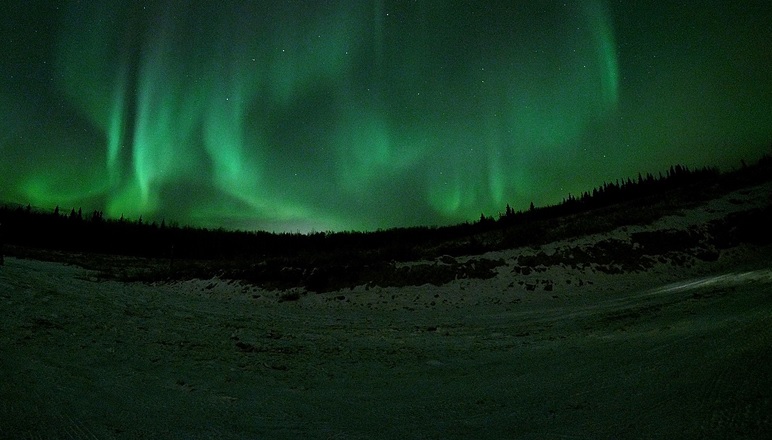
Aurora borealis. Each appearance of the northern lights is unique. Often you see three green bands across the night sky. Or the lights come as flickering curtains or rolling smoke. The color is a luminous green, often with a hint of pink along the edge, and occasionally with a deep violet centre. If there is a lot of activity up there, the northern lights explode for a minute or two in a corona. (Photos: NordenBladet)
The science behind the northern lights
What exactly is the northern lights? It is the sun that lies behind the formation of the auroras.During large solar explosions and flares, huge quantities of particles are thrown out ofthe sun and into deep space. When the particles meet the Earth’s magnetic shield, they areled towards a circle around the magnetic North Pole, where they interact with the upper layers of the atmosphere. The energy which is then released is the northern lights. All this happens approximately 100 kilometres above our heads.
Living legend
Perhaps not so surprisingly, the northern lights’ spectacle has given rise to as many legends as there have been people watching. Symbols linked to the northern lights are found on the Sami shamanistic drum. The phenomenon has several different names in Sami. It is, for instance, known as Guovssahas, which means “the light which can be heard”. The northern lights were traditionally associated with sound by the Sami, the indigenous people of Norway. And during the Viking Age (793–1066 AD), the northern lights were said to be the armour of the Valkyrie warrior virgins, shedding a strange flickering light.
Be patient
When dreaming about seeing the northern lights, you must remember that you are at the complete mercy of nature. The northern lights love to play hide and seek. Observing the Aurora borealis is often a tug of war between your patience and the aurora itself. Stay in the northern lights area at least a week, preferably two, and you will be rewarded – unless local weather suddenly decides to obstruct your view with clouds.
1. Do the Northern Lights really exist?
The bright dancing lights of the aurora are actually collisions between electrically charged particles from the sun that enter the earth’s atmosphere. The lights are seen above the magnetic poles of the northern and southern hemispheres.
2. What is the best time of year to see the northern lights?
In this period of time, no Northern Lights can be observed. In the most intense Northern Lights area (notably Alaska, Iceland, Northern Scandinavia and Yukon), the lights are observed from late August to mid April. However, from late September to late March, it is dark after 6pm, and one enjoys maximum chances.
3. Can you see northern lights with naked eyes?
The Aurora Borealis appears in a spectrum of colors. … Our naked eye can most easily see the green-yellow part of the spectrum where the sun emits most of its light. Green is the most common color observed but the Northern Lights can also appear white-gray.
4. Are the Northern Lights dangerous?
The Northern Lights occur so high up in the atmosphere that they don’t pose any threat to people watching them from the ground. The aurora itself is not harmful to humans but the electrically charged particles produced could have some potentially negative effects to infrastructure and technology.
5. Do the Northern Lights give off radiation?
“Northern Lights appear when high energy particles from the sun collide with atoms and molecules in the atmosphere, causing them to emit light. … And no, the Northern Lights themselves are no source of radiation but a manifestation of what is happening all the time (the sun emits energy).
6. Can you see northern lights if cloudy?
The best conditions for seeing the Northern Lights include a few key factors: Mainly dark skies without any clouds. And, usually, the less light pollution in the sky, the better. … While it’s true that a full moon can dim the Lights a bit, it certainly doesn’t negate your chances of seeing them.
7. How often do the northern lights occur?
April to August. To see the Northern Lights you need dark skies and from early-April until late-August, the Aurora may be blazing across the Arctic firmament but it is visible only to scientific equipment, as the skies are just too light for the human eye to see the show.
8. When can I see northern lights in Norway? Can northern lights be seen in Norway?
The northern lights are therefore always present. Historically, the chances of seeing the northern lights are best viewed in Northern Norway between October and March, because the polar night makes them easier to see. The northern lights are visible in a belt around the magnetic North Pole.
9. Where is the best place to see northern lights Norway?
Tromsø Tromso is “the capital of the Arctic”, and it’s location 217 miles north of the Arctic Circle makes it one of the best places on earth to observe the northern lights. This is the largest city in Northern Norway, and operates as a hub for Safaris and nightly visits to northern light camps.
10. What month is best to see the northern lights in Norway?
The weather in November, December and January can be brutal, so a lot of people say that the best months to see the Northern Lights in Norway are late September, October, February, and March.
11. Can you see Northern Lights from Oslo?
Of course, if the conditions are right, there’s nothing to stop you catching the lights well outside that area. It’s not unheard of to see them as far north as Svalbard or as far south as Oslo – but realistically, the chances of you seeing green skies over the Norwegian capital are very low indeed.
12. Can you see the Northern Lights from the Norwegian fjords?
The Northern Lights are visible between October and March when the sky is clear, depending on the Northern Lights activity. The best place to see the Northern Lights is in the Northern, Arctic parts of Norway.
13. Can you see Northern Lights from Reykjavik?
Can You See The Northern Lights in Reykjavik? … You may be able to see the Northern Lights in the city but a few criteria would have to be met. You will need darkness and clear skies and northern light activity, all three of which only appear together mostly during the winter months.
14. Do the Northern Lights happen every night?
The Northern Lights are unpredictable. In order to see the Northern Lights, you need a dark, clear night. There also needs to be solar flares on the sun or solar wind; the Aurora Borealis happens when particles from the sun enter Earth’s atmosphere and collide violently with gas atoms.
15. Is it a good night to see the northern lights?
The Best Time of Day. First and foremost, to see the Northern Lights, the skies must be dark. Once darkness falls, the Aurora can be visible at any time of day and we have seen them as early as 4pm and as late as 6am (that was quite a night!).
16. What is the auroral oval?
When we look up and see the Northern Lights, we are only seeing a tiny section of a huge auroral oval. The geomagnetic field surrounds the Earth and extends into space as the magnetosphere, and the Geomagnetic Pole is the centre of the region around which the Northern Lights can be seen.
17. What is the auroral zone?
The auroral zone is a ring of light emission created by the precipitation of particles in the atmosphere and centred around the magnetic pole. The cusp and boundary layers on the dayside, and the plasma sheet and plasma sheet boundary layer on the nightside are the sources of these precipitations.
18. Why is it called aurora borealis?
In northern latitudes, the effect is known as the aurora borealis or the northern lights. The former term was coined by Galileo in 1619, from the Roman goddess of the dawn and the Greek name for the north wind. … The aurora can be seen best at this time, which is called magnetic midnight.
NordenBladet – What to do in Denmark? If you are a nature lover, visit Denmark’s national parks*! There are six national parks in the Kingdom of Denmark; five in Denmark proper and one in Greenland.
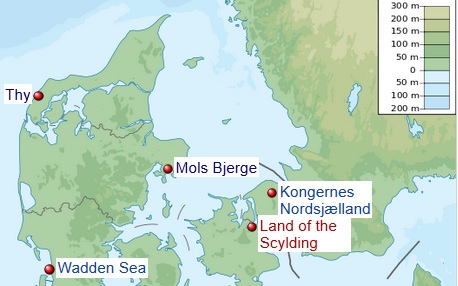
The first national park in Denmark proper was Thy National Park (Danish: Nationalpark Thy), created in 2008. It is located in Thisted Municipality, Nordjylland. The park is a narrow stretch of land along the North Jutlandic Island’s west coast from Hanstholm southward to Agger Tange, excluding Hanstholm, Klitmøller, Nørre Vorupør, Stenbjerg and Agger. Thy National Park is named after Thy, an area that includes not only today’s national park but also adjacent land further east. The park has dunes, heath, forests and grassland and also covers several small lakes and a small part of the Limfjord, which is the fjord that separates the North Jutlandic Island from the Cimbrian Peninsula.
In August 2009, the second national park Mols Bjerge National Park was inaugurated, followed by Wadden Sea National Park in October 2010, and Land of the Scylding National Park in 2015. Two additional areas in mainland Denmark were proposed in 2008 and 2009 to become national parks, but one of these plans was abandoned in 2012. The other, Kongernes Nordsjælland National Park, was inaugurated in 2018.
Greenland has had its own national park since 1974. The Northeast Greenland National Park stretches across three fifths of the northern parts of Greenland’s east coast and, since its expansion in 1988, two thirds of the eastern parts of Greenland’s north coast. Bounded by the coasts, the park covers the island’s entire north-eastern quarter, all of which is almost uninhabited.
Like Greenland, the Faroe Islands forms another autonomous region of the Kingdom of Denmark, but contains no national parks.
Nature awaits, all day every day
Denmark has three national parks, where you can venture out into some of the country’s most beautiful and unique landscape. Danish national parks are open all day, every day, and are free to access. You can explore the parks on foot, by bike, on horseback or by car. Check the signs when you enter to find details and regulations.
Park activities
Denmark’s national parks are un spoilt natural playgrounds where you can try everything from picnics, wild camping and campfires, to cycling, bird watching and horse riding. Each park has a visitor centre with ideas for how to get the most out of your visit and with details on park guides and trails.
1. Thy National Park (read about Nature and Cultural history here)
(Address: Kirkevej 9, 7760 Hurup Thy, Denmark)
Thy National Park (Photo: NordenBladet)
Denmark’s biggest and oldest national park lies on the North West Coast of Jutland. Thy National Park (Danish: Nationalpark Thy) is over 200km² in size and it offers you a dramatic landscape shaped by the sea. Much of it is covered with large areas of windswept dunes and sandy grassland.
Wildlife
Thy National Park is a great place to see wildlife, such as roe and red deer and extremely rare birds, such as the golden plover and sandpiper. Bird enthusiasts should head to Agger Tange, to see flocks of migrating birds. If you’re lucky, from Tved Klitplantage bird hide in early spring, you might even sight dancing cranes.
Cultural experiences
The coastline of Thy National Park is dotted with remnants of the largest WWII bunker network in Northern Europe. At the Museums Center Hanstholm you can learn more about how the system worked. The North Sea Oceanium in North Vorupør, presents you with the rich sea life of the North Sea. In the small fishing villages of North Vorupør and Stenbjerg Landing, you can witness fisherman dragging their boats up onto the shore after a day out at sea.
Activities
Thy National Park is criss-crossed by cycling and walking trails that take you past the best of the park’s scenery. You can even hire Icelandic horses to ride. Klitmøller is known as one of Europe’s best windsurfing spots, and golfers can enjoy the park from Nordvestjysk Golf Club which crosses the park.
2.Mols Bjerge National Park (read about legal status, geography and attractions here)
(Address: Grenåvej 12, 8410 Rønde, Denmark)
The Mols Bjerge National Park (Photo: NordenBladet)
The Mols Bjerge National Park, in East Jutland, is one of the most rugged and varied landscapes in Denmark, with many rare animal and plant species. The park covers 180 km² and is named after the area’s best known natural feature, the Mols Hills.
Spectacular views of the national park
You can see spectacular views of the whole Mols Bjerge National Park at the Jernhatten ridge. The central area of the national park is made up of high heathlands, forests and large open pastures, while along the coast there are many great beaches to discover.
Mols Bjerge Wildlife
You can see otters at Stubbe and Lange lakes, in the north of Mols Bjerge National Park. To the west, you will find the Kaløs marshes and forests are rich with flora and fauna, including rare insects in the park’s trees.
Cultural experiences
There are many Bronze Age sites in the park, with visible mounds to explore. Ancient towns, villages, churches and old manors tell the story of the area’s development over time. Visit Kalø Castle Ruin, the remnants of a royal Middle Age castle. The coastal village of Ebeltoft is a treat, with big attractions such as the Jutland Frigate and Glass Museum.
Activities in Mols Bjerge National Park
You can enjoy a good network of sign-posted cycle and walking routes throughout the park and along the coast you will find quiet, child-friendly swimming beaches. The area also offers you some great fishing spots.
3. The Wadden Sea National Park (Nationalpark Vadehavet) (Address: Havnebyvej 30, 6792 Rømø, Denmark)
The Wadden Sea National Park is Denmark’s largest and newest national park. It’s also a UNESCO World Heritage Site because of its enormous ecological importance as the world’s largest unbroken system of intertidal sand and mud flats. Head here for unbeatable bird watching!
Denmark’s newest World Heritage Site
The Wadden Sea is a national park and World Heritage Site in Denmark. It extends along the southern stretch of Denmark’s West Coast, from Ho Bay to the German border. The park is an easily accessible day trip from nearby towns such as Ribe, Denmark’s oldest town, and Esbjerg, home of the imposing Man Meets the Sea sculpture. It’s an unmissable thing to do in Denmark if you love birdwatching, wildlife and exploring intertidal habitats. Visit nearby towns like fascinating Ribe and Esbjerg.
Unique things to see at the Wadden Sea National Park
When the tidal waters retreat, the exposed seabed comes to life and teems with creatures. The Wadden Sea’s sand dunes are popular resting places for breeding colonies of seals. During spring and autumn, you’ll witness the arrival of enormous flocks of migratory birds. Around 12 million migratory birds pass through the Wadden Sea National Park en route to breeding and wintering grounds around the world.
Holiday islands in the Wadden Sea National Park
The islands in the Wadden Sea National Park are popular holiday destinations in Denmark. Rømø Beach is one of the biggest beaches in Europe. For a unique thing to do, take the tractor bus to Mandø island or head to the incredible International Kite Fliers Festival on the island of Fanø.
* A national park is a park in use for conservation purposes. Often it is a reserve of natural, semi-natural, or developed land that a sovereign state declares or owns. Although individual nations designate their own national parks differently, there is a common idea: the conservation of ‘wild nature’ for posterity and as a symbol of national pride. An international organization, the International Union for Conservation of Nature (IUCN), and its World Commission on Protected Areas (WCPA), has defined “National Park” as its Category II type of protected areas.
While this type of national park had been proposed previously, the United States established the first “public park or pleasuring-ground for the benefit and enjoyment of the people”, Yellowstone National Park, in 1872. Although Yellowstone was not officially termed a “national park” in its establishing law, it was always termed such in practice and is widely held to be the first and oldest national park in the world. However, the Tobago Main Ridge Forest Reserve (established in 1776), and the area surrounding Bogd Khan Uul Mountain (1778) are seen as the oldest legally protected areas, predating Yellowstone by nearly a century. The first area to use “national park” in its creation legislation was the U.S.’s Mackinac, in 1875. Australia’s Royal National Park, established in 1879, was the world’s third official national park. In 1895 ownership of Mackinac National Park was transferred to the State of Michigan as a state park and national park status was consequently lost. As a result, Australia’s Royal National Park is by some considerations the second oldest national park now in existence. Canada established Parks Canada in 1911, becoming the world’s first national service dedicated to protecting and presenting natural and historical treasures.
The largest national park in the world meeting the IUCN definition is the Northeast Greenland National Park, which was established in 1974. According to the IUCN, 6,555 national parks worldwide met its criteria in 2006. IUCN is still discussing the parameters of defining a national park.
National parks are almost always open to visitors. Most national parks provide outdoor recreation and camping opportunities as well as classes designed to educate the public on the importance of conservation and the natural wonders of the land in which the national park is located.
Tags: National parks in Denmark, Danish nature, Denmark, Denmark’s national parks, Jutland, List of national parks of Denmark, Nordic travel, Thy National Park, Tourism, tourist, travel, travel guide, Norden, Scandinavia, Nordic info, Nordic travel, Nordic travel guide, Nordic travel guides. address, area, hours, directions. what to do in Denmark, best things to do in Denmark, visit Denmark, Kingdom of Denmark, culture, Cultural experiences, weather, weather forecast, weather forecast in Denmark. Nationalpark Vadehavet, The Wadden Sea National Park, Mols Bjerge National Park, info, information, articles about Denmark´s national parks, map, maps, videos. Norden Bladet
NordenBladet —Today, the Riigikogu passed five Acts, and concluded the second reading of nineteen Bills and the first reading of a draft Resolution.
The Covered Bond Act (760 SE), initiated by the Government, creates the possibility for credit institutions to issue covered bonds, which is a special type of bond.
The Act creates a legally reliable environment in Estonia for credit institutions for issuing covered bonds and for the functioning of the covered bond market. The Act will develop the Estonian capital market and create a possibility to issue a new type of bonds and to invest in them. In addition, financial stability will be increased by establishing an additional instrument for engaging capital from money markets for Estonian credit institutions, and the Estonian credit market will be enhanced by increasing the opportunity for credit receivers (in particular, businesses) to also receive funding under the circumstances of a financial and economic crisis.
Covered bonds are guaranteed bonds issued by credit institutions, which are guaranteed by claims of “a high-quality bank” against borrowers which generally are claims arising from mortgage loans or loans granted to public sector. That is, put simpler, covered bonds are usually guaranteed by claims of credit institutions against recipients of real estate loans, in particular, housing loans, or against the state and local governments.
The provisions concerning the pledge of claims in the Law of Property Act do not apply to the guaranteeing of covered bonds; that is subject to a special procedure. This means above all that, in the event of failure of a credit institution (the issuer), collateral is separated and it is excluded from the bankruptcy estate of the credit institution. At the same time, collateral is above all intended to satisfy the claims of covered bond holders (investors). In addition, the issuing of covered bonds is accompanied by strengthened financial supervision of the credit institution which among other things is manifested in the obligation to apply for an additional authorisation.
75 members of the Riigikogu voted in favour of the Act.
The Act on Amendments to the Law of Ship Flag and Registers of Ships Act and Amendments to the Income Tax Act and Other Associated Acts (722 SE), initiated by the government, supports the Estonian maritime sector. Among other things, it sets a 0 per cent income tax rate for the remuneration of the staff of cargo vessels, and passenger ships operating internationally outside the European Union.
The purpose of the Act is to create more favourable conditions for bringing foreign ships in the Estonian register of bareboat chartered ships. As a result of that, the Estonian fleet will increase, which will contribute to the growth of the Estonian economy and the emergence of the shore sector. The tax revenues of the state will increase through the receipt of the registrar’s fees.
In addition, thanks to the amendment, the Estonian seafarers will have the possibility to conclude a voluntary contract with the Estonian Health Insurance Fund and thereby their access to health insurance will improve.
According to forecasts, the amendments could bring several hundred large seagoing vessels under the Estonian flag by 2025.
During the debate, Peeter Ernits, Krista Aru from the Free Party Faction, Sven Sester from the Faction Isamaa, Erki Savisaar from the Centre Party Faction and Jaanus Marrandi from the Social Democratic Party Faction took the floor.
77 members of the Riigikogu voted in favour of the Act and there was one abstention.
The Act on Amendments to the Social Benefits for Disabled Persons Act (663 SE), initiated by the Estonian Free Party Faction, doubles the social benefits for children with a moderate or severe disability, and triples the allowance for a child with a profound disability, compared to the current rates.
The amount of the disabled children allowance is based on the social benefit rate which has not been changed since 2006. As a result of the new amendment, as of the new year, an allowance of 138 euro will be paid to children with a moderate disability, and 161 euro to children with a severe disability. An allowance of 241 euro will be paid to children with a profound disability.
The Act aims to increase disabled children’s benefits so that this would ensure independent subsistence to every person who needs help, support their social coping, and create equal opportunities for subsistence. The partial compensation of additional costs due to disability also facilitates studying and working, and helps implement the rehabilitation plan of the person who needs help.
Nearly 13 000 disabled children live in Estonia. The figure has nearly doubled compared to 2009. In 2017, the allowance for a child with a moderate disability was paid to 5000 children, the allowance for a child with a severe disability was paid to 7164 and the allowance for a child with a profound disability was paid to 732.
The Act enters into force on 1 January 2020.
During the debate, Andres Herkel from the Free Party Faction, Helmen Kütt from the Social Democratic Party Faction and Priit Sibul from the Faction Isamaa took the floor.
72 members of the Riigikogu voted in favour of the Act.
The Act on Amendments to the Imprisonment Act (680 SE), initiated by the Government, provides for allowing prisoners access to the websites of the Riigikogu and the Chancellor of Justice via computers specially adapted for that purpose and under the supervision of the prison authorities, but does not allow access to electronic communication. At present, prisoners are not allowed to use the Internet, but they do have access to the official databases of legislation and the database of judicial decisions under the supervision of the prison authorities.
The amendment is due to the judgment of the European Court of Human Rights in the case of Romeo Kalda vs Estonia, whereby a violation of Article 10 of the Convention for the Protection of Human Rights and Fundamental Freedoms was ascertained, as the prisoner had not been ensured access to the website of the Riigikogu, the website of the Chancellor of Justice and the website of the Council of Europe Information Office in Tallinn (the latter no longer exists). The amendments ensure prisoners access to the website of the Riigikogu and the Chancellor of Justice. At the same time, access to the parts of websites that allow electronic communication is prohibited.
The Act also amends the provisions concerning responding to emergencies in prisons, and the competence of the prison service in resolution of events that may endanger the security or order in the prison.
67 members of the Riigikogu voted in favour of the Act and there was one abstention.
The Act on Amendments to the Basic Schools and Upper Secondary Schools Act (799 SE), initiated by the Estonian Reform Party Faction and the Government, gives schools the possibility to impose sanctions on students who carry items or substances that are prohibited in school.
In order to ensure security, prevent situations of danger and intervene where necessary, the Act provides for a list of items and substances prohibited for students in school, and regulates the seizure and depositing of prohibited items.
The Act allows to check, in case of justified doubt, items used by the student, including his or her clothes, and the locker used by him or her.
The Act provides for limits to the seizure of prohibited items, but it is intended to be applied in situations where other measures are insufficient. It is possible to seize a prohibited item or substance from a student, and search for such items and substances against his or her will only in the event of an immediate threat to life, health or another person’s item. According to the Act, the person who applies the sanction to be established must have the training necessary therefor.
During the debate, Jürgen Ligi from the Reform Party Faction and Krista Aru from the Free Party Faction took the floor.
76 members of the Riigikogu voted in favour of the Act.
Nineteen Bills passed the second reading in the Riigikogu:
The Bill on Amendments to the Fertilisers Act and the State Fees Act (639 SE), initiated by the Government, will simplify and lower the cost of registration of fertilizers. For example, the placing on the Estonian market of new fertilizers that are sold in small quantities will become more favourable. One aim of the Bill is to ensure efficient supervision of fertilizers marked “EC fertilizer” in the domestic market. The state fee system will also be simplified. Instead of the current five state fees, one fee will have to be paid in the future. In addition, smaller specifications will be made.
In the future, all handlers of fertilizers operating in Estonia, including distributors of products marked “EC fertilizer”, will have to submit a notice of economic activities on the basis of which the handler and the fertilizer sold by the handler will be entered into the register. This will allow to obtain actual and up-to-date data on the Estonian fertilizer market from the fertilizer register. At present, there is no overview of products marked “EC fertilizer” which complicates supervision. The Agricultural Board is notified when the handling of a marked fertilizer is begun, but there is no information as to for how long the fertilizer remains on the market.
During the second reading, the state fee rates were amended. According to the Bill, the state fee is planned to be uniform for conformity supervision operations regarding every fertilizer entered in the register of fertilisers. With an amendment, different state fees will be charged for the handling of fertilisers packaged in small packaging (up to 25 kg or 25 litres), and fertilisers packaged in larger packaging and loose fertilisers. The due date for payment of the state fee and the date of entry into force of the Act will also be changed, and the Bill will be amended by adding a transitional provision in connection with these dates. These amendments will ensure a smooth transition to the new state fee system.
The Bill on Amendments to the Estonian Defence Forces Organisation Act (783 SE), initiated by the Security Authorities Surveillance Select Committee, will extend the rights of the Defence Forces in the conduct of a background check of persons, in order to verify their suitability to be employed in the Defence Forces or to cooperate with the Defence Forces. According to the Bill, the Defence Forces will be able to perform acts to a wider extent than the current verification against registers, and to use covert measures to ensure that the collection of information is covert, upon obtaining information needed for background check. The function of collecting and processing information to protect the restricted military area of the Defence Forces is provided for for the Defence Forces as a new function upon the conduct of military intelligence.
The Bill will give the Defence Forces the right to collect and process data in order to ensure the protection of their restricted military area and to prevent potential threat. The above-mentioned amendments are necessary in order that, in the event of incidents directly affecting security, the Defence Forces were able to identify a threat and to respond to it itself in a timely manner.
Hanno Pevkur from the Reform Party Faction took the floor during the debate.
The Bill on Amendments to the Plant Propagation and Plant Variety Rights Act, the Administrative Co-operation Act and the State Fees Act (733 SE), initiated by the Government, will update the Act, reduce the functions of the state, and increase the producers’ own responsibility.
The Bill will simplify the system for certification of seeds so that seed producers would have the possibility to have a field inspection done in the event of a certified seed category, and to draw samples and also to analyse them in the event of all categories of seeds subject to certification. Persons who wish a field inspection, a sampling or a laboratory analysis of samples to be carried out, or to provide an abovementioned service, will have to have authorisation for economic activity.
The amendments provided for in the Bill also concern the entry of varieties of fruit species in the Variety List. Varieties of fruit species will be included among the varieties of species entered in the Variety List. Up to now, it has been possible to register varieties of fruit species, but they have not been entered in the Variety List. As of 1 January 2017, the common list of varieties of the European Union, FRUMATIS, began to be established, and in connection with that, the possibility to enter also varieties of fruit species in the Variety List in Estonia will be created.
An amendment provided for in the Bill concerns the availability of the information on seeds produced privately, and the payment of licence fee for using a protected variety to the holder. That is, by way of a difference, it will be permitted to produce seeds of certain important crops for own use, but a fee will also have to be paid to the holder for that. Under the current Act, holders do not obtain sufficient information on seeds of varieties produced privately, nor do they receive any fee for the use of the varieties, and consequently also have no information or basis for implementing protection of their rights. As a result of that, the holders’ interest in the Estonian market has fallen, and therefore the newest, most productive, and most disease and pest tolerant varieties are not available on the Estonian market. In order to change the situation on the Estonian market for the better and to raise productivity, it is necessary to amend the provisions on the scope of plant variety rights with the Bill.
The Bill will increase the amounts of the state fees relating to the certification of seeds. Seed producers who use the opportunity to carry out field inspections and to draw samples from seed lots subject to certification themselves if they have a relevant authorisation for activity, as provided for by the Bill, or who avail themselves of the services of persons who hold a relevant activity permit, will be exempt from payment of state fee.
During the second reading of the Bill, several motions to amend specifying the text of the Bill were made. Among other things, the establishment of a system of notification for collecting data on varieties and seeds used in agricultural production is provided for.
The Bill on Amendments to the Industrial Emissions Act and the Alcohol, Tobacco, Fuel and Electricity Excise Duty Act (736 SE), initiated by the Government, will specify the provisions of the current Act and eliminate conflicts with EU law that the European Commission has pointed out. The amendments are primarily of a technical nature: the wording of provisions will be improved, a more uniform system of concepts will be used, and the requirements for the submission and disclosure of the special environmental inspection report will be specified. The Bill provides that, for testing and using emerging techniques, the issuer of permits may grant temporary derogations in the rules in order to prevent potential pollution. The Bill provides for the possibility to apply the requirement to implement relevant preventive measures within nine months. This will simplify the testing and use of emerging techniques as compared to the requirement established in current law.
Three motions to amend the Bill were submitted during the second reading. One motion to amend aims to amend the Alcohol, Tobacco, Fuel and Electricity Excise Duty Act. The reason for the amendment is that the environmental sector has for a long time been searching for a solution to the problem of end-of-life tyres. By now it has appeared that tyre chips could be successfully used as input for producing shale oil. In the future, shale-derived fuel oil will not have to be produced 100 % from oil shale, but 70 % of the mass of the main component will have to be oil shale, and other raw materials or fuel components may be used to the extent of the remaining 30 %.
Peeter Ernits took the floor during the debate.
The International Sanctions Bill (721 SE), initiated by the Government, will update and organise the International Sanctions Act. The Bill of the consolidated text of the new International Sanctions Act has four main aims: to correct the distribution of competence in the national implementation of international sanctions so that it would be in conformity with developed sanction regimes; to add a legal framework concerning the imposition of sanctions by the Government of the Republic for situations where no agreement on the imposition of sanctions is reached in the UN or the EU; to update the special regulation of financial sanction and to amend the Penal Code so that it would allow for more efficient proceedings on violations of sanctions.
The new Act will have a positive impact on the foreign relations of Estonia, as it will help perform the obligation of Estonia to impose international sanctions without delay and correctly, arising from international and EU law. The updated regulation will also have a positive national impact, as the obligations relating to the imposition of the sanction will become more understandable to both the public and the private sector.
The Bill on Amendments to the Trade Marks Act, the Industrial Design Protection Act and Other Acts (765 SE), initiated by the Government of the Republic, will confer the exclusive competence to resolve disputes relating to intellectual property rights upon Harju County Court. In the current legislation, all Estonian county courts have the competence to adjudicate civil matters relating to intellectual property. In practice, however, the majority of intellectual property disputes end up in Harju County Court, which is also the only court that has judges specialised in intellectual property. In addition, with an amendment, the Estonian Patent Office will have the possibility to use electronic proceedings in the case of trade marks and designs, which will facilitate electronic communication between the Estonian Patent Office and persons. For that, possibilities to submit and release information electronically will be provided for. The amendments will also simplify acquisition of the profession of patent attorney for sworn advocates. Under the current Act, a person may be awarded the profession of a patent attorney if the person has worked for a patent attorney or for a company of patent attorneys at least for the last four years. In the future, the time spent providing legal services in the field of industrial property in a law office will also be included in the length of service required to acquire the profession. However, the requirement to take the professional examination for patent attorneys will be maintained for sworn advocates.
The explanatory memorandum to the Bill on Amendments to the Traffic Act (752 SE), initiated by the Legal Affairs Committee, notes that the provisions of the current regulation of speed cameras have not allowed for implementation of portable speed cameras so far. Although under the Traffic Act traffic supervision may be exercised with portable or fixed technical equipment, subsections of the same section in the Act provide for the possibility of using only fixed equipment in the case of the automatic traffic supervision system.
At present, it is possible to use two speed measuring solutions out of three, that is, measuring with hand camera and measuring with fixed camera, in Estonia. The possibility of using mobile speed cameras will not change the current legal order, that is, the outcome will be the same for persons. However, the aim is to enable the persons exercising traffic supervision to influence a significantly greater number of people also in regions where it was impossible earlier.
The aim of the installation of portable speed cameras is to calm traffic and thereby to reduce the number of accidents.
Before the second reading, a motion to amend the Bill was submitted which aimed to amend the Bill by including two provisions in the Traffic Act to regulate a situation where a roadworthiness test on a power-driven vehicle and its trailer registered in the Estonian motor register is carried out in another European Union Member State and the results are also valid in Estonia. The aim of the amendment is to allow for roadworthiness tests on vehicles registered in the motor register but mainly engaged in international traffic (in Europe) to be carried out outside Estonia. At the same time, the amendment requires that roadworthiness tests performed outside Estonia will have to be carried out in accordance with requirements equivalent to those provided for in the Traffic Act and legislation established on the basis thereof. Observance of the requirements will be ensured with the fact that definite persons who will be allowed to carry out roadworthiness tests on vehicles registered in the motor register will be defined in cooperation agreements. Before the conclusion of a relevant cooperation agreement, the Road Administration will evaluate the relevant requirements of the respective country and, if necessary, carry out a thorough training and instruction of the persons designated in the cooperation agreement. Thus, no changes regarding the carrying out of roadworthiness tests would be involved for the owner or authorised user of a vehicle or the person who submits a vehicle to a roadworthiness test. As a positive impact of the amendment, the competitiveness of transport companies will increase as they will have the possibility to have roadworthiness tests on their vehicle fleet to be carried out outside Estonia.
The Personal Data Protection Act Implementation Bill (778 SE), initiated by the Constitutional Committee, provides for the implementation of the European Union General Data Protection Regulation and the Law Enforcement Directive in various legal areas.
The Bill provides for the precise purposes of and bases for personal data processing, and the permitted scope of personal data processing.
The Bill will amend 126 Acts. As of 25 May 2018, the General Data Protection Regulation is in force in the European Union, and relevant amendments will have to be introduced into the Estonian Acts to implement it and the Law Enforcement Directive.
The Bill will update the regulations concerning databases – the purposes of processing of personal data and the compositions of data will be amended, and the period of preservation of data will also be limited. The establishment of the statutes of databases has been transferred from the Government level to the competence of ministers where possible.
Jüri Saar from the Free Party Faction took the floor during the debate.
The Free Party Faction moved to suspend the second reading of the Bill. 11 members of the Riigikogu voted in favour of the motion and 32 were against. The motion was not supported and thus the second reading of the Bill was concluded.
Under the Bill on Amendments to the Riigikogu Rules of Procedure and Internal Rules Act and the Constitutional Review Court Procedure Act (762 SE), initiated by the Constitutional Committee, the appointment of members of the select committees, the committees of investigation and the study committees, in addition to those of the standing committees, and the approval of changes thereto will fall within the competence of the Board of the Riigikogu.
In addition, the work arrangements of the plenary assembly will be made more flexible. While up to now, the principle applied that replies to interpellations were scheduled only for Monday’s sittings, and the readings of draft legislation were scheduled for sittings on Tuesday, Wednesday and Thursday, the Bill will allow for replies to interpellations and readings of draft legislation on all sitting days. A time restriction will be imposed on Monday’s sitting.
The regulation of the deliberation of a motion to express no confidence in the Government of the Republic, the Prime Minister or any other minister will be specified. Amendments concerning the rules of legislative drafting will also be made.
The aim of the Bill is to reduce bureaucracy in the organisation of the work of the Riigikogu and to make work processes quicker and more flexible.
During the second reading, several motions to amend the Bill were submitted. One amendment aims to extend the Question Time of the Riigikogu by one hour by bringing it forward. In addition, another amendment provides that, in Question Time, two minutes will be allotted for putting a question, instead of the current one minute, and three minutes will be allotted for replying, instead of two minutes.
Andres Herkel from the Free Party Faction took the floor during the debate.
The Bill on Amendments to the Official Statistics Act and the Public Information Act (794 SE), initiated by the Government, will regulate data management that provides for specific rules with which data in databases and data management must comply. Coordination of data management will be given to Statistics Estonia. At present, no uniform rules of national data management have been agreed on, and therefore it is also impossible to implement the ‘once-only’ principle. Nor does current law provide a regulation as to who should coordinate data management at national level. The Bill will include in the Public Information Act data dissemination service that will enable linking of different data sources and processing of data for scientific or statistical purposes in the future. With the amendments, it will be possible to interconnect data held in databases, to provide better services, to reduce administrative burden and to produce official statistics on the basis of the data collected.
Between the first and second reading, two motions to amend the Bill were submitted, with similar content. The amendment aims to provide for the ‘once-only’ principle when collecting data into a database. The principle is necessary in order to reduce the administrative burden when submitting data and to ensure more effective functioning of the state. A database is used for the performance of functions provided in an Act, legislation issued on the basis thereof or an international agreement. If the data necessary for the performance of such functions are already there in a database, such data must be used, instead of asking them additionally. Therefore it is reasonable to include the in the Act the principle that the ‘once-only’ principle is adhered to when collecting data into a database.
The Bill on Amendments to the Accounting Act (795 SE), initiated by the Government, will make machine-processable invoices mandatory in invoicing with the public sector. The amendments aim to reduce the workload and the time required in invoicing with the public sector.
Two motions to amend the Bill were submitted in the course of the second reading. One motion to amend will specify the text of the Bill to provide that, in the case of a state accounting entity, local authority, legal person in public law or accounting entity over which the abovementioned persons have dominant influence directly or indirectly or who is a contracting authority or entity within the meaning of § 5 of the Public Procurement Act, only accounting entities will have to submit electronic invoices.
The Republic of Estonia as a legal person in public law, local authorities, all legal persons in private or public law registered in Estonia, sole proprietors, and branches of foreign companies registered in Estonia are accounting entities. Under this specification, foreign undertakings would not have the obligation to submit electronic invoices. This is necessary because there may not be equally good possibilities to send electronic invoices in other countries, and therefore it is not reasonable to require electronic invoices from them.
The Bill on Amendments to the Trade Marks Act, the Principles of Legal Regulation of Industrial Property Act and Other Acts (793 SE), initiated by the Government, will transpose the relevant directive harmonising trade mark law in EU Member States. The requirement that signs protected as trade marks must be capable of being represented graphically will be eliminated from the current law. A trade mark is a sign used to distinguish the goods or services of an undertaking from similar goods or services of other undertakings. The Bill will simplify the protection of non-traditional trade marks, e.g. sound, multimedia and hologram signs as it will be possible to submit them to the Estonian Patent Office also as sound or video files in the future. Under the current law, each trade mark must be capable of being represented graphically. Under the current law, in the course of registration of a trade mark, the Estonian Patent Office verifies that there are no absolute (e.g. the sign is not distinctive or it is only descriptive) or relative (e.g. the existence of an earlier confusingly similar trade mark) grounds for refusal which preclude registration of the trade mark. According to the Bill, in the future, the Estonian Patent Office will no longer examine relative grounds for refusal. In order to meet the requirements of the directive, the Board of Appeal will be transferred from the Ministry of Justice to the Estonian Patent Office. Since the directive requires that the board be located at the central industrial property office of the Member State. The board is an independent body which resolves disputes relating to industrial property (trade mark, patent, design) by way of mandatory pre-trial proceedings. In addition, the structure of the Board of Appeal will be amended. A board consisting of two permanent members will be provided for, instead of the current eight-member board. Similarly to the current system, also in the future, the board will settle disputes in a three-member panel, involving in its membership an additional member or members as experts in the relevant field. Under the Bill, the competence of the board will also be extended. In addition to the appeals against decisions from the Estonian Patent Office, and notices of opposition of trade marks, the board will also adjudicate applications for declaration of nullity of the exclusive right of the proprietor of a trade mark, and for declaration of the exclusive right of the proprietor of a trade mark extinguished, and applications for revocation of legal protection granted to other objects of industrial property rights which are resolved by county courts at present. According to the Bill, measures to make the board’s proceedings quicker and more efficient will also be provided for.
The Bill on Amendments to the Ports Act and the Liquid Fuel Act (780 SE), initiated by the Government, will implement the EU Regulation establishing a framework for the provision of port services and common rules on the financial transparency of ports in ports of the trans-European transport network, or TEN-T. The Regulation of the European Parliament and of the Council enters into force on 24 March 2019.
Based on the Regulation, the requirements for managing bodies of the ports for consultation of port users and stakeholders will be included in the Ports Act. The stakeholders will have to be consulted in the cases when changes are planned in the matters specified in Article 15 of Regulation (EU) 2017/352. The Bill designates the Competition Authority to resolve complaints due to application of the Regulation. It establishes the procedure for handling complaints, and the possibility of imposing a penalty payment if a port fails to comply with a precept in the event of a violation.
In Estonia, ten ports belong to the trans-European TEN-T network: Tallinn Old City Harbour, Paldiski South Harbour, and the ports of Muuga, Paljassaare, Rohuküla, Heltermaa, Kuivastu, Virtsu, Pärnu and Sillamäe.
The Bill will also introduce an amendment to the Liquid Fuel Act. Inasmuch as, in the implementation of the amendment that entered into force on 1 May, it has appeared that it is impossible to statistically transfer biofuel between suppliers on account of biomethane as of 1 January 2019 due to inaccurate use of a term in subsection 21 (1) of the Liquid Fuel Act. Biomethane is a category of biofuel, and the Bill will correct the error that has occurred.
Arto Aas from the Reform Party Faction took the floor during the debate.
The aim of the Heritage Conservation Bill (684 SE), initiated by the Government, is to balance the rights and duties of the state and those of the owners of monuments. The Bill stresses that the preservation and valuing of cultural heritage is a common duty of society.
For that, the state will take up part of the costs that owners of cultural monuments must bear in connection with monuments. For example, the expenses made on study and heritage conservation supervision will be compensated to the owner of a monument or structure located within heritage conservation area. Also, in the future, the preparation of special conditions for heritage conservation which so far was carried out at the expense of the owner of the monument will be the task of the National Heritage Board. In addition to the support for preservation of a monument which has also been allocated under the current Act, there will be an additional possibility to support the preservation of monuments restituted in the course of the ownership reform from the ownership reform reserve fund.
The Bill sets out that, when changes are made to historical environment, the special needs of disabled people will have to be taken into account, and it is specified that when carrying out works on a monument, original materials and traditional technologies are used if possible and in justified cases.
Various provisions stress the need to involve the owner in the decision-making, and attention is paid to simplification of the proceedings, for example, in the case of certain activities (some works and studies), the current obligation to apply for an activity licence is omitted and it is replaced by a notification obligation.
The Bill is intended to attach importance to advisory and prevention activities.
The Act is to enter into force on 1 May 2019.
During the debate, Yoko Alender from the Reform Party Faction, Jüri Jaanson from the Reform Party Faction, Viktoria Ladõnskaja-Kubits from the Faction Isamaa and Krista Aru from the Free Party Faction took the floor.
The Faction Isamaa moved to suspend the second reading of the Bill. 14 members of the Riigikogu voted in favour of the motion and 30 were against. The motion was not supported and thus the second reading of the Bill was concluded.
The Higher Education Bill (725 SE), initiated by the Government, will organise and simplify the regulations relating to higher education. The Bill will increase flexibility both for students and institutions of higher education, facilitate cooperation between institutions of higher education, strengthen the links between universities and society, and enable to shape a career model that is attractive to academic workers.
The Bill will not change the fundamentals of the higher education system, like tuition-free studies, extensive autonomy of institutions of higher education and the three-tier higher education studies.
The Bill will create the regulation of the post of academic worker which will enable to create clear career models in institutions of higher education and research institutions. The Bill points out that, as a general rule, the expected educational requirement for workers in the highest posts (professor, research fellow) is a Doctoral level degree. In addition, the duration of the holiday of academic workers (42 or 56 days, as a general rule) will also be specified, and the rules for awarding the title of “emeritus” will be organised.
The Act is to enter into force on 1 September 2019.
Krista Aru from the Free Party Faction took the floor during the debate.
The Tallinn University Bill (726 SE), initiated by the Government, will establish the Tallinn University Act, which will provide for the mission, the functions, and the bases for the management and funding of the University. The Bill is connected with the Higher Education Bill.
The Bill will provide for the area of responsibility of the University in educational science, humanities, natural science and social science, as well as arts, teacher training and pedagogy. The Bill will update the management structure of the University. It provides that the Council, the Senate and the Rector are the managing bodies of the University.
Under the Bill, the University has an eleven-member Council that makes strategic decisions and involves external members and whose membership is determined by the Government for five years. Under the regulation of the current Universities Act, the Council is the academic decision-making body which does not involve external members, and members from outside the university are included in the Board of Governors whose membership is determined by the Government.
The Bill additionally provides that a managing body of the University is the Senate which is responsible for the issues of instruction, research and development. The Senate has the right to issue regulations within its competence and adopt resolutions. The Rector as a managing body of the University and the Chairman of the Senate is responsible for the statutes, the development plan and the implementation of the budget of the University.
The University is financed from the state budget, and the bases for the financing will not be changed. Compared to the current law, the Bill provides for a change concerning the founding of private schools or research and development institutions in private law. At present, it is possible to found one in the case when it is a foundation where one of the founders is the state, while under the Bill, legal persons in private law founded by the University will not be entitled to found private schools or research and development institutions in private law.
The Act is planned to enter into force on 1 September 2019. The new management model will be implemented in full as of 1 January 2020.
The Estonian University of Life Sciences Bill (727 SE), initiated by the Government, will establish the Estonian University of Life Sciences Act, which will provide for the mission, the functions, and the bases for the management and funding of the University. The Bill is connected with the Higher Education Bill.
The Bill provides for the area of responsibility of the University in the areas relating to the development of rural life and the rural economy. The Bill will update the management structure of the University by providing that the University is managed by the Council, the Senate and the Rector. Under the Bill, the University has a seven-member Council that makes strategic decisions and involves external members and whose membership is determined by the Government for five years. Under the regulation of the current Universities Act, the Council is the academic decision-making body which does not involve external members, and members from outside the university are included in the Board of Governors whose membership is determined by the Government. The Bill additionally provides that a managing body of the University is the Senate which is responsible for the issues of instruction, research and development. The Senate has the right to issue regulations within its competence and adopt resolutions. The Rector as a managing body of the University and the Chairman of the Senate is responsible for the statutes, the development plan and the implementation of the budget of the University.
The University is financed from the state budget, and the bases for the financing will not be changed. Compared to the current law, the Bill provides for a change concerning the founding of private schools or research and development institutions in private law. At present, it is possible to found one in the case when it is a foundation where one of the founders is the state, while under the Bill, legal persons in private law founded by the University will not be entitled to found private schools or research and development institutions in private law.
The Act is planned to enter into force on 1 September 2019. The new management model will be implemented in full as of 1 January 2020.
The Estonian Academy of Arts Bill (730 SE), initiated by the Government, will establish the Estonian Academy of Arts Act, which will provide for the mission, the functions, and the bases for the management and funding of the Academy. The Bill is connected with the Higher Education Bill.
The Bill provides for the area of responsibility of the Academy in the fields of art, design and architecture. It also points out the function of the institution of higher education to engage in art and science which also includes a specific form of research, artistic research. The Bill will update the management structure of the Academy by providing that the Council, the Senate and the Rector are the managing bodies of the Academy. Under the Bill, the Academy has a nine-member Council that makes strategic decisions and involves external members and whose membership is determined by the Government for five years. Under the regulation of the current Universities Act, the Council is the academic decision-making body which does not involve external members, and members from outside the university are included in the Board of Governors whose membership is determined by the Government.
The Bill additionally provides that a managing body of the Academy is the Senate which is responsible for the issues of instruction, research and development. The Senate has the right to issue regulations within its competence and adopt resolutions. The Rector as a managing body of the Academy and the Chairman of the Senate is responsible for the statutes, the development plan and the implementation of the budget of the Academy.
The Academy is financed from the state budget, and the bases for the financing will not be changed. Compared to the current law, the Bill provides for a change concerning the founding of private schools or research and development institutions in private law. At present, it is possible to found one in the case when it is a foundation where one of the founders is the state, while under the Bill, legal persons in private law founded by the Academy will not be entitled to found private schools or research and development institutions in private law.
The Act is planned to enter into force on 1 September 2019. The new management model will be implemented in full as of 1 January 2020.
The Estonian Academy of Music and Theatre Bill (728 SE), initiated by the Government, will establish the Estonian Academy of Music and Theatre Act, which will provide for the mission, the functions, and the bases for the management and funding of the Academy. The Bill is connected with the Higher Education Bill.
The Bill provides for the area of responsibility of the Academy in the fields of music and theatre, as well as for the role of the Academy in promoting the general education and vocational education in music. The Bill will update the management structure of the Academy by providing that the Council, the Senate and the Rector are the managing bodies of the Academy. Under the Bill, the Academy has a seven-member Council that makes strategic decisions and involves external members and whose membership is determined by the Government for five years. Under the regulation of the current Universities Act, the Council is the academic decision-making body which does not involve external members, and members from outside the university are included in the Board of Governors whose membership is determined by the Government. The Bill additionally provides that a managing body of the Academy is the Senate which is responsible for the issues of instruction, research and development. The Senate has the right to issue regulations within its competence and adopt resolutions. The Rector as a managing body of the Academy and the Chairman of the Senate is responsible for the statutes, the development plan and the implementation of the budget of the Academy.
The Academy is financed from the state budget, and the bases for the financing will not be changed. Compared to the current law, the Bill provides for a change concerning the founding of private schools or research and development institutions in private law. At present, it is possible to found one in the case when it is a foundation where one of the founders is the state, while under the Bill, legal persons in private law founded by the Academy will not be entitled to found private schools or research and development institutions in private law.
The Act is planned to enter into force on 1 September 2019. The new management model will be implemented in full as of 1 January 2020.
One draft Resolution passed the first reading in the Riigikogu:
The Draft Resolution of the Riigikogu “Holding a Referendum on the Issue of Participation in the UN’s Global Compact for Migration” (764 OE), submitted by the Estonian Conservative People’s Party Faction, aims to hold a referendum on the issue of participation in the UN’s Global Compact for Migration.
During the debate, Martin Helme from the Conservative People’s Party Faction and Oudekki Loone from the Centre Party Faction took the floor.
The lead committee moved to reject the draft Resolution at the first reading. 14 members of the Riigikogu voted in favour of the motion and 14 were against. The motion was not supported and the draft Resolution passed the first reading.
The second reading of a Bill was suspended:
The Bill on Amendments to the Tobacco Act and the Alcohol, Tobacco, Fuel and Electricity Excise Duty Act (775 SE), initiated by the Government, will transpose two articles of the EU Tobacco Directive, on the basis of which a European-wide tracking and tracing system for tobacco products will be implemented as of 20 May 2019. The purpose of the system is to provide the Member States and the Commission with an effective tool for fighting illicit trade in tobacco products.
During the debate, Toomas Kivimägi from the Reform Party Faction, Aadu Must from the Centre Party Faction, Andres Metsoja from the Faction Isamaa, Madis Milling from the Reform Party Faction, Tarmo Kruusimäe from the Faction Isamaa, Eiki Nestor from the Social Democratic Party Faction and Helmen Kütt from the Social Democratic Party Faction took the floor.
Several motions to amend the Bill were submitted during the second reading, and they were voted on at the plenary sitting. After the voting, the initiator of the Bill moved to suspend the second reading of the Bill. Since the motion came from the initiator of the Bill, no voting was held. Thus, the second reading of the Bill was suspended.
The deadline for motions to amend is 27 February at 5.15 p.m.
A Bill was dropped from the proceedings of the Riigikogu:
The Bill on Amendments to the Value-Added Tax Act (763 SE), initiated by the Estonian Free Party Faction, proposed to provide that, for small businesses with up to ten employees and a turnover of up to 200,000 euro a year, the VAT period would be one year. For small businesses with up to ten employees and a turnover of 200,000–2,000,000 euro a year, the VAT period would have extended to up to three months. As a justification, it was pointed out that a longer VAT period would reduce the administrative burden for small businesses and the Tax and Customs Board.
The lead committee moved to reject the Bill at the first reading. 45 members of the Riigikogu voted in favour of the motion, 12 were against, and there was one abstention. Thus, the Bill was dropped from the legislative proceedings.