Reklaam

Helena-Reet Ennet

Helena-Reet Ennet
4698 POSTS 0 COMMENTS

The delegation of the Verkhovna Rada and Zhytomyr Region visits Estonia

NordenBladet —

First Deputy Chairman of the Verkhovna Rada of Ukraine Oleksandr Korniyenko and the delegation of the members of the Verkhovna Rada (Parliament) of Ukraine, and representatives of the local governments and businesses of Zhytomyr Region is on a visit to Tallinn.

On Sunday, the 22-member Ukrainian delegation visits the NATO Cooperative Cyber Defence Centre of Excellence, e-Estonia Briefing Centre, NGO Slava Ukraini and the cruise ferry M/S Isabelle that provides accommodation to war refugees from Ukraine. They also attend a ceremony in Tallinn Town Hall, where Chairman of Tallinn City Council Jevgeni Ossinovski presents Korniyenko Tallinn City Decoration of Honour awarded to President of Ukraine Volodymyr Zelenskyy as a special tribute from the city. In the evening, the Ukrainian delegation will attend the dinner hosted by President of the Riigikogu (Parliament of Estonia) Jüri Ratas.

On Monday, the Ukrainian delegation will have meetings at the Riigikogu with Jüri Ratas and the Estonia-Ukraine Parliamentary Friendship Group, as well as with Minister of Culture Tiit Terik, Minister of Defence Kalle Laanet, Minister of Entrepreneurship and Information Technology Andres Sutt and Minister of Economic Affairs and Infrastructure Taavi Aas. The Ukrainian delegation will also meet with the representatives of the Ministry of Education and Research, the Ministry of Foreign Affairs, the Estonian Centre for International Development, and the cyber security company CybExer.

Deputy Chairman of the Verkhovna Rada Korniyenko will leave Estonia on Monday evening. On Tuesday, other members of the Ukrainian delegation will visit the Estonian Chamber of Commerce and Industry, the Association of Estonian Cities and Municipalities, Muuga Kindergarten and the Estonian Woodhouse Association, and have meetings with the Estonian entrepreneurs and Minister of Foreign Affairs Eva-Maria Liimets.

Together with Korniyenko, the Ukrainian delegation includes five members of the Verkhovna Rada. Other members of the delegation are representatives of the local governments and businesses of Zhytomyr Region. During the reconstruction of Ukraine after the war, Estonia will focus on assisting this region.

Source: Parliament of Estonia

Ratas discussed Ukraine’s EU perspective with President of the European Parliament

NordenBladet —

The President of the Riigikogu Jüri Ratas met with the President of European Parliament Roberta Metsola today in Tallinn to discuss giving Ukraine a quick and clear perspective for joining the European Union.

Estonia supports giving Ukraine the status of an EU candidate country as soon as possible. “Ukraine deserves a clear EU accession perspective. By making Ukraine a candidate country, the European Union would send a strong political message,” he said.

Ratas and Metsola discussed the options of the European Union and the Member States to offer even more military and humanitarian aid to Ukraine and increase economic pressure on Russia.

They also talked about post-war rebuilding of Ukraine and the need to coordinate the relevant help. Estonia is ready to put a long-term focus on rebuilding Zhytomyr Oblast after the war. On Sunday, a delegation of Ukrainian MPs, local government representatives, and businessmen is arriving to Estonia to discuss the needs for help.

Photos of the meeting (Author: Erik Peinar, Chancellery of the Riigikogu)

Source: Parliament of Estonia

Ratas confirmed willingness to contribute to post-war rebuilding of Ukraine

NordenBladet —

The President of the Riigikogu Jüri Ratas met the Deputy Chair of the Ukrainian parliament Olena Kondratiuk, pledging Estonia’s strong support and readiness to contribute in the long term to the post-war rebuilding of Ukraine.

Ratas promised that Estonia would continue to offer every possible support to Ukraine and do everything to encourage our partners to also continue providing military, economic, and political aid. “Estonia’s role is to intensify its efforts to urge other countries to offer more help to Ukraine as well – in the shape of actions rather than words,” he said.

Concerning the post-war rebuilding of Ukraine, Estonia is planning to focus particularly on Zhytomyr Oblast. Estonia is also a staunch supporter of Ukraine’s accession to the European Union. “Estonia strongly encourages giving Ukraine the status of a European Union candidate country, and we are doing our best to move the process along as quickly as possible,” he said.

Kondratiuk addressed the Riigikogu at the beginning of the sitting and will meet the members of the Estonia-Ukraine parliamentary group later today. She will also meet with President Alar Karis, Prime Minister Kaja Kallas, Minister of Social Protection Signe Riisalo, Minister of Health and Labour Tanel Kiik, and leadership of the Ukrainian community. The Deputy Chair of the Ukrainian parliament will also visit the passenger ferry M/S Isabelle which is used to house Ukrainian war refugees.

Photos of the visit (Author: Erik Peinar, Chancellery of the Riigikogu)

Source: Parliament of Estonia

The Foreign Affairs Committee discusses supporting Ukraine in the Netherlands

NordenBladet —

The delegation of the Foreign Affairs Committee of the Riigikogu (Parliament of Estonia) visiting the Netherlands will speak about continuing support to Ukraine in the war with Russia at the meetings in the Parliament of the Netherlands, the Ministry of Foreign Affairs and the International Criminal Court (ICC) today. Among other things, investigating the crimes committed by Russia in Ukraine and supporting Ukraine on its path of joining the European Union will be discussed.

Chair of the Foreign Affairs Committee Marko Mihkelson said that the main topic of all meetings held in the Netherlands would be giving even stronger military, economic and political support to Ukraine to help the country win the war with Russia. “Ukraine is fighting for the whole Europe. We will certainly discuss with our colleagues how to help Ukraine also on their path to the European Union,” he added.

In the International Criminal Court (ICC), the members of the Foreign Affairs Committee will meet with President of the Court Piotr Hofmański, Prosecutor of the Court Karim Khan and Deputy Prosecutor Mandiaye Niang, with whom they will discuss investigating Russia’s crimes against international law, and the activities of the Criminal Court. “The brutal and systematic crimes of aggression, war crimes, crimes against humanity and genocide crimes committed in Ukraine must be documented in international cooperation, and the perpetrators must be brought to justice and prosecuted. Estonia will support the ICC’s investigation and collection of evidence in every way, and we will also be sending our experts to the region,” Mihkelson said.

Besides meetings in the Parliament of the Netherlands and the International Criminal Court, the delegation of the Foreign Affairs Committee also plans to have meetings at the Ministry of Foreign Affairs of the Netherlands and The Hague Centre for Strategic Studies.

The Chairman of the Foreign Affairs Committee is accompanied on the visit by members of the Committee Ruuben Kaalep, Mihhail Lotman, Mailis Reps and Indrek Saar.

Source: Parliament of Estonia

Deputy Chair of Verkhovna Rada Olena Kondratiuk visits Estonia

NordenBladet —

Olena Kondratiuk, Deputy Chair of the Verkhovna Rada (Parliament) of Ukraine will visit Estonia. On Thursday, she will meet with the state leaders of Estonia and make an address to the Riigikogu (Parliament of Estonia).

Kondratiuk will deliver her address at the sitting of the Riigikogu which will start at 10 a.m. on Thursday. She will have meetings with President of the Riigikogu Jüri Ratas and members of the Estonia-Ukraine Parliamentary Friendship Group.

During her visit, the Deputy Chair of the Verkhovna Rada will also meet with President Alar Karis, Prime Minister Kaja Kallas, Minister of Social Protection Signe Riisalo and Minister of Health and Labour Tanel Kiik. Kondratiuk will visit the passenger ship Isabelle that provides accommodation to war refugees from Ukraine and will meet with the head of the Ukrainian community in Estonia.

Source: Parliament of Estonia

SOME of the technologies that are commonly used in machine learning and AI development

NordenBladet – The backend of companies that develop and promote friendly AI in the form of advanced machine learning models are likely made up of a combination of several different technologies and architectures, including:

Cloud computing: Machine learning models are trained and run on large-scale cloud computing infrastructure, such as Amazon Web Services* (AWS) or Google Cloud Platform** (GCP), to ensure that they have access to the necessary computational resources to function.

Distributed computing: Machine learning models are distributed across multiple machines, which allows them to take advantage of parallel processing to speed up training and inference.

Machine learning frameworks: Most likely they use popular machine learning frameworks such as TensorFlow*** or PyTorch**** to build and run their models. These frameworks provide a set of pre-built tools and libraries that can be used to train and run machine learning models.

Neural networks: Machine learning are likely based on neural networks, which are a type of machine learning model that is inspired by the structure and function of the human brain. Neural networks can be trained to perform a wide range of tasks, including image recognition, natural language processing, and more.

Large data sets: Machine learning likely have access to large data sets that are used to train their models. The more data a model has access to, the better it can perform.


What is a machine learning model?

A machine learning model is a file that has been trained to recognize certain types of patterns. You train a model over a set of data, providing it an algorithm that it can use to reason over and learn from those data.

What is artificial intelligence (AI) development?
Artificial intelligence is the simulation of human intelligence processes by machines, especially computer systems. Specific applications of AI include expert systems, natural language processing, speech recognition and machine vision.

The definition of an AI developer is pretty self-explanatory: they develop the artificial intelligence software and applications that a particular business might use. They program systems that will change to suit the business’s needs based on the data collected and analyzed.

What is a Neural Network?
A neural network is a series of algorithms that endeavors to recognize underlying relationships in a set of data through a process that mimics the way the human brain operates. In this sense, neural networks refer to systems of neurons, either organic or artificial in nature.

What is an expert system?
In artificial intelligence, an expert system is a computer system emulating the decision-making ability of a human expert. Expert systems are designed to solve complex problems by reasoning through bodies of knowledge, represented mainly as if–then rules rather than through conventional procedural code.
_______________________________
* AWS (Amazon Web Services) is a comprehensive, evolving cloud computing platform provided by Amazon that includes a mixture of infrastructure-as-a-service (IaaS), platform-as-a-service (PaaS) and packaged-software-as-a-service (SaaS) offerings.

** Google Cloud Platform, offered by Google, is a suite of cloud computing services that runs on the same infrastructure that Google uses internally for its end-user products, such as Google Search, Gmail, Google Drive, and YouTube.

*** TensorFlow is a free and open-source software library for machine learning and artificial intelligence. It can be used across a range of tasks but has a particular focus on training and inference of deep neural networks.

****PyTorch is a machine learning framework based on the Torch library, used for applications such as computer vision and natural language processing, originally developed by Meta AI and now part of the Linux Foundation umbrella. It is free and open-source software released under the modified BSD license.

Featured image: Unsplash

Iceland: “The Settlement Exhibition” showcasing Reykjavík’s history and settlement

NordenBladet — On 7th May, Reykjavík City Museum will be opening a new exhibition as part of a continuation of The Settlement Exhibition, which represents Reykjavík’s history from settlement to the present day.

The exhibition looks at the city’s history, which sheds light on the resident’s daily life, and the Zeitgeist throughout the centuries is brought into focus. The approach of the display is to reach all users of the museum in the best way possible.

With this new display, the importance of Aðalstræti* as the center of Reykjavík’s history is furthermore emphasized. The Reykjavík City Museum will be in the foreground in the heart of the old city center and surroundings. All this is a significant lever of the oldest street of Reykjavík and a milestone in the city’s cultural life.

The festival will be open from 13:00, with various opening day celebrations, including a street theatre at 13:10, which will be repeated at 14:30. The Vikings from Rimmugýgur will show martial arts, and women from the Icelandic Handicraft Association will walk around the area in beautiful national costumes. The Vintage Car Association members will park their luxurious cars, and dancers will show Lindy hop. There will also be an opportunity to relax in summer chairs at Ingólfs square.

The Reykjavík City Museum is located at Aðalstræti 10 in Reykjavík.

More info: reykjavikcitymuseum.is
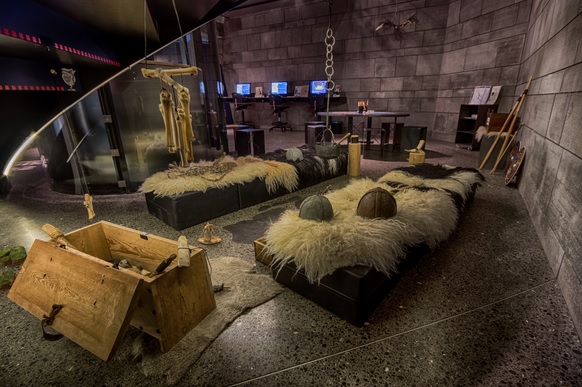
Featured image:  The Settlement Exhibition Family Area (Reykjavík City Museum)

___________________________

Aðalstræti, (“Main Street”) is Reykjavík’s oldest street. Ingólfur Arnarson’s farm is generally considered to have been situated at the southern end of the street, which must then have been the path he walked along down to the sea. While Reykjavík was small, Aðalstræti was the main street, lined with the homes of influential people, the meeting house and the town’s main well, Ingólfsbrunnur (“Ingólfur’s well”), outside the present No.9. One of the oldest buildings in Reykjavík built around 1762, is No. 10, which is from the time of Skúli Magnússon.


The Riigikogu discussed use of privatisation proceeds

NordenBladet —

At its today’s sitting, the Riigikogu discussed whether the owners of restituted historical buildings that have not been classified as architectural monuments but are located in heritage conservation areas should also have the possibility to apply for support allocated from the ownership reform reserve fund. However, it was decided to reject the relevant Bill.

The Bill on Amendments to the Use of Privatisation Proceeds Act (538 SE), initiated by Faction Isamaa, would have provided for the use of privatisation proceeds for the maintenance, repair, conservation, restauration and renovation of buildings that were restituted in the course of the ownership reform and are located in heritage conservation areas.

It was pointed out in the explanatory memorandum of the Bill that there are 12 heritage conservation areas in Estonia, and with the exception of Rebala Heritage Reserve, they are all located in historic town centres, in Tallinn, Valga, Tartu, Pärnu, Võru, Paide, Viljandi, Kuressaare, Rakvere, Haapsalu and Lihula. The explanatory memorandum noted that the same restrictions and environmental requirements apply to the renovation of buildings located in heritage conservation areas as for architectural monuments, but the owners of restituted buildings located in heritage conservation areas cannot apply for the support allocated from the ownership reform reserve fund if the building is not classified as a cultural monument.

The explanatory memorandum also underlined the need to find flexible additional possibilities for the preservation of valuable architectural heritage. The Bill did not provide for increasing the allocations from the ownership reform reserve fund for restoration of restituted architectural monuments.

During the debate, Marika Tuus-Laul from the Centre Party Faction, Jaak Juske from the Social Democratic Party Faction and Tarmo Kruusimäe from Faction Isamaa took the floor.

The lead committee moved to reject the Bill at the first reading. 36 members of the Riigikogu voted in favour of the motion and 17 voted against. Thus, the motion was supported and the Bill was dropped from the legislative proceedings of the Riigikogu.

Verbatim record of the sitting (in Estonian)

Video recording of the sitting will be available on Riigikogu YouTube channel.
(Please note that the recording will be uploaded with a delay.)

Source: Parliament of Estonia

The Foreign Affairs Committee is on a visit to Sweden

NordenBladet —

On Wednesday and Thursday, the delegation of the Foreign Affairs Committee of the Riigikogu (Parliament of Estonia) is on a visit to Sweden, where they will discuss the security situation and strengthening of security cooperation.

Chairman of the Foreign Affairs Committee Marko Mihkelson said that the main topics of the discussions held in the Parliament as well as in the Ministry of Defence and the Ministry of Foreign Affairs of Sweden would be the security situation and the decisions relating to it. “The meetings will focus on the question of what more we can do to support Ukraine in its war with Russia. Helping Ukraine to victory is our most important task at the moment,” he added.

The cooperation between Estonia and Sweden and strengthening it also at the parliamentary level will be discussed at the meetings. Another important issue that will be spoken about is the debate on NATO membership, which involves all parliamentary parties in Sweden. “The debate held in recent weeks over Sweden’s possible accession to NATO shows how Russia’s aggression in Ukraine has had a significant impact on security in the Baltic Sea region,” Mihkelson said.

On Wednesday, the delegation of the Foreign Affairs Committee will meet with Speaker of the Riksdag (Parliament) of Sweden Andreas Norlén and members of the Committee on Foreign Affairs and the Committee on Defence of the Riksdag and the delegation to NATO Parliamentary Assembly. On Thursday, the members of the Foreign Affairs Committee will have meetings with Minister of Defence of Sweden Peter Hultqvist and Director of the Swedish Institute of International Affairs Jakob Hallgren. The delegation will also have a meeting at the Ministry of Foreign Affairs. The members of the Riigikogu will speak about the activities of the Estonians living in Sweden with Chair of the Association of Estonians in Sweden Sirle Sööt.

The visit will last until Thursday evening. The delegation includes Chairman of the Foreign Affairs Committee Marko Mihkelson, Deputy Chairman Raivo Tamm and members of the Committee Henn Põlluaas, Valdo Randpere, Mailis Reps and Indrek Saar.

Source: Parliament of Estonia

Denmark: Purchases of cooking oil limited in Danish supermarkets

NordenBladet — A number of supermarket chains in Denmark are putting limits on the purchasing of cooking oil due to the current conflict in Ukraine. Danish chains The Salling Group, Rema 1000, and now Coop have limited the amount of cooking oil consumers can purchase.

In Scandinavia, cooking oil is normally widely available in supermarkets, grocery stores, and online shops. There are also specialty stores that sell high-quality oils and gourmet ingredients, which are popular among food enthusiasts and professional chefs. Many Scandinavians purchase cooking oil from local farmers’ markets and health food stores, where they can find organic and also locally produced oils.

According to the latest data from 2017, the average consumption of cooking oil in Sweden was around 11 liters per person per year, in Denmark it was around 10 liters per person per year, and in Norway it was around 9 liters per person per year.

Speaking to TV2 News, the Head of Communications at Coop, Lars Aarup, explains, “We don’t currently have a lack of oil, but we are doing it out of due diligence.”

It is reported that customers are now limited to buying three bottles of oil per day from Coop’s chains, including, Irma, Fact, Kvickly, and Superbrugsen. Last week, Rema 1000 and The Sailing, which runs Føtex, Netto, and Bilka, also announced rationing.

“Ukraine is one of the world’s biggest producers of sunflower oil. The war has led to fewer deliveries and, while we are not sold out, the demand for it and other oil products is increasing worldwide,” states Jonas Schrøder, Rema 1000’s Head of Communications.