NordenBladet — It has been proposed that provisions be added to the Seafarers’ Employment Contracts Act on breathalysing of employees. The legislative draft to be sent out for statements proposes that the employer be given the right to oblige an employee working on their vessel to take a breathalyser test to determine whether the employee is under the influence of alcohol during working hours. The Ministry of Economic Affairs and Employment will organise a round of statements on the amendment from 8 July to 3 September 2021.
Breathalyser tests for employees on vessels are justified from the perspective of maritime safety and the special conditions of maritime travel. Current legislation does not contain provisions that would allow the employer to oblige an employee on a vessel to take a breathalyser test. Under to the proposed amendments, the employer could oblige employees to take breathalyser tests, if the conditions laid down in the Act are met. Random breathalyser tests or regularly conducted tests, for example, at the beginning of each shift would be possible for people whose tasks where working while intoxicated could endanger safety on vessels. An employer could also oblige an individual employee to take a breathalyser test if the employer has reason to suspect that the employee is intoxicated at work.In addition, it has been proposed that provisions that require the use of appropriate procedures for organising breathalyser tests and provisions on the processing of personal data in connection with breathalyser tests be added to the Act.
The new legislation would also apply to pontoon ferries that are not covered by the Seafarers’ Employment Contracts Act
NordenBladet — The discussions at the meeting of President of the Riigikogu (Parliament of Estonia) Jüri Ratas and Prime Minister of Spain Pedro Sánchez focused on strengthening of bilateral relations, defence cooperation in NATO and developing of digital services.
Ratas noted that although already 100 years had passed from the establishing of diplomatic relations between Estonia and Spain, the contacts between them had noticeably improved during recent years.
The President of the Riigikogu thanked Spain for their contribution to the NATO’s Baltic Air Policing and to the Enhanced Forward Presence of NATO allies in the Baltic States. He expressed hope that Spain would deploy its fighters again in Ämari Air Base in the coming years.
Ratas assured the Prime Minister of Spain that the Baltic States were not only consumers of the security provided by NATO, but also contributed to it themselves. “As the members of NATO, we share the principle of 360-degree approach to security and make our contribution in the missions in the South,” Ratas said.
At the meeting, Ratas made a proposal that Estonia and Spain could more actively promote cooperation in developing the digital society. “Both Estonia and Spain have already made great efforts to develop a wide variety of public digital services, but partnerships in this domain would definitely accelerate the growth,” Ratas emphasised. In his opinion, the recent COVID-19 crisis has demonstrated people’s need for digital skills and secure and reliable communication lines.
Member of the Foreign Affairs Committee of the Riigikogu Indrek Saar and Chair of the Estonia-Spain Parliamentary Friendship Group Vilja Toomast also participated in the meeting with the Prime Minister of Spain Pedro Sánchez. They underlined the importance of parliamentary cooperation in different fields.
NordenBladet — Minister for Foreign Affairs Pekka Haavisto will meet Turkey’s Minister of Foreign Affairs Mevlüt Çavuşoğlu on 8 July in Helsinki.
The Foreign Ministers will discuss such topical matters as the bilateral relations between Finland and Turkey, the relations between Turkey and the EU, and international issues of current interest.
NordenBladet — The OSCE Parliamentary Assembly held its Annual Session in Vienna, Austria. At the Session, three questions of urgency were adopted, the activities of the Assembly during the last year were discussed and a new President was elected.
Head of the Estonian delegation Mati Raidma said that the adoption of the resolution condemning the destabilizing military build-up by the Russian Federation near Ukraine and in temporarily occupied Crimea was a strong statement in support of Ukraine.
“It is good that support was expressed to regional security and Ukraine’s efforts to restore its territorial integrity in internationally recognised borders,” Raidma said. According to him, the sharpness of discussions is illustrated by the fact that the delegation of the Russian Federation did not accept the decision and left the OSCE PA session in Vienna after it was voted on.
Two more urgency items were adopted at the Session. On the initiative of the Netherlands, the resolution “The general approach to dissent in Belarus” was adopted, and the USA initiated the item “Addressing the Rise in Hate, Intolerance, Violence and Discrimination across the OSCE Region”.
At the Annual Session, Deputy Head of the Swedish delegation Margareta Cederfelt was elected the President of the Assembly.
The Annual Session, which was held in hybrid format from 30 June to 6 July, was also attended by members of the Estonian delegation Heljo Pikhof and Marko Šorin.
The aim of the OSCE Parliamentary Assembly is to increase the involvement of its member countries in resolving European political and security issues and to strengthen the responsibility and influence of members of parliament.
NordenBladet — President of the Riigikogu (Parliament of Estonia) Jüri Ratas and Head of the Federal Department of Foreign Affairs of the Swiss Confederation Ignazio Cassis spoke of bilateral cooperation in digital developing of public services and establishing of direct contacts in the promotion of business and tourism at their meeting today.
“Estonia and Switzerland are close partners, and it is important to maintain our close connections and to deepen cooperation in economy, culture and tourism,” the President of the Riigikogu said.
Ratas and Cassis admitted that the direct flights between Tallinn and Zürich, which had started last month, contributed to the development of bilateral relations. “It provides our people with a much-needed connection, and it will help both tourism and business to expand their market,” Ratas said. He added that good flight connection was also important to the more than a thousand Estonians living and working in Switzerland who have close relations with Estonia.
At the meeting, Ratas recalled his recent visit to Switzerland that had been a part of the celebrations of 100 years of diplomatic relations between the two countries. Both at the visit and at today’s meeting, the digital development of public services was discussed. “Estonia and Switzerland seem to have many promising beginnings of cooperation in this field,” Ratas said, and expressed hope that both the governments and the start-up companies in both countries could find ways to do more together.
The Swiss Minister of Foreign Affairs saw the possibility to learn from Estonia’s experience in digitalisation of data and providing the e-services of digital governance as the next step in bilateral relations. The President of the Riigikogu gave his guest an overview of the public digital services of Estonia and also spoke of e-elections and the attitudes of people in using the digital services. The need to ensure cyber security and protection of personal data were discussed as well. Chairman of the Estonia-Switzerland Parliamentary Friendship Group Anti Poolamets, who participated in the meeting, highlighted the cyber security aspects of digitalisation and the need to add it to school curriculum as an elective course.
Experiences of overcoming the COVID-19 pandemic were shared, and the organisation of the daily work of the governments and parliaments and the holding of referendums was compared in the two countries.
Chairman of the Foreign Affairs Committee of the Riigikogu Marko Mihkelson and Deputy Chairman of the Foreign Affairs Committee Mihhail Lotman also met with the Minister of Foreign Affairs of Switzerland. They discussed the international policy work of parliaments, Estonia’s participation in international peacekeeping missions and Estonia’s Presidency in the UN Security Council. Mihkelson underlined the importance of rules-based world order in international relations and close cooperation of democratic countries in defending it.
NordenBladet — On Tuesday 6 July, the Government decided on temporary amendments to the Communicable Diseases Act and on a model for preventing the spread of COVID-19 infections to Finland from abroad.From 12 July 2021 onwards, people arriving in Finland will be required to show proof of full vaccination against COVID-19 or of recovery from COVID-19 within the past six months. Those who show proof of one of the above will not be subject to other health security obligations upon arrival in Finland.
All other persons must show proof of a negative COVID-19 test taken before entering the country or proof of a first dose of COVID-19 vaccine received at least 14 days prior to entry. In both of these cases, the person must also take a COVID-19 test 3–5 days after arriving in the country. They must avoid contact with others and remain at home or in their place of accommodation until they receive confirmation of a negative test result.
If a person arriving in Finland does not have proof of full vaccination against COVID-19, recovery from COVID-19, a negative test result or a first dose of COVID-19 vaccine received at least 14 days prior to arrival in Finland, they must be tested for COVID-19 as soon as they arrive in Finland and a second time 3–5 days after arrival.The obligation to show proof or be tested for COVID-19 does not apply to people arriving in Finland from countries or regions where the incidence of COVID-19 or the prevalence of virus variants does not pose a particular risk. The Government has issued a decree on these countries and regions. They are: Australia, Hong Kong, Iceland, Israel, China, Macao, Malta, Poland, San Marino, Singapore, New Zealand and the Vatican, and the Norwegian municipalities of Storfjord, Kåfjord, Nordreisa, Kautokeino, Karasjok, Tana, Nesseby and Sør-Varanger. The decree will be amended if the epidemiological situation so requires.The obligation to be tested for COVID-19 applies to people over 16 years of age. The amended Act also specifies exceptional categories of people who are not subject to this obligation. Under the Communicable Diseases Act, neglecting to undergo the required COVID-19 tests is a punishable offence.The government decree and the temporary amendments to the Communicable Diseases Act will enter into force on 12 July 2021. The temporary amendments to the Communicable Diseases Act will remain in force until 15 October 2021. The decree will remain in force until 31 August 2021.
NordenBladet — This year, the High-level Political Forum on Sustainable Development (HLPF) will focus on sustainable recovery from the COVID-19 pandemic.
The Finnish delegation will be headed by Minister for Development Cooperation and Foreign Trade Ville Skinnari.Finland’s Permanent Representative to the United Nations, Ambassador Jukka Salovaara together with the Permanent Representative of Iraq to the UN are co-facilitating the consultation process leading to the adoption of the Ministerial Declaration. In the important role of co-facilitator, Finland aims to ensure that the Ministerial Declaration will bring added value to the implementation of the 2030 Agenda for Sustainable Development.
NordenBladet — The Marine Environment Protection Committee (MEPC) of the International Maritime Organisation (IMO) has adopted a global short-term emission reduction measure. The decision is insufficient for any clear reduction of emissions in line with IMO targets. Finland joined the other EU Member States in opposing the inadequate level of carbon intensity cuts at a session that concluded on 17 June.
The IMO took a decision in 2018 to reduce the carbon intensity of international shipping by at least 40 per cent between 2008 and 2030. States at the MEPC session expressed differing views as to whether the remaining need for reductions between 2019 and 2030 was 10 or 21.5 per cent.
The meeting decided on a measure that seeks to reduce the carbon intensity of navigation by 11 per cent between 2019 and 2026. The decision for 2027-2030 was left to a later date. Finland and the EU Member States supported the more scientifically justified option of a reduction of no less than 21.5 per cent between 2019 and 2030, as this would certainly have achieved the 2030 emission reduction target. The 27 EU Member States were nevertheless outvoted when the final decision was taken at the session of 174 IMO members.
“It is unfortunate that no more ambitious outcome was reached at the IMO, and that there is no certainty of achieving the targets. The decision fails to send a sufficiently strong signal to shipowners and the entire maritime cluster about the urgency of climate action. Pressure is now growing on the European Union’s own large-scale emission reduction measures,” explains Finnish Minister of Transport and Communications Timo Harakka.
Carbon intensity refers to the ratio of carbon dioxide emissions to transport work done. While regulation now seeks to reduce carbon intensity, absolute emissions from navigation may fall, remain at the present level, or even grow. The final outcome will depend on the volume of maritime transportation. The annual carbon intensity reduction levels for 2027-2030 will be defined by 2026.
Exemptions for winter navigation to be decided later
Finland proposed an exemption from regulation at the MEPC session that would apply to ice-strengthened vessels moving in ice conditions. This would avoid imposing additional burdens on Finnish competitiveness due to winter navigation. The requested regulatory exemption was not adopted.
Negotiations concerning ice-strengthened vessels and other exemptions proposed at the session will continue when new guidelines are agreed to clarify the regulation. Finland will continue advocating and reaching out to other IMO Members to ensure that the special features of winter navigation are taken into account.
“We shall continue working to persuade other IMO Member States that the special features of winter navigation should be considered when regulating emissions. This is our primary aim in order to ensure a level playing field for shipping and Finnish competitiveness in international shipping,” Minister Harakka stresses.
Remote meetings have led to slower policymaking
The proposal of a few States and the shipping industry to collect marginal fuel levies for an international R&D fund was not agreed at this session. Consideration of this proposal will continue at the next MEPC session in November.Discussion of market-based and other medium and long-term measures will likewise continue at working group level and at the November session. Finland supports the development and early introduction of a global market-based emission reduction measure, such as carbon content pricing of maritime fuels.
Discussions on such topics as scrubbers, fuel life cycle emissions and reducing plastic waste from ships at sea were also postponed to the autumn session. The working day at IMO remote sessions is shorter than usual to maximise daytime attendance around the world.
Finnish attendees at the session held between 10 and 17 June 2021 represented the Ministry of Transport and Communications, the Ministry of the Environment, the Finnish Transport and Communications Agency (Traficom), the Finnish Meteorological Institute, and the Provincial Government of Åland.
What are the next steps?
Discussion of market-based and other medium and long-term emission reduction measures will begin at the next MEPC session in November. The emission reduction impact of these measures will probably be much greater than that of the short-term measure now decided. Finland has proposed new working arrangements to speed up discussion of GHG matters at the IMO. These proposals were warmly received, with a decision expected at the next MEPC session in November 2021.
The European Commission has declared an intention to broaden EU emissions trading to include shipping. A proposal is due on 14 July 2021 as part of the Commission’s Fit for 55 climate package. Details have yet to emerge on how European maritime emissions trading would be implemented.
NordenBladet —Earlier this week, a report has shown that Denmark’s central bank was compromised during the global SolarWinds hacking operation in 2020, leaving a “backdoor” to its network open for seven months.
It was noted that the hackers were unusually sophisticated and created modified code in SolarWinds’ network management software, which was downloaded globally by 18,000 customers. The hackers then used this information to create a backdoor for potential continued access, including the Danish central bank.
U.S. security firm Fire Eye discovered that a backdoor stood open at the Danish central bank for seven months.
The bank told Reuters that there were “no signs that the attack had any real consequences”, despite managing transactions worth billions of dollars each day.
Additionally, The SolarWinds attack hit Denmark’s financial infrastructure. However, those systems that were compromised were contained and analyzed once the hit was made apparent.
NordenBladet — Government of Finland and UNICEF partnership helps address the education and water, sanitation and hygiene needs of children and families amidst the pandemic.
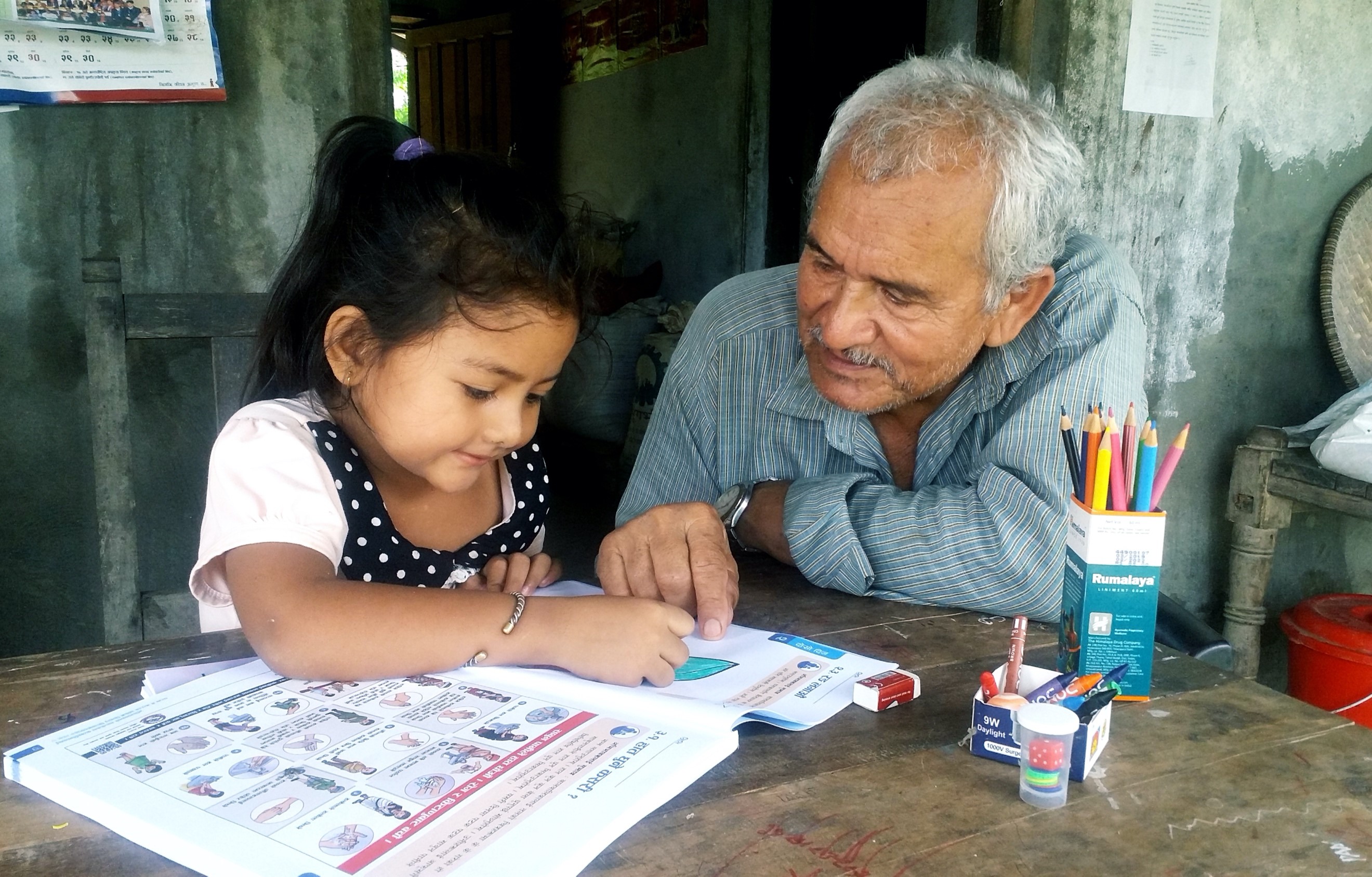
Subechha Puri, 5, does lessons with her grandfather Nandalal in their home in Kapilvastu District in western Nepal. To help the little girl continue learning at home, the family has been making use of a self-learning pack.
Photo: Unicef Nepal
Subechha Puri misses her friends. The five-year-old from Shivaraj Municipality in Kapilvastu District in western Nepal hasn’t seen her friends for over a year now.“They live too far away,” she said. “And I can’t go out.
”Nepal first announced COVID-19 lockdown in late March last year, and schools were subsequently closed. The country had slowly started easing the restrictions when it began experiencing the second wave beginning April this year. By end of May, 561,302 confirmed cases have been reported with 7,386 deaths, a 67 per cent increase in total cases and 122 per cent in total deaths in just one month. The positivity rate frequently exceeded 40 per cent, with parts of western Nepal even recording 80-90 per cent, the highest rates in the world.
The situation prompted another lockdown this year, thwarting any hopes of Subechha going back to school and her friends.The pandemic has not only impacted Subechha’s time with her friends but also seriously affected her education. School closures in the wake of the current wave of COVID-19 have brought substantial loss in learning amongst almost 8.1 million children and puts each individual child and Nepal’s future economic and social development at risk.
“Subechha absolutely loved school, and never complained about having to go,” said Mr Nandalal Puri, Subechha’s grandfather.
However, Mr Puri worried that if she stayed idle for too long, it would be difficult for Subechha to get back on track once lessons did resume. In order to prevent this, Mr Puri began to spend a few hours a day home-schooling Subechha.
These efforts were further bolstered when Subechha received a self-learning pack from the municipality, provided with support from UNICEF and Government of Finland, as part of the partnership to improve the education and water, sanitation and hygiene (WASH) situation of children and families in Nepal.
Nearly 36,000 young children have benefited from such self-learning packs, which ensure learning continuity of the most disadvantaged children without access to alternative means of education via radio, television and internet during school closure. Each of these packs comprise age-appropriate activity books, stationery like crayons and colour pencils, as well as materials for play such as skipping ropes and board games and children are expected to use them with guidance from parents and caregivers.
Many municipalities have also taken the lead to work with parents and teachers to enable them to help children use these learning materials.
Padam Baduwal, mayor of Badimalika Municipality of remote Bajura District in far western Nepal – where 609 students from 17 schools were provided these learning packs – said feedback from his community has been great and parents are more than enthusiastic to contribute towards children’s learning. In fact, the municipality decided to create similar packs with their own resources to distribute to other students in the district.
“It’s great to see families actively involved in children’s learning,” Mr Baduwal said. “It’s a practice that I hope continues even after schools reopen, because it’s so important for children’s overall development to have that kind of support system at home.”
An evolving partnership for changing needs The UNICEF and Finland partnership for children in Nepal goes back several years with the two entities working together with Government of Nepal to ensure children and communities have access to safe drinking water, sanitation and hygiene. Over the years, the partnership has evolved with the changing needs of children and communities. Currently, the focus is on responding to emerging issues and challenges brought on by the second wave of the COVID-19 pandemic.
The second wave in Nepal also coincided with the large influx of migrant workers returning to the country from India after the second wave struck there. An additional challenge of managing the points of entries (land borders with India) arose, given insufficient personal protective equipment, testing capacity and basic provisions for border workers and migrants waiting for admission and processing including drinking water, toilets and hand washing facilities. As children and families pass through the various stages of transit, such as getting their temperature checked upon arrival – and if showing any symptoms, getting an antigen test at the health desk – they also have access to a range of WASH services, thanks to the support of UNICEF and Government of Finland.This includes being provided free bottles of drinking water as well as leaflets and flyers with information on preventive measures against COVID-19.
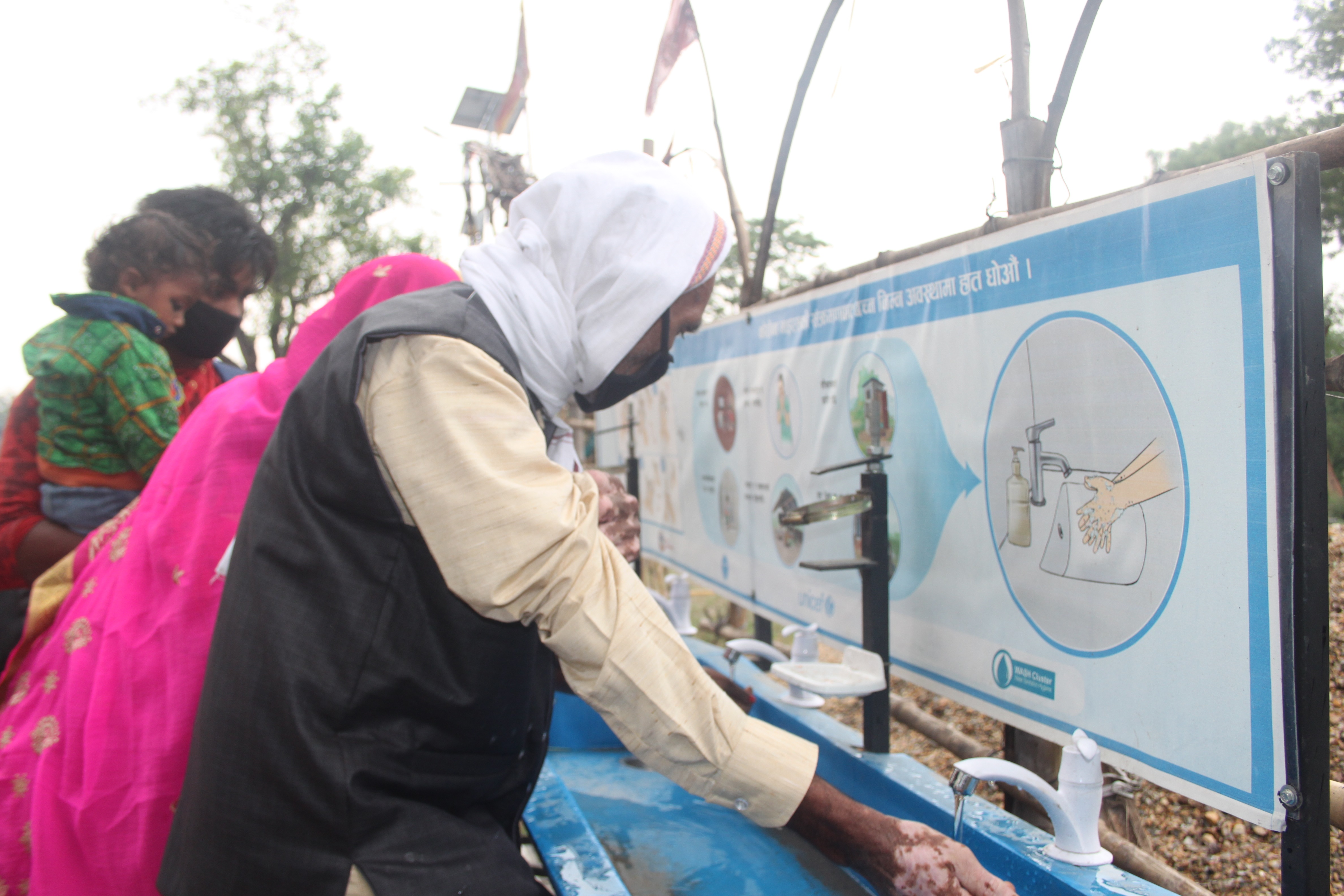
The point of entry have also been equipped with temporary toilets, separate ones for male and female. And to promote better hand hygiene among returnees, handwashing stations have been installed. Similar support has been extended to various other points of entry all along the border with India, several of which continuously saw between 1,000 – 1,200 people coming through on a daily basis during the peak.
Ramesh Sah, a local volunteer working with UNICEF, says that things are much more manageable now than they had been when the second wave first hit back in April.“People are calmer now, and many are more aware about preventive measures,” Mr Sah said. “But because there is likely to be a rise in numbers of people passing through when restrictions are loosened in India or Nepal in the coming days – we need to be prepared to receive them and help them – particularly more vulnerable people, especially people with disability.”
Returnee migrants and families use hand washing station at Birgunj point of entry in Parsa District in southern Nepal.
Photo: Unicef Nepal
The article was written by the UNICEF Nepal and translated by the MFA