NordenBladet — Forget running around in high heels – comfortable sneakers are the way to go, and instructions regarding hair, makeup, tattoos and nail polish are gone. The new uniforms are gender-neutral, and the PLAY crew can pick whatever works for them from a varied selection of outfits encompassing the companies core values, simplicity, playfulness, competitiveness, equality and on-time performance.
The PLAY uniforms were designed by local designer couple Gunni Hilmars and Kolla, who were keen to tackle a modern take on the airline’s uniforms.
“We were honoured and pleased to get to work with PLAY on this clothing line for their uniforms. We really wanted to throw out all those old ideas about airline uniforms and bring in more comfort. We tried to scrap the constrictive rules often associated with these uniforms and include relaxed fits, stretchy fabrics, and, of course, shoes meant for working on your feet! The result is a mix of activewear and a fresh uniform.”
“It was really satisfying to see how well Gunni and Kolla got our brief and our ideas for this line. We had certain ideas about the clothing and how it should represent and work with our brand and the results are just amazing,” says Jónína Guðmundsdóttir, CPO of PLAY.
NordenBladet —The Icelandic Border Control has launched a pilot program to accept the Excelsior Pass at the countries border from passengers flying from New York.
The Excelsior Pass is currently available to New Yorkers, a free voluntary digital health pass developed by New York State in partnership with IBM to verify their COVID-19 vaccination or test results.
The pilot program results will likely allow Iceland to accept and verify health credentials from the IBM Digital Health Pass platform.
The Excelsior Pass is a simple, secure way to share COVID-19 test results or vaccination status received from a trusted issuer. Each pass will have a secure QR code scanned at the Iceland border control system operated by Iceland based Origo to confirm someone’s COVID-19 health status. Individuals can either print out their pass or store it in the secure digital wallet application on their mobile phone.
According to current rules and until July 1st, all passengers must undergo a PCR-test for COVID-19 upon arrival in Iceland. In addition, all travellers to Iceland are required to fill out a pre-registration form before arrival.
Read more about the status of COVID in Iceland and how to get into the country here. The website is maintained & managed by the Directorate of Health and The Department of Civil Protection and Emergency Management.
NordenBladet — Rowda Olad and Abdirizaq Ahmed share a common goal: they want to promote peace in Somalia. As part of a communication project in Somalia and funded by the Ministry for Foreign Affairs, active youth, like Olad and Ahmed, tell about their work to promote peace development.
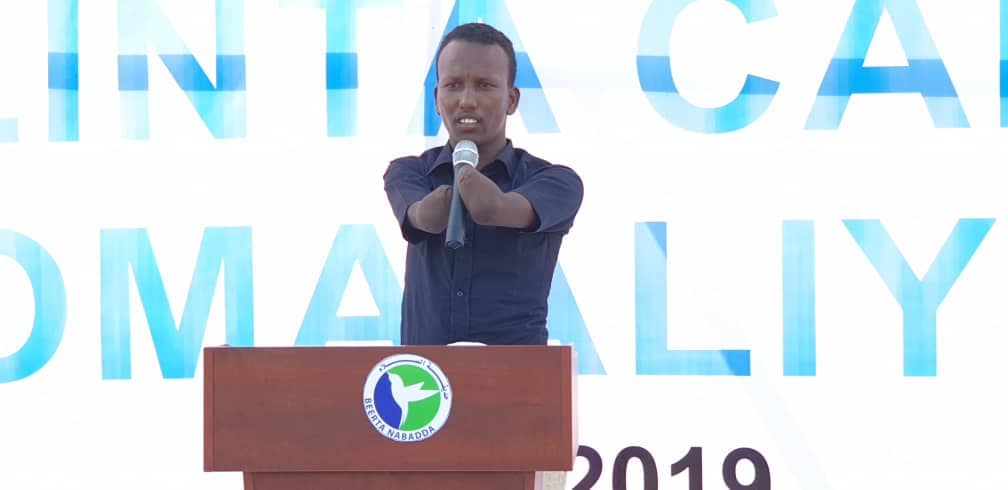
Abdirizaq Ahmed visits different events to talk about his experiences, forgiveness and breaking the chain of revenge. Picture: Wali HashiRowda Olad works as a psychologist in Baidoa prison in southern Somalia. Her clients include former terrorist group members, who, according to Olad, have been brainwashed to support terrorist ideologies. In her work, Olad seeks to convince her clients to believe in free thinking.
“Mental health is not properly addressed in Somalia. If a person has mental health issues, they are simply labelled as crazy,” Olad describes.
She thinks that more of society’s resources should be channelled to mental health services, especially when the continuing conflicts are causing chronic stress to people and weakening their abilities to lead normal lives.Olad is also politically active and wants to promote the peace development in Somalia. For example, she is taking a stand on the country’s clan system. The clans are choosing the candidates for elections, which continues to aggravate the political atmosphere.
Furthermore, usually only men are involved in politics and women have to fight to get their voices heard.
“If women were involved in the decision making process, this country would be considerably more peaceful,” Olad says.From herdboy to university studentWhen Abdirizaq Ahmed was 8 years old, his aunt tied his hands with a rope as a punishment for letting sheep escape. Consequently, Ahmed’s hands had to be amputated.As a young adult, Ahmed decided to forgive his aunt. This gave rise to a story that Ahmed wants to share with the youth of his country.
“I told my aunt that people make mistakes. I don’t want to be a victim. If I can forgive my aunt, I believe that everyone in this country can do the same,” says Ahmed, who is currently studying at university.Ahmed also reckons that the long traditions of revenge and hate are driven by the clans.
“The clan system in Somalia is holding up the peace development. I want to work to ensure that the youth do not inherit this culture.”
Olad and Ahmed’s stories and the short documentaries based on them are a part of the Ministry for Foreign Affairs’ communication project that advances peace in Somalia. Journalist Wali Hashi is leading the project until 2023. The project naturally links to a broader Cafis Campaign (forgiveness), initiated by Wali Hashi in 2017.
The short documentaries can be viewed at the Ministry for Foreign Affairs’ Youtube channel with English subtitles. See Rowda Olad’s story: From Trauma Healing Towards Peace and Abdirizaq Ahmed’s story: Disabled Hero of Peace. The documentaries are broadcasted in Somalian television channels during July.
The short documentaries can be viewed at the Ministry for Foreign Affairs’ Youtube channel with English subtitles.
NordenBladet — An evaluation of the transition in co-operation between Finland and Vietnam has found that the transition phase led to a reduction in development co-operation and growth in other types of co-operation. Trade and investment have become important instruments for achieving development goals and building a mutually beneficial partnership.
Photo: Florian Wehde
Vietnam is an interesting country from an economic and trading perspective. “Finns can learn something from the entrepreneurial mindset of Vietnamese people. Everything does not always have to be perfect, but you can make progress when you have the passion and make an effort,” explained former Commercial Counsellor to Vietnam Eija Tynkkynen in a webinar address. Tynkkynen now serves as China Country Manager at Business Finland.
A recently published external evaluation commissioned by the Finnish Ministry for Foreign Affairs examined the successes and drawbacks of the transition phase, and studied how development co-operation contributed to the transition towards a diversified partnership.
The evaluation findings were presented in a webinar on 16 June 2021. Under-Secretary of State Elina Kalkku pointed out in her opening remarks that Vietnam has been one of Finland’s most important development co-operation partners for almost four decades. Following tremendous economic development in Vietnam, a process of change in development co-operation began in 2008.
“The transition process ultimately took 12 years, and sought mutually beneficial co-operation and involvement of the private sector,” Kalkku continued.
“Relations between the countries are still vibrant after a decade of transition”
NordenBladet — The Ministry for Foreign Affairs is making preparations to expand and strengthen the network of Finnish missions abroad. A new embassy will be opened in Doha, Qatar. The embassy would commence operations at some point later this year. The Qatari Ministry of Foreign Affairs has informed that the country will establish an embassy in Finland, too.
The operation of the Foreign Service relies on a comprehensive network of diplomatic and consular missions abroad. There must be a sufficient number of missions, and they must be established in locations that are of key importance for us. It is important that Finland’s interests are promoted also in areas where it has not been present before, and the network of missions should reflect the changes that are taking place in the world around us. In the first years of the 21st century, some missions had to be closed to make savings, but efforts are now made to increase Finland’s global presence. In September 2020, Finland reopened its embassy in Manila, the Philippines. Opening a new embassy is a long and complex process. The Ministry for Foreign Affairs aims to allocate resources to countries and regions whose political and economic weight for Finland is growing. We have looked extensively into various opportunities. Both foreign policy needs and Finland’s commercial interests were taken into account in the consideration. An embassy in Doha will enable further development of political and economic relations between Finland and Qatar and provide greater possibilities for dialogue on various themes. These themes could include trade, commerce, investment, research, innovation, the environment, regional security and democracy.
“An embassy in Doha will deepen the political relations between the countries and open up better opportunities for Finland to follow developments in the region,” says Minister for Foreign Affairs Pekka Haavisto.
Qatar offers significant potential for both short- and long-term commercial cooperation. “A new embassy in Qatar will open up considerable opportunities for Finnish companies around Qatar and the Gulf region with their high purchasing power,” says Minister for Development Cooperation and Foreign Trade Ville Skinnari.
NordenBladet — Under the aegis of the Things Foundation, the markings used in Denmark for the collection of waste by type have been analysed to determine which of the 91 pictograms could be adopted in Estonia. The result is a website (www.liigitikogumine.ee) promoting the pictograms, which a number of local governments have already stated they are willing to adopt.
Things Foundation CEO Kristiina Kerge says that since the interest of local governments in the pictograms and their willingness to start using them are so important to the project, it is gratifying that such a high degree of interest has been shown. Among the first making preparations to adopt the markings are the City of Narva, Saaremaa and Saku municipalities, Tallinn Waste Recovery Centre and the NPO Eesti Elektroonikaromu (collecting waste generated from electrical and electronic equipment).
“Together we’ll be able to offer everyone in Estonia easy-to-understand instructions for sorting waste by type,” Kerge said. “The pictograms will make passing on information about collecting waste clearer and will enable information materials and mediums to be planned across countries.”
Deputy-Mayor of Narva Sergei Gorlatš says that the City of Narva decided to join the project because the sorting of waste is such a topical issue. “We feel that by being part of the project we’ll be able to turn more attention to the sorting of waste, make people more aware of it and introduce new types of waste in sorting,” he explained. “We want Narva to be one of the first cities to get involved in this amazing initiative.”
Katrin Koppel, the senior specialist on waste management with Saaremaa Municipal Government, hopes that using the pictogram system for waste collection throughout the country will get the entire population sorting their waste by type. “As a local government, we’ve been trying for years to explain such sorting to our residents, and we still are,” she said. “Now we can use these eye-catching pictograms to do just that, marking all sorts of different types of waste.”
The NPO Eesti Elektroonikaromu likewise decided to join the project so that people would find it as simple as possible in the future to sort their waste by type. “If you have specific symbols for different types of waste that are the same everywhere, that makes it much clearer to people where they’re supposed to take things or put things,” said Aivo Kangus, the chairman of the management board of the organisation. “For us personally, that will mean we’re able to collect old batteries and electronic equipment much more efficiently as well.”
The first stage of the plan being undertaken by Saku municipality is to immediately adopt the pictograms and to order A3-sized magnetic signs featuring them for its household waste recycling centre and for the waste collection point in Kiisa. “A unified system of images will be of help to people whatever waste handling site they happen to be at,” said Saku municipality environmental specialist Kerli Laur. “The pictograms should make it easier for people to bring in their waste, since they won’t have to take a look in the containers any more to double-check what they can throw into them, but simply look for the image they’re familiar with set against a fixed background colour.”
Tallinn Waste Recovery Centre is convinced the pictograms will make it easier for residents of the city to understand the sorting of waste by type. “The first place we’re planning to start using the pictograms is at our waste recovery stations, where clarity of information is very important,” explained the centre’s environmental specialist Sofia Pereskoka.
A cooperation project is being undertaken by the Things Foundation, the Nordic Council of Ministers’ (NCM) Office in Estonia and the Ministry of the Environment to determine whether and how the Danish Pictogram System can be adopted in Estonia. Similar projects are underway in Finland, Sweden, Latvia and Lithuania, while in Denmark itself, as many as 93 of the country’s 98 local governments are using the pictograms. A joint debate between Nordic and Baltic partners on adding the new pictograms to packaging is to be held for the planning of the next stages in the project.
The joint project was launched in Estonia, Latvia and Lithuania in February 2021 and will last for one year. The lead partner in Estonia is the Things Foundation, the team behind which is also known for creating the Kuhuviia.ee site. The project is mainly being financed by the NCM.
The project is designed to share experience and best practice in and promote the use of the Danish pictograms in the Nordic and Baltic region, as well as to encourage the adoption of good waste-handling practices. The project is directly linked to the objective set out in the NCM’s ‘Vision 2030’ action plan of promoting the circular economy and bioeconomy, sustainable and competitive production, sustainable food systems and resource-efficient and non-toxic production cycles.
For further information please contact: Kristiina Kerge kristiina.kerge@kuhuviia.ee
NordenBladet — At the end of May, a total of 301,200 unemployed jobseekers were registered at the Employment and Economic Development Offices and municipalities participating in the local government pilots on employment. This is 131,500 less than a year earlier, but 74,600 more than in May two years ago. The number of unemployed jobseekers was down by 17,200 from the previous month. Of the unemployed jobseekers, 154,500 were customers of municipalities participating in the local government pilots on employment. The number of unemployed jobseekers also includes those fully laid off. These figures are from the Employment Bulletin of the Ministry of Economic Affairs and Employment.
At the end of May, the number of people laid off was 56,100 in the whole country, which was 125,300 fewer than at the same time the year before. The number of people fully laid off totalled 41,200, representing a decrease of 117,000 from May the year before. The number of people fully laid off decreased by 12,700 from April.The number of long-term unemployed — that is those who had been unemployed without interruption for at least a year — amounted to 110,900, up 41,100 on the previous year. The number of unemployed jobseekers over 50 years of age was 110,500, or 31,200 less than at the same time a year earlier.Unemployed jobseekers under 25 years of age numbered 36,100, representing a decrease of 20,200 from May last year. Of the unemployment periods of youths, 56.4 per cent ended before reaching three months between January and May.
This is 5.9 percentage points less than a year before.Increase in new vacancies
The number of new vacancies reported during May totalled 80,800, or 35,700 more than in May the previous year. In all, the number of unfilled vacancies in May amounted to 154,800, which is 57,900 more than a year ago.At the end of May, the number of persons covered by services included in the activation rate amounted to 113,400, up 7,800 on the previous year. These services include pay subsidies, labour market training, work trials and self-motivated studies.
Statistics Finland: Unemployment rate 9.6%According to the Labour Force Survey issued by Statistics Finland, in May the number of people in employment was 138,000 more than on the previous year. The employment rate was 73.0%, which was 4.0 percentage points higher than in May the year before. According to the Survey, the unemployment total was 275,000, which is 25,000 less than a year ago. The unemployment rate was 9.6%, or 1.3 percentage points lower than the previous year.
Key differences between Employment Service Statistics and the Labour Force Survey
This information is based on the Ministry of Economic Affairs and Employment’s Employment Service Statistics and the Labour Force Survey of Statistics Finland. The Employment Service Statistics of the Ministry are compiled on the basis of the information in the Employment and Economic Development Offices’ customer register, while the Labour Force Survey of Statistics Finland is based on sampling. In the Ministry’s Employment Service Statistics, people that are not in an employment relationship or employed in business are listed as unemployed. Persons fully laid-off but not full-time students are also categorised as unemployed in the Employment Service Statistics. The Labour Force Survey of Statistics Finland has a stricter definition of being unemployed: a person is unemployed if he or she has actively sought employment during the preceding four weeks and is available for work over the coming two weeks. The figures of the Labour Force Survey of Statistics Finland are internationally comparable and thus they are the official Finnish unemployment statistics.
NordenBladet — The EU COVID-19 vaccination certificate is now available in the My Kanta Pages. The two other EU Digital COVID Certificates, the test certificate and the certificate of recovery, will be available in the My Kanta Pages as of 14 July.
The EU COVID-19 vaccination certificate contains information about the COVID-19 vaccine the certificate holder has received, such as vaccine name, the date of administering the most recent dose and the number of doses received. You can get a certificate after you have received your first dose of vaccine.
How to get your vaccination certificate:
Log on to your My Kanta Pages at kanta.fi using the identification token of your choice, such as online banking codes or mobile certificate.Select ‘Koronatodistus’ (COVID-19 certificate) from the left-hand menu. There is also a link to the certificate section on the front page of the My Kanta Pages.
To get your certificate click on the link “Avaa rokotustodistus (pdf)” (Open vaccination certificate). If you have a vaccination certificate, it will open in a new tab in pdf format.
Save the pdf file on your mobile phone or take a screenshot. In this way you will have the certificate ready when you need it. You can show the EU COVID-19 vaccination certificate on your mobile device or print it out. The information in the EU COVID-19 vaccination certificate is in three languages, Finnish, Swedish and English. The certificate is free of charge.
Finland’s national COVID-19 vaccination certificate can no longer be used, and you should get the EU COVID-19 vaccination certificate even if you already have the Finnish certificate saved on your mobile phone or printed on paper. In the My Kanta Pages, the EU COVID-19 vaccination certificate will automatically replace the national certificate.
Most vaccination information available in My Kanta Pages
More than 92 per cent of those who have received at least one COVID-19 vaccine dose can now get their certificate in the My Kanta Pages. Your certificate will be available in the My Kanta Pages as soon as the necessary information has been transferred into the Kanta services from the organisation that administered your vaccine. There is still some regional variation in the transfer process, and some vaccinated persons may have to wait awhile for their certificate. Check the progress of the transfer process in your own area (in Finnish) If your certificate is missing in the My Kanta Pages or there are errors in the certificate’s information, please contact the organisation that administered your vaccine. The organisation that entered the vaccination information will correct any errors.
Paper certificates available from healthcare providersIn future, the vaccination certificate will be available in the My Kanta Pages within five days of vaccination.
Everyone who has been vaccinated can get a certificate from the My Kanta Pages, and they can print it out. You can also authorise someone else to use the My Kanta Pages on your behalf.At the moment, you can ask your healthcare provider to give you a similar certificate of your COVID-19 vaccination if you do not use the My Kanta Pages and you do not authorise anyone to use it on your behalf.
In July, a national printing and registering service will be introduced for the temporary use by healthcare professionals. This will ensure that the EU Digital COVID Certificate will be available even to those who do not use the My Kanta Pages.
Certificate validator app to be introduced on 1 July
The content and accuracy of the EU Digital COVID Certificate can be checked using a digital validator app. The validator app will be introduced in Finland on 1 July. It is a mobile application designed for the use by authorities responsible for health security at border crossing points. They will use it to scan the QR code of the vaccination certificates. Travellers can show the certificate on paper or on their mobile phones. The QR code will show the name and vaccinations of the traveller.The validator app will be primarily used by health authorities and authorities providing executive assistance, such as the Border Guard.
The COVID-19 certificates can be checked at three points:In the country of origin in respect of people travelling to Finland. In this case, transport operators may, if they so wish, require a certificate from travellers. However, the Communicable Diseases Act does not obligate transport operators to check certificates.
Upon arrival in Finland. In this case, health authorities and executive assistance authorities are responsible for checking certificates under the Communicable Diseases Act.
Upon departure from Finland. In this case, transport operators may have to check certificates if the countries of destination so require.
NordenBladet — With the declaration signed in Portugal on 21 June 2021, the EU Member States make the commitment to take determined action to eradicate homelessness by 2030.
“We know that homelessness is directly linked to social, health and mental health problems. This is why Finland has for a long time worked hard to combat homelessness,” Minister of the Environment and Climate Change Krista Mikkonen said when opening the roundtable discussions after the declaration had been signed.“We are very happy that the other European countries have also raised the level of ambition in their work against homelessness.
”The pledges made in the declaration include better cooperation among the EU and its Member States in eradicating homelessness and adequate funding for the work. A cooperation body will be set up as a platform for sharing means and solutions to support the Member States.
Finland is the only EU country where homelessness has been decreasing for several consecutive years.
“This has required – and still requires – persistent efforts, and we will be happy to share the knowledge we have accumulated during this process. For example, Finland’s Housing First principle has proven an effective tool, and we encourage the other EU countries to adopt it as well,” Mikkonen says.
In line with the Government Programme, the Finnish Ministry of the Environment, together with other ministries, key urban districts, service providers and NGOs, has launched a cooperation programme to halve homelessness by 2023.
The work to prevent homelessness in advance is also supported by making housing advice a statutory obligation. Minister of the Environment and Climate Change Krista Mikkonen attended the conference in Lisbon, Portugal via video conferencing.
NordenBladet — In connection with its General Assembly, the UN will organise a High-level Dialogue on Energy in New York in September. This is the first time since 1981 that the UN addresses energy issue at this level. The aim of the meeting is to strengthen Member States’ efforts to achieve the Paris Climate Agreement and the Sustainable Development Goal (SDG) on energy in preparation for the COP26 Climate Change Conference in Glasgow in November.
Ahead of the meeting in September, five thematic ministerial forums will be held virtually on 21–25 June. Finland will participate in the forum on Innovation, Technology and Data on 22 June and act as one of its co-chairs. Minister of Economic Affairs Mika Lintilä will represent Finland as a Global Champion and facilitate the discussion. “The UN’s High-level Dialogue on Energy is a unique forum that will speed up global climate action. In Finland, as elsewhere, economic recovery is an opportunity to invest in clean energy solutions and the digital economy. I hope that Finland can show an example and inspire the rest of the world to make ambitious and rapid changes to the energy sector, where reductions in emissions can be significant,” Lintilä says.
The four other forums focus on energy access (21 June), energy transition (23 June), enabling SDGs through inclusive and just energy transitions (24 June) and finance and investment (25 June). A report will be published on each forum including recommendations for concrete actions and for discussion at the High-level Dialogue in September. The UN will use these thematic reports to create a roadmap to achieve a transition in the energy sector. The forums are inclusive and will bring together ministers and leading experts from the Member States as well as representatives of various stakeholders, such as businesses, civil society and young people, to share experiences and discuss the possibilities of speeding up the implementation of SDG7 and the Paris Climate Change Agreement in the 2020s. The SDG7 aims to ensure access to affordable, reliable, sustainable and modern energy for all.
Finland to co-chair the forum on Innovation, Technology and Data The Innovation, Technology and Data forum focuses on promoting energy access and transition and on meeting the SDGs through development work and applications related to knowledge, technology, innovation and research. “I am pleased that innovation, technology and data are one of the dialogue’s five themes. We need local and clean innovative technology solutions to achieve equal access to clean energy around the world. These solutions can also support other SDGs and create new business opportunities,” Lintilä says.
“Long-term decision-making and a stable regulatory environment are also important for all stakeholders in promoting the transition towards climate neutrality. In the energy sector, political decisions can have an impact for decades to come and investment decisions are made in the long term,” Lintilä adds.
The ministerial segment of the forum will be held on Tuesday, 22 June at 16.00–18.00. In addition to Finland, Mauritius and Morocco will give opening speeches at the ministerial segment. Besides Lintilä and officials from the Ministry of Economic Affairs and Employment and the Ministry for Foreign Affairs, several Finnish speakers will participate in the forum. Business Finland, Ministry of Economic Affairs and Employment, Outokumpu, VTT Technical Research Centre of Finland and Fingrid will address the participants of the forum. Karoliina Loikkanen, Head of Sustainability at Nokia, will take part in the leadership conversation on energy transition. The forum was prepared by technical expert working groups, including VTT, which participated in the preparation of the forum for Innovation, Technology and Data. The forum’s side events (to be held at 15–16 and 17.30–02.00 Finnish time) will focus on sharing innovations, best practices and experiences. The dialogue also includes the possibility for those involved to launch new voluntary energy commitments (Energy Compacts).
In May 2021, Finland was selected as one of the Global Champions to help prepare the UN’s High-level Dialogue on Energy in September. The main task of the Champions is to lead the international influencing work on their own theme and to work together with other Champions to host the ministerial meeting. “Finland applied to host the Innovation, Technology and Data forum at the request of the European Commission, because we have a reputation as a leader in clean energy transition and the low-carbon economy. We also have a lot to offer in the discussion on the promotion of innovation and clean technology,” Minister Lintilä said in the spring.