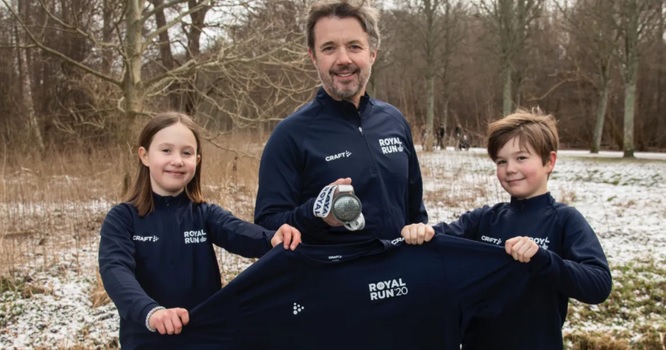
NordenBladet – The Crown Prince of Denmark had some help announcing the Royal Run’s new date, sharing the spotlight with his two youngest children, Prince Vincent and Princess Josephine.
In a video shared on the Danish Royal House website and social media channels, Crown Prince Frederik and his twin children announced the new fall date for the Royal Run, which has been twice-postponed due to the coronavirus.
In the video, Crown Prince Frederik stated: “For almost a year, it has been a condition for all of us that we have had to change our plans and our dreams. This has also been the case for the Royal Run. Twice before we have postponed the race and we must once again admit that it is not is realistic to complete the planned exercise party with over 70,000 people in the month of May, so it has been decided to postpone the Royal Run once again until Sunday 12 September, where we hope that it is again possible to gather so many people for a running party.”
Interspersed with Crown Prince Frederik’s announcement is footage of the trio running around the snow-covered grounds of Fredensborg Palace, where they’re currently residing, training for this fall’s race.
In a statement posted on the Danish Royal House’s website, Crown Prince Frederick elaborated, “In the meantime, we need to make sure to keep body and soul going. Especially right now in the dark period – it provides profit and well-being.
“So I hope that many of you will spend the time until September 12th to maintain the joy of exercise and running that Royal Run has already brought with it.”
NordenBladet – Crown Princess Mary shared a poignant message about hope for an end to the coronavirus pandemic on the Danish Royal House’s Instagram account.
The post, shared Wednesday afternoon, comes after the Crown Princess attended a meeting of the World Health Organisation’s Regional Office for Europe earlier in the day, where the ambassadors for the region received an update on the coronavirus and a status on vaccinations.
“What I took with me from the briefing was that even though there is still a long way to go, there is reason to be optimistic – infection rates are falling in several places, we are constantly building up new important knowledge… and then we now have the vaccine. I can feel in myself and others around me that it feels heavy right now and that our patience is being put to the test. Therefore, it is good to hear that we can be hopeful – it can give us energy to persevere and hold on.”
The Crown Princess has long been associated with the World Health Organisation and has championed vaccinations, both in Denmark and in developing countries as a way to promote health.
Crown Princess Mary posted a photo of the sunrise from her home to accompany the status, writing that, “Instead of a screenshot, I have chosen one of my own images, which should signal that with each passing day, we are moving towards brighter times.”
Crown Princess Mary’s son, Prince Christian, was revealed to have tested positive for the coronavirus last fall. In line with health protocols, he was quarantined away from family members for a period of two weeks, and no other member of the Crown Prince Family were revealed to have tested positive.
On 1 January this year, Queen Margrethe became the first European royal to publicly reveal that they’d received the coronavirus vaccine and reported that she would receive the second shot three weeks later.
NordenBladet – The annual Reykjavík Winter Lights Festival opens today and continues through Sunday, Morgunblaðið reports. Its format this year is different from that of previous years, due to COVID-19-related restrictions. Therefore, there will be no formal opening ceremony or crowded events, such as normally have been held at the city’s museums and swimming pools.
Instead, the winter lights walking path will be the main attraction. The map, which you can view HERE, shows the location of 23 light installations that will be projected onto buildings and windows, as well as alleys, between the hours of 6 pm and 9 pm every night of the festival. The path extends from Hallgrímskirkja church to Austurvöllur square and all the way to Reykjavík City Hall.
The City of Reykjavík and ON Power, in cooperation with Iceland Design and Architecture, recently held a light installation competition, and the top two works will be featured at the festival.
The winner of the competition was a work by Katerina Blahutova and Þorsteinn Eyfjörð Þórarinsson, which will be on display in the park by the Einar Jónsson Art Museum. The other work is by Litten Nystrøm and Haraldur Karlsson. It will be projected onto Hallgrímskirkja church.
The Reykjavík Art Walk mobile app is designed to help you locate and enjoy outdoor sculptures in Reykjavík. It not only provides you with a map of the city, showing the location of the sculptures, but provides you, too, with excellent information about the works of art and the artists. For more information, see HERE.
For more information about the Winter Lights Festival, see HERE.
NordenBladet — The Digivision 2030, a joint project between Finnish universities and universities of applied sciences, will bring greater opportunities for all learners to learn flexibly. The aim is to restructure Finland’s higher education over the next decade by means of digitalisation and to make Finland a model country for flexible learning.
The project will develop common procedures for higher education institutions and create a shared digital service platform. Other key areas for development include digital pedagogy and guidance based on the learner’s path and shared data.
The digital vision for higher education institutions is a core element of the implementation of the Government Programme. Under Prime Minister Marin’s Government Programme, the higher education system will be developed as a platform for learners and continuous learning. The aim is that degree students, lifelong learners and those without a student place can study flexibly, selecting courses from all Finnish higher education institutions irrespective of organisational boundaries and geographical location. By implementing the vision, Finnish higher education institutions can create a robust international competitive edge for Finland as a society and for every citizen as a learner.
“Digivision 2030 brings higher education closer to every Finn and strengthens cooperation between higher education institutions. New ways of organising educational programmes and studying also attract international interest and promote the admission of international students to Finland,” said Minister of Science and Culture Annika Saarikko.
The need for continuous learning and for raising the level of knowledge, competence and skills transcends the different levels of education and age groups, and ties together the needs of education and working life. In line with the common policies reforming continuous learning adopted in December 2020, Finland will gradually introduce a digital service package for continuous learning. It consists of interconnected intelligent online services, such as services for assessing competence and identifying prior learning, guidance services, search services for education, services for the provision of education, and related data resources. The implementation of the digitalisation vision for higher education institutions is a core component in developing the digital service ecosystem.
The Ministry of Education and Culture has awarded a special grant of EUR 20 million to the Digivision 2030 project. In addition to the special grant, the Ministry of Education and Culture is allocating EUR 17.8 million from the strategic funding for higher education institutions to the project for the years 2021-2024. “Digivision 2030, jointly prepared by the entire higher education field, is one of the most important digitalisation projects in the education sector in Finland. We are very grateful to the Ministry of Education and Culture for its strong support in helping prepare the project and for the substantial financial resources that have now been granted for implementing the project,” said Ilkka Niemelä from Aalto University, President of the Digivision 2030 steering group.
All Finnish higher education institutions are committed to the Digivision 2030 project. “It is good that universities and universities of applied sciences have found a common outlook for the digital development of higher education institutions throughout Finland. Funding for this work will keep Finnish higher education at the forefront of the global competition for competence, skills and learning in the coming years, too,” said Matti Sarén, President/CEO at Kajaani University of Applied Sciences and member of the Digivision Steering Group.
NordenBladet — Municipal elections will be held in Finland in April 2021. Election day is Sunday 18 April. The advance voting period is in Finland from 7 to 13 April 2021 and abroad from 7 to 10 April 2021.The Ministry of Justice is preparing for the municipal elections in cooperation with the Finnish Institute for Health and Welfare (THL). The Ministry of Justice and the Finnish Institute for Health and Welfare monitor the development of the COVID-19 epidemic closely and, if necessary, they will issue more specific instructions on the election arrangements. Instructions on safe voting will be sent to all eligible voters together with the notice of right to vote (polling card) in March.
The objective is to make sure that everyone can vote safely regardless of the epidemiological situation. Finland is well prepared to organise municipal elections during the COVID-19 epidemic.
Advance polling stations have been selected
Municipalities had to enter information about their general advance polling stations in the election information system by 29 January. The advance polling stations abroad were determined by government decree issued on 21 January. There are 932 advance polling stations in Finland and 108 abroad. The total number of election day polling stations is 1,854.
If you are abroad, you can vote by post or at an advance polling station Eligible voters residing or staying abroad during the elections may vote by post from abroad. It is also possible to vote in advance at a Finnish diplomatic or consular mission. Eligible voters wishing to vote by post must order the postal voting documents themselves. The service for ordering the documents has been open since 18 January. Postal voting will be possible once the candidate numbers have been confirmed, in other words from 18 March onwards. More detailed instructions on postal voting are available at www.electionsfinland.fi. The voter must send the ballot and the other necessary documents so that they arrive at the right central municipal election board by 19.00 on Friday 16 April 2021. Candidate applications must be submitted by 9 March In municipal elections, a person can stand as a candidate in their municipality of residence. Another prerequisite is that the candidate must be entitled to vote in the municipal elections in some municipality.
Political parties and constituency associations can nominate candidates. Political parties nominate their candidates in accordance with their rules and regulations. A constituency association may be established by ten, five or three persons entitled to vote in the same municipality, depending on the population of the municipality. Candidate applications must be submitted to the central municipal election board by 16.00 on Tuesday 9 March. Notifications of electoral alliances and joint lists must be submitted together with the candidate applications.
The central municipal election boards will confirm the nomination of candidates in each municipality on 18 March 2021 and draw up a list of candidates and their candidate numbers. Information about all candidates in the entire country will be published in the evening of 18 March at www.electionsfinland.fi.
NordenBladet — The Ministry of Education and Culture and the Finnish Institute for Health and Welfare have drawn up guidelines on principles for organising, restricting and suspending group leisure activities for those under 18 years of age at the different tiers of the epidemic specified in a Government Resolution. The guidelines are part of the measures outlined by the Government to minimise the negative effects of COVID-19 on children and young people. The Ministry of Education and Culture and the Finnish Institute for Health and Welfare recommend that the guidelines be followed in indoor group leisure activities already at tier 1, and when moving to tier 2, also in outdoor group leisure activities.
On 26 January, the Government issued a Government Resolution for supplementing the action plan implementing the hybrid strategy for combating the COVID-19 epidemic. The supplement to the action plan describes three tiers to prevent the outbreak from escalating and, in particular, to curb the spread of COVID-19 variants. In tier 1 in areas that are in the community transmission phase, it is recommended that adult group leisure activities and participation in them be temporarily suspended altogether. Special consideration should be given to group leisure activities for children and young people under 18 years of age.
In tier 2, may be recommended that children’s and young people’s indoor group activities that are considered to cause high risk of infection be temporarily suspended and, where possible, be carried out remotely. Leisure activities would be suspended if they fail to comply with the established principles of safe leisure activities.
The purpose of the guidelines is to highlight practices and situations that have an impact on the leisure activities of children and young people from the point of view of health security. Thus, at least the age of the children, how unchangeable the composition of the group is, the content of the activities, the size of the facilities, the size of the leisure group and whether the activities are carried out indoors or outdoors must be examined.
Age of children
The guiding principle of the Government Resolution is that group leisure activities for children under 12 years of age should not be restricted. Thus, the recommendations of these guidelines mainly apply to indoor group leisure activities for 12-18-year-olds. However, in tier 2, it is recommended that indoor leisure activities for those under 12 years of age comply with the criteria laid down in the guidelines for safe and secure leisure activities.
Criteria for safe and secure leisure activities
Constancy of the composition of leisure activity groups
To prevent and trace the spread of COVID-19, it is important that each leisure activity group always meets in the same composition. If the leisure activities of children and young people take place during the community transmission phase, it is crucial that it happens only in the group’s composition and only in the form of the group’s own sessions and training. This means that the group should not take part in competitions, concerts, performances, shows or other situations in which the group comes into contact with other leisure activity groups. Teachers, instructors and coaches should also always be the same ones. Parents may not spend time in their children’s leisure activities and dressing rooms.
Content of the activities
The content of the activities plays a major role in the risk of infection. The risk of infection is highest in team activities and contact sports as well as in other activities that involve close contact and strenuous use of voice. For reasons of impartiality, it is not justified to prohibit activities such as group leisure activities altogether, as individual training sessions can also take place in such a way that no close contacts are formed. If children’s and young people’s indoor leisure activities are allowed during the community transmission phase, all teachers, instructors and coaches, as well as parents and guardians, should pledge to comply with the principles laid down. National organisations should also pledge to instruct, guide and self-monitor their member organisations. The organisers of the leisure activities or instruction are always responsible for instructing and supervising the compliance of the guidelines by those taking part in the leisure activities, the personnel and all stakeholders.
Size of facilities and leisure activity groups
In indoor leisure activities, taking into account the size of the facilities, it would be advisable, where appropriate, to limit the number of participants to 10 people. In big gyms and other large spaces, it is possible for separate groups of 10 people to exercise without any contact between the groups. In large cultural and sports facilities that have several different spaces and rooms, the restrictions on the number of participants could be applied separately for each space and taking into account the size of each space.
Leisure activities outdoors and in restricted areas outdoor areasThe risk of infection is much lower outdoors than indoors. For this reason, even in the community transmission phase in tier 1 of the epidemic, there are no grounds for restricting group leisure activities outdoors or in restricted outdoor areas. However, when tier 2 is reached, group leisure activities in restricted areas outdoors should follow the recommended procedures.
Guidelines on the organisation, restriction and suspension of leisure activities for children and young people (including basic art education) in the different tiers of the epidemic referred to in the Government Resolution of 26 January 2021
NordenBladet — A comprehensive international evaluation of the activities of the Academy of Finland will commence. Using international expertise, the evaluation aims to produce an overall picture of the activities of the Academy of Finland and to propose ways to improve its impact, activities and structures.
The evaluation examines the activities of the Academy of Finland in a changing operating environment. The evaluation will produce proposals for development so that the Academy of Finland can optimally improve the quality and impact of research carried out in Finland as well as the functioning of the entire innovation system and its own activities. The evaluation will also provide more information and proposals for enhancing the guidance of the Academy of Finland. An evaluation consortium, led by Technopolis Group, which is an international organisation, and 4Front Oy of Finland as its partner, were selected to carry out the comprehensive evaluation on the basis of competitive tendering. The evaluation will be completed and published in February 2022.
NordenBladet — The Ministry for Foreign Affairs urges to avoid all travel to the Brazil, Ireland, Portugal, South Africa and the United Kingdom in accordance with the recommendation of the Finnish Institute for Health and Welfare. For all other countries, the Foreign Ministry’s general travel advice due to the COVID-19 pandemic is to avoid all but essential travel.
The coronavirus pandemic remains a major global risk to travel safety, and the situation may deteriorate abruptly and unpredictably in any country or region. Travellers may face limited access to healthcare, quarantine and restrictions on being outdoors. The Finnish Ministry for Foreign Affairs has only limited capabilities to assist travellers in distress during the pandemic.In its meeting on Wednesday 13 January, the Government discussed measures to prevent the spread of the new COVID-19 variants and the renewed acceleration of the epidemic. According to the Finnish Institute for Health and Welfare (THL), the new virus variants may be more infectious and spread faster than other variants.In accordance with the THL recommendation and to prevent the spread of the new virus variants to Finland, the Ministry of Foreign Affairs urges to avoid all travel to Brazil, Ireland, Portugal, South Africa and the United Kingdom
For all other countries, the Foreign Ministry’s general travel advice due to the COVID-19 pandemic is to avoid all but essential travel. This general advice does not apply to countries for which the Finnish Government has already lifted the entry restrictions. In addition, the Foreign Ministry recommends to avoid all travel to certain countries due to their general security situation or to leave such countries immediately. Country-specific travel advice
Avoid non-essential travel
Finnish citizens always have the right to leave Finland if they wish to do so, provided that there is no legal impediment to this, and Finnish citizens always have the right to return to Finland.If you are planning to travel, it is important to remember that all countries may impose restrictions on entry at their own borders, and it may not be possible to travel to all countries. Before travelling, always check the current entry regulations in your destination from the authorities of the country in question, e.g. from the nearest mission of the country. Countries may also impose entry restrictions on transit traffic.
An increasing number of countries are not permitting entry unless travellers show proof of a negative COVID-19 test or recovery from COVID-19 or proof of COVID-19 vaccination. Most countries require the certificates to be either in their own language or in English. Travellers must themselves find out what kinds of certificates they need to enter the country or countries they intend to visit.
If you travel, act responsibly
If you still decide to travel, you must act responsibly and follow the recommendations and regulations given by the authorities.Before you travel, check the validity and coverage of your travel insurance. Now it is particularly important to make sure that the insurance policy provides sufficient coverage even when the pandemic situation is taken into account. We recommend that you submit your travel plans and contact details at matkustusilmoitus.fi.Before you travel, please also read the frequently asked questions of the Ministry for Foreign Affairs.
NordenBladet — EU competitiveness ministers will discuss research and innovation policy at an informal videoconference on 3 February 2021. The meeting will focus on how the EU can promote attractive research careers in public and private sectors as part of the European Research Area (ERA). Finland will be represented by Minister of Economic Affairs Mika Lintilä.
“Research and innovation, researchers and their career opportunities are key factors for strengthening Europe’s competitiveness. Green transition and digitalisation need new investments, in particular. This calls for broad cooperation of experts from different sectors,” Lintilä says.
Promoting research careers is one of the ERA’s objectives. In September 2020, the European Commission published a Communication on renewing the ERA. The objective is to improve the European research and innovation environment, promote the EU’s transition towards climate neutrality and digital leadership, and support Europe’s recovery from the social and economic impact of the coronavirus epidemic.
In December 2020, the Council of the European Union adopted conclusions on the future of the ERA in response to the Commission Communication. The initiative to this informal meeting, where no decisions will be made, came from the Portuguese Presidency.
NordenBladet — The working group’s final report finds that the level of information security and data protection in sectors critical to society should be increased by means of additional resources and more effective cooperation. The working group would steer the level of information security by means of more detailed and targeted statutory requirements and obligations, the implementation of which would be actively monitored. The working group’s report was published on 1 February 2021.
A digital society consists of many interdependent actors whose activities require reliable and secure connections and information systems. This is particularly important to the functioning of society’s critical services. In these sectors, individual information security and data protection violations and disruptions can have a direct impact on citizens’ lives and the functioning of the national economy.
Although general and sector-specific information security and data protection-related obligations have been imposed on critical services, the work of the working group has demonstrated that there are major differences between sectors in their ability to respond to growing information security and data protection challenges.
The working group made proposals for policy guidelines to improve the information security and data protection of critical sectors, and specified the parties responsible for the measures and schedules for their implementation.
The policy proposals are based on seven requirements that should be implemented to ensure that the information security and data protection of operations are adequate:
1. Legislation must include adequate information security and data protection requirements and obligations for critical sectors and precise regulations for their implementation.
2. Actors must have sufficient knowledge and competence to comply with the obligations.
3. Authorities must have sufficient powers to monitor the implementation of information security and data protectionand to engage in cross-sector cooperation.
4. Authorities must have sufficient competence and courage to exercise their powers and guide their sector.
5. Authorities must have sufficient resources to exercise their powers.
6. Each actor bears responsibility for the information security and data protection of their operations.
7. Authorities have an up-to-date situational picture of the level and situation of information security and data protection throughout the operating environment.
The report also provides an assessment of needed additional resources, with a focus on developing the operational capacity of supervisory authorities.
Investments in cyber security
The newly completed report by the working group is part of a larger cyber security-related entity.
“To ensure cyber security, society must be alert, prepared, and ready to partake in cooperation. Leadership is required from the Government, legislation must be reformed and the efficiency of the activities of the authorities must be improved. Resources must also be increased, but this is an investment in security that will pay for itself manifold,” emphasises Timo Harakka, Minister of Transport and Communications.
In Finland, many of society’s key sectors are obliged to ensure the information security and cyber security of their services. These obligations are supplemented by voluntary cooperation and exchange of information between the authorities and service providers. In addition, the Finnish Transport and Communications Agency’s National Cyber Security Centre monitors and develops the reliability and security of communications networks and services and helps in investigating information security breaches.
The development programme that extends over numerous government terms currently under consultation will also improve the planning and development of cyber security. The aim of the Programme is to provide guidance for the cyber security development extending across sectoral borders and government terms.
In 2020-2023, public administration’s digital security services will also be developed in accordance with the Ministry of Finance’s Haukka implementation plan. The implementation plan will also support the preparation and implementation of the cyber security strategy development programme.
The significance of cyber security was also highlighted in the final report of the Working group for a digital leap forward. The working group on digital means for the after-care of the coronavirus crisis proposed that Finland should promote the development of the information and cyber security ecosystem and infrastructure with research and by supporting the Finnish cyber industry. This would also safeguard Finland’s international competitiveness.
Background of the working group on information security and data protection in critical sectors
In November, the Ministry of Transport and Communications appointed a working group to identify needs to amend the legislation on data security and protection in sectors of key importance for the functioning of society and to submit a proposal to the Government for policy guidelines on them.
The working group’s report concentrated on the key sectors of society, such as health care, energy supply, the financial sector, water supply, traffic and digital infrastructure and its services.
The aim is for information security to be part of society’s preparedness and for the services provided by society and citizens’ data to be better protected from unauthorised processingThe group will be chaired by Laura Vilkkonen, Director-General at the Ministry of Transport and Communications. The group consisted of representatives from ministries and the authorities.
The working group’s final report Improving information security and data protection in the critical sectors of society can be read on the Government website (in Finnish, abstract in English).