NordenBladet — At the sitting today, the Foreign Affairs Committee heard about the working plans made according to the Foreign Policy Development Plan and the 2021 budget, as well as about the principles of drafting strategic documents.
The Chairman of the Committee Enn Eesmaa welcomed the fact that the strategic documents accord increasing attention to strengthening foreign trade and developing business diplomacy. He was also pleased about the emphasis on the possible reporting on the Foreign Policy Development Plan, e.g. in the explanatory memorandum of the budget, the consolidated annual report of the state, or the annual discussion on foreign policy. “The Foreign Affairs Committee is strongly advocating for being included, and we are constantly providing input into the process of drafting national and regional strategies,” he added.
The Deputy Chairman of the Committee Marko Mihkelson raised the issue of a possible Asia Strategy for Estonia. He referred to the proposal made by the Foreign Affairs Committee to the Government on drafting Estonia’s Asia Strategy that would reflect Estonia’s long-term plans concerning the developments, opportunities, and challenges taking place in Asia.
“Drafting a comprehensive strategy on the whole Asian region is undoubtedly difficult. At the same time, it is important that Estonia as a country has a clear vision and a plan on how to map out its activities in Asia, and how to use its resources to establish embassies and shape their cooperation,” Mihkelson explained. He added that the visions of other ministries, think tanks, and universities should be taken into consideration next to those of the Ministry of Foreign Affairs.
Mihkelson also emphasised that any fragmentation of foreign policy must be avoided in drafting different strategies. “Every strategy must link up with the priorities of the Foreign Policy Development Plan, and the resources or the specific foreign policy actions needed to fulfil the set objectives must also be provided,” he said.
The Estonian Foreign Policy Development Plan 2030, which was approved by the Foreign Affairs Committee in May and the Government in August, sets out the foreign policy goals and the steps to implement these, supports the implementation of the fundamental strategic documents on foreign policy, plans foreign policy activities and instruments, and introduces a strategic planning control system which is the basis for implementing performance-based budgeting.
The Development Plan covers the foreign policy activities of the state until 2030. The implementation of the goals of the Development Plan falls into the remit of the Ministry of Foreign Affairs.
Ministry of Foreign Affairs Undersecretary on Political Affairs Rein Tammsaar and Undersecretary on Administrative Affairs Kadri Maasik were also invited to the sitting.
NordenBladet — At today’s sitting, the Riigikogu passed a number of Resolutions concerning the Defence Forces missions. Seven of them concern extending of missions.
The Resolution of the Riigikogu “Extension of the Time Limit for the Use of the Defence Forces in the Fulfilment of the International Commitments of the Estonian State in France’s Military Operation Barkhane in Mali” (263 OE), submitted by the Government, extends the time limit for the use of the Defence Forces in the fulfilment of the international commitments of the Estonian state in France’s military operation Barkhane in Mali until 31 December 2021 from 1 January and reduces the maximum number of the Defence Forces personnel to up to 75 servicemen.
60 members of the Riigikogu voted in favour of passing the Resolution, three voted against, and there was one abstention.
The Resolution of the Riigikogu “Extension of the Time Limit for the Use of the Defence Forces in the Fulfilment of the International Commitments of the Estonian State in the UN Peacekeeping Mission in Lebanon” (264 OE), submitted by the Government, extends the time limit for the use of up to three servicemen in the fulfilment of the international commitments of the Estonian state in the United Nations-led international peacekeeping mission UNIFIL (United Nations Interim Force in Lebanon) in Lebanon until 31 December 2021 from 1 January.
64 members of the Riigikogu voted in favour of passing the Resolution.
The Resolution of the Riigikogu “Extension of the Time Limit for the Use of the Defence Forces in the Fulfilment of the International Commitments of the Estonian State in the European Union Training Mission and the UN Peacekeeping Mission in Mali” (265 OE), submitted by the Government, extends the time limit for the use of up to ten servicemen in the European Union training mission EUTM Mali (European Union Training Mission in Mali) until 31 December 2021 from 1 January.
The Resolution also provides for the extension of the time limit for the use of the Defence Forces in the fulfilment of the international commitments of the Estonian state in Mali in the United Nations peacekeeping mission MINUSMA (United Nations Multidimensional Integrated Stabilization Mission in Mali) until 31 December from 1 January and a reduction in the maximum number of the Defence Forces personnel to up to five servicemen.
58 members of the Riigikogu voted in favour of passing the Resolution and one voted against.
The Resolution of the Riigikogu “Extension of the Time Limit for the Use of the Defence Forces in the Fulfilment of the International Commitments of the Estonian State in the Post-Conflict Peacekeeping Mission in Lebanon, Israel, Egypt and Syria” (266 OE), submitted by the Government, provides for the extension of the time limit for the use of up to six servicemen in the United Nations-led peacekeeping mission UNTSO (United Nations Truce Supervision Organization) in Lebanon, Israel, Egypt and Syria until 31 December 2021 from 1 January.
59 members of the Riigikogu voted in favour of passing the Resolution.
The Resolution of the Riigikogu “Extension of the Time Limit for the Use of the Defence Forces in the Fulfilment of the International Commitments of the Estonian State in the International Military Operation ‘Inherent Resolve’” (267 OE), submitted by the Government, extends the time limit for the use of the Defence Forces in the United States-led international military operation “Inherent Resolve” until 31 December 2021 from 1 January and reduces the maximum number of the Defence Forces personnel to up to ten servicemen.
62 members of the Riigikogu voted in favour of passing the Resolution.
The Resolution of the Riigikogu “Use of the Defence Forces in the Fulfilment of the International Commitments of the Estonian State in the Composition of the North Atlantic Treaty Organization Readiness Units” (268 OE), submitted by the Government, provides for the use of up to 70 servicemen as necessary from 1 January to 31 December 2021 in the composition of the North Atlantic Treaty Organization (NATO) Response Force NRF (NATO Response Force) and up to 200 servicemen in the composition of the NATO Readiness Initiative in a military operation organised for the purpose of maintaining or restoring peace and security on the basis of Chapter VI or VII of the Charter of the United Nations and in any other international military operation in accordance with generally recognised principles and provisions of international law.
61 members of the Riigikogu voted in favour of passing the Resolution.
The Resolution of the Riigikogu “Use of the Defence Forces in the Fulfilment of the International Commitments of the Estonian State in Another International Military Operation Led by the North Atlantic Treaty Organization or its Member State, the European Union or the UN upon the First Contribution thereto” (269 OE), submitted by the Government, provides for the use of up to 50 servicemen, as necessary, from 1 January to 31 December 2021 in a military operation organised for the purpose of maintaining or restoring peace and security on the basis of Chapter VI or VII of the Charter of the United Nations, led by the North Atlantic Treaty Organization or its Member State, the European Union or the United Nations, or in any other international military operation in accordance with generally recognised principles and provisions of international law, upon the first contribution thereto.
63 members of the Riigikogu voted in favour of passing the Resolution.
The Resolution of the Riigikogu “Extension of the Time Limit for the Use of the Defence Forces in the Fulfilment of the International Commitments of the Estonian State in the North Atlantic Treaty Organization Mission in Iraq” (270 OE), submitted by the Government, provides for the extension of the time limit for the use of the Defence Forces in the fulfilment of the international commitments of the Estonian state in the North Atlantic Treaty Organization mission in Iraq until 31 December 2021 from 1 January and an increase in the maximum number of the Defence Forces personnel in this mission to up to 40 servicemen.
62 members of the Riigikogu voted in favour of passing the Resolution.
The Resolution of the Riigikogu “Use of the Defence Forces in the Fulfilment of the International Commitments of the Estonian State in the Composition of the United Kingdom’s Joint Expeditionary Force” (271 OE), submitted by the Government, provides for the use of up to 24 servicemen as necessary from 1 January to 31 December 2021 in the composition of the United Kingdom’s Joint Expeditionary Force in a military operation organised for the purpose of maintaining or restoring peace and security on the basis of Chapter VI or VII of the Charter of the United Nations and in any other international military operation in accordance with generally recognised principles and provisions of international law.
59 members of the Riigikogu voted in favour of passing the Resolution.
The Resolution of the Riigikogu “Extension of the Time Limit for the Use of the Defence Forces in the Fulfilment of the International Commitments of the Estonian State in the Training and Advisory Mission in Afghanistan” (273 OE), submitted by the Government, allows contributing with up to 46 servicemen in the North Atlantic Treaty Organization (NATO)-led training and advisory mission RSM (Resolute Support Mission) in Afghanistan from 1 January to 31 December 2021.
63 members of the Riigikogu voted in favour of passing the Resolution.
The Draft Resolution of the Riigikogu “Use of the Defence Forces in the Fulfilment of the International Commitments of the Estonian State in the European Union Military Mission EUNAVFOR Med/Irini” (274 OE), submitted by the Government, provides for the use of up to six servicemen in the fulfilment of the international commitments of the Estonian state in the European Union military mission EUNAVFOR Med/Irini from 1 January to 31 December 2021.
On 22 June 2015, the European Union launched the military operation EUNAVFOR Med/Sophia in the central area of the Mediterranean to combat and prevent the activities of criminal networks engaged in human trafficking and the deaths of refugees on their journey across the Mediterranean to Europe.
61 members of the Riigikogu voted in favour of passing the Resolution.
Three Bills passed the second reading
The Bill on Amendments to the Local Government Financial Management Act and the Maritime Safety Act (282 SE), initiated by the Finance Committee, will enable local governments to increase their net debt burden. This is necessary in order that, in the emergency situation due to the spread of COVID-19 and in the period following it, local governments could take larger loans as necessary to stimulate economy and make necessary investments in the circumstances of a slowdown of revenue growth in 2020–2027.
In ordinary circumstances, the upper limit for net debt burden for each local government is a sixfold value of its operating result or 60 per cent of its operating revenue. At present, the upper limit for net debt burden has been set at the tenfold value of operating result or 80 per cent of operating revenue as an exceptional case for 2020 and 2021. The Bill will extend the exemption for the upper limit for net debt burden until the end of 2024. From then on, the upper limit will gradually decrease in 2025–2028.
The Bill also amends the Maritime Safety Act to implement a reduction of the waterway due. The amendment is due to the need to support the continuation of international maritime transport through Estonian ports and to motivate consignors to direct their trade flows through Estonian ports.
The Bill on Amendments to the Occupational Health and Safety Act and Other Acts (257 SE), initiated by the Government, will define at the level of Act the aim of the working environment database, the data collected and the retention periods of data on the basis of the Personal Data Protection Act. The Bill provides for a new requirement for the employer to draw up a risk assessment of the working environment in the working environment database or to forward the risk analysis to the Labour Inspectorate in a format which can be reproduced in writing.
The purpose of the Bill is to facilitate the creation of a safe working environment and to reduce the administrative burden for employers in complying with occupational health and safety requirements. For this, the working environment database will be developed, facilitating the communication of agencies and businesses with the state and offering new services. The Bill will increase the extent of the liability of the employer and the employee in the working environment.
The amendments included in the Bill are intended to reduce employees’ own liability when they fall ill and to reduce the risk of people going to work when ill and thereby the spread of the COVID-19 disease over four months starting from January. According to the Bill, upon compensation for the days of sick leave, employees’ own liability will decrease to one day instead of the current three days, and the employer will begin to pay for four days instead of five.
During the debate, Riina Sikkut (Social Democratic Party) and Tõnis Mölder (Centre Party) took the floor on behalf of their factions.
The main aim of drafting the Bill on Amendments to the Law of Obligations Act (lease relationships) (232 SE), initiated by the Government, is to stimulate and develop the leasing market and thereby to offer people the option of leasing a place of residence as a sensible alternative to owning a home. The lease regulation has remained unchanged for nearly 20 years.
As a result of the amendments, market participants will be enabled to regulate their mutual relations more flexibly, at the same time keeping in mind the need to rely on balanced solutions.
For example, the absolute ban on contractual penalty in the case of residential lease contracts will be eliminated and in the future it will be possible for parties to agree on the distribution of the repair obligation. According to the Bill, the lessor will have the right to cancel the contract due to delay in payment by the lessee in the event of smaller arrears or a shorter delay (two months instead of three).
At the same time, the Bill provides for restrictions on the amount of contractual penalty, several content and format requirements for agreements on the repair obligation, as well as more extensive notification obligations for lessor upon cancellation due to delay in payment.
Heljo Pikhof (Social Democratic Party) took the floor during the debate, and on behalf of her faction moved to suspend the proceedings on the Bill at the second reading. Nine members of the Riigikogu voted for the suspension and 47 voted against.
The Riigikogu did not support a draft Resolution
The Draft Resolution of the Riigikogu “Making a Proposal to the Government of the Republic to Organise the Provision of Preschool and School Education in Estonia Uniformly and in the Estonian Language” (243 OE), submitted by the Estonian Reform Party Faction, was intended to make a proposal to the Government to organise the provision of preschool and school education in Estonia uniformly and in the Estonian language. According to the explanatory memorandum to the draft Resolution, this would have ensured the cohesion of society and ensured young people’s competitiveness and equal access in education and the labour market regardless of their native language. At the same time, non-Estonian students would be ensured the possibility to study their native language and culture.
During the debate, Mart Helme (Estonian Conservative People’s Party), Oudekki Loone (Centre Party), Katri Raik (Social Democratic Party), Priit Sibul (Isamaa) and Kaja Kallas (Reform Party) took the floor.
At least 51 votes were needed for the Resolution to be passed. 36 members of the Riigikogu voted in favour of passing, 43 voted against and there was one abstention.
Minister of the Environment Rain Epler replied to the interpellation concerning the developments in forestry (No. 41) submitted by members of the Riigikogu. Among other things, the members of the Riigikogu wished to know the minister’s opinion on the new forestry development plan that had got stuck. When answering the questions, Epler said that today he had signed the decision on the dissolution of the steering council that had been formed to draw up the forestry development plan up to 2030 because the steering council had failed in its task, and he promised to ensure that a new development plan would be completed as soon as possible.
Jevgeni Ossinovski (Social Democratic Party) took the floor as one of interpellators during the debate.
At the beginning of the sitting, alternate member of the Riigikogu Imre Sooäär took his oath of office.
NordenBladet – Lately the kids do not want to eat in the morning anymore, sometimes they do but not always, because at school Ivanka Shoshana has three meals during the day and Estella Elisheva has two. However, I still enjoy starting the day in a relaxed manner and this will always entail coffee (my favourite is Löfbergs Lila french press) and either porridge (mostly oat or buckwheat with cottage cheese and boiled grated beets) or I make some sandwiches (my favourite is salmon toast with avocado, dill, and oregano, or seed bread with cheese). In case I have baked a cake or pie the night before (which happens now and then), then that will also be a welcomed good in line with the morning coffee.
I bake and cook quite a lot, rarely less than an hour daily, usually 1-2 hours a day will be invested preparing the meals. I enjoy preparing a lovely meal, it means a lot to me that the dishes are pleasant to look at (we use ceramic dishes made by myself, the sets made by Ivanka Shoshana, or also commercial pottery). When laying the table I like to place the pots, pans and cooking utensils on a hot-base right on the dinner table so that it would be convenient to eat, and the napkins are also always on the table. I enjoy purchasing and changing the napkins. It has also become a tradition to photograph the food, yet posting the pictures (blog or Instagram posts) remain infrequent, mostly I send them to my sisters via WhatsApp.
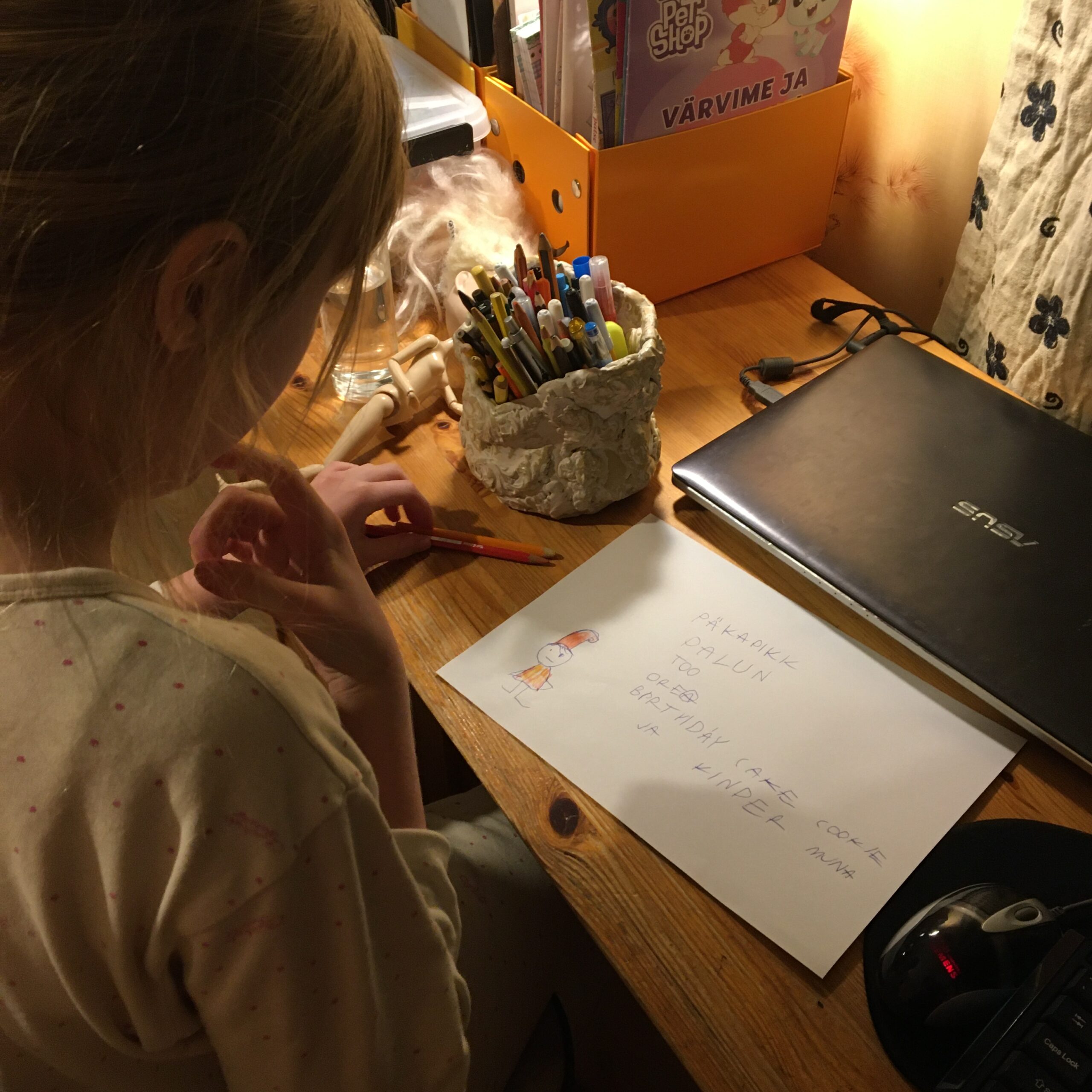
Since we celebrate both Hanukkah and Christmas then all of December is the time for presents and cooking. Last week Ivanka Shoshana wrote a letter to the Christmas elves, in order to explain what she desires to find from the windowsill slipper. Among her favourite sweets right now are Oreo cookies, Mesikäpp cookies and Marabou chocolate chip cookies, very much does she also love cheese popcorn. This year she discovered that the Christmas elf had hid the big sweets bag under my bed and wrote cleverly what she desired most. Several Kinder chocolate eggs are the most common sweets among what the elf brings to her. However, it is not allowed to eat the sweets right in the morning, thus the egg remains to be eaten after the school day when the proper meal has already been eaten.
Last week I rearranged Ivanka Shoshana’s room once more (I do so every month, I like to rearrange the furniture) and I also built a log pile near the house. This year I bought dried spruce from Puu24. Some people say that fir trees would ooze a lot of resin, but I adore the wonderful smell filling the room that stems from heating with the spruce. I have also found from Osta.ee with a discount the cool vintage sewing machine legs and to accompany these I bought from Laagri Bauhof the light veneered sawdust plate. The result is a nice self-made desk onto which I placed two handmade ceramic vases along with an own handmade tray (onto which I added tangerines, but by the time of taking pictures those had already vanished).
My cooking inclination (which I have caught from the great food guru Estella Elisheva) has now also begun to bloom in Ivanka Shoshana. Ivanka came to me with a recipe that she had found on the internet and the two of us baked some chocolate pie. The recipe, by the way, is extra simple, when you prepare it from layered dough. Melt the frozen puff pastry, roll it nice and thin with the rolling pin, then cut beautiful quadrangles, chop or grate plenty of chocolate, mix it with sour cream and lay on the dough. Wind the dough into a nice roll or just fold the dough, and put the pie into the stove at 180 degrees for 20 minutes.
NordenBladet — At today’s cabinet meeting, the members of the Government decided that the crisis measures directed at KredEx, the Estonian Rural Development Foundation, and tourism sector will continue to be implemented in the coming year.
According to Prime Minister Jüri Ratas, the state has to support the economy in difficult times. ‘We support an economy that has been hammered by the crisis. The least we can do is ensure that critical resources for rapid economic recovery are available after the crisis,’ he emphasised. ‘When making decisions in today’s difficult situation, we need to think about the future.’
KredEx
The cabinet meeting of the Government approved in principle the continuation of the implementation of the KredEx measures. The proposal of the Minister of Entrepreneurship and Information Technology Raul Siem to increase the limit of the credit loss indemnity in case of the emergency crisis measure of KredEx from 30% to 50% in guaranteeing new loans granted by banks was supported.
‘Although the economic downturn turned out to be less severe than expected since the beginning of the crisis, the new outbreak of the coronavirus will postpone the economic recovery, maintaining the need of entrepreneurs to survive the crisis with state support. Therefore, we proposed to the Government to transfer the funds remaining from the supplementary budget allocated to KredEx this year to the next year,’ Minister of Entrepreneurship and Information Technology Raul Siem said.
In order to direct companies to invest more, it is planned to abolish the budgetary allocations of direct loans at KredEx and to merge the budget for working capital and investment loans.
‘In spring, we divided the business loan budget of KredEx in a way that 500 million euros were allocated to working capital loans and 50 million euros to investment loans. As the crisis has deepened, we also need to increase flexibility, and we have decided to remove these limits in the direct loan budget of KredEx,’ Minister Siem said. ‘We will use the remaining funds with a common budget, which will help increase the volume of the investment loans at KredEx and contribute to the fact that new business ideas of companies can be realised as soon as possible and have a better starting point in growing competition,’ he added.
Estonian Rural Development Foundation
In 2021, loan guarantees, working capital and investment loans, and support measures for the financial lease of agricultural land will continue to be implemented.
‘Existing crisis measures of the Estonian Rural Development Foundation have been of great help to businesses, but the crisis is far from over and the business sector has a lot of uncertainty about the future. In order to cope with and better overcome the crisis, it is important to continue to implement the developed crisis measures after 31 December 2020,’ Minister of Rural Affairs Arvo Aller said.
There has been a great deal of interest in the COVID measures of the Estonian Rural Development Foundation, indicating that in times of crisis, it is important to support businesses both in solving liquidity problems and in realising investments that would help them adapt to the new situation and better prepare for any crises in the future. As of the beginning of December, loan decisions in the amount of 79 million euros, guarantee decisions in the amount of 29 million euros, and financial lease decisions in the amount of 2.6 million euros have been made.
Enterprise Estonia
The Government approved in principle the enabling of the use of 5 million euros allocated from the Government’s reserve on 10 November to support the tourism sector next year. This amount will be accompanied by the balance of the crisis support for lease payments of trade and service companies of Enterprise Estonia in the amount of 3 million euros.
According to Minister of Entrepreneurship and Information Technology Raul Siem, the aim of crisis measures for the tourism sector is to support the most severely affected accommodation companies, catering companies in the Old Town of Tallinn, travel companies, and handicraft shops all over Estonia. ‘With the new crisis measures, we help tourism entrepreneurs whose business activities are most dependent on foreign tourists and who are relevant service providers in the recovery of foreign tourism,’ Siem said.
Enterprise Estonia can provide support in 2021.
The content and conditions of support covering all crisis measures will be decided in the near future.
NordenBladet — The Government proposes that wellbeing services counties be established and healthcare, social welfare and rescue services be reformed. The proposed counties would be established as soon as possible after the passing and approval of the relevant bills. The bills would enter into force in stages, the first ones on 1 July 2021 and the last ones on 1 January 2023. However, Parliament needs to pass the legislative package before the reform can enter into force. The Government submitted its proposal to Parliament on 8 December.
The aim of the health, social and rescue services reform is to reduce inequalities in health and wellbeing; safeguard equal and quality health, social and rescue services for all; improve the availability and accessibility of services; ensure the availability of skilled labour; respond to the challenges of changes in society; curb the growth of costs; and improve safety.
Responsibility for health, social and rescue services duties to rest with 22 organisersIn line with the government proposal, 21 wellbeing services counties would be established in Finland and entrusted with the health, social and rescue services duties that are currently the responsibility of municipalities and joint municipal authorities. A total of four wellbeing services counties would be established in the Region of Uusimaa, based on the special arrangements made for Uusimaa. The City of Helsinki would also in the future be responsible for organising healthcare, social welfare and rescue services. In addition, the joint county authority for the Hospital District of Helsinki and Uusimaa would be responsible for organising specialised medical care in Uusimaa. The responsibility for organising healthcare would be divided between the wellbeing services counties in the Region, the City of Helsinki and the joint county authority for the Hospital District of Helsinki and Uusimaa as separately laid down by law and in an agreement on the organisation of services.In the wellbeing services counties, rescue services would be a separate sector working in parallel with the healthcare and social welfare sector. The level of rescue services in the wellbeing services counties should correspond to national, regional and local needs and the counties should prepare for accidents and threats in their areas.
The operation of hospital districts and special care districts would be transferred to the wellbeing services counties. Similarly, the responsibility for organising the services of school social workers and school psychologists would be transferred to the wellbeing services counties. Both the wellbeing services counties and the municipalities would be in charge of promoting health and wellbeing. The municipalities would assume responsibility for the organisation of environmental healthcare as a whole.A county council, elected by direct popular vote, would be the highest decision-making body of wellbeing services counties. The activities of each wellbeing services county would be managed in accordance with the strategy for the wellbeing services county approved by the relevant county council, which would also decide on the organisational structure of the county. The act on organising health and social services would lay down provisions on the responsibility for organising healthcare and social welfare, the promotion of wellbeing and health, the securing of locally accessible services and linguistic rights, cooperation between wellbeing services counties and their guidance, direction and supervision. The act on organising rescue services would lay down provisions on the responsibility for organising rescue services and on their development, guidance, direction and supervision.
Role, responsibility and obligations of organisers are specified The proposal defines in more detail the wellbeing services counties’ responsibility for organising services. The counties should have sufficient competence, functional capacity and readiness to take responsibility for organising health, social and rescue services in all situations, including incidents and emergencies. The counties should have in their employment all the necessary professionals and other personnel. They should also have appropriate premises and tools at their disposal and ensure other necessary working conditions. In addition, the counties should have a sufficient service provision of their own in the healthcare and social welfare sector but they would not be required to maintain overcapacity.
The responsibility for organising services would include the responsibility for statutory duties; decision-making; the supervision of the provision of services; the integration of services; and the exercise of powers assigned to the counties as public authorities. The wellbeing services counties would also assume responsibility for preventive healthcare and social welfare, training and research, preparedness for incidents and emergencies and the security of supply, among other things.The counties would be public law entities that have autonomy in their areas. In mainland Finland, the areas of the new wellbeing services counties would correspond to those of the current regions, but the Region of Uusimaa would be divided based on the decision on special arrangements for Uusimaa. An elective county council would be the highest decision-making body of counties.There would be five collaborative catchment areas for regional coordination, development and cooperation in healthcare and social welfare. The counties of each collaborative catchment area would draw up a cooperation agreement every four years.
Purchased services and use of temporary agency labour
The proposal defines in more detail the general conditions for purchasing health and social services.The model of multiple providers could still be applied to the provision of health and social services but within the limits imposed by legislation. All services could be purchased from private service providers, unless specifically prohibited by law. Service vouchers could continue to be used to procure services.
The wellbeing services counties could purchase health and social services for clients from private service providers based on an agreement, if that was necessary to perform their duties appropriately. The content, scope and quantity of the services to be purchased should be such that the counties could, in all situations, fulfil their responsibility for organising services.
The counties could not purchase from private service providers services relating to duties fulfilling the responsibility for organising services or the management of public administrative duties, social work, emergency social services or primary and specialised 24-hour healthcare services. However, the counties could procure labour and temporary agency workers in 24-hour emergency services to supplement their own personnel. Private service providers should fulfil the conditions laid down in the Private Healthcare Act and the Act on Private Social Services. The counties would supervise private service providers and their subcontractors. Private service providers would also supervise their subcontractors.
The proposed implementation act would lay down provisions on the invalidity of contracts for purchased health and social services in certain situations, the opportunity of the counties to terminate such contracts and the opportunity of private service providers to receive reimbursement.
Central government guidance and direction The wellbeing services counties would be provided with guidance and direction by using an interactive and continuous process designed for this purpose. Guidance and direction would be strategic in nature, and it would focus on issues essential to organising duties and ensuring the sufficiency of funding. The Government would confirm the strategic objectives of healthcare, social welfare and rescue services every four years. The counties should take the objectives into account in their own activities and also when preparing cooperation agreements with collaborative catchment areas for healthcare and social welfare. An advisory board for healthcare and social welfare would be established under the Ministry of Social Affairs and Health. The Government would appoint the board for a term of four years. Its task would be to monitor and assess the fulfilment of health and social services duties and support the national guidance and direction of healthcare and social welfare.Similarly, an advisory board for rescue services would be established under the Ministry of the Interior. The Government would appoint the board for a term of four years. Its task would be to monitor and assess the fulfilment of rescue services duties and support the national guidance and direction of rescue services.The Ministry of Social Affairs and Health, the Ministry of the Interior and the Ministry of Finance would hold annual negotiations with each wellbeing services county. The aim of these negotiations would be to monitor, assess, guide and direct the organisation of healthcare, social welfare and rescue services in the counties at the strategic level.
A shared knowledge base for guiding and directing the counties would consist of information and key indicators concerning the counties’ population and finances and the organisation of healthcare, social welfare and rescue services.Each county would draw up an annual investment plan, and the Ministry of Social Affairs and Health and the Ministry of the Interior would decide whether to approve it. An approved investment plan would be a requirement for new investments and asset transfers in the county.
Funding of wellbeing services counties and municipalities
One of the objectives of the health and social services reform is to curb the growth of general government expenditure. The proposed funding model aims to ensure this. However, major reforms always cause significant transition costs. Taking into account all costs arising from the reform, the reform would weaken the balance in general government finances in the 2020s, after which the costs would start decreasing.
The operation of wellbeing services counties would be financed mainly from central government funds and partly from client fees to be collected from the users of services. Provisions on funding would be laid in the act on the funding of wellbeing services counties. The funding of wellbeing services counties would be universal. It would be divided among the counties based on imputed factors describing the service needs and conditions for duties related to healthcare, social welfare and rescue services. Some of the funding would be based on population numbers and some would be determined by the criteria for health and wellbeing performance. The funding of rescue services would also be determined on the basis of a risk coefficient.
The imputed funding for healthcare and social welfare would be based on the service need coefficients that describe the need for healthcare, social welfare and services for older people. In calculating these coefficients, account would be taken of the information on the age and gender structure, morbidity and socio-economic factors of the population and their use of services as well as the costs arising from the use of services. The health and social services need coefficients and the coefficient for services for older people would be determined annually for each wellbeing services county. They would describe the service needs of residents in the county in relation to other counties. The needs-based factors incurring healthcare and social welfare costs along with their weighting coefficients would be determined so that each factor would have different weighting coefficients based on how common they are and how high the costs are. In healthcare, for example, the needs-based factors would include a total of about 50 diseases that are significant in terms of costs. Socio-economic factors describing income, education and training, single-parent family, marital status, one-person household and main activity would also be considered as new needs-based factors more broadly than the current system of central government transfers for basic public services. The needs-based factors and weighting coefficients are based on a study by the Finnish Institute for Health and Welfare that was published in April 2020 . The needs-based factors and weighting coefficients would be assessed regularly after the Act’s entry into force, and they would be updated as criteria for determining funding.
Transferring the responsibility for funding from municipalities to the central government would mean that the central government revenue would need to be increased and, at the same time, the revenue of municipalities would need to be reduced to correspond to the responsibility for funding transferred from them. To prevent the total tax ratio from rising, all municipalities would be obligated to reduce the municipal income tax. The reduction would be 13.26 percentage points in all municipalities. Moreover, the municipalities’ share of corporation tax revenue would be reduced and the state’s share would be increased correspondingly. The changes in taxation would be as neutral as possible from the standpoint of taxpayers. On their entry into force, the changes to the tax structure would not result in tax increases.The wellbeing services counties would not, as a rule, be authorised to take a long-term loan. However, they could take a loan to finance their investments if the Government granted them the authorisation to do so. In addition, provisions would be introduced whereby it would be possible to take a further loan to finance urgent and necessary investments.
Organisation of rescue services
According to the government proposal, rescue services would in future be organised by the wellbeing services counties and the City of Helsinki, which would also be responsible for organising healthcare and social welfare in their areas. Rescue departments could continue to provide prehospital emergency medical services for healthcare. Currently, the rescue departments carry out approximately 500,000 urgent prehospital emergency medical care duties every year. Rescue services would, however, continue to be a separate sector working in parallel with the healthcare and social welfare sector.As a result of the reform, the role of central government guidance and direction in rescue services would be strengthened. Stronger national guidance and direction would improve the provision of more harmonised and thus more equal rescue services throughout the country. The aim is also to develop the operations of rescue services as a national system.
The Ministry of the Interior will issue a separate press release on the organisation of rescue services.Personnel transfers The reform would entail major organisational changes and changes in the organisation of services that would materially affect the duties and placement of personnel. In 2023, about 172,900 people currently employed by 332 municipalities or joint municipal authorities would be transferred to the employment of the wellbeing services counties in line with the transfer-of-business principle. Based on 2018 statistics, the labour costs of personnel affected by the reform are estimated to be around EUR 10.7 billion per year, which is about 52 per cent of all labour costs in municipalities and joint municipal authorities.
All healthcare and social welfare personnel and their tasks would be transferred from municipalities and joint municipal authorities to the employment of the wellbeing services counties. School social workers and school psychologists working in the education sector in municipalities would also be transferred to the employment of the counties. Personnel would be transferred from joint municipal support services to the employment of the wellbeing services counties if at least half of their present duties were devoted to municipal health, social or rescue services. Personnel would be transferred in accordance with the transfer-of-business principle so that at the time of the transfer they would retain their current rights and obligations under the terms of their employment or public service relationships.
The arrangements required by the reform would be made in 2021 and 2022 in cooperation with the wellbeing services counties, the municipalities and the representatives of personnel of the municipalities. The scope of the Act on Cooperation between the Employer and Employees in Municipalities would be expanded to apply to the wellbeing services counties, too. The scope of application of other local government employment legislation would also be expanded to apply to the personnel of the wellbeing services counties. This would mean that the status of personnel would not change in this respect.
Transfers of assets and liabilitiesThe joint municipal authorities for hospital districts and the joint municipal authorities for special care districts would be transferred to the wellbeing services counties with their assets and liabilities. The wellbeing services counties would acquire the movable assets and contracts of the municipalities and joint municipal authorities relating to healthcare, social welfare and rescue services as well as the holiday pay liabilities of the transferable personnel without compensation.The counties would lease municipality-owned facilities for healthcare, social welfare and rescue services for a transition period of three years with one year’s option. Liabilities transferred from hospital districts and special care districts to the wellbeing services counties would be granted a state guarantee to safeguard the status of creditors and keep the loans in the zero-risk category. The transfers would be carried out based on reports drawn up by the municipalities and joint municipal authorities.
Asset arrangements could generate costs for municipalities which are beyond their control. For this reason, the proposal includes a compensation rule as required by the Constitutional Law Committee. According to the proposal, municipalities would be entitled to receive compensation for costs incurred in making asset arrangements when the costs exceed the compensation limit set by law.
Wide-ranging impact assessment of the legislative proposal
In line with the guidelines for the impact assessment of legislative proposals and the Bill Drafting Instructions, the impact assessment describes the main impacts of the proposed reform. The economic effects are assessed particularly from the viewpoint of municipal finances, central government finances, the finances of the wellbeing services counties, the tax system and asset arrangements. The effects of the reform on pension funding and ICT services are also assessed, along with the overall effects on general government finances. During the consultation round, the effects of the reform on the regional division and ICT services were addressed extensively in separate background memorandums. The costs arising from the implementation of the reform have also been assessed.In assessing the effects on the authorities, emphasis was placed on the effects on the organisations of the municipalities and wellbeing services counties, duties related to the management of agreements and contracts, supervisory authorities and courts. The effects of the reform on the Åland Islands were assessed separately. In addition, the harmonisation of client fees, the effects of data protection regulations and the resource needs of the authorities were assessed.Impacts on society were assessed both at the system level and from the perspective of impacts on people. Particular attention was paid to the effects on different population groups and civic engagement. An assessment was also made of the effects on personnel, preparedness, contingency planning and organisations. The effects on linguistic rights and fundamental and human rights were also assessed.
The effects of the reform on the service provision were assessed from the viewpoint of services purchased by clients and from the viewpoint of temporary agency workers and workers procured through other procedures. It was also assessed how the reform would affect businesses.
Government proposal contains key provisions
The government proposal includes the key provisions required for the establishment of wellbeing services counties, the transfer of duties and the operation of counties, namely the provisions on the regional division, duties, management and audit of the administration and finances, funding, changes in central government transfers to local government, taxation and the application of legislation on general administration. All in all, the government proposal includes 50 bills.
The bills relevant for the establishment and operation of the counties and the transfer of duties are:act on wellbeing services countiesact on organising health and social servicesact on organising rescue servicesact on the division into counties and regionsact on organising healthcare, social welfare and rescue services in the Region of Uusimaa act implementing the reform of health, social and rescue services and the related legislationact on the funding of wellbeing services countiesIn addition, the Government proposes that legislation on central government transfers to local government, tax legislation, legislation on the personnel of wellbeing services counties and certain acts on general administration be amended. Timetable — some of the bills to enter into force in summer 2021
The proposed wellbeing services counties would be established as soon as possible after the entry into force of the implementation act. The Government proposes that the act enter into force on 1 July 2021. The joint county authority for the Hospital District of Helsinki and Uusimaa would be established through an agreement approved by the wellbeing service counties of the Region of Uusimaa and the City of Helsinki. The first county elections would be held on early in the year 2022. The county elections would not apply to the residents of the City of Helsinki. At the first stage, the counties’ provisional governance and, after the county elections when the county councils would start their work, the counties would prepare the organisation of their activities and the transfers of personnel and assets jointly with the municipalities and joint municipal authorities. The responsibility for organising healthcare, social welfare and rescue services and other services and duties to be stipulated separately would be transferred to the wellbeing services counties from the beginning of 2023.
The aim is for the bills included in the proposal to enter into force in stages so that some of them would enter into force on 1 July 2021 while others would enter into force on 1 March 2022 when the new county councils would start operating. The last bills would enter into force on 1 January 2023. The proposal also includes transition periods. The act implementing the reform is scheduled to enter into force on 1 July 2021. In addition, parts of the act on wellbeing services counties would be applied to the operation of counties immediately. The health and social services reform requires that a wide range of technical changes be made to other legislation, too. The preparation of these changes is already underway, and the proposals for the necessary amendments will be submitted to Parliament in spring 2021. Source: Valtioneuvosto.fi
NordenBladet — According to the government proposal, the wellbeing services counties and the City of Helsinki would be responsible for organising rescue services in their respective areas starting at the beginning of 2023. Contract fire brigades could be used to provide these services as at present. The role of central government guidance and direction in rescue services would be strengthened.On Tuesday 8 December, the Government submitted a proposal to Parliament concerning the establishment of wellbeing services counties and the reform of healthcare, social welfare and rescue services.
“This reform is made primarily in order to ensure well-functioning basic public services. I consider it important that this reform will improve people’s equal access to services and that the long-term preparation is now proceeding to discussion in Parliament,” Minister of the Interior Maria Ohisalo says.
Towards harmonised and equal rescue services
Currently, municipalities and joint municipal authorities are responsible for the organisation of rescue services. After the reform, the new wellbeing services counties and the City of Helsinki would be responsible for organising both rescue services and health and social services in their respective areas. However, rescue services would continue to be a separate sector operating alongside the health and social services.
The rescue services reform aims to improve the provision of more harmonised and thus equal rescue services in the whole country. This would safeguard the current level of local emergency services and a comprehensive fire station network across the country.
“The entire basic task of the rescue services is to improve the safety of people, communities and society as a whole. This is also at the heart of this reform. The aim is to improve people’s safety by strengthening the provision of rescue services,” says Minister Ohisalo.
The rescue services reform is being carried out as part of the health and social services reform. A further objective is that rescue departments can, in addition to their rescue service duties, continue to provide prehospital emergency medical services and first response services. Currently, the rescue departments carry out approximately 500,000 emergency medical care duties every year. Cooperation will continue to ensure cost-effective and high-quality emergency medical services throughout the country.
Stronger national guidance to improve preparedness for major accidents
As a result of the reform, the role of central government guidance and direction in rescue services would be strengthened. Stronger national guidance and direction would in future guarantee more harmonised rescue services throughout the country. The aim is also to develop the operations of rescue services as a national system.
“The rescue services reform aims to achieve a more efficient and economical system. The reform will also enable us to better prepare for unforeseen threats, rare major accidents, emergencies or natural disasters throughout the country,” says Kimmo Kohvakka, Director General for Rescue Services.
Government guidance would mean that the Government would confirm the national strategic objectives of the rescue services. The Government could also decide on the centralisation of some special tasks carried out by the rescue services so that these are handled by one or more wellbeing services counties. However, each wellbeing services county would organise the most important rescue services in its area.
The Ministry of the Interior would guide and direct the organisation of the rescue services of the wellbeing services counties and the City of Helsinki. The counties and the Ministry of the Interior would hold annual negotiations to provide guidance and direction concerning the organisation of rescue services. In addition, an advisory board for rescue services would be established under the Ministry of the Interior. The ministries responsible for the guidance and direction of the wellbeing services counties would participate in the work of this board. The guidance would be interactive and based on a shared knowledge base.
The county councils of the wellbeing services counties, elected by direct popular vote, would decide on the level and standard of rescue services ensuring that they correspond to national, regional and local needs and the risk of incidents and accidents. The Regional State Administrative Agencies would assess the level and standard of rescue services and be responsible for the oversight of legality of rescue services.
The proposed counties would be established as soon as possible after the passing and approval of the bills. The bills would enter into force in stages, the first ones on 1 July 2021 and the last ones on 1 January 2023. However, Parliament needs to pass the legislative package before the reform can enter into force.
NordenBladet — Minister of Defence Antti Kaikkonen has authorised the Defence Forces Logistics Command to sign a pricing update for the strategic Partnership Agreement with Millog Oy for 2021-2028. The Partnership Agreement is in force until further notice.
Millog Oy and the Defence Forces are in a strategic partnership and, since 2009, Millog Oy has provided services in maintenance, expertise, logistics and capability building. The Partnership Agreement between the Defence Forces and Millog Oy will create a comprehensive overall services solution which applies to all readiness conditions covered by the partnership. Strategic partnership is an internal element in comprehensive defence and the services provided by Millog Oy are part of the Defence Forces’ logistics system. The extensive contract period enables long-term cooperation, cost-efficient operating, and developing readiness between the Defence Forces, Millog Oy and its subcontractors. This has an economy stabilising effect for its part.
The total value of the services during the pricing period 2021-2028 will be approximately EUR 1.4 to 1.6 billion. The domestic employment effect of the contract will be about 10,000 to 11,000 person-years.
NordenBladet — The Freedom Online Coalition (FOC) is an important intergovernmental organisation that promotes free, open and safe internet. Finland will serve as the Coalition Chair in 2021.
Wide and equal access to electronic information networks is essential for both democratic and economic development. However, the majority of the world’s population do not have access to the internet. Reducing the digital divide can help to strengthen both the open internet and people’s democratic participation. One of the priorities during Finland’s term as FOC Coalition Chair will be to support the operation of the open internet as a part of sustainable development especially in Africa. To mark the start of the chairmanship, the Ministry for Foreign Affairs and the Finnish Internet Forum (FIF) will co-organise a virtual seminar entitled Free, open and safe internet to all. The event will be held on the international Human Rights Day, Thursday 10 December. The themes of discussion will be universal access to the internet and the priorities of the Finnish Coalition Chair in 2021. More information about the speakers and programme will be available on the website of the Ministry for Foreign Affairs. The language of the event will be Finnish.
A live webcast of the seminar can be accessed at FIF website (the link cannot be accessed until on the date of the event).
Additionally, internet dependency and digital addiction as well as their impact especially on children will be discussed at an event entitled Digital dilemma – Expert panel on what do we really know about internet addiction and other threats to children, which will be held on Wednesday 16 December 2020 at 10.00–13.00. The language of the event will be English, and it will be co-organised by the Finnish Internet Forum and Save the Children Finland. More information about the event will be available on the Foreign Ministry’s website. A live webcast of the event will be available at FIF website (the link cannot be accessed until on the date of the event).
NordenBladet — Minister of Defence Antti Kaikkonen and French Minister for the Armed Forces Florence Parly will have bilateral discussions on Monday, 7 December 2020. The discussions will be held in virtual format.
Subjects on the agenda will include developments in Europe’s security environment, defence cooperation in the European Union, military crisis management, and bilateral defence cooperation between Finland and France.
NordenBladet — On Wednesday the 16th of December we will be discussing rights of the child and the possible harms digital devices and services might bring.
When it comes to digital tools, can we talk about addiction? What kind of research has actually been done on the harmful effects of social media and gaming? In a digital world where international tech companies aim to have us spend as much time as possible on their platforms, how do we guarantee that children’s rights and the welfare of families is taken into consideration?The lives of Finnish families have been revolutionised in a few decades due to an increase in the usage of digital tools. Research and management are delayed in offering information and solutions to this revolution. Individual families have a variety of new questions related to wellness and safety – but there are solutions that tech companies, families and individuals can take today.
These issues will be delved into during an online panel discussion organised on Wednesday 16th of December at 10.00-11.30 am.
In the panel discussion we will hear from: Christine Grahn, Public Policy Manager, Facebook