NordenBladet —Today morning, the ceremony of raising the national flag and lighting the ancient fire on the occasion of the Victory Day was held in the Governor’s Garden at Toompea in Tallinn. President of the Riigikogu (Parliament of Estonia) Henn Põlluaas said in his speech that the Estonians had many reasons to be proud of the achievements of their nation.
“We won the War of independence and founded our state. We have passed a complicated path of history. It is necessary to know this, and tell about this to the young people,” Põlluaas said in his speech. “If we do not know our history, if we do not have national self-awareness and pride, we will lose our roots. And a tree that has no roots perishes.”
Põlluaas expressed assurance that we would overcome all hardships also in the future, because the Estonian values were rooted deep in our hearts. “In a fight with no matter how powerful or strong enemy, those who uphold the principles of morality, and defend their family, their country and their people will always win in the end. It is important to have will – will for freedom, will to defend your fatherland, will to be and to remain masters of one’s homeland. We have this will,” he emphasised.
Põlluaas said that it was our duty to hold and protect this wonderfully beautiful country, and to pass it on as even better and more beautiful, so that the fires of freedom would burn brightly in the hands of our children and all coming generations.
The events of the Victory Day started today at 7 a.m., when the members of the Women’s Voluntary Defence Organisation and the Defence League raised the flag of Estonia in all county centres. In Tallinn, the flag was raised at the Tall Hermann Tower. In the Governor’s Garden next to the Riigikogu Building, the Young Eagles (members of the youth organisation of the Defence League) lit the ancient fire without using matches or lighters. This fire will be taken to the Presidential Palace in Kadriorg, and at 11 o’clock, it will be united with the memory fire lit in Tori. After that, the President of the Republic will send victory fires to all counties.
The Victory Day commemorates the victory of Estonia over the Baltic Landeswehr in the Battle of Võnnu on 23 June 1919.
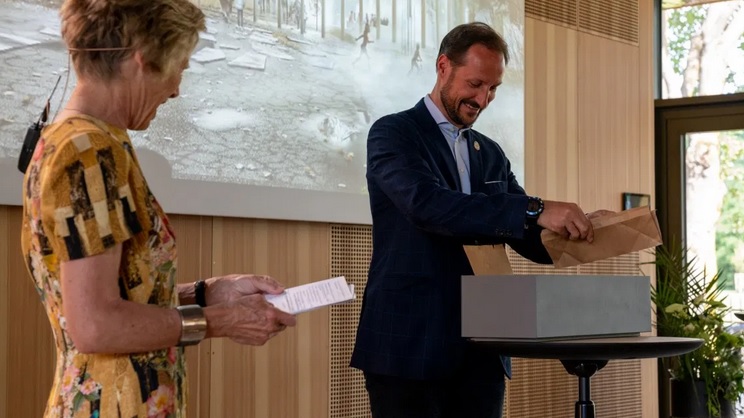
NordenBladet – His Royal Highness Crown Prince Haakon of Norway opened Oslo’s newest and largest public library on Thursday. The day of the opening was not random as Crown Prince Haakon opened the library exactly 87 years after his great-grandfather King Haakon VII opened the old main library in Oslo.
His Royal Highness was welcomed to the library by Oslo’s Mayor and a number of Norway’s best authors. Authors Lars Saabye Christensen and Camara Joof opened the ceremony. Musicians Lars Lillo Stenberg and Maria Lotus performed some of their songs before library manager Knut Skansen spoke and welcomed guests to Oslo’s oldest and newest library.
Crown Prince Haakon held the opening speech in which he said: “A library can both shape and change lives. The library can strengthen communities. The library can make the world a better place. Through the books, we have the opportunity to discover the world, to open ourselves to it and find our place in it. We have the opportunity to seek both knowledge and recognition. The library offers all this and is open and free to everyone.”
After the Crown Prince’s speech, the Opera’s children’s choir performed and His Royal Highness was given a tour of the brand new building.
After the opening ceremony, the doors were opened to the public. Because of Covid-19, there can only be 1000 people inside the library at a time until further notice.
The library has a collection of about 450,000 books, films, music and games. The new building has six floors, each with its own distinctive features. The library also has a restaurant and café, cinema, and study rooms, sound studios, a room with 3D printers and a collection of old manuscripts. The most famous book in the collection is Aslak Bolt’s handwritten Bible from 1250.
NordenBladet —At its today’s sitting, the European Union Affairs Committee of the Riigikogu (Parliament of Estonia) discussed the positions formulated by the Government of the Republic on the Communication of the European Commission “The European Green Deal” and the proposal for a European Climate Law. When formulating Estonia’s position, the Committee also considered the opinion of the Economic Affairs Committee of the Riigikogu and the additional motions to amend by the Environment Committee of the Riigikogu.
Chairperson of the Committee Anneli Ott pointed out that climate neutrality was important and the steps to achieve it should be taken as quickly and resolutely as possible. “In implementing the Green Deal and achieving a climate neutral European Union by 2050, it is important that increasing the EU’s 2030 climate target would be preceded by a thorough analysis of Member States and sectors. At today’s sitting, we approved Estonia’s position and complemented it with the recommendation to support local transport. Besides rapid implementation of the Single European Sky concept, the European Union has to increase funding for the development of local train and tram transport,” she said.
Ott stated that one of the amendments added to Estonia’s position was the recommendation to channel additional investments into increasing the energy efficiency of private houses and apartment buildings, and the possibilities for monitoring the actual observance of energy performance certificate through smart solutions.
Member of the European Affairs Committee Mart Võrklaev also underlined the need for increasing the European Union funding for the development of local train and tram traffic. “Transport causes one fourth of the greenhouse gas emissions in the EU, and in order to achieve climate neutrality by 2050, the emissions from transport will have to be reduced by 90 per cent,” he explained.
As regards the smart solutions used to monitor energy performance certificates, Võrklaev said that Estonia could lead the way here thanks to its strong digital competencies. “At present, the energy class is assigned when buildings are designed, but the conformity of real energy consumption to it is not checked afterwards.”
Võrklaev expressed his regret that the Government had not thought it necessary to underline the importance of Rail Baltic in Estonia’s positions.
The European Green Deal is a policy strategy with the aim of transforming Europe into a society with resource efficient and competitive economy where climate neutrality is achieved by 2050.
Estonia supports setting the EU’s 2050 long-term climate-neutrality objective in legislation. At the same time, the states should be allowed flexibility in deciding on sectoral objectives and choosing the ways that suit them for achieving their targets. The proposal for increasing the European Union’s climate and energy goals for 2030 should be preceded by a thorough analysis of Member States and sectors, conducted by the European Commission. Estonia also considers it important that tax policy should support the achievement of the climate targets.
NordenBladet —Today, the Riigikogu concluded amending the Family Benefits Act. Among other things, in the future the special protection period of parental benefit in the case of successive births of children will be extended from 2.5 years to 3 years.
The Bill on Amendments to the Family Benefits Act and Amendments to Other Associated Acts (185 SE), initiated by the Government, will specify the payment of child benefit for children under 16. Pursuant to the Bill, the payment of parental benefit can be suspended and continued according to a parent’s choosing on the basis of calendar months until the child attains three years of age. The Bill also specifies that parental benefit can be suspended and continued only after the child attains 70 days of age. The amendments will ensure legal clarity so that mothers who are not entitled to maternity benefit could use their individual right to a benefit during the first 70 days of life of the child, and this right would not be transferable to the father later with a suspension of the parental benefit.
The Bill would also extend the period of successive births, during which the new parental benefit is calculated on the basis of earlier income, to three years. The amendment is necessary in order to ensure the livelihood of families upon successive birth of children, to prevent the postponement of desired births and to bring the provision on the same bases as the length of parental leave.
Besides that, the regulation regarding the payment of maintenance allowance during the enforcement procedure would be amended. The Bill would create the possibility to start paying maintenance allowance three months sooner. This would improve the livelihood of parents raising their children alone and enable them to ensure the growing environment necessary for the child.
The Bill also specifies the payment of child benefit for children under 16. Under the current Family Benefits Act, a child who is enrolled in a basic school or upper secondary school, or a child without secondary education enrolled in formal vocational education has the right to receive child allowance until he or she attains 19 years of age. The child benefit is paid retroactively for summer months in the case when the young person continues his or her studies in the same year after graduation from a basic school. Currently, there is no direct legal basis for paying family allowances for summer months in the case of young people who have completed a year at a secondary school or their formal vocational education and wish to study at another school or another specialty. There were rules for that in an earlier version of the Act, but they had been omitted by mistake in the course of the amendment of the Act, although the legislature has not wished to essentially change the relevant practice. The purpose of the amendments proposed by the Bill is to restore the earlier procedure and to ensure payment of child allowance for such children in summer months, too.
Jaak Valge (Estonian Conservative People’s Party Faction) took the floor during the debate.
The Bill on Amendments to the Labour Market Services and Benefits Act and the Unemployment Insurance Act (206 SE), initiated by the Government, will increase flexibility in the unemployment insurance benefit system, and will provide people greater social protection in the event of unemployment. The Bill provides for the possibility of temporary working, or doing gigs or small jobs, while registered as unemployed.
Pursuant to the Bill, it will be possible in the future to work temporarily for up to eight days a month while registered as unemployed. The Bill provides that while registered as unemployed, a person may temporarily work during 12 calendar months in a 24-month period, and the remuneration paid for each period of temporary work in a specific calendar month must not exceed 40 per cent of the minimum wage in that year. This year, the minimum wage is 584 euro and 40 per cent of it is 233 euro.
Besides allowing gigs or small jobs, the Bill also specifies calculation of unemployment insurance benefit in a situation where the insured person worked in Estonia before becoming unemployed, and before that outside Estonia. The Bill would change the amount of unemployment benefit in the context of both the unemployment insurance benefit and the unemployment allowance, and also the conditions for receiving the unemployment insurance benefit in order to facilitate the seasonal working of the unemployed.
The Bill will specify the calculation of the unemployment insurance benefit in a situation where the insured person has been working in Estonia before he or she loses his or her job and, before that, outside Estonia in another contracting state of the European Economic Area or in the Swiss Confederation.
The replacement rates of unemployment benefits will also change: in the first hundred days of unemployment, the unemployment insurance benefit will be 60 per cent of previous income, instead of the current 50 per cent, and the unemployment allowance will be 50 per cent of the minimum wage in the previous year, instead of the current 35 per cent.
To facilitate seasonal employment of the unemployed, the Bill will amend the conditions for receiving the unemployment insurance benefit so that if a person loses their job again after the end of seasonal work, the payment of the benefit will continue if the benefit has not been paid for all days of the previous period of the payment of the benefit and no more than 12 months have passed since the person took up employment.
The Bill provides for the entry into force of the Act on 1 September 2020 when the provisions on temporary employment will enter into force. The increase in the replaced rate of the unemployment insurance benefit will enter into force on 1 August 2020. The changes to the replaced rates will thus concern the benefits calculated from 1 August, and they will have no retroactive effect.
During the debate, Signe Riisalo (Reform Party), Heljo Pikhof (Social Democratic Party) and Urmas Espenberg (Estonian Conservative People’s Party) took the floor.
Due to the end of working hours of the sitting, the first reading of one Bill was adjourned in the Riigikogu:
The Bill on Amendments to the Bankruptcy Act and Other Acts (195 SE), initiated by the Government of the Republic, will increase the efficiency of bankruptcy proceedings and thereby improve the functioning of the business environment. Among other things, the Bill will provide for establishing an insolvency service, changing the system of remuneration of trustees, extending the obligation to file bankruptcy petition, speeding up of determining the number of votes of creditors, and specialisation of courts.
The procedure for defending and acceptance of claims will also be reorganised. Currently, the defending of claims takes place at a meeting of creditors for the defence of claims, and disputes concerning claims are solved in separate and time-consuming proceedings. According to the Bill, in the future defending of claims would be conducted in writing and acceptance of claims would take place in court in one procedure. Substantiation of objection will be mandatory, and the list of claims to be accepted without defence will be amended, which will result in reduction of disputes over claims.
The Bill also provides for greater specialisation of courts on insolvency matters, as a result of which the judges will adjudicate the cases faster and in a more uniform manner. Adjudication of insolvency matters of legal persons will take place in Tallinn and Tartu County Courts. In the case of natural persons, the jurisdiction will remain the same.
The system of remuneration of trustee in bankruptcy will also be made more transparent and predictable. Pursuant to the Act currently in force, the remuneration of a trustee is calculated on the basis of the size of the bankruptcy estate, and the trustee does not have to keep working time records and prepare an expected action plan. The Bill will propose that in all proceedings, a trustee should plan their expenses and possible remuneration at the beginning of proceedings and keep records of working time. This will make the proceedings more transparent and enable the courts and the creditors to better estimate the formation of the remuneration of trustee.
In the bankruptcy proceedings of natural persons, that are simpler by their nature, it will be possible to pay the remuneration as a one-time fixed operation fee. When the trustee decides to accept operation fee, they do not have to keep records of working time.
The remuneration of trustee will also cover the trustee’s general costs, like the office expenses. In connection with that, the minimum and maximum amounts of remuneration of trustee will be increased by 21 per cent, which is the average rate of general expenses.
Obligation to file bankruptcy petition will be extended. Pursuant to the Act currently in force, it is possible that in the absence of members of management board, nobody has the obligation to file bankruptcy petition. The amendment will extend the obligation to file bankruptcy petition to persons who have the duty to ensure the existence of management board. For example, in the case of a private limited company, such persons are the members of governing council or the shareholders. They will not be held responsible if there is a management board.
In connection with the unexpected and abrupt change of economic situation as a result of the impact of the COVID-19 coronavirus, the Bill temporarily enables to make changes to reorganisation plan and debt restructuring plan more flexibly. The Act which is currently in force does allow changing reorganisation plan. Such a possibility is temporary and relevant applications can be submitted up to the end of 2020.
The first reading of the Bill will continue on Wednesday.
As replying to interpellations was adjourned due to the end of the working hours of the Riigikogu on Monday, discussion of two interpellations was added to the agenda of Tuesday’s sitting, and the debates continued at the beginning of today’s sitting.
Prime Minister Jüri Ratas continued replying to the interpellation concerning the monitoring of the budget expenditure (No. 35) that had been submitted to him. During the debate, Maris Lauri (Reform Party), Aivar Sõerd (Reform Party), Taavi Rõivas (Reform Party) and Jürgen Ligi (Reform Party) took the floor on behalf of the interpellators.
The reply to the interpellation concerning the Road Management Plan for 2020–2030 (No. 25) by the Minister of Economic Affairs and Infrastructure Taavi Aas was also postponed to the agenda for today’s sitting. At the debate, Aivar Sõerd (Reform Party), Urmas Kruuse (Reform Party), Jüri Jaanson (Reform Party) and Helmen Kütt (Social Democratic Party) took the floor on behalf of the interpellators. At the open microphone session, Jürgen Ligi (Reform Party) took the floor.
NordenBladet – Success for Norwegian UN campaign backed by Crown Prince Haakon! The country’s politicians are delighted and have shown their gratitude to Crown Prince Haakon who has been a high profile supporter of the country’s campaign for a place on this prestigious body.
Norway won 130 votes in the polls which took place on June 17th 2020. Along with the Republic of Ireland, with 128 votes, it was elected from the western bloc of nations with Canada failing to secure a seat. India and Mexico were also elected.
Crown Prince Haakon has taken a high profile role in the Norwegian fight for a seat on the United Nations Security Council.
In 2018 the Crown Prince launched the campaign for a seat in the council in New York. Following the official announcement for the candidacy, Crown Prince Haakon visited the Hall where the Security Council has its meetings, together with representatives from a number of other countries. The hall was donated by Norway to the UN in 1952.
Due to the coronavirus crisis, Norway had to change its election campaign strategy in the last minute. The Foreign Minister and the Norwegian diplomacy have run election campaigns from their home office and over video conferencing.
On June 11, the Norwegian delegation to the United Nations was to have a big election campaign event which Crown Prince Haakon and Crown Princess Mette Marit were set to attend. The event was to be held in New York to a big cost. Instead of the grand dinner and reception His Royal Highness Crown Prince Haakon last week attended a digital reception for UN ambassadors on the occasion of the campaign for Norway’s candidate for UN Security Council 2021-2022.
“It is important to have an international system of rules, negotiations and constructive dialogue. Therefore, the UN is important. I have been an ambassador for the UN Development Fund (UNDP) for 14 years. Through those years I have seen how the UN works at the country level, and what good efforts the UN is doing for health, education and fighting poverty”, said the Crown Prince to the press in 2018.
Norway will sit on the UN Security Council for the period 2021 – 2022.
NordenBladet – Maud Angelica Behn, daughter of Princess Martha Louise and Ari Behn is also the granddaughter of King Harald and Queen Sonja. She impressed many with her moving speech at her father’s funeral in January this year. Ari Behn took his own life on Christmas Day 2019. For the first time since the death, Princess Martha Louise and her daughters have talked about the hard time with the Norwegian Telegram Agency.
Maud Angelica Behn, who is seventeen, says that she felt overwhelmed and in shock after her father’s death. Nevertheless, today she is proud of the poignant speech she made in his honour. She says: “It was so important to me to give that speech. It meant so much to me that I could get some value and something nice out of all the awfulness. And I felt that I could do that with my speech and to use my grief to say something to others.”
Princess Märtha Louise and her daughters Emma Tallulah Behn, Leah Isadora Behn and Maud Angelica Behn also gave NTB a tour of Gallery Varden where a selection of Ari Behn’s art will now be on display. The exhibition opens to the public on Saturday.
This week the family has been on several trips to Jeløya, where a memorial exhibition is being prepared. It will include a selection of Ari Behn’s paintings as well as prints made by Maud Angelica.
Maud Angelica was very open about receiving support from a psychologist and from a care group she has participated in. Nevertheless, she told NTB the past months have been painful. She continues: “Mom has said it is a bit like breathing in and out. Sometimes you have to think about it, and sometimes not. My father was very good with words and compliments. It was so poetic and nice.”
Princess Märtha Louise says it has been difficult time for the children after their father died, continuing “luckily, things are getting better and better gradually. At the same time, there are many good memories to look back on. That they are going to grow up without a father is just heart-breaking.”
Featured image: Princess Märtha Louise (By Richter Frank-Jurgen – Flickr, CC BY-SA 2.0)
NordenBladet —Riigikogu passed five Acts at the last sitting of the spring session
87 members of the Riigikogu voted in favour of the Act on Amendments to the Family Benefits Act and Amendments to Other Associated Acts (185 SE), initiated by the Government.
Under the Act, the payment of parental benefit can be suspended and continued on a parent’s request, on the basis of calendar months, until the child attains three years of age. The Act also specifies that parental benefit can be suspended and continued only after the child attains 70 days of age. The amendments ensures legal clarity so that mothers who are not entitled to maternity benefit could use their individual right to a benefit during the first 70 days of the life of the child, and this right would not be transferable to the father later with a suspension of the parental benefit.
The Act also extends the period of successive births to three years, during which the new parental benefit is calculated on the basis of earlier income. The amendment is necessary in order to ensure income to families upon successive birth of children, to avoid postponing desired births, and to bring the provision onto the same bases as the length of parental leave.
The regulation regarding the payment of maintenance allowance during the enforcement procedure is also amended. The Act creates the possibility to start paying maintenance allowance three months sooner. This would improve the means of parents who are raising their children alone to ensure the growing environment necessary for the child.
The Act also specifies the payment of child benefit for children under 16. Under the current Family Benefits Act, a child who is enrolled in a basic school or upper secondary school, or a child without secondary education enrolled in formal vocational education, has the right to receive child allowance until he or she attains 19 years of age. The child benefit is paid retroactively for summer months in cases where the young person continues his or her studies in the same year after graduation from the basic school. Currently, there is no direct legal basis for paying family allowances for summer months in the case of young people who have completed a year at a secondary school or formal vocational education and wish to study at another school or another specialty. An earlier version of the Act included relevant provisions but these had been omitted by mistake in the course of amending the Act, although the legislature has not wished to introduce fundamental changes into the relevant practice. The purpose of the amendments proposed by the Act is to restore the earlier procedure and to ensure the payment of child allowance for such children in summer months as well.
Priit Sibul (Isamaa) and Helmen Kütt (Social Democratic Party) took the floor during the debate.
The Act on Amendments to the Labour Market Services and Benefits Act and the Unemployment Insurance Act (206 SE), initiated by the Government, increase the flexibility of the unemployment insurance benefit system, and provides greater social protection in the event of unemployment. The Act provides for the possibility of temporary work, or gig work, while registered as unemployed.
Under the Act, it will be possible to work temporarily for up to eight days a month while registered as unemployed. The Act provides that while registered as unemployed, a person may do temporary work for no more than 12 calendar months during a 24-month period, and the remuneration paid for each period of temporary work in a specific calendar month must not exceed 40 per cent of the minimum wage in that year. This year, the minimum wage is EUR 584, and 40 per cent of it is EUR 233.
Besides allowing gig work, the Act also specifies the calculation of unemployment insurance benefit in a situation where the insured person worked in Estonia before becoming unemployed, and abroad prior to that. The Act changes the amount of unemployment benefit in the context of both the unemployment insurance benefit and the unemployment allowance, as well as the conditions for receiving the unemployment insurance benefit, in order to encourage seasonal work among the unemployed.
The Act specifies the calculation of the unemployment insurance benefit in a situation where the insured person has been working in Estonia before he or she loses his or her job and, before that, outside Estonia in another contracting state of the European Economic Area or in the Swiss Confederation.
The replacement rates of unemployment benefits also change: during the first one hundred days of unemployment, the unemployment insurance benefit is 60 per cent of the prior income, instead of the current 50 per cent, and the unemployment allowance is 50 per cent of the minimum wage of the previous year, instead of the current 35 per cent.
To facilitate seasonal employment of the unemployed, the Act amends the conditions for receiving the unemployment insurance benefit to the effect that if a person again becomes unemployed after the end of seasonal work, the payment of the benefit will continue if the benefit has not been paid for all the days of the previous payment period, and no more than 12 months have passed since the person took up employment.
The Act will enter into force on 1 September 2020 when the provisions on temporary employment will enter into force. The increase in the replacement rate of the unemployment insurance benefit will enter into force on 1 August 2020. The changes to the replacement rates will thus concern the benefits calculated from 1 August, and will have no retroactive effect.
Signe Riisalo (Reform Party), Priit Sibul (Isamaa) and Lauri Läänemets (Social Democratic Party) took the floor during the debate.
82 members of the Riigikogu voted in favour of the passage of the Act.
According to the Act on the Ratification of the Protocol amending the Convention for the Protection of Individuals with regard to Automatic Processing of Personal Data (143 SE), initiated by the Government, the purpose of the Convention is to protect the inviolability of private life in the automatic processing of personal data. The Convention was opened for signature in 1981. The technological development and the globalisation of information has brought about new challenges in the field of personal data protection, and consequently the Convention has also needed updating.
The Protocol establishes a legal framework to facilitate the cross-border movement of data as well as to ensure the effective protection of personal data when it is processed. The regulations of the EU General Data Protection Regulation have also been taken into account in the drafting of the Protocol.
73 members of the Riigikogu voted in favour of the passage of the Act.
NordenBladet —In cooperation with the Estonian Defence Forces and in support of Baltic region allies and partner nations, U.S. Air Forces in Europe has temporarily relocated MQ-9 Reaper remotely piloted aircraft, personnel and support equipment assigned to the 52nd Expeditionary Operations Group Detachment 2 to Ämari Air Base, Estonia until the end of July.
The aircraft will support Air, Land and Maritime Domain Awareness by leveraging the MQ-9’s inherent multi-role capabilities and support RPA Agile Combat Employment concepts.
The MQ-9 Reaper aircraft are temporarily moving from Miroslawiec Air Base, Poland, while Miroslawiec AB’s runway is under construction.
“We are pleased to welcome our allies in Ämari. Drones are a hot topic today, and the implementation of drones to aviation culture is about laying a new foundation, ”said Colonel Rauno Sirk, Commander of the Estonian Air Force. According to him, the biggest challenge is to integrate drones into daily aviation activities.
The aircraft have been operating out of Poland since May 2018. The operations aim to promote stability and security within the region and strengthen relationships with NATO allies and other European partners. In the past, the Reapers have been deployed to Romania.
The MQ-9 Reaper is an armed, multi-mission, medium-altitude, long-endurance remotely piloted aircraft that is employed primarily against dynamic execution targets and secondarily as an intelligence collection asset.
NordenBladet —This morning, the Chairperson and the Deputy Chairperson of the European Union Affairs Committee of the Riigikogu (Parliament of Estonia) participate in the video conference Meeting of the Chairpersons of the Conference of Parliamentary Committees for Union Affairs of Parliaments of the European Union (COSAC). The main topic of the meeting is the plan for restarting the EU and the Multiannual Financial Framework of the EU for 2021–2027.
Chairperson of the European Union Affairs Committee Anneli Ott said that the meeting should have taken place in May in Zagreb, the capital of Croatia, but it had been cancelled due to the pandemic. “However, it was decided to hold the meeting a little later than originally planned, and for the first time in the video conference format. One can only agree to this decision, because six months have already passed from the last meeting of the European colleagues. In that time, many things have changed and completely new topics have emerged,” she said.
Ott stated that the main topic of the meeting would be the recovery plan for the European Union and the long-term budget of the European Union for 2021–2027. “Discussions on this topic are currently relevant also in our Committee, and the European Union Affairs Committee will formulate Estonia’s position on this issue already at its tomorrow’s sitting. We will certainly be able to consider also the points that will be dealt with at the meeting this morning,” Ott said.
Deputy Chairperson of the European Union Affairs Committee Riina Sikkut added that the second topic of the meeting was the Conference of the Future of Europe, which aimed to bring the citizens closer to Europe and make them see added value in the European Union. “We try to find approached that would help maintain the link between the citizens and the EU also in other times than the elections. It is important to adopt a relevant joint declaration in the nearest future, so that it would be possible to start with the conference in the autumn,” Sikkut said.
COSAC is a cooperation format that brings together the Committees for Union Affairs of the national parliaments of the 27 Member States of the European Union.
NordenBladet —On Monday, a United States B-52 strategic bomber entered the Estonian airspace and conducted a formation flight over Tallinn together with two Baltic Air Policing aircrafts.
“Americans come to Ämari with their flight units several times a year and participate in regional exercises as well as in exercises taking place only in Estonia. With today’s exercise, the United States Air Force demonstrated its global reach and affirmed that allied relations are important to them, “said Colonel Rauno Sirk, the Commander of Estonian Air Force.
Strategic bomber B-52 arrived in Estonia from North Dakota Minot air base in the United States, air refueling was also performed during the flight. The bomber was accompanied by a French Mirage 2000-5 from Ämari Air Base and a British Eurofighter from Šiauliai Air Base in Lithuania. From Tallinn, they headed to repeat the exercise around Riga Airport.
The United States conducts similar exercises regularly to assess its readiness and, if necessary, to fulfill its security responsibilities. The exercises help to increase the level of training of NATO Allies which is important for responding to potential crises around the world.
The B-52H Stratofortress is a long-range, heavy bomber that can perform a variety of missions. The bomber is capable of flying at high subsonic speeds at altitudes of up to 50,000 feet (15,166.6 meters). It can carry nuclear or precision guided conventional ordnance with worldwide precision navigation capability. In a conventional conflict, the B-52 can perform strategic attack, close-air support, air interdiction, offensive counter-air and maritime operations.