The Chairman of the Foreign Affairs Committee of the Riigikogu Marko Mihkelson describes the cooperation with Latvian and Lithuanian Foreign Affairs Committees as closer than ever, as is testified by numerous joint visits and statements. “If we hope to achieve our goals in foreign and security policy, it is crucial that we continue our close cooperation, harmonise our positions, and plan our further steps together,” he said.
The meeting will focus on supporting Ukraine in its fight against Russia, who continues its war of aggression. The Secretary General of the Ministry of Foreign Affairs Jonatan Vseviov will take part in the discussion on Russia’s aggression in Ukraine and the global security situation more broadly. The Ambassador of Sweden to Estonia Ingrid Tersman will participate in the discussion on cooperation within NATO and strengthening European security.
The delegations of Foreign Affairs Committees will take part in a commemoration of victims of the 1941 June deportation in Kudjape cemetery and lay flowers on their memorial. They are also scheduled to visit Baltic Workboats in Nasva.
Other members of the Foreign Affairs Committee of the Riigikogu to take part in the meeting with Baltic colleagues are Ester Karuse and Luisa Rõivas.
NordenBladet —As of Friday, June 14th, the Estonian Defence Forces is represented in the European Union’s Naval Force Operation Aspides, which purpose is to safeguard maritime security and civilian shipping in the Red Sea from attacks and threats posed by Houthi rebels. Since the end of 2023, the maritime security situation …
NordenBladet – Norse mythology is a rich and complex web of beliefs, gods, and creatures that played a significant role in the lives of the Scandinavian people. The Norse cosmos was divided into nine different realms, each with its own unique characteristics, inhabitants, and stories. In this article, we will explore the nine realms of Norse mythology and gain a deeper understanding of the ancient Norse worldview.
In Norse mythology, the nine realms were not just physical places but also represented different aspects of the universe and the human experience. For example, Midgard represented the human world and the experiences of humans, while Asgard represented the divine and the experiences of the gods.
The Norse cosmos was also believed to be constantly in motion, with the realms constantly interacting and influencing each other. For example, the events in Midgard would affect the gods in Asgard, and vice versa.
The Norse gods were not immortal, and their fate was ultimately linked to the fate of the cosmos. In the end, the Norse believed that the world would come to an end in a great battle called Ragnarok, where the gods would fight the giants and the forces of chaos.
Another important aspect of Norse mythology was the concept of fate, known as the Norns. The Norns were three goddesses who were said to spin the thread of fate and determine the course of individual lives and the world as a whole.
The Norse people also believed in reincarnation, and that after death, the soul would be reincarnated into another body. This cycle of reincarnation was seen as a way for the soul to continue learning and growing until it was finally able to reach Valhalla and live with the gods.
The nine realms of Norse mythology were not just physical places, but also represented different aspects of the universe and the human experience. The Norse worldview was rich and complex, encompassing ideas of fate, reincarnation, and the interaction between the gods and humans. These beliefs and myths continue to captivate and inspire people to this day.
The nine relams:
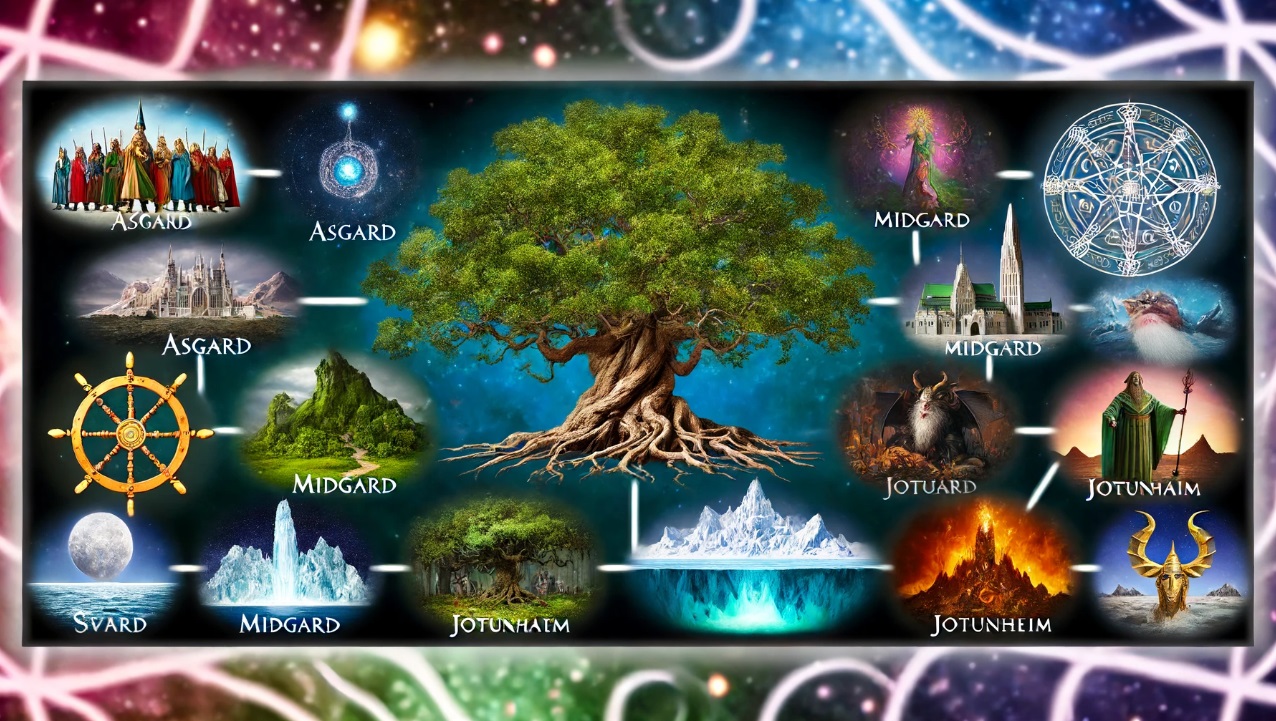
Image depicting Norse mythology, showcasing the nine distinct realms interconnected by the ash tree Yggdrasil (Illustrations by NordenBladet)
Asgard: Asgard (Old Norse: Ásgarðr) is the realm of the gods, the home of Odin, Thor, and the other Aesir gods. It is located in the highest part of the cosmos and is said to be surrounded by a rainbow bridge called Bifröst. Asgard was a place of great beauty and prosperity, where the gods lived in magnificent halls and feasted on the flesh of the goat Heidrun.
Valhalla (Valhǫll) is the great hall of the god Odin, located in Asgard. It is where the bravest and most honored warriors who died in battle would go after they died, and where they would train and prepare for the final battle of Ragnarok.
In Valhalla, the warriors would live a life of constant feasting, fighting, and revelry, forever honored and remembered by the gods and other warriors. The idea of Valhalla was a source of great comfort and inspiration for the Norse people, who valued bravery and honor in battle above all else.
It was also believed that the warriors who went to Valhalla would be chosen by the Valkyries, female warriors who would ride over the battlefield and select the bravest warriors to bring to Valhalla. This idea was a source of great fascination and inspiration for the Norse people, and the Valkyries remain an important part of Norse mythology and culture to this day.
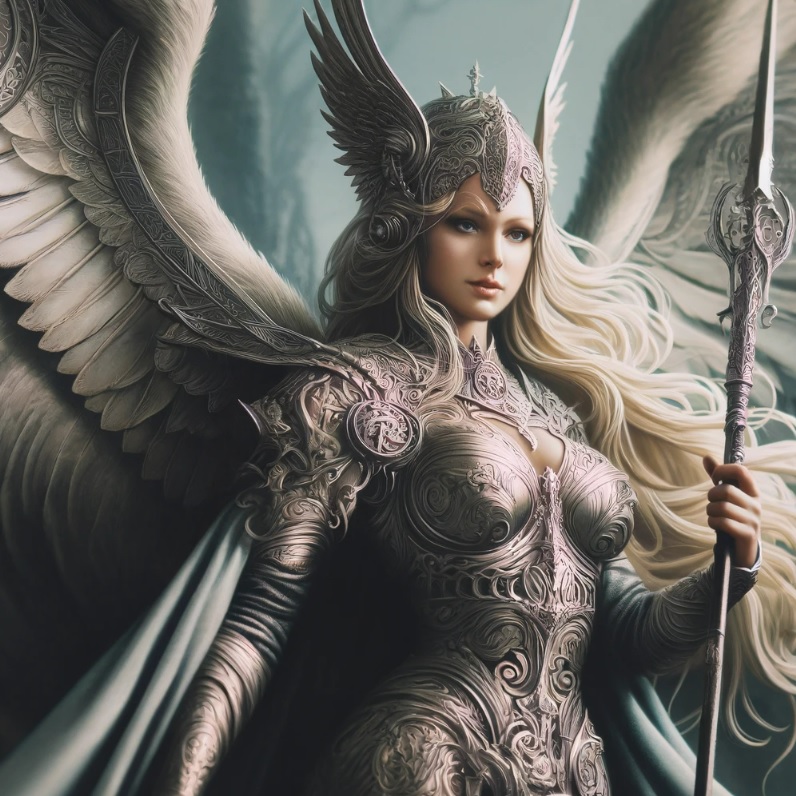
Valkyrie (Illustrations by NordenBladet)
Viking(Illustrations by NordenBladet)
Folkvangr is a hall in Norse mythology, often associated with the goddess Freyja. It is believed to be located in Asgard and is said to be one of the nine realms of Norse cosmology.
In Norse mythology, Freyja was the goddess of love, fertility, and war, and was considered to be one of the most powerful and beloved of all the gods and goddesses. Folkvangr was her dwelling place and was said to be a place of great beauty and splendor, where Freyja would receive half of the souls of those who died in battle.
The idea of Folkvangr was a source of great fascination and inspiration for the Norse people, and Freyja remains one of the most popular and beloved figures in Norse mythology to this day. Folkvangr was seen as a place of honor and reward for the brave warriors who died in battle, and as a place of comfort and solace for their loved ones who remained behind.
Vanaheim: Vanaheim was the home of the Vanir gods, a different tribe of gods than the Aesir. The Vanir were associated with fertility, the harvest, and the natural world. The goddess Freya was one of the most famous Vanir, known for her love of beauty and her ability to control the minds of men. Vanaheim was a peaceful realm, where the Vanir lived in harmony with nature and each other.
Svartalfheim (Nidavellir): Svartalfheim was the realm of the dwarves, a race of skilled craftsmen who lived underground. The dwarves were said to be able to forge magical items and were often sought after by the gods for their talents. The dwarves were also known for their love of gold and their great wealth.
Midgard (Miðgarðr): Midgard was the realm of humans, located in the center of the Norse cosmos. It was said to be surrounded by an ocean and was the only realm accessible to humans. Midgard was a place of great turmoil and change, where humans lived and died and the forces of nature were constantly at work.
Alfheim: Alfheim was the realm of the elves, a race of beings known for their beauty, grace, and magic. The elves were said to be light and joyful creatures, who lived in harmony with nature and were the guardians of the natural world. Alfheim was a place of great beauty, where the elves lived in peace and prosperity.
Jotunheim (Jǫtunheimr): Jotunheim was the realm of the giants, a race of beings known for their great size and strength. The giants were often in conflict with the gods, who saw them as a threat to their power and control. Jotunheim was a place of great danger, where the giants lived and plotted against the gods.
Muspelheim (Múspellsheimr): Muspelheim was the realm of fire, a place of great heat and light. The giant Surt was said to rule over Muspelheim, and it was believed that the fire of Muspelheim would eventually consume the world. Muspelheim was a place of both destruction and creation, where the flames gave birth to new life and consumed all that was old.
Niflheim (Niflheimr): Niflheim was the realm of ice, a place of cold and darkness. The goddess Hel was said to rule over Niflheim, and it was believed that the dead who did not die in battle would end up in this frozen underworld. Niflheim was a place of death and decay, where the cold winds and ice forever chilled the souls of the dead.
Hel (Helheim): Helheim was the underworld, a place of darkness and decay, where the dead who did not die in battle went after. In Norse mythology it is associated with death, the underworld, and the afterlife. It was believed to be located in the far northern regions, beyond the realm of Midgard.
In Norse mythology, Hel was the daughter of Loki and the giantess Angrboda. She was depicted as a half-dead, half-alive figure with a pale complexion and was said to rule over the dead in the underworld. The souls of those who did not die in battle and did not go to Valhalla or Folkvangr were believed to go to Hel after they died.
In Norse cosmology, Hel was considered to be a place of punishment for the wicked and the damned, where they would spend eternity in cold and darkness. However, it was also believed that some souls could be redeemed and eventually leave Hel and go to a better afterlife.
The idea of Hel was a source of great fear and fascination for the Norse people, who believed that death was not the end, but rather a journey to the afterlife. Hel remains an important part of Norse mythology and continues to be a symbol of death, the underworld, and the afterlife to this day.
Image: In Norse mythology, the structure of the universe is organized into nine distinct realms that are interconnected by the ash tree Yggdrasil. The nine worlds were Asgard, Midgard, Jotunheim, Niflheim, Muscenters, Helheim, Alfheim, Svartalfheim, and Vanaheim. (Illustrations by NordenBladet)
The Speakers confirm that their countries will continue the work on bilateral security cooperation agreements and their implementation, and regard commitments for sustained long term military assistance to Ukraine as a priority. “Comprehensive support to enhance Ukraine’s combat capability in the fight against Russia’s war of aggression, as well as initiatives to ensure the rapid supply of weapons and ammunition to the Ukraine’s armed forces we see as particularly important,” they declare.
According to the joint declaration, the Speakers appreciate the prospect of establishing a NATO-Ukraine Joint Analysis, Training and Education Centre in Poland so that Ukraine can share its experience in combating Russia`s war of aggression. They also recognize that the war effort is more effective without setting limitations to our support. “We reiterate that Ukraine has the right to defend itself according to the international law, and that also includes striking legitimate military targets in Russian territory. Ukraine must be able to hit back the attacks that come from Russia or the occupied territories of Ukraine,” the Speakers say in the joint declaration.
The Speakers welcome the readiness of some countries to join an international coalition and send their instructors to Ukraine, at a time suitable for them, to train Ukraine’s military. “[We] recognize that a significant escalation of the situation, which will pose a threat to Ukrainian statehood, will require more decisive actions from the pro-Ukrainian coalition.” they say.
The Speakers believe that a condition for ensuring sustainable peace in Europe is to secure Ukraine’s place in Euro-Atlantic structures, and expect that the NATO Summit in Washington in July will contribute to defining irreversible Ukraine’s path to membership. They also point out that Ukraine’s accession negotiations with the European Union are a strategic objective for Ukraine and the EU, and therefore, the First intergovernmental conference to open accession talks with Ukraine must be held no later than June. “Poland, Estonia, Latvia, and Lithuania support Ukraine and are ready to share the experience of 20 years of their membership in the European Union,” the joint declaration underlines.
The Speakers also declare continued intensive cooperation between their nations to counter the pressing and pervasive threat of Russia’s neo-imperialist policies. “[We] firmly believe that our collective strength – Poles, Estonians, Latvians, Lithuanians, Ukrainians – is the key to confronting the Russia’s threat and ensuring regional security,” they say.
Besides Hussar, the joint declaration was also signed by Daiga Mieriņa from the Parliament of Latvia, Viktorija Čmilytė-Nielsen from the Parliament of Lithuania, Szymon Hołownia from the Parliament of Poland, and Ruslan Stefanchuk from the Parliament of Ukraine.
The Speakers made the joint declaration after their two-day meeting in Białystok, where supporting Ukraine, strengthening the security of Europe and joint resistance to Russia’s intensifying hybrid and cyber attacks was discussed. Regional security was addressed at the meeting also in a wider sense, by discussing the cooperation between local governments, cross-border projects, science and culture cooperation and youth exchange. The Speakers of parliaments also met with local young people, with whom they exchanged ideas about the security situation in Europe and possible further developments.
The Bill on supplementary budget passed the first reading
The aim of the Bill on the Supplementary Budget for 2024 (456 SE), initiated by the Government, is to ensure the financial stability and sustainability of the country.
Minister of Finance Mart Võrklaev explained that, on 8 December 2023, the Riigikogu had adopted the state budget for 2024, which had a revenue volume of approximately 16.7 billion euro and an expenditure volume of 17.7 billion euro, and an investment and investment subsidies budget of approximately 1.9 billion euro.
“According to last year’s summer economic forecast, on the basis of which the Government prepared the 2024 budget, Estonia’s public finances were in a difficult situation. The main problems stemmed from a long-term budget deficit and rapid expenditure growth outpacing revenue growth. The deficit was exacerbated by soaring interest costs,” the minister admitted.
According to Võrklaev, the state budget for 2024 has been adopted in such a way that it contains decisions in the order of 500 million euro to improve the budget and put it on a sustainable path. This follows savings decisions totalling around 850 million euro over the period 2024–2027. This includes both last year’s ministerial savings and making allowances for families with many children more affordable for the state.
Võrklaev noted that this year’s spring economic forecast, published on 3 April, was more pessimistic than the previous one. The economic recovery has been slower and so tax revenues have been lower. “If the state receives less revenue, it will have to make additional efforts to rein in spending as well. To this end, the Government decided to make a negative supplementary budget for 2024,” the minister said.
Reducing the state budget deficit is a preparatory step for drafting next year’s national budget where it will have to be ensured that up to 80% of the austerity measures will be of a permanent nature and meet the target of reducing budget deficit in future years. In order to bring the general government deficit below 3% of GDP this year and to comply with European Union budgetary rules, it has been decided to bring government revenue and expenditure closer together by 183 million euro, with a budgetary impact of 173 million euro.
Including the supplementary budget measures, this year the general government deficit will reach 1.19 billion euro, or 3% of GDP. The negative supplementary budget includes 115 million euro in savings measures and 68 million euro in revenue measures. All ministries and agencies, as well as public foundations, will contribute to savings, saving mainly on their operational and management costs. The amount of savings for ministries will be in the order of 63 million euro.
Võrklaev said that the Government did not plan to cancel major investments, but the state of the budget would be affected by the postponement of some investments. The agreement is that investments should be put in place as soon as possible. “We have set a target that 70% of investments and investment subsidies will have to be committed by August this year in order to implement the investment budget to the maximum extent by the end of the year. The task of the supplementary budget has been to take an honest look at which investments can be delivered this year and which ones cannot,” the minister said.
The negative supplementary budget will not reduce funding for national defence which is the highest priority sector. However, the Ministry of Defence, in solidarity with others, is finding ways to save on labour and management costs. The funds released will be channelled into improving defence capabilities.
In the area of government of the Ministry of the Interior, the saving will come at the expense of one-off costs in the order of 3 million euro. This time, the budget savings measures do not concern the foundations of museums, theatres or concert organisations, or legal persons governed by public law. Hospitals have been given a guideline to improve their budgetary position by reducing operating costs to the extent of 1%. The level of research and development and innovation expenditure will be reduced to 1% of GDP, taking into account the revised GDP forecast, while maintaining the agreed target.
To increase revenue, we have decided to increase the amount of dividends from the State Forest Management Centre and Elering Ltd. In addition, the reserve of the Government of the Republic, both unallocated and earmarked, will be reduced.
The aim of the supplementary budget is to ensure the country’s financial stability and allow the Government to respond flexibly to different situations and needs that may arise during the year. “A negative supplementary budget is one of the necessary steps to achieve this goal,” Võrklaev said.
The Chairman of the Finance Committee Annely Akkermann gave an overview of the discussion that had taken place in the Committee.
During the debate, Urmas Reinsalu (Isamaa), Priit Lomp (Social Democratic Party), Andrei Korobeinik (Centre Party), Maris Lauri (Reform Party) and Kert Kingo (Estonian Conservative People’s Party) took the floor.
The Estonian Centre Party Group moved to reject the Bill at the first reading. The motion was not supported because 15 members of the Riigikogu voted in favour, 50 were against and there was one abstention. The first reading of the Bill was concluded and the deadline for submission of motions to amend was set for 4 p.m. on 12 June.
The Riigikogu heard replies to three interpellations
Prime Minister Kaja Kallas replied to the interpellations submitted by members of the Riigikogu concerning the increase of the pioneer capability of the war-time Defence Forces in light of the experience of the present stage of the Russian-Ukrainian war (No. 607), Ukraine’s accession to the European Union (No. 613) and the non-taxation of the extraordinary profits of banks (No. 615).
At the beginning of the sitting of the Riigikogu, the justice of the Supreme Court Oliver Kask took his oath of office.
Urve Tiidus took the floor during the open microphone.
The sitting ended at 5.27 p.m.
Photos (Author: Erik Peinar, Chancellery of the Riigikogu)
57 members of the Riigikogu supported and 13 voted against the adopting of the Statement of the Riigikogu “On the Crisis of Democracy in Georgia” (449 AE), submitted by 44 members of the Riigikogu.
In the Statement, the Riigikogu points out that despite widespread protests, calls from the EU and Georgia’s allies and a veto by the President of Georgia, on 28 May the Parliament of Georgia, with the votes of the ruling party Georgian Dream, passed the Law on Transparency of Foreign Influence, which is inspired by the Russian Federation’s so-called Foreign Agents Law that the Putin regime uses to repress civil society, the media and political opposition.
According to the Statement, the EU, the Venice Commission of the Council of Europe as well as the Georgian civil society have declared the law to be contrary to the European Convention on Human Rights and the UN International Covenant on Civil and Political Rights, as it violates the principles of the rule of law, legality and proportionality, as well as non-discrimination.
The Riigikogu condemns the activities of the Government and the parliamentary majority of Georgia in passing the Law on Transparency of Foreign Influence and abandoning the European values, and calls on the Parliament and Government of Georgia to immediately repeal the Law on Transparency of Foreign Influence.
The Riigikogu also calls on the Government of Georgia to stop using violence against demonstrators, civil society and opposition politicians, to carry out legal investigations in regard of the authorities and individuals who have used violence against peaceful protesters, to uphold its promise to promote the rule of law and protect human rights, and to implement the reforms that are demanded by the overwhelming majority of the citizens of Georgia and are a precondition for the accession to the EU.
The Statement underlines that as long as the Government and Parliament of Georgia have not started to resolve the democratic crisis in a way that respects the rule of law and civil rights, have not returned to the reform and democratisation programme agreed upon with the EU, and have not repealed the Law on Transparency of Foreign Influence, the Riigikogu considers it necessary for Estonia to block in the Council of the European Union all further processes relating to Georgia’s accession in the EU, freeze development cooperation with Georgia’s state agencies and use the funds released to support Georgian civil society.
The Riigikogu also considers it necessary to propose to the Council of the European Union to impose sanctions, including an entry ban into the European Union, on Bidzina Ivanishvili, members of the Government of Georgia, the leaders of the Parliament of Georgia and the leadership and Parliamentary Group of the Georgian Dream party. If this proposal is not supported, the Riigikogu wants Estonia to impose sanctions of the Government of the Republic, including an entry ban into the Republic of Estonia, against these persons.
The Parliament of Estonia also wants that Estonia proposes to the Council of the European Union to impose sanctions on the representatives of the power structures and law enforcement agencies of Georgia who have been involved in the violent suppression of peaceful demonstrations of the citizens of Georgia and the repressing of Georgia’s opposition and civil society. If this proposal is not supported, the Riigikogu wants Estonia to impose sanctions of the Government of the Republic against these persons.
The Riigikogu also considers it necessary that Estonia supports in the Council of the European Union the freezing of the visa-free regime between Georgia and the European Union until the Law on Transparency of Foreign Influence is repealed. “The Riigikogu expresses its respect to the brave Georgian people who stand for Georgia’s democratic and pro-European future,” the Statement says.
NordenBladet —On Sunday, 9th of June, General Randy A. George, U.S. Army Chief of Staff paid a quick visit to Estonia to meet with the Deputy Commander of the Defence Forces of Estonia as well as U.S. soldiers serving here. Bilateral cooperation between the two Allies and development of military capabilities …
The main focus will be on the continued support for Ukraine, and the role of the Baltic states, Poland, and Ukraine in strengthening European security. The Marshal of the Sejm of Poland Szymon Hołownia will deliver the opening address, and the Speaker of the Verkhovna Rada of Ukraine Ruslan Stefanchuk will outline the current state of Russia’s war of aggression and the crucial needs of Ukraine. Another topic of the meeting is the common response to Russia’s increasingly intensifying hybrid and cyber attacks in the Euro-Atlantic region.
The Speakers will discuss regional security from a broader perspective as well, touching on issues of economy, energy, and infrastructure. Further items on the agenda concern cooperation between local governments and ongoing cross-border projects as well as cooperation in research and culture, and youth exchanges.
In addition to Hussar, Hołownia, and Stefanchuk, the Speaker of the Latvian Saeima Daiga Mieriņa and the Speaker of the Lithuanian Seimas Viktorija Čmilytė-Nielsen will also attend the meeting. At the conclusion of the meeting, the Speakers plan to adopt a Joint Statement.
Proposal of the Chancellor of Justice to bring the regulation on building exclusion zones in the Nature Conservation Act into conformity with the Constitution
At the plenary assembly today, the Riigikogu discussed the 6 May proposal of the Chancellor of Justice to bring the provisions on building exclusion zones in the Nature Conservation Act into conformity with the Constitution.
The proposal was presented by the Chancellor of Justice Ülle Madise, who agreed that although the existing provisions of the Nature Conservation Act that prohibit new buildings or constructions in the waterside building exclusion zones are largely constitutional, they do create disproportionate property restrictions in certain cases.
The Chancellor referred to a list of exceptions to the building exclusion zone set out in the Nature Conservation Act; these are, however, lacking.
“Consequently, let’s say that a museum wants to install a sewage pipe, or a landowner wants to install a culvert over a land improvement ditch, and a bridge over that, they need to initiate a detailed spatial plan and reduce the building exclusion zone. We have heard from local governments that these proceedings over one sewage pipe, minor driveway, or a culvert and bridge can take up to 18 months, plus the working time of the officials,” Madise said in her presentation to the members of the Riigikogu. The Chancellor of Justice proposed amending or complementing the Nature Conservation Act with an extended list of permitted constructions, and to provide simpler and less burdening proceedings that would allow the Environmental Board to decide on allowing the construction.
The Chancellor was asked whether the amendment would not give people with malicious intent a loophole that could be used to bypass the restrictions of a building exclusion zone. Madise replied that the Environmental Board would remain authorised to assess whether the specific action compromised the protection of waterside areas. However, the amendment would considerably accelerate the process.
The proposal found support, with 43 members of the Riigikogu voting in favour and one against it. Consequently, the Environment Committee received the task of initiating a Bill on bringing the Nature Conservation Act into conformity with the Constitution.
Proposal of the Chancellor of Justice to bring the Code of Civil Procedure into conformity with the Constitution
The Chancellor of Justice made a proposal to the Riigikogu on 3 May on bringing the Code of Civil Procedure into conformity with the Constitution.
The Chancellor of Justice recommends amending the Code of Civil Procedure in a way that would allow to take into account the person’s expenses on food, medicines, communication means, and products of hygiene when providing them procedural assistance, at least during a non-contentious procedure. The Chancellor also asked that a similar option would be at least considered for contentious procedure as well.
Procedural assistance is provided to enable a person to take part in a civil procedure. Procedural assistance means that a person is completely or partially released from covering the expenses of the court proceedings (such as state fees, translation expenses, or legal fees of an attorney). The assistance is calculated based on the average monthly income of the applicant, with expenses set out in the law deducted; today, these include only taxes, mandatory insurance fees, statutory maintenance obligation payments, and reasonable housing and transport costs. However, the provision excludes the deduction of the expenses on food, medicines, communication, and hygiene products.
The Chancellor of Justice referred to the most vulnerable members of the society (such as underprivileged individuals or people with limited active legal capacity or special needs) who come into contact with non-contentious proceedings and who would be particularly hard hit if the expenses for their basic needs would not be taken into account in the decision to provide procedural assistance. Such persons may find it particularly difficult to defend their rights in different non-contentious proceedings and they have unreasonably lesser chances of defending their rights compared to other social groups. This goes against the general equality principle enshrined in the Constitution.
45 members of the Riigikogu voted in favour of the proposal, one was against it, and one abstained. This means that the proposal of the Chancellor of Justice was approved, and the Legal Affairs Committee was given the task of initiating a Bill to bring the Code of Civil Procedure into conformity with the Constitution.
Proposal of the Chancellor of Justice to bring the Work Ability Allowance Act into conformity with the Constitution
The Riigikogu discussed the proposal of the Chancellor of Justice from 9 May on amending the Work Ability Allowance Act with the goal of bringing it into conformity with the Constitution.
Madise explained that she had been contacted by a person with no capacity for work who had lost their work ability allowance after the termination of their employment relationship because they had been paid during one calendar month not only their pay for the previous month but also the payments to be paid at the termination of the employment relationship, including the pay for the current month and the holiday pay.
The aim of the work ability allowance is to support the working and employment of people with a reduced capacity for work, and to ensure them an income. If a person with reduced capacity for work is working and their gross monthly income exceeds EUR 1,851.30, their work ability allowance is reduced.
Occasionally, an employer might make a single payment in one month covering several months’ pay, which can lead to the reduction of the work ability allowance. The Work Ability Allowance Act provides exceptions in situations where the income in a month exceeds this limit because of the payment of holiday pay, sickness benefit, or benefit for temporary incapacity for work, or a change in the payment schedule. However, these exceptions do not cover a situation where a person receives several months’ pay in one month because their employment relationship ended during the current month and they received both the pay for the previous month and all the payments to be made at the termination of the employment relationship.
The Chancellor of Justice felt that there was no reasonable justification to the different treatment of people with a reduced capacity for work, and that this was not in conformity with the Constitution. She therefore made a proposal to the Riigikogu to bring the Act into conformity with the Constitution so that the work ability allowance was not reduced in a situation where a person receives several months’ pay in one month as well as their holiday pay because their employment relationship terminated that month.
The proposal of the Chancellor of Justice was supported with 48 votes in favour. The Social Affairs Committee was given the task to initiate a Bill on bringing the Work Ability Allowance Act into conformity with the Constitution.
One Bill passed the second reading
The Bill on Amendments to the Motor Insurance Act and Amendments to Other Associated Acts (400 SE), initiated by the Government, will transpose into Estonian law the amendments to the European Union Motor Insurance Directive.
According to the Bill, personal light electric vehicles with a maximum design speed of over 25 km/h or a maximum net weight of more than 25 kg and a maximum design speed of more than 14 km/h will have to be insured. Any vehicle moving on land and propelled solely by an engine will have to be insured. A derogation will be made for motorised wheelchairs and vehicles used only in confined areas, such as lawn tractors. In order to make it easier to understand whether compulsory motor insurance cover extends to a vehicle or not, the Estonian Motor Insurance Bureau is planning to publish information material online.
In addition to the requirement to insure personal light electric vehicles, Estonian law will transpose the principle that in the event of the bankruptcy of an insurance company, each Member State must have a guarantee fund to compensate damages instead of the insolvent company. In Estonia, this task is given to the Estonian Motor Insurance Bureau, which will collect funds from insurance companies to cover the risk of insolvency.
The Bill will also raise the limits of maximum insurance payouts: from EUR 1.2 million to 1.3 million in the event of damage to property and from EUR 5.6 million to EUR 6.45 million in the event of personal injury. According to the explanatory memorandum, the average damage to property in Estonia is around EUR 2,200 and personal injury EUR 4,200. The greatest motor insurance damage ever in Estonia occurred in 2018, amounting to EUR 5.6 million, EUR 5.4 million of which was for personal injury.
One of the amendments made in the Bill during the second reading allows victims of traffic accidents to also have access to information regarding the previously paid compensation payouts for non-patrimonial damage. Today, insurance providers have access to the relevant comparative statistics, but victims do not, which sets the victim in an unfair information monopoly situation.
The meetings in the Parliament of Norway focused on further assistance to Ukraine, and it was considered especially important that as many countries as possible ensured providing long-term support to Ukraine. Hussar acknowledged Norway for recently concluding the bilateral security agreement and said that Estonia was also planning to conclude a similar agreement. “With this political agreement, we confirm the continuation of Estonia’s long-term and comprehensive support to Ukraine, which will include military assistance to Ukraine amounting to at least 0.25 per cent of GDP over the next four years,” he said.
Speaking of holding Russia accountable for war crimes, Hussar mentioned the Act passed by the Riigikogu in the middle of May that allowed to use the assets of persons in Russia, which had been frozen under international sanctions, for compensating the war damages caused to Ukraine. He called on other allies to move on with the creation of a relevant legal regulation. Besides Russia’s aggression in Ukraine, joint response to Russia’s hybrid attacks was also discussed at the meetings.
Preparations for the NATO Summit that will be held in Washington in July, including increasing national defence spending and strengthening defence capabilities, were also spoken about at the meetings. Good bilateral relations were acknowledged, and the need to further develop the cooperation between the Nordic Countries and the Baltic States was recognised.
Today, Hussar also visited the University of Oslo and the headquarters of Orkla Group, and in the evening he met with the Estonians living in Norway at the Embassy of Estonia. Tomorrow, he will travel to Bodø with First Vice President of the Storting Svein Harberg. Bodø is located north of the Arctic Circle, and this year bears the title of the European Capital of Culture along with Bad Ischl and Tartu.
In Bodø, the Hussar will meet with Mayor Odd Emil Ingebrigtsen and Deputy Chair of the County Government Marianne Dobak Kvensjø, and open the exhibition of the most beautiful Estonian books in Stormen Library. He will also visit the Norwegian Joint Headquarters to get an overview of the security situation in Northern Europe and the Arctic Region and the development plans of the Norwegian Armed Forces, and go to the Norwegian Aviation Museum and Nordland Cultural Centre.
The President of the Riigikogu is accompanied on the visit by Vice-President of the Riigikogu, Chairman of the Estonia-Norway Parliamentary Friendship Group Toomas Kivimägi and member of the Parliamentary Friendship Group Kristina Šmigun-Vähi.
Photos (Erik Peinar / Chancellery of the Riigikogu)