NordenBladet — On 14 January 2022, the Ministry of Economic Affairs and Employment released its informed conclusion on the environmental impact assessment report of Fortum Power and Heat Oy’s nuclear power plant in Loviisa. In the conclusion, the Ministry of Economic Affairs and Employment, as the coordinating authority, states its view on the significant environmental impacts of the project. The conclusion is based on the environmental impact assessment (EIA) report, statements and opinions issued, and the Ministry’s own evaluation.The EIA procedure assessed the impact of continuing the operation of the Loviisa nuclear power plant by a maximum of 20 years, or alternatively, decommissioning the plant when the current operating licences expire. The valid operating licences for the Loviisa 1 and Loviisa 2 units and the buildings necessary for the management of nuclear fuel and nuclear waste will expire in 2027 and 2030. In addition to the national EIA procedure, the project was also subject to the transboundary environmental impact assessment specified in the so-called Espoo Convention.After the EIA procedure, the company will decide whether to apply for new operating licences for the power plant units or whether to decommission them.Report meets the requirements of EIA legislation and compares alternatives sufficientlyIn its informed conclusion, the Ministry of Economic Affairs and Employment states that the assessment report meets the requirements of EIA legislation. The alternatives examined were not found to have such significant adverse environmental impacts that could not be accepted, prevented or mitigated to an acceptable level. The most significant effect of the nuclear power plant during normal operation is the thermal load of cooling water in the nearby sea area. According to the Ministry, the report compares the different alternatives to a sufficient degree. As a whole, the environmental impacts of continuing the use of the plant are greater than those of decommissioning alone, as in the case of continued use, the plant must eventually be decommissioned anyway. However, the assessment of environmental impacts of the alternatives must also take into account the project’s energy-economic significance, which is high nationally. The Ministry of Economic Affairs and Employment will announce its informed conclusion by public notice. The Ministry will submit the informed conclusion to the party responsible for the project, the relevant authorities and all those who have received a request for an statement. The conclusion will also be submitted to the Ministry of the Environment, which in turn will forward it to the other countries participating in the Espoo Covention procedure.The informed conclusion, the EIA report and the statements and opinions received during the consultation period have been published on the website of the Ministry of Economic Affairs and Employment at www.tem.fi/loviisan-yva-selostus
NordenBladet — Internal border control will continue and the restrictions on entry will remain largely unchanged until 31 January. However, some exemptions will be made for people who cannot be vaccinated against COVID-19 for medical reasons. The Government decided on these changes at its session on 13 January and they will enter into force on 17 January 2022.Internal border control was reinstated for traffic between Finland and all Schengen countries as of 28 December. In addition, entry restrictions and health security measures were tightened so that, apart from a few exceptions, all passengers arriving in Finland from abroad will be required to present proof of full vaccination against COVID-19 or proof of recovery from COVID-19 within the past six months, along with a certificate of a negative COVID-19 test taken less than 48 hours prior to arrival. This requirement applies to those born in 2006 or earlier.Exemptions for people who cannot be vaccinated against COVID-19 for medical reasonsThe decision on internal border control adopted at the end of December will be amended so that people who cannot be vaccinated against COVID-19 for medical reasons may enter Finland if they have a medical certificate indicating this, along with a certificate of a negative COVID-19 test taken less than 48 hours prior to entry.The decision on external border traffic will also be amended so that entry into Finland from non-Schengen EU countries would be permitted for people who cannot be vaccinated against COVID-19 for medical reasons if they hold the above mentioned certificates. With regard to third countries, restrictions on entry will continue in line with the previous decision.External border traffic refers to traffic between Finland and non-Schengen third countries.Exceptions for residents of border communities and people arriving in ÅlandAs an exception to the above, residents of border communities at Finland’s land border with Sweden and Norway as well as persons travelling between the Swedish municipality of Norrtälje and the province of Åland may enter Finland if they have proof of full vaccination with an approved COVID-19 vaccine, proof of recovery from COVID-19 less than six months prior to entry, or a certificate of a negative COVID-19 test taken no more than seven days prior to entry.Finnish citizens not required to present a negative test resultA negative COVID-19 test result will not be required from Finnish citizens, foreign nationals residing permanently in Finland, or persons who have an essential reason for entry, such as compelling family matters or another compelling personal reason. However, all passengers are required to present certificates laid down in the Communicable Diseases Act and comply with the decisions made by the Regional State Administrative Agencies on compulsory health examinations.Finnish travellers should note that while they are allowed to enter Finland without a test, other countries and airlines may have their own testing requirements.
NordenBladet — On 13 January, the Government amended both the decree on narcotic substances, preparations and plants (Narcotics Decree) and the decree on psychoactive substances prohibited on the consumer market. The decrees will enter into force on 14 February 2022.A total of 27 new substances that are used for intoxicating purposes will be added to the list of psychoactive substances prohibited on the consumer market in Finland. They are not medicines or narcotics and, as far as is known, they do not have any industrial purposes either. In addition, three substances will be removed: CUMYL PEGACLONE, diphenidine and metonitazene, which will be transferred to the Narcotics Decree. New substances classified as narcoticsThe Narcotics Decree will, for the first time, classify bromazolam and metonitazene as narcotics at the national level. Bromazolam is a derivative of benzodiazepine the health risks of which are comparable to those of other benzodiazepines already on the list of narcotics. Metonitazene is a synthetic opioid. New synthetic opioids are extremely dangerous, as they are effective in very small doses, making accurate dosage difficult and overdoses lead to a life-threatening respiratory depression.In the same context, seven substances are re-classified. MDMB-4 en-PINACA, 3- methoxyphencyclidine, CUMYL-PEGACLONE, diphenidine, clonazolam, diclazepam and flubromazolam have been placed under control in the UN Convention of 1971 and are therefore listed in Appendix II of the Narcotics Decree. These substances have previously been banned as narcotic substances by a decision of the European Union or at national level, or as psychoactive substances prohibited on the national consumer market.
NordenBladet — The number of parental leave days will increase and there will be more flexibility for parents to take leave. The reform aims to increase equality in working life and between parents and to take better account of different types of families. The new types of parental leave will mainly apply to families where the child’s estimated date of birth is 4 September 2022 or later. The Government proposes that the bills for the acts concerning the family leave reform be approved by the President. Parliament adopted the reform on 8 December 2021. The reform will, for the first time, give both parents an equal quota of parental leave. Parents may take leave over several periods until their child reaches the age of two, and they can transfer some of their own leave days to the other parent, other custodian, their spouse or the spouse of the other parent. New types of family leaveNew and old family leave models as a timeline imageThe family leave reform will give both parents a quota of 160 parental allowance days. Parents will be allowed to transfer up to 63 parental allowance days of this quota to the other parent, other custodian, their spouse or the spouse of the other parent. For the final stage of pregnancy, there will be a pregnancy allowance period of 40 daily allowance days. There will be six daily allowance days per week. All in all, allowance days for parents during family leaves will amount to more than 14 months. Single parents will have the right to use the quotas of both parents. Twins, triplets and other multiple-birth children will form an exception to this model — the quota of parental allowance days for their parents will increase by 84 daily allowance days per second child and every child thereafter.
Parents can use parental allowance days until the child reaches the age of two. Daily allowance days can be used in several parts. Parents in employment relationships will be entitled to split the leave up to four parts. Only pregnancy allowance days will have to be used in a single continuous period and started 14–30 days before the estimated date of birth. Parents may also take part-time parental leave. In such cases, one partial parental allowance day will take up half a day of the quota. The amount of partial parental allowance is also half the amount of full parental allowance. All parents who have custody of their child will have an equal right to daily allowance regardless of whether they are biological or adoptive, custodial or non-custodial and regardless of the gender of the parent. The duration and time of leaves laid down in the Employment Contracts Act will be changed in a similar manner.
At present, family leaves consist of the mother’s maternal allowance period (105 working days or approximately 4.2 months) which starts before the child’s estimated date of birth, the father’s paternal allowance period (54 working days or approximately 9 weeks) and the parental allowance period which may be taken by one of the parents or shared between the parents (158 working days or approximately 6.3 months). The Act on Early Childhood Education and Care will be amended so that the right to early childhood education and care will start in the month when the child turns nine months. A child’s right to the same early childhood education and care place will be maintained if the parental leave does not exceed 13 weeks. No client fees for early childhood education and care will be charged for this period.In addition, the reform will introduce the right to take unpaid carers’ leave for up to five days per year, based on the Work-life Balance Directive. The impact of the family leave reform will be monitored and assessed on a long-term basis, and the impact assessments will be published. The Government submitted the relevant legislative package for approval on Thursday 13 January. The President of the Republic is to approve the bills for the acts on Friday. The acts will enter into force on 1 August 2022, which means that the new family leaves will apply to families where the child’s estimated date of birth is 4 September 2022 or later. Regardless of the estimated date of birth, the current provisions will apply if the child is born before 1 August 2022. As for adopted children, the new provisions will apply if the adopted parents start to take care of the child on or after 31 July 2022.
NordenBladet — Nearly 53,600 new COVID-19 cases were reported in Finland between 3 and 9 January, compared to more than 42,100 new cases in the previous week. Cases are now reported even among people who have been vaccinated. The need for inpatient specialised healthcare has grown considerably while the burden on intensive care remains high but relatively stable. Vaccinations continue to provide good protection against the more serious forms of the disease.In the last 14 days (between 27 December 2021 and 9 January 2022), the incidence of new cases was 1,721 per 100,000 inhabitants, compared to 629 in the preceding two-week period. This means that the number of new infections has nearly tripled since December. On 12 January 2022, the estimated effective basic reproduction number was 1.05–1.2 with a 90 per cent probability. On 12 January, the total number of patients in intensive care was 59, while in the preceding three-week period the number was between 47 and 58. Between 3 and 9 January, a total of 59 new COVID-19 patients were admitted to intensive care, while in the preceding four weeks, the number varied between 36 and 40.
NordenBladet – In Estonia the electricity prices have already been very high for several months. The record was December 7th 2021 when the power price reached as high as 1000 euros per megawatt-hour, i.e. for a kilowatt-hour, before VAT and other taxes (excise + network price) a full euro had to be paid. December’s unusually expensive electricity prices were reflected on January’s bills, which in many cases exceeded people’s monthly income.
Table 1. Power prices in Estonia on December 6th and 7th 2021
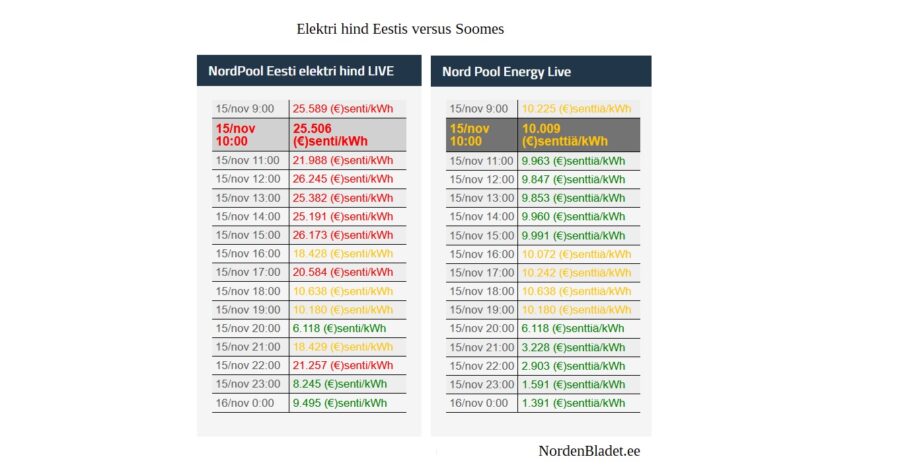
Although the valid stock exchange power price is today, on January 13th, more favorable than earlier (almost a week the price has been in the yellow zone), the prices, as compared to Finland, are partly 20 times higher. While a Finnish citizen pays 1.3 euro cents for electricity’s kilowatt-hour, then in Estonia up to 21 euro cents per kilowatt hour must be paid.
Table 2. Comparison of Finland’s and Estonia’s power prices. Today’s (January 13) power prices in Finland (left column) and Estonian prices in the right column.
What can a simple homeowner do in order to alleviate their complicated situation created by the high power price?
1. Observe power prices daily – you will find real time power prices from the power prices LIVE guidelines. Estonia’s power prices are on NordenBladet.ee site and Finland’s power prices are on NordenBladet.fi website. All who have concluded an hour-based tariff electricity package, for you the amount of the bill will depend on the amount of electricity consumed each hour and on the stock exchange price valid during that hour. Thus it is very important to daily observe the hourly power prices!
NordenBladet’s hour-based power prices graph (electricity market’s PRICES GUIDELINE) allows you to easily and conveniently observe power prices and plan the day’s more power consuming activities to a more favorable time zone. The price guideline functions as a traffic light (red light warns that the prices are high and the green light lets you know the prices are in a favorable zone). We define a price favorable when it is up to 10 euro cents per kilowatt hour.
(Those who have a fixed price stock exchange package need not worry, since the kilowatt-hour based price has been fixed for a certain time period and the bill shows a similar kilowatt-hour price every month).
2. Be aware of the amount of home appliances (technology) that are consuming electricity in your home. A long and thorough insight about domestic appliances that consume power can be found HERE. By knowing how much an electric stove, television, washing machine, computer and other home appliances consume energy, you will be able to make decisions that in conclusion will positively be reflected on your electricity bill.
3. It is possible to cut electricity costs by using several saving tips at home – beginning from a simple “switch the lights off” principle to a proper heat insulation of the building. You can find various tips and recommendations on how to limit electricity consumption HERE.
NordenBladet – People have received their first enormous electricity bills and those who did not yet observe the power prices have carefully started checking the electricity prices and have limited or even completely avoided electricity consumption during the expensive hours. If you are not willing to lose all your salary due to the rising prices of electricity, then the daily power prices should be calculated and you should plan doing laundry, using the oven for several hours or having the floor heating turned on during the more favourable hours, in order to consume electricity in a smart way.
The following is a major and thorough insight – all that you might like to know about power prices and electricity consumption!
1. HOW MUCH DOES ELECTRICITY COST right now in real time? How much does electricity cost today and tomorrow? How do I know when electricity prices are good and when it is expensive?
NordenBladet.fi (Finland’s power prices) and NordenBladet.ee (Estonia’s power prices) hour by hour electricity price tables (electricity price guidelines) give you easy and clear information about electricity market prices (stock exchange of the moment). Simple, intelligible and convenient info about all day’s hour by hour electricity price in a graph showing the current electricity price.
Electricity prices are displayed on NordenBladet home pages sitewide, in the right hand side of the page, in a table. You can look up the exact electricity price from one full hour to the next.
2. How to use NordenBladet’s electricity guideline so that you would be able to consume less power and thus receive a smaller bill by the end of the month?
For a start, check the general provisions of the contract that you have with the service provider and understand exactly what type of conditions you have. In case you have an hour-based stock exchange package then it is vital that you observe the power prices!
Electricity price guidelines can be read as the traffic lights:
? Red – expensive price zone, i.e the day’s highest prices (20-… euro cents kWh) (In order to save money, try using less electricity during this period of time!)
? Amber – average price zone (10-20 euro cents kWh)
? Green – the day’s best price zone (… -10 euro cents kWh). (If you wish to save money and economize, we recommend that you use power during the green time zone!)
(extra to the prices indicated, there will be + VAT, network price according to your network service provider and location of the domestic consumer’s zone, and excise tax)
Home owners and entrepreneurs that have a stock exchange package, are better off when daily observing today’s and tomorrow’s stock exchange price and completing the most power consuming procedures during the most favourable (green) time zone.
By observing the electricity prices you will receive a smaller electricity bill and will be able to save considerable sums (hundreds, in some case even thousands of euros)!
? NordenBladet LIVE electricity price table has been exactly adjusted to the local time (we are displaying Finland’s as well as Estonia’s prices) and it shows in kilowatt-hours the CURRENT POWER PRICE!
Easy, free and intelligible time-based price table for working days as well as weekends.With this Nordenbladet application we will be displaying the daily electricity price that you can easily observe from our website from a computer as well as from your smartphone. Great help every day! Many people who used NordenBladet’s electricity prices already last month, received half of the size of the electricity bills that they might otherwise have received!
3. HOW TO CONSUME LESS POWER and thus save money? What can I do to consume less electricity? I want my average electricity consumption to be less so that I could save electricity. How to limit the electricity costs?
a).Heat insulation
When your living space is not well insulated and your home does not maintain the warm temperature, this will bring forth greater energy consumption. You might consider a proper insulation for the basement, the window sills, and walls. Also during the dark time of the day, use window coverings to minimise the necessity of heating during cold weather. The quickest and cheapest way is to roll up and place a small blanket or a large towel on the window sill as a temporary „wind shield”.
b). Room temperatures
Should you need to heat the rooms directly or indirectly with electricity (geothermal heating / electric radiators), a great financial difference already comes from lowering the temperature just a few degrees. And again, switch the electricity on just during the good price time zone.
c). Review your lighting
About one fourth of the household’s energy costs is usually due to lighting! We recommend you to exchange all light bulbs/halogen lights for LED lamps. LED, i.e. light-emitting diodes is a semi-solid semiconductor that converts electric energy directly into light, as opposed to the light bulb where 95% of the bulb’s light is converted to heat. By using LED lamps/LED bulbs, you save electric energy up to 90% as compared to regular light bulbs!
The life cycle of a LED lamp is up to 50 000 hours which also means economizing on the maintenance side. Also check that the lights are not on without a purpose, in the rooms that are empty, switch the lights off.
d). using the washing machine
Set the program on the day’s best time zone, if necessary, use the machine at night in case the electricity prices are in the red zone (extra high) for long periods of time. Usually night time prices are two times better. Also, usually during the weekend the electricity prices are better. The drier consumes about 450 kWh a year. Drying the clothes on a laundry rack will help you save money.
e). Refrigerator and deep freeze
Quite a few households use more than one fridge and deep freeze. It is reasonable to place all things in one fridge and eliminate the other for winter time. Annually, the energy consumption of an older generation fridge reaches dozens of euros, which may turn out more expensive than the products that are kept in cold. When the temperatures sink and the weather is cold, you may just as well switch off the fridge in the garage or the shed for 24 hours, when the prices are extra high, and then switch them back on again.
f). See if you are at all using all the appliances
Plug off the appliances! When bringing home technology, be smart and choose the energy saving appliances. However… even though the domestic appliances are more and more energy efficient these days, the number of various appliances in homes is very high and thus our energy consumption keeps increasing. Studies have shown that more than one fourths of people keep their utensils on standby. This however means that each watt spent on standby regime brings along the cost of one euro a year. Plug off the utensils and the battery chargers that you are not using daily. The standby energy consumption of your utensils may make up as much as 10 percent of the household’s electricity bill.
4. HOW MUCH DO DIFFERENT UTENSILS consume power? Which home appliances consume most electricity? How much do home appliances /technology consume energy on an average?
The electric stove and oven consume the annual 23%, around 280 + 420 kWh. Considering the average one time consumption to be 1.4 kWh and considering that the stove is being used 300 and the oven 200 times a year, we get the annual energy consumption of 700 kWh. Glass ceramic stove generally consume less energy that metal top stoves with a heater.
Refrigerator – a ten-year-old refrigerator will annually consume 850 kWh electricity, at the same time, the new A+ fridges will use an annual 280 kWh. An average fridge will consume an annual 420 kWh. PS! The more ice gathers, the more grows the energy consumption!
Television – a TV-set will consume the annual 100 kWh. The newest A+++ class led-televisions consume one third less energy than the regular A class efficiency television set, and about 60% less than plasma televisions.
Dish washer – it consumes around 280 kWh annually. On an average, the dish washer can take 12 sets of dishes, using 1 kWh energy. When washing the same amount of dishes by hand, the heating of the water would take an average of 2,5 kWh energy. Therefore the dish washer takes 60% less energy when compared to washing by hand.
Washing machine – consumes about 260 kWh annually.
Tumble dryer – this consumes a lot of energy, an annual 450 kWh. Since it is largely a convenience device, it would be reasonable to give it up to save money. Older machines consume 4 kWh energy per working cycle, for 200 working cycles it will sum up the annual 800 kWh.
Computer – the most energy efficient is a laptop, it consumes 80% less energy than a personal computer. Even more efficient are tablets. The PC consumes the annual 500 kWh electricity, the laptop 60 kWh and the tablet only 3 kWh.
Other home appliances – from smaller home appliances the kettle, the iron, the microwave oven and the vacuum cleaner consume most power. Less power consuming are the coffee machine, blenders and food processors, blow dryers, ventilators, air cleaners. Heating water with an electric boiler makes up about 20% of the annual energy consumption.
Observing the current stock exchange power prices, economizing and awareness of electricity consumption, knowing how much your home technology consumes power, you may save hundreds of euros per month. In case you have an hour-based stock-exchange electricity package, start observing the power prices already today!
Today and tomorrow, Deputy Chair of the European Union Affairs Committee of the Riigikogu (Parliament of Estonia) Raimond Kaljulaid attends the Meeting of Chairpersons of the Conference of Parliamentary Committees for Union Affairs of the Parliaments of the European Union (COSAC) in Paris, France. The main topic of discussion at the meeting will be the achievements and the future of the euro.
“The debate on the achievements and the future of the euro is inspired by the 20th anniversary of the single currency,” Kaljulaid said. “At the meeting, the representatives of the European Union Affairs Committees will have the possibility to present their assessment of the euro in the context of their countries, the euro area and the European Union, and also discuss if the euro area should move today towards greater coordination of the economic policies of its members. Improving of parliamentary control of the functioning of the euro area and strengthening the international role of the euro will be spoken about as well,” the Deputy Chairman added.
The members of national parliaments will also hear about the priorities of the French Presidency and discuss new working methods within COSAC, in particular the creation of new working groups so that the members of national parliaments would have the possibility for more in-depth debate on important issues.
COSAC is a cooperation format that brings together the Committees for Union Affairs of the national parliaments of the 27 Member States of the European Union.
NordenBladet — A new study published on 13 January shows that the most effective support policy for research and development is to allocate subsidies to businesses with high R&D productivity or innovation capacity. Uniformly targeted subsidies – which in practical innovation policy are similar to R&D tax incentives – also bring about substantial growth, albeit to a lesser extent than selectively targeted innovation subsidies.The study suggests that increasing subsidies and tax incentives for research and development is proper policy in Finland. When it comes to direct R&D subsidies, efforts should be made to develop ways to assess the innovation capacity of businesses so that subsidies can be allocated effectively.Understanding the overall economic impact of business subsidies is essential for planning effective support policy and implementing business policy measures. Successful innovation policy can accelerate economic growth and improve competitiveness.The report by researchers from the Research Institute of the Finnish Economy ETLA and the VATT Institute for Economic Research, titled ‘Innovation, reallocation and growth in the 21st century’, offers new insight on the impact of business subsidies on economic growth and the welfare of businesses. Relatively few studies of this type have been conducted around the world, and this is the first study conducted using Finnish data.The project examined policies in which subsidies are targeted to businesses uniformly regardless of R&D productivity and more selectively targeted policies in which subsidies are allocated based on R&D productivity. Implementing a selectively targeted policy means that the officials making decisions on R&D subsidies must be able to distinguish between businesses with a high and low innovation capacity.“By nature, uniformly targeted subsidies are similar to neutral R&D tax subsidies that are not allocated to specific types of businesses or projects. Selectively targeted subsidies, on the other hand, are similar to direct subsidies. The recipients of subsidies must be selected on a case-by-case basis following an assessment of their innovation capabilities; subsidies cannot be allocated based on the general information available for taxation,” says ETLA Research Director Heli Koski.A key finding of the study was that the most effective solution would be a selective innovation policy that allocates R&D subsidies to businesses with high R&D productivity or innovation capacity. A selective subsidy policy would cause low-productivity R&D companies to exit the market. As a result, their resources could be put to more productive use in higher-productivity companies.Uniformly targeted support also leads to a significant growth in the welfare of businesses, but to a lesser extent than selective subsidies. This means that, in general, increasing the amount of R&D subsidies and tax incentives is profitable in Finland.“In practice, it is impossible to allocate R&D subsidies based entirely on the innovation capability of businesses. However, our results on the benefits of uniformly targeted subsidies show that even imperfectly targeted R&D subsidies and tax incentives are proper policy in Finland,” says Research Director Heli Koski.The research team proposes that, in practice, the innovation capabilities of businesses could be assessed based on the number of new products produced over a certain period of time, while also taking into account further innovation that enhances the quality of products or does not, at least not immediately, lead to the creation of new products. Especially in the case of young businesses, it would also be important to be able to assess the company’s future capacity to innovate and the quality of future innovations.
Today at the ceremony held in Tallinn, Estonian Navy Officer Commander Ott Laanemets was assigned as the new commander of the NATO Mine Countermeasures Group One and took over the responsibilities from Polish Navy Officer Commander Michal Dziugan.
„I am humbled to take command of SNMCMG1. Me and most Estonian sailors have been deployed to SNMCMG1 many times and SNMCMG1 has been a red thin line through the whole of Estonian Navy’s development, integration to NATO and operating alongside allies. Since establishment in 1973 the tasks of SNMCMG1 have remained the same – provide the Alliance with immediately ready mine countermeasures capability and demonstrate the cohesion of allies. I will do my best to deliver a ready mine countermeasures capability for the Alliance during these challenging times,“ said Commander Ott Laanemets.
The new commander will be responsible for leading the unit and maintaining combat readiness as part of the NATO Response Force. This includes training within the SNMCMG1, exercises with allies, mine countermeasures operations and participation in major NATO exercises.
In accordance with the practice of the ceremony, the new commander’s pennant was hoisted on the new SCMCMG1 staff ship LVNS Virsaitis and the former commander’s pennant was returned to Commander Michal Dziugan.
„Every organization, group is as strong, as the people making it, and we had luck to have within the staff and command platform to meet and to cooperate with amazing people,“ said Commander Michal Dziugan.
In addition to the new commander and its staff, the ceremony was also attended by the Polish ambassador in Estonia Grzegorz Kozłowski, the former commander of SNMCMG1, the previous staff, the crew of the new group’s staff ship LVNS Virsaitis and the crew of the minehunter EML Sakala, which will also be part of the SNMCMG1 this year.
Commander Ott Laanemets has formerly been deployed as the commander of EML Sakala and as the chief of staff of SNMCMG1.
Since 2005, Estonia has contributed to the NATO Mine Countermeasures Group one with staff ships, minehunters and a commander and staff. The minehunters take part of the group annually, the Estonian commander and the staff have previously been a part of SNCMGM1 once in 2016-2017.