Reklaam

Helena-Reet Ennet

Helena-Reet Ennet
4698 POSTS 0 COMMENTS

Changes to opening hours of food and beverage service businesses and to use of COVID-19 passport

NordenBladet — The Government has amended the decree that restricts the activities of food and beverage service businesses due to the COVID-19 epidemic. From now on, all food and beverage services businesses must close at 18.00. In addition, the restrictions on the use of the COVID-19 passport will be extended until the end of January. The decree on the opening hours of food and beverage service businesses will enter into force on 12 January 2022 at 00.00 and it will remain in force until 31 January 2022. The decree restricting the use of the COVID-19 passport will enter into force on 12 January 2022.Until 31 January 2022, COVID-19 passport cannot be used as an alternative to restrictionsThe Government has updated the decree on temporary restrictions to the use of the COVID-19 passport issued under section 58i of the Communicable Diseases Act. In practice, this means that until 31 January 2022 the COVID-19 passport cannot be used as an alternative to regional restrictions on public events and customer premises.The decree will apply to all public events and customer premises that are subject to existing restrictions. Regional authorities will decide what restrictions are in place in their areas. The decree will apply to the areas of the hospital districts that meet the characteristics of community transmission areas.Restrictions on food and beverage service businesses in community transmission areas from 12 January at 00.00Restrictions on food and beverage service businesses that are necessary to prevent the spread of the epidemic will be introduced in all community transmission areas.The restrictions for community transmission areas will apply to the regions of Uusimaa, Southwest Finland, Satakunta, Kanta-Häme, Pirkanmaa, Päijät-Häme, Kainuu, Kymenlaakso, South Karelia, North Karelia, Central Finland, Ostrobothnia, South Ostrobothnia, Central Ostrobothnia, North Ostrobothnia, Lapland, South Savo, North Savo and Åland.Serving of alcoholic beverages in all food and beverage service businesses will end at 17.00. Such businesses may keep their premises open to food and beverage service customers between 5.00 and 18.00. The restriction will also apply to businesses that do not serve alcoholic beverages (e.g. cafes and fast food restaurants).Food and beverage service businesses that primarily serve alcoholic beverages may have only half the normal number of customer seats in use in their indoor and outdoor premises. Other food and beverage service businesses are restricted to 75 per cent of their normal number of customer seats indoors.All customers must have their own seats at a table or similar in indoor premises.Restrictions on food and beverage service businesses cannot be circumvented by using COVID-19 passportThe use of the COVID-19 passport will not exempt food and beverage service businesses from the restrictions on customer numbers and opening and licensing hours. Serving of alcoholic beverages in all food and beverage service businesses will end at 17.00. All food and beverage service business will be required to close at 18.00The restrictions on the use of the COVID-19 passport will be in force until 31 January 2022.
The obligation to observe the general hygiene guidelines and to keep a safe distance applies in all regions.
Even if the use of the COVID-19 passport does not exempt food and beverage service businesses from the restrictions as before, all food and beverage service businesses in Finland will still have the right to require customers to present the COVID-19 passport at all hours.Exceptions to restrictions remain unchangedThe restrictions laid down in the decree do not apply to the activities of staff restaurants or to takeaway sales of food to customers. The restrictions on opening hours do not apply to food and beverage service businesses on vessels and aircraft that operate between Finland and other countries or abroad or to food and beverage service businesses that operate at distribution stations for liquid fuels.

Source: Valtioneuvosto.fi
The Riigikogu discussed the use of rapid tests as proof of non-infectiousness

NordenBladet —

At today’s sitting, the Riigikogu discussed the draft Resolution that was intended to make a proposal to the Government to accept negative COVID-19 rapid test result as proof of non-infectiousness in public spaces and events. The Riigikogu did not pass the Resolution.

The Draft Resolution of the Riigikogu “Making a Proposal to the Government of the Republic “To Accept Negative COVID-19 Rapid Test Result as Proof of Non-infectiousness”” (484 OE) was submitted by the Estonian Conservative People’s Party Faction.

During the debate, Anti Poolamets (Estonian Conservative People’s Party), Helir-Valdor Seeder (Isamaa), Tiiu Aro (Reform Party) and Jevgeni Ossinovski (Social Democratic Party) took the floor on behalf of their factions.

30 members of the Riigikogu voted in favour of passing the Resolution, but a majority vote of the members of the Riigikogu, that is, 51 votes in favour, was needed for the Resolution to be passed.

The first reading of a Bill was adjourned

Due to the end of the working hours of the sitting, the first reading of the Bill on Amendments to the Traffic Act (433 SE), initiated by the Social Democratic Party Faction and Member of the Riigikogu Raimond Kaljulaid, was adjourned and will continue at tomorrow’s sitting.

According to the Bill, in the interests of the road safety of pedestrians, the speed limit for personal transporters will be restricted on some roads, and local governments will be given the right to apply additional restrictions where necessary.

Verbatim record of the sitting (in Estonian)

The video recording of the sitting will be available on the Riigikogu YouTube channel.
(Please note that the recording will be uploaded with a delay.)

Source: Parliament of Estonia

Migration Institute report highlights development needs for authorities to better prevent exploitation of foreign labour 

NordenBladet — The exploitation of foreign labour is expected to grow in Finland as work-based immigration increases. Preventing problems requires more information on exploitation-related phenomena and investments in the resources and cooperation between authorities. In spring 2021, the Ministry of Economic Affairs and Employment commissioned a report from the Migration Institute of Finland on the support needs and knowledge gaps of the authorities in preventing exploitation of foreign labour. The report supports in particular the implementation of the amendment to the Aliens Act (554/2021) in the Finnish Immigration Service. The amendment entered into force on 1 October 2021. The Aliens Act was amended to include new, special permit types for victims of work-related exploitation. This means that the Finnish Immigration Service will receive new tasks and the administrative and legal practices related to them will only develop over time.“Promoting labour migration also requires effective measures to combat exploitation. The Immigration Service will need all possible support to succeed in this demanding task. The Migration Institute’s report highlights areas of development and in this way facilitates authorities’ work,” says Minister of Employment Tuula Haatainen.Supervision alone is not enoughThe report identifies a number of development needs for the authorities to improve their work. A key conclusion is that the internationalisation of the labour market and the legislative amendment underline the increased role of the authorities in safeguarding the rights of foreign workers, in contrast to mere licensing and supervision duties. Building trust between the victims of exploitation and authorities will encourage victims to report suspected abuse to the authorities without any unnecessary fear. “The authorities possess a great deal of specialised expertise in the prevention of work-related exploitation, but expanding and improving these activities nationally require that different authorities streamline their operating models and establish clear objectives,” says Mika Raunio, Senior Researcher at the Migration Institute. The proposed measures will be evaluated and prepared for implementation in the relevant administrative branches to support the prevention of the exploitation of foreign labour as well as possible. 

Source: Valtioneuvosto.fi

Finland performs comparably well in implementing EU Single Market rules

NordenBladet — The European Commission has published the Single Market scoreboard that measures the implementation of the Single Market rules in the Union during 2020. The Single Market refers to the free movement of people, goods, services and capital in the EU. The Commission has extended the scope of the scoreboard to include three new policy areas: business environment for SMEs, greening of the industry, and market surveillance.The Single Market Scoreboard provides an overview of how the EU’s single market rules were implemented and applied in each country. The Scoreboard compares the implementation of the EU Single Market in eight policy areas as well as the application of ten governance tools. The implementation of the Single Market improved slightly in certain monitoring areas throughout the EU in 2020. The state of the Single Market has remained stable overall. As in previous years, Finland scored better than the EU average.Despite the general good development, all EU Member States have certain areas where they need to improve the implementation of the Single Market. The coronavirus pandemic has also affected the operation of the Single Market. While the digital transition is progressing, at the same time certain Member States have restricted the free movement of goods within the EU.Country-specific comparisons show in concrete ways what matters in national legislation the Member States should focus on to develop the Single Market. A more efficient implementation of the Single Market rules would allow companies and citizens to benefit from the single market freedoms and rights better than now. Three new policy areas in ScoreboardThis year, the Single Market Scoreboard includes three new policy areas: business environment of small and medium-sized enterprises (SMEs), greening of the  industry, and market surveillance. The coronavirus pandemic has hampered the operations of many SMEs and their number fell by 1.3% in the EU in 2020. While the year 2021 has been slightly better than the previous one, EU countries must continue to invest in creating a favourable business environment for SMEs.Another new policy area on the Scoreboard examines the progress of green transition in Europe’s industry. A large part of the European industry is still based on the consumption of natural resources. The green transition will renew the EU’s industry and economy as a whole in the near future. Market surveillance – an essential part of a well-functioning internal market – is the third new policy area added to the Scoreboard. Market surveillance ensures that products comply with regulations and do not endanger consumers in the EU internal market. Key highlights of the Single Market Scoreboard for 2020A well-functioning single market requires more effort and action from the Member States.In 2020, it took EU Member States longer than before to transpose single market directives into national legislation. More and more directives had not been implemented by the deadline. The number of single market-related infringements has also risen. Member States must make more effort to implement the directives and to prevent and tackle infringements. Member States must ensure the necessary administrative resources for the implementation of the Single Market. For example, too few human resources in the SOLVIT service delay the processing of cases. SOLVIT is an informal problem-solving tool that helps citizens and companies in problems concerning incorrect or incomplete application of EU regulations. Better access to information and advice on the single marketEU citizens have better access to information on the single market through different information and advisory services. Last year, over 2,600 cases were submitted to SOLVIT, of which 80% were solved. Another example of help and advice services for EU citizens is the Your Europe portal, which contains information and advice on the Single Market rights of citizens and companies. The portal attracted nearly 33 million views in 2020. Public procurement should pay more attention to Single MarketPublic procurement plays an important role in the economies of the Member States. Implementation of the Single Market rules in public procurement needs to be improved, as many calls for tender attract only few bids and the lowest price remains the sole award criterion in a many calls. The absence of open and effective competition is an obstacle to the completion of the Single Market.

Source: Valtioneuvosto.fi

Elements of AI course continues to increase artificial intelligence skills among Europeans

NordenBladet — Elements of AI, launched during Finland’s Presidency of the Council of the EU, is the first educational course launched across Europe and an important investment in artificial intelligence (AI) skills throughout the continent. The course is available in all official EU languages. It was started with funding from the Ministry of Economic Affairs and Employment and will continue to increase Europeans’ competence in AI in cooperation with the University of Helsinki and Reaktor.As part of its Presidency in 2019, Finland donated the Elements of AI course to all Europeans. The European Commission translated the course into the Union’s official languages and it was made available in the EU Member States in cooperation with local partners. According to a preliminary plan, the course would have been free for Europeans to attend in 2020−2021. However, Reaktor and the University of Helsinki have decided to continue offering the course to Europeans also after 2021.The objective of the course was to train one per cent of EU citizens in the basics of artificial intelligence, and thereby strengthen digital competence in the whole of EU. The coronavirus pandemic delayed the launch of the course in many countries. At the same time, the pandemic has highlighted the importance of digital skills in people’s daily lives as well as in different sectors. “Digitalisation and rapid changes in working life require continuous learning from all of us. Elements of AI is an excellent example of different options for continuous learning. I am proud that Finland donated the course as part of its Presidency to the whole of Europe,” says Minister of Employment Tuula Haatainen.“Artificial intelligence is one of the key technologies that enable sustainable growth and competitiveness in the EU. It is important that Finland and Europe continue to lead digital and technological development, and the Elements of AI course in part contributes to achieving this goal. The work on this topic will continue at the Ministry of Economic Affairs and Employment, for example in the Artificial Intelligence 4.0 programme, which aims to strengthen the digitalisation of Finnish SMEs,” says Minister of Economic Affairs Mika Lintilä.Course strengthens Finland’s image as a pioneer in education, gender equality and technologyThe number of participants in the course has varied from country to country. In Finland, more than two per cent of the population have already attended the course. Croatia comes second, with almost one per cent of the population having completed the course so far. The course has received very positive feedback from all over Europe and it has been described as instructive and accessible.Across Europe, men and women have been equally interested in the course. As regards age distribution, the most participants in the course have been young adults. However, older people are also interested in artificial intelligence, with nearly 12 per cent of the attendees aged over 65.“The majority of users attend the course to improve skills needed in working life. We will enhance not only AI competence but also learning skills. What would be a more suitable objective for an educational innovation from Finland than supporting continuous learning all over the world?” says Professor Teemu Roos, who developed the course.The course was launched in several countries in cooperation with Finnish embassies and local partners.“The Elements of AI course has attracted positive attention across Europe. At the same time, it has strengthened Finland’s image as a leader in education, gender equality and technology,” says Mikko Koivumaa, Director General of Communications at the Ministry for Foreign Affairs.Elements of AI to expand and develop furtherThe courses will continue under the direction of Reactor and the University of Helsinki. Local partners have been found in all participating countries, with the aim to expand the course to different educational institutions, for example. “We are pleased to be involved in exporting Finnish expertise in this way too. When European universities and other actors join to solve educational challenges, we can ensure that both Finns and Europeans have the needed skills for the future,” says Sari Lindblom, Rector of the University of Helsinki. “Launching this course is only the first step towards the one per cent target. We will continue to work closely with our broad network in Europe and encourage new sectors and organisations to join our AI challenge. I would like to thank the Finnish missions for their valuable work in promoting the country partner network and raising awareness of the course,” says Ville Valtonen from Reaktor Education.

Source: Valtioneuvosto.fi

Amount of reimbursement for COVID-19 vaccinations administered by occupational healthcare to be raised 

NordenBladet — The amount of reimbursement will be raised from the current EUR 10 to EUR 16. The temporary provision will enter into force on 10 January 2022 and it will remain in force until 30 June 2022.The legislative amendment will secure and facilitate access to COVID-19 vaccination for people covered by health insurance and give employers better opportunities to provide COVID-19 vaccination through occupational healthcare.Municipalities are responsible for COVID-19 vaccinations. They must, however, determine whether occupational healthcare service providers that operate in their areas can participate in the rollout of COVID-19 vaccinations, if this is necessary to ensure the provision of vaccinations without delays. The Social Insurance Institution of Finland, Kela, can continue to reimburse COVID-19 vaccinations administered by occupational healthcare either as occupational healthcare costs or as medical expenses. The reimbursement for COVID-19 vaccinations may be paid directly to private occupational healthcare service providers while employers are liable for paying a deductible for vaccinations.Compared to the current situation, raising the amount of reimbursement will reduce the occupational healthcare costs to employers when COVID-19 vaccinations are included in occupational healthcare services. The total costs to employers will depend on the contract made with occupational healthcare.The Government submitted the bill amending the Health Insurance Act for approval and the President of the Republic approved the bill on Friday 7 January 2022. The amended Act will enter into force on 10 January 2022. The higher reimbursement amount will apply to COVID-19 vaccinations carried out on or after 1 January 2022.
 

Source: Valtioneuvosto.fi

Foreign Affairs Committee: NATO’s Eastern Flank needs immediate reinforcement

NordenBladet —

Today, the Foreign Affairs Committee of the Riigikogu (Parliament of Estonia) held an extraordinary video sitting to discuss Estonia’s positions at the extraordinary virtual meeting of NATO Ministers of Foreign Affairs, which will take place tomorrow. The Committee pointed out that Russia’s demands should not be a basis for negotiations and NATO’s Eastern Flank needed immediate reinforcement.

According to Chairman of the Foreign Affairs Committee Marko Mihkelson, Minister of Foreign Affairs Eva-Maria Liimets told the Committee that the agenda of tomorrow’s meeting of NATO Ministers of Foreign Affairs covered broader European security issues, the issues relating to Ukraine and preparations for the NATO-Russia Council.

Mihkelson underlined that Russia had made several ultimative demands that must not be the basis for any talks. Also, no concessions should be made on the sanctions imposed on Russia, because the aggression against Ukraine has not abated in the slightest.

The Chairman of the Foreign Affairs Committee thinks that it is important that the NATO allies unanimously support the territorial integrity of both Ukraine and Georgia. Mihkelson emphasised that that in the current security situation, the Foreign Affairs Committee considered it essential to reinforce NATO’s Eastern Flank. “It is in our direct interest that the reinforcement of NATO’s Eastern Flank took place now and immediately,” Mihkelson said.

Deputy Chairman of the Foreign Affairs Committee Mihhail Lotman also underlined that the NATO side must not base its talks with Russia on the latter’s agenda, but had to be proactive and present its own demands. “It should be made clear that Russia’s greater security risks arise from its own aggressive adventures,” Lotman said. Lotman also stated that we must not let ourselves be misled by Russia’s terminological games.

Source: Parliament of Estonia

Helena-Reet: Waking up with excitement, living to the fullest, NEW PAINTING AGAIN and an overview of tonight’s non-alco beer testing

NordenBladet – For the past two days I have again been on the creativity and art wavelength. When looking out of the window in the morning I once more admitted that life in the countryside is amazing, that my home is amazing. Though life in the countryside is a luxury and not always easy to lead, I absolutely enjoy every moment of it. Living in the countryside is inspiring. Snowy wild and beautiful scenery, burning wood in the furnace, the purring cat, a large personal piece of land of the beautiful Estonia, silence, peace (unless this silence is interrupted by the noisy music sometimes voluntarily coming from my speakers).

I enjoyed a long and calm breakfast along with today’s newspapers. I drank a glass of God Morgon red grape juice, two cups of coffee, and ate my favorite breakfast – a toast with onion, salmon and caviar! Yummm… Then I took two shots of Chaga elixir and went outside to plow the snow. In the fresh air I smoothly burnt several hundred calories and gathered over 6000 steps. Then back inside, a shower, and off to the beauty salon.


Today I had my eyelashes done. I have my eyelashes and eyebrows done every 2-3 weeks, it is comfortable and then I can look fine without having to spend time on putting on any make-up. I put on make-up only when I have a photo shoot or a major event coming, on a daily basis never really.

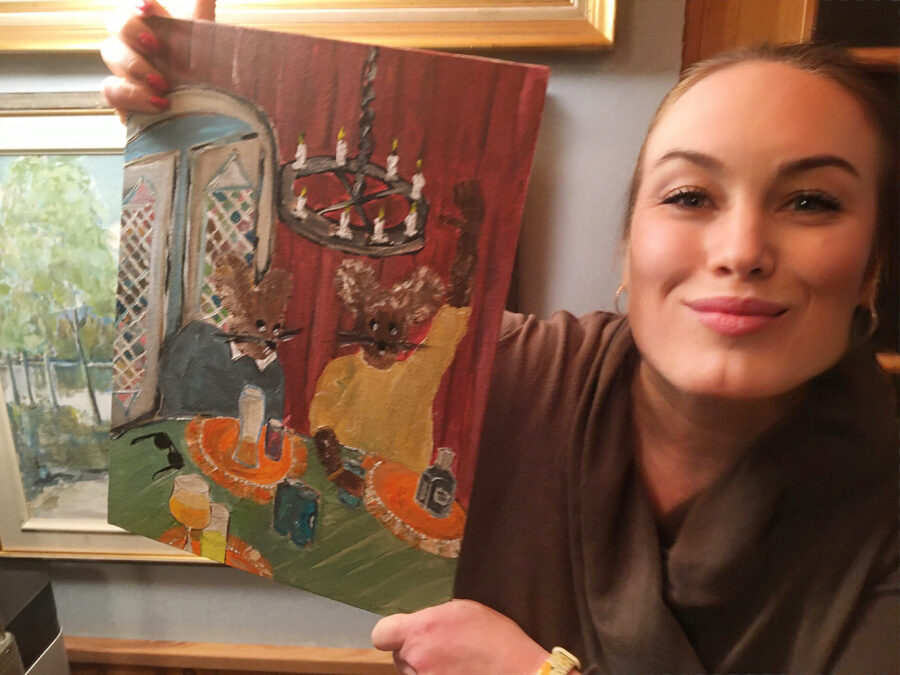
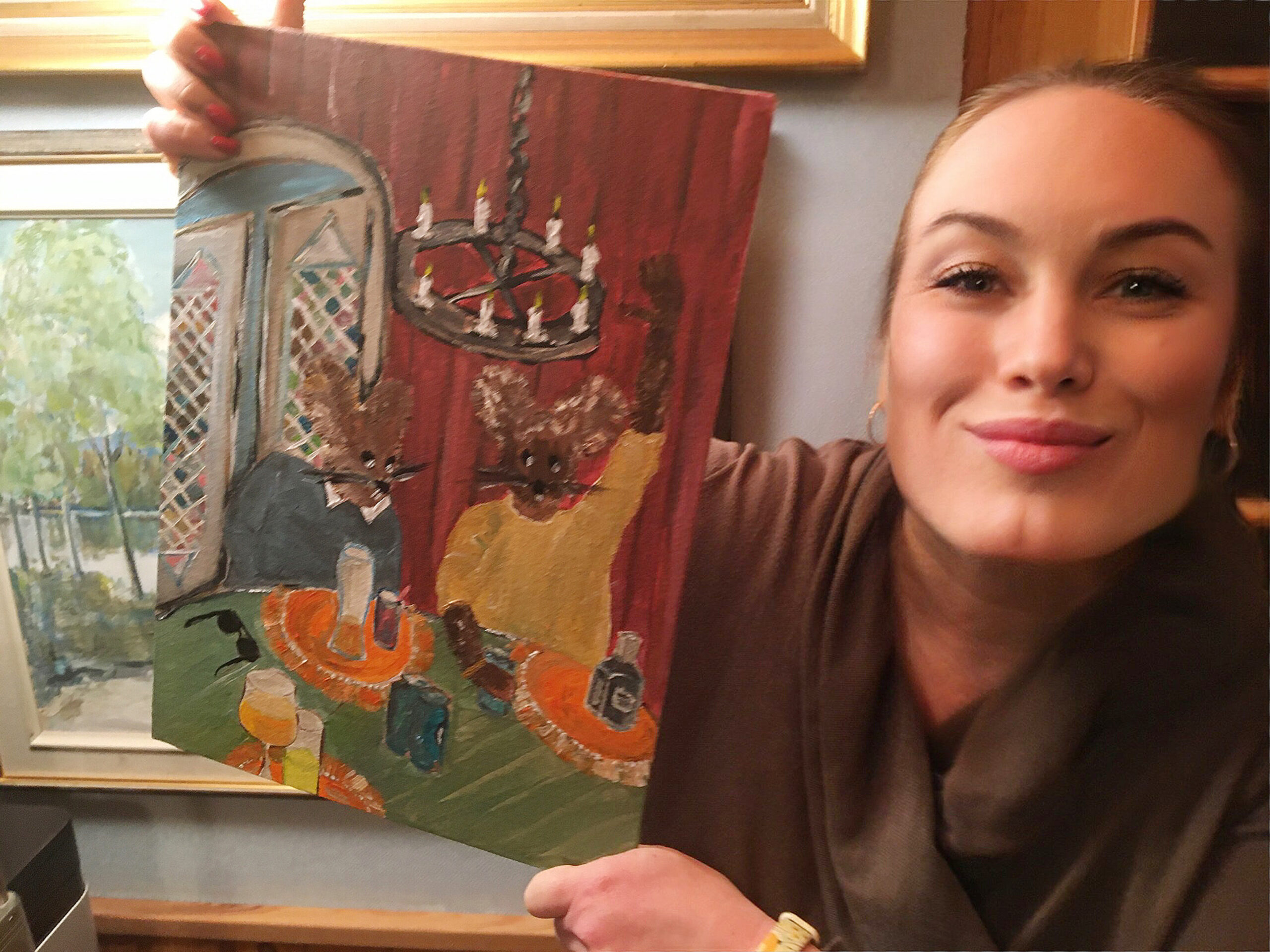
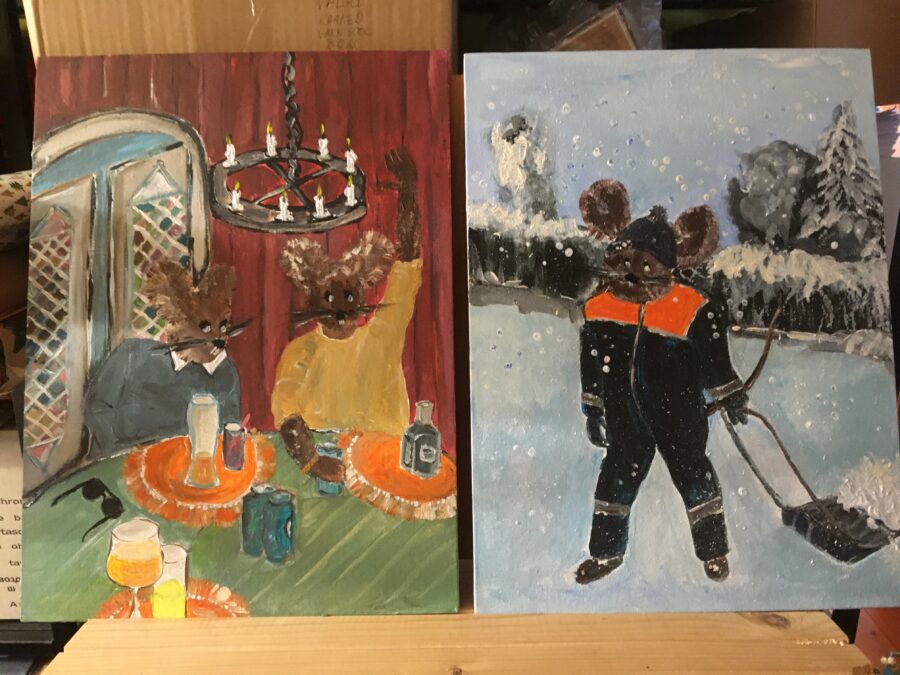
This month I have already completed two paintings – about the first, where the mouse boy Ivar Apodemus plows the snow, I already wrote in my NordenBladet blog (see HERE), my ElishevaShoshana.com art blog (see HERE) and my OHMYGOSSIP site (see HERE). Yesterday evening I completed yet another painting (His Highness Mouse the First – series painting nr 16). It depicts two mice in the pub. I am really full of enthusiasm and power, and the more I do the more I have new energy. Recently I have been reading Merit Raju’s book “Life on a new level – Wake up with excitement. Live to the fullest. Sleep in peace.” Life really is on a new level when you focus on your development, dream, and make your dreams come true, give the best you have and have courage to be seen, be honest, loving, free and creative. Today I can claim all of this about myself – I wake up with excitement and happiness, and go to bed fulfilled!


I have already posted that I decided to give up alcohol for an indefinite time. This is a gift to myself, not any kind of suffering or any of the new year’s resolutions. Yet since I like it, I have to replace it with something. I really like herbal teas which I also prepare very often from the herbs I have gathered, but I also like the taste of beer. Namely the taste, not that it comes with spirits. Thus I am testing various non-alco 0%-0,5% beers. One of my favorite is the green can non-alco Go Pilsner by Saku brewery (the price-quality proportion is suitable), yet also several other non-alco beers taste good.

Today I tested six beers and here is my evaluation of them 🙂

1. place: A.Le Coq “Warsteiner Premium Fresh” (23 kcal / 0%). Super good, big applause and words of praise… it came first very easily to my mind. It is very tasty and it really feels real, I wouldn’t believe it was non-alco, if I didn’t know.
2. place: Heineken (21 kcal / 0%) Second and third place taste quite similar, Heineken perhaps is stronger than Carlsberg. Both taste good and are great beers.
3. place: Carlsberg (20 kcal / up to 0.5%)
4. place: Budweiser Budvar (15,5 kcal / up to 0.5%) You can drink it but it is not as good as the previous three.
5. place: Stella Artois (18 kcal / 0%) Had the aftertaste of an apple, didn’t like it much.
6. place: Clausthaler (26 kcal / up to 0.5%) – this, from the six beers, was the worst, actually the only one I didn’t really like. Had a weird strong aftertaste.

That’s all for this time! Have fun!
Hugs!

Do read also my previous blog posts (all posts are available in four languages – Estonian, Finnish, Swedish and English!)

Recent blog posts:
Helena-Reet: SHOULD I get a “winter home” in Spain, about cultural events, and about the new Mouse painting + GALLERIES!
Helena-Reet: Shocking documentaries, my wonderful life + OUR TODAY’S NEW YEAR’S EVE!
Helena-Reet: Christmas + BIG GALLERY added
Helena-Reet: Today’s blog – Wonderful life in the countryside, operetta “The Merry Widow” in Estonian National Opera, Paintball, 2 birthdays and ginger bread season!
Helena-Reet: In Tartu V SPA and in Vorbuse, the Comedy Estonia “Autumn Tour” and plenty of other exciting things!
Helena-Reet: COMPLETE overview of my week and AHH, MEN, HOW GOOD IT IS THAT YOU EXIST!
Helena-Reet: Operetta “The Count of Luxembourg”, talkshow with the Timmers in Vatican Tallinn, and Sunday’s Father’s Day
Helena-Reet: Making presents, ordering beauty products, and about the renovation of the children’s room! WISHED-ACCOMPLISHED! + BIG GALLERY!
Helena-Reet: The weekend in Pärnu (Viking SPA Hotel, the restaurants Steffani and Kolhethi) and children’s school holiday…
Helena-Reet: That feeling when you dream of something extraordinary and the reality is EVEN BETTER! + Netflix series Squid Game, Alice in Borderland etc.
Helena-Reet: In Viru Variety Entertainment Hall, enjoying the revue theatrical entertainment Starlight Cabaret night “Creme de la Creme” + BIG GALLERY & VIDEO!
Helena-Reet: For the past two weeks we have actively worked on our home or rather say homes + OTHER STORIES!

Temporary restrictions on use of COVID-19 passport into force in Åland

NordenBladet — The Government has amended the decree on temporary restrictions to the use of the COVID-19 passport referred to in section 58i of the Communicable Diseases Act. The COVID-19 passport cannot be used as an alternative to regional restrictions on public events and customer premises in Åland.The amendment to the decree will enter into force on Friday 7 January 2022 at 00.00.By virtue of the decree, the effects of the COVID-19 passport will be temporarily restricted between 30 December 2021 and 20 January 2022, when it cannot be used as an alternative to regional restrictions on certain public events and customer premises.The decree will apply to all public events and customer premises that are subject to existing restrictions. Regional authorities will decide what restrictions are in place in their areas. Any questions on the restrictions should be directed to the Regional State Administrative Agencies. They also supervise compliance with the restrictions.The derogation to the use of the COVID-19 passport will apply to the areas of the hospital districts that meet the characteristics of community transmission areas. These include the following hospital districts: Helsinki and Uusimaa, Southwest Finland, Satakunta, Kanta-Häme, Pirkanmaa, Päijät-Häme, Kymenlaakso, South Karelia, North Karelia, South Savo, East Savo, North Savo, Central Finland, Vaasa, South Ostrobothnia, Central Ostrobothnia, North Ostrobothnia, Länsi-Pohja and Lapland and in Åland.This temporary regulation, necessitated by the exceptional epidemiological situation, will help in safeguarding people’s right to health and wellbeing by curbing the rapid spread of the disease. Improving the vaccination coverage is the most significant means of curbing the epidemic effectively.The Ministry of Social Affairs and Health instructs the Regional State Administrative Agencies to examine the restrictions on public events and customer premises in their areas of operation, especially as concerns low-risk events.

Source: Valtioneuvosto.fi
Restrictions on food and beverage service businesses applicable in community transmission areas to be introduced in Åland

NordenBladet — The Government has amended the decree restricting the activities of restaurants and other food and beverage service businesses due to the COVID-19 epidemic. Restrictions on food and beverage service businesses that are necessary to prevent the spread of the epidemic will be introduced in Åland.The decree will enter into force on Friday 7 January at 00.00.Restrictions on food and beverage service businesses in community transmission areas from 7 January at 00.00The restrictions for community transmission areas apply to the regions of Uusimaa, Southwest Finland, Satakunta, Kanta-Häme, Pirkanmaa, Päijät-Häme, Kymenlaakso, South Karelia, North Karelia, Central Finland, Ostrobothnia, South Ostrobothnia, Central Ostrobothnia, North Ostrobothnia, Lapland, South Savo and North Savo and in Åland.Serving of alcoholic beverages in all food and beverage service businesses will end at 17.00. The premises may be open to food and beverage service customers from 5.00 to 18.00. The restriction also apply to restaurants that do not serve alcoholic beverages (e.g. cafes and fast food restaurants). Restaurants that mainly serve food may remain open until 20.00, provided that the customers are required to present the COVID-19 passport.Food and beverage service businesses that primarily serve alcoholic beverages may have only half of the normal number of customer seats in use in their indoor and outdoor premises. Other food and beverage service businesses are restricted to 75 per cent of their normal number of customer seats indoors. The restrictions on the number of customer seats do not apply in Åland.All customers must have their own seats at a table or similar in indoor premises.If food and beverage service businesses intend to require their customers to present a COVID-19 passport, the requirement must apply throughout the opening hours of the business.Temporary changes to use of COVID-19 passport from 7 January at 00.00As from Tuesday 28 December, the use of the COVID-19 passport will not exempt food and beverage service businesses from the restrictions, as has been the case so far. Serving of alcoholic beverages in all food and beverage service businesses will end at 17.00. Food and beverage service businesses that primarily serve alcoholic beverages will be required to close at 18.00. Restaurants that mainly serve food may, however, remain open until 20.00, provided that the customers are required to present a COVID-19 passport.The restrictions on the use of the COVID-19 passport will be in force until 20 January 2022.Restrictions on food and beverage service businesses in the region of Kainuu from 7 January at 00.00There are no separate restrictions on the number of customers or on licensing and opening hours.The obligation to observe the general hygiene guidelines and to keep a safe distance applies in all regions.Even if the use of the COVID-19 passport will not exempt the businesses from the restrictions as has been the case so far, restaurants still have the right to require customers to present the COVID-19 passport at all hours.If food and beverage service businesses intend to require their customers to present a COVID-19 passport, the requirement must apply throughout the opening hours of the business.Exceptions to restrictions remain unchangedThe restrictions laid down in the decree do not apply to the activities of staff restaurants or to takeaway sales of food to customers. The restrictions on opening hours do not apply to food and beverage service businesses on vessels and aircraft that operate between Finland and other countries or abroad or to food and beverage service businesses that operate at distribution stations for liquid fuels.

Source: Valtioneuvosto.fi