NordenBladet – Tjodhilde was credited for Erik the Red’s conversion to Christianity and the building of the first church on the North American continent.
Tjodhilde’s husband, Erik the Red, had the honour of being the first European to set foot in Greenland, and their son, Leif Eriksson, was the man who not only brought Christianity to the Viking community in Greenland, but was also the first European to make landfall in North America, some 500 years before Columbus.
Tjodhilde herself, however, also achieved remarkable feats: It was she who was behind the first Christian church on the North American continent in Brattahlid, and it was also she who converted her warlike, pagan husband to Christianity.
RECONSTRUCTION IN QASSIARSUK
Today, more than 1000 years later, Tjodhilde’s wish concerning the erection of a church has in a way been fulfilled once again.
Since the start of the new millennium, travellers to the south of Greenland have had the chance to visit accurate reconstructions of Tjodhilde’s Church and Erik the Red’s longhouse.
The reconstructions in Qassiarsuk, which is the Greenlandic name for Brattahlid, are built in turf and timber not far from where the original church was sited.
The internal dimensions of the church are just 2 x 3.5 metres (6.5 x 11.5 feet) and although it is a bit of a squeeze, there is actually room for 20 – 25 people.
NordenBladet – The Vikings settled in southern and western Greenland about 1,000 years ago. Brattahlid is the best preserved of Old Norse settlements.
TRAVEL IN THE FOOTSTEPS OF THE VIKING SETTLERS
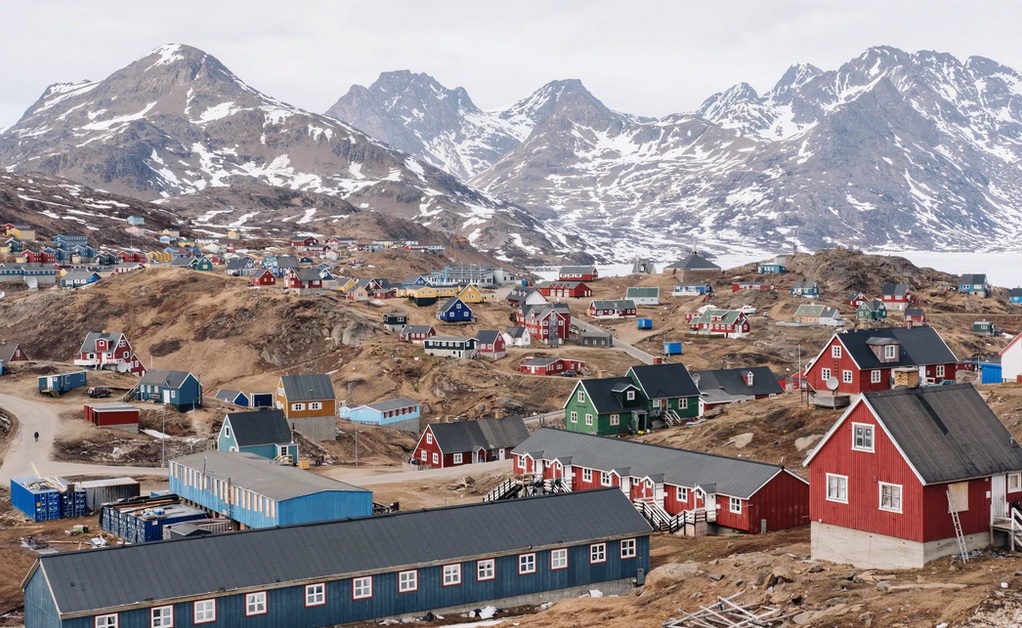
The traces of the Vikings – also called the Norse – can be found in the innermost and warmest fjord systems in South- and West Greenland. The landscape here continues to be dominated by large ruins of farms, stables, storerooms, etc., made of sandstone and granite blocks. The ruins can be anything up to 1000 years old.
GREEN LANDSCAPES
Lots of the same land that the Viking settlers originally cultivated is today occupied by enterprising sheep farmers and other farmers who offer guests overnight accommodation on the banks of deep fjords and or on grassy mountain slopes. Nature-lovers can thus experience authentic settings as they begin to explore the area in the footsteps of the earlier Norse settlers.
THE BEST PRESERVED RUINS
The best preserved ruins are found in Southern Greenland, where around 500 groups of ruins have been unearthed. After just half an hour by boat from Narsarsuaq international airport, you arrive at Qassiarsuk, where the fascinating Brattahlid ruins can be seen.
The area is also home to a reconstruction of a Viking longhouse and Tjodhilde’s Church which was the first Christian church built on the North American continent.
Brattahlid is also the location from where Leif Eriksson set sail and discovered Vinland – the North American continent at Newfoundland and Labrador.
HVALSEY CHURCH RUINS
If you are in the vicinity of Qaqortoq, you must not miss out on the chance to go on an excursion to the beautiful Hvalsey Church which is by far and away the best preserved ruin in the country.
The final accounts of the Norse population were heard from here through a wedding described in the Vatican’s annals in 1408. After this account, no further written evidence exists – only the mystery of what become of the Viking population.
THE VIKING POPULATION IN NUUK
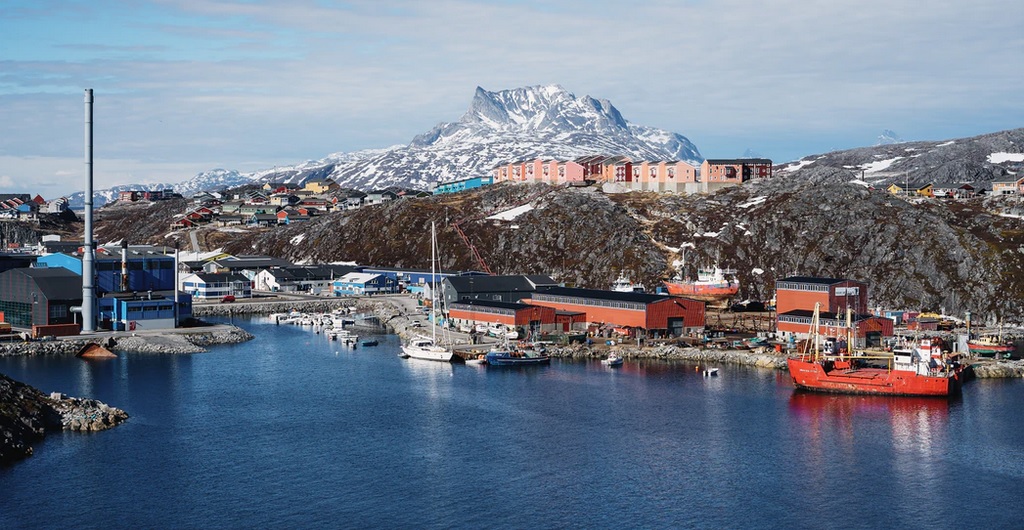
The Viking settlers did not only restrict themselves to the south of Greenland, as evidenced by the fact that in the innermost fjords near the capital of Nuuk up to 100 groups of ruins have been found. These ruins can be reached on a daytrip by boat or by taking a helicopter flight.
NordenBladet – Greenland heads to the polls on Tuesday in snap elections which could have major consequences for international interests in the Arctic. The vast territory, which belongs to Denmark but is autonomous, lies between North America and Europe and has a population of just 56,000.
Greenland’s economy relies on fishing and Danish subsidies, but melting ice and a planned mine could change the course of the vote – and the territory’s future.
Here’s what you need to know.
What’s at stake Disagreement over a controversial mining project in the south of Greenland has split the government and paved the way for this week’s election.
The company that owns the site at Kvanefjeld says the mine has “the potential to become the most significant western world producer of rare earths”, a group of 17 elements used to manufacture electronics and weapons.
The Siumut (Forward) Party supports the development, arguing that it would provide hundreds of jobs and generate hundreds of millions of dollars annually over several decades, which could lead to greater independence from Denmark.
But the opposition Inuit Ataqatigiit (Community of the People) party has rejected the proposal, amid concerns about the potential for radioactive pollution and toxic waste.
The future of the Kvanefjeld mine is significant for a number of countries – the site is owned by an Australian company, Greenland Minerals, which is in turn backed by a Chinese company.
Why is Greenland important? Greenland has hit the headlines several times in recent years, with then-President Donald Trump suggesting in 2019 that the US could buy the territory.
Denmark quickly dismissed the idea as “absurd”, but international interest in the territory’s future has continued.
China already has mining deals with Greenland, while the US – which has a key Cold War-era air base at Thule – has offered millions in aid.
Denmark has itself acknowledged the territory’s importance: in 2019 it placed Greenland at the top of its national security agenda for the first time.
And in March this year, one think tank concluded that the UK, the US, Australia, Canada and New Zealand – known collectively as the Five Eyes – should focus on Greenland to reduce their dependency on China for key mineral supplies.
Mining isn’t Greenland’s only issue, however.
The territory is on the front line of global warming, with scientists reporting record ice loss last year. This in turn has significant implications for low-lying coastal areas around the world.
But it is the retreating ice that has both increased mining opportunities and raised the possibility of new shipping lanes through the Arctic, which could reduce global shipping times.
This changing reality has also increased focus on long-running territorial disputes, with Denmark, Russia and Canada all seeking sovereignty over a vast underwater mountain range near the North Pole known as Lomonosov Ridge.
Russia, meanwhile, has been increasing its economic and military activities in the Arctic, where it has a long coastline, prompting concern from western governments.
NordenBladet – The Estonian Textile Artists’ Union annual awards were announced this week which celebrate the Textile Artist of the Year, Young Artist of the Year and the Act of the Year.
The winner of the Textile Artist of the Year Award was Ülle Saatmäe. Saatmäe was awarded the prize for her use of sustainable nature-themed themes and designs which combine the nature and flora of her homeland, natural colors and plant printing and nature photography.
Karl-Artur Korsar was chosen as the young textile artist of the year. Korsar received an award for a comprehensive result in the development of the KarlKorsar brand.
The textile act of the year 2020 was awarded to Marju Raabe’s who was recognized for her consistent chronicling and analysis of church textiles and the profession in general in the format of a personal blog, and for the organization of the church textile symposium “Church Textiles as a Messenger” in 2020.
The jury consisted of Kai Lobjakas, director of the Estonian Museum of Applied Art and Design and curator of the design collection (chairwoman of the jury), Krista Leesi – Textile Artist of the Year 2019, Young Textile Artist of the Year 2019 Maryliis Teinfeldt-Grins and Karin Paulus.
The exhibition of the winners’ work will take place at the end of the year at the annual exhibition of the Estonian Textile Artists’ Union at the Museum of New Art in Pärnu.
Featured image: Example of Karl Korsar’s creations. Source: Krõõt Tarkmeel
NordenBladet – Greenland could break away from Denmark if a leading party gets its way in today’s crunch election, setting alarm bells ringing in Brussels, express.co.uk mediates.
EU officials are watching today’s vote closely, especially the vote share for Inuit Ataqatigiit, the party which successfully campaigned for Greenland to leave the then-European Economic Community (1985). It comes as the northern pole is back on the EU’s agenda, with the Commission currently redrafting the bloc’s Arctic policy.
NordenBladet — Finance ministers from more than 60 countries will gather today, Tuesday 6 April, from 16.30 to 18.30, for a meeting of the Coalition of Finance Ministers for Climate Action to discuss climate and economic policies.
The spring meeting of the Coalition will be co-chaired by Finland’s Minister of Finance Matti Vanhanen and his counterparts Rodrigo Cerda from Chile and Sri Mulyani Indrawati from Indonesia. This meeting will mark the end of the Chilean co-presidency, as the country will be succeeded by Indonesia. Finland will continue as Chair.
Finance ministers from more than 60 countries will take part in the meeting. The United States, Japan, China, India and South Korea have been invited to participate. The Coalition meeting brings together the world’s two largest emitters of greenhouse gases: the United States and China. The meeting invitees include US Secretary of the Treasury Janet Yellen and China’s Minister of Finance Liu Kun. In a dialogue with stakeholders, the finance ministers will discuss climate and economic policy priorities and the work of the Coalition. The topics for discussion include:post-pandemic economic recovery, economic growth and the transition to a carbon neutral economythe role of finance ministers and central banks in managing climate riskspromotion of a carbon neutral economy (discussion with the World Wide Fund for Nature (WWF), the Institute of International Finance, and the International Chamber of Commerce).
Bringing climate into economic policyThe Coalition of Finance Ministers for Climate Action aims to bring climate change into the planning of economic policy and financing solutions in accordance with what are known as the Helsinki Principles. The Coalition was launched in Washington DC in April 2019 on Finland’s initiative.
The Coalition meeting will be held virtually in connection with the Spring Meetings of the World Bank Group and the International Monetary Fund, which are scheduled for 5–11 April.
NordenBladet – Prince Christian of Denmark’s confirmation has been scheduled for May; it had originally been due to take place last year, but the COVID-19 pandemic forced its postponement.
The future monarch’s confirmation will take place on 15 May at Fredensborg Palace Church. It will begin at 15.00 and be officiated by Chaplain-in-Ordinary, bishop Henrik Wigh-Poulsen.
The Royal House announced that it will be celebrated privately afterwards due to the pandemic.
Both Christian’s grandmother, Queen Margrethe, and father, Crown Prince Frederik, were confirmed into the Church of Denmark at Fredensborg Palace Church.
Prince Christian’s godparents are Prince Joachim of Denmark, his paternal uncle; Jane Stephens, his maternal aunt; Crown Prince Haakon and Crown Princess Mette-Marit of Norway; Crown Princess Victoria of Sweden; Crown Prince Pavlos of Greece; and Jeppe Handwerk and Hamish Campbell, friends of his parents.
Due to the pandemic and travel restrictions, it is unknown which godparents will be able to attend the confirmation ceremony. More information regarding the religious ceremony will be released in due course.
Prince Christian, the eldest child of Crown Prince Frederik and Crown Princess Mary, was born on 15 October 2005 and is second in line to the Danish throne. He was christened on 21 January 2006 in Christiansborg Palace Chapel.
NordenBladet — Pekka Haavisto, Foreign Minister of Finland, mandated by the EU High Representative Josep Borrell, is undertaking a second mission to Addis Ababa, Ethiopia. The Foreign Minister will discuss the situation in Ethiopia, notably the crisis in Tigray and its regional implications.During his visit, Haavisto will meet with Ethiopian authorities, and convey EU’s continued concern regarding the humanitarian situation in Tigray, calling all parties to end hostilities and for the respect of International Humanitarian Law and International Refugee Law, as well as to allow independent investigations on alleged human rights abuse. He will also recall that Eritrean forces shall withdraw from Tigray. Finally, he will consult with the African Union to exchange views on the situation in Ethiopia as well as on regional issues.On his way to Ethiopia, Haavisto is travelling to Saudi Arabia and to the United Arab Emirates for discussions on regional issues as well as the situation in Tigray.He will report about his visit to European Ministers of Foreign Affairs during the next Foreign Affairs Council in April.More information: Jeri Aalto, Special Adviser to Minister for Foreign Affairs, tel. +358 50 472 0725 or Theresa Zitting, Director, Unit for the Horn of Africa and Eastern Africa, tel. +358 50 4651 748The Foreign Ministry’s email addresses are in the format [email protected]
NordenBladet — Today, on 1 April 2021, the United Nations’ Human Rights Committee issued its recommendations to Finland concerning Finland’s seventh Periodic Report on the implementation of the International Covenant on Civil and Political Rights.
The Committee welcomes a number of legislative and policy measures implemented in Finland, including the reform of the Non-Discrimination Act, amendments to the Equality Act, the Act on the National Prosecution Authority, the National Action Plans on Fundamental and Human Rights, the Action Plan against Trafficking in Human Beings, and Finland’s Roma Policy Programme.
The Committee issued recommendations to Finland on the realisation of civil and political rights. The Committee will monitor the implementation of three recommendations in an expedited procedure: (1) hate speech and hate crimes; (2) violence against women; and (3) the rights of the Sámi indigenous people. Finland must submit a report on the implementation of these recommendations to the Committee by 26 March 2022.
In addition, recommendations were given, among other things, on human rights impact assessments, counter-terrorism measures, the prevention of ethnic profiling, treatment of aliens, conscientious objectors, and freedom of religion.
The Human Rights Committee on is a body of independent experts, which monitors the implementation of the Covenant. Finland’s seventh periodic report was reviewed in a public virtual session on 2–4 March 2021.
NordenBladet — Slightly fewer new COVID-19 cases were reported in Finland between 22 and 28 March than in the first weeks of the month. The current restrictions and recommendations and the closure of businesses serving food or beverages seem to have slowed down the spread of the epidemic. It takes some time for the restrictive measures to take effect, and the number of new cases remains high. Therefore, it is possible that the epidemic could take a rapid turn for the worse.
There are major regional differences in the development of the epidemic. South and southwest Finland are the worst hit areas. COVID-19 incidence remains very high in the Hospital District of Helsinki and Uusimaa and the Hospital District of Southwest Finland. The incidence is lowest in the hospital districts of South Ostrobothnia, Central Ostrobothnia, North Ostrobothnia, Lapland, Vaasa and Kainuu.
Percentage of positive samples remained high throughout MarchBetween 22 and 28 March, about 4150 new cases were reported to the communicable diseases register, showing a decrease of more than 500 cases from the previous week. The incidence of new cases was 75 per 100,000 inhabitants, while in the previous week it was 85.
The total number of new cases in the last two-week period was about 8850, which was more than 500 cases fewer than in the preceding two-week period. The incidence of new cases was 160 per 100,000 inhabitants, while in the preceding two-week period it was 170. Currently, the estimated basic reproduction number is 0.90–1.05, with a 90 per cent probability. This is slightly less than the week before. More than 135,000 COVID-19 tests were taken between 22 and 28 March, showing a slight decrease on the testing numbers earlier in the month. Positive results accounted for 3.1 per cent of all tests. The percentage of positive test results was high, more than 3 per cent, throughout March.
In Finland as a whole, the source of infection was traced in about 70 per cent of all new cases of domestic origin. Cases where the virus was contracted abroad accounted for 2 per cent of all new cases, and the further infections resulting from them accounted for less than one per cent of all cases. About one third of all new cases were reported among people already in quarantine. Between 22 and 28 March, most of the new cases were reported among working-age adults, especially among those aged 20 to 29 years, showing no change on the previous week.
Good progress in the vaccination of older adults – need for hospital care remains high
Vaccines are effective in protecting older adults and high-risk groups, and there has been good progress in the vaccination of these groups. The vaccination percentages were 84 per cent for people aged over 80 years, 68 per cent for those aged 75–79 years and 34 per cent for those aged 70–74 years. It is estimated that all people aged 70 years in Finland will have received their first vaccine dose by 18 April or 25 April.
There was a considerable increase in the need for hospital care in March. On 31 March, a total of 295 patients were in hospital care due to COVID-19, showing no change on the previous week. Primary healthcare had 65 inpatients, while specialised healthcare had 180 and intensive care 50 inpatients.
There was a clear increase in the need for intensive care in March, and the number of intensive care patients peaked with 64 COVID-19 patients on 23 March 2021. However, there was a decrease in the number of intensive care patients between 22 and 28 March. On 31 March 2021, the total number of deaths related to the disease was 844.
The monitoring report on the epidemic published today and the previous reports are available on the website of the Finnish Institute for Health and Welfare. This week the report includes a monitoring report on COVID-19 variants.
At present, genome sequencing is performed on up to 40 per cent of all positive samples. In the Hospital District of Helsinki and Uusimaa, the UK variant has accounted for 60–70 per cent of all samples and the South African variant for about 8 per cent. In the rest of the country, the percentages are 50 per cent and 5 per cent, respectively. Signs of an increase in the number of variants are seen throughout the country, while the growth is strongest in the Hospital District of Helsinki and Uusimaa. Since genome sequencing takes time, it is not possible to draw any conclusions from the data for the past three weeks.