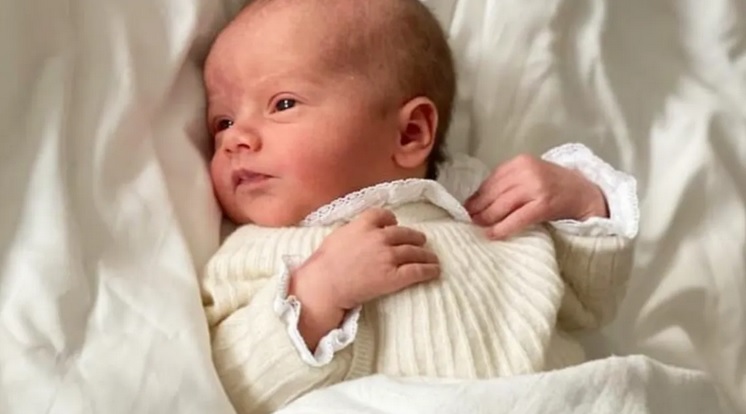
NordenBladet – Princess Sofia of Sweden gave birth to her third child on Friday at 11.19 am at Danderyd Hospital. King Carl XVI Gustaf revealed the name of his two-day-old grandson this morning in a cabinet meeting with the Prime Minister.
The new royal’s names are Julian Herbert Folke, and he is the Duke of Halland. So, where did his names come from?
The name Julian was selected by Prince Carl Philip and Princess Sofia for the simple reason that they liked it. It does not have any family links. In 2020, the name Julian ranked 74th in Swedish names, so it is not an overly popular name in the Scandinavian country either.
The middle name Herbert honours Princess Sofia’s late grandfather, who went by Herbert. Information Manager at the Royal Court, Margareta Thorgen, told Svenskdam: “The name Herbert in Prince Julian’s name is after Princess Sofia’s grandfather, who was named Herbert in his middle name.”
The name Folke is after the King and Count Folke Bernadotte. Folke is one of the King’s middle names, and he was named after the Count, who was a World War II hero that saved many Jews and non-Jews from the Nazis. Learn more about Folke Bernadotte’s heroism here.
With the little royal’s middle names, Carl Philip and Sofia have paid tribute to beloved family members while also giving him an ‘unroyal’ first name – fitting as he does not have the Royal Highness style and will not have the pressure of representing the Royal Family as he becomes an adult.
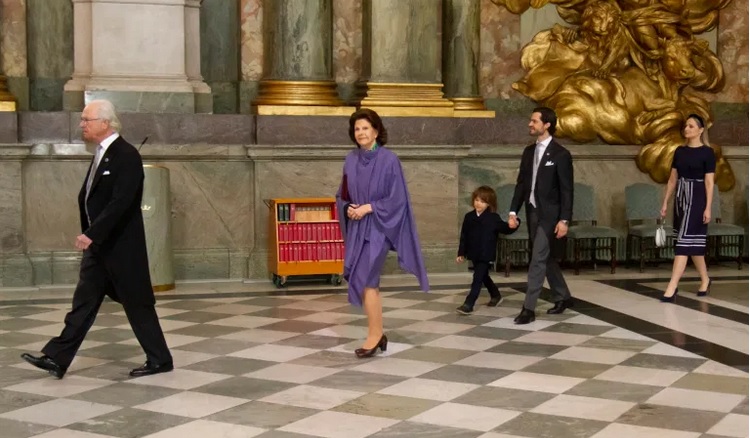
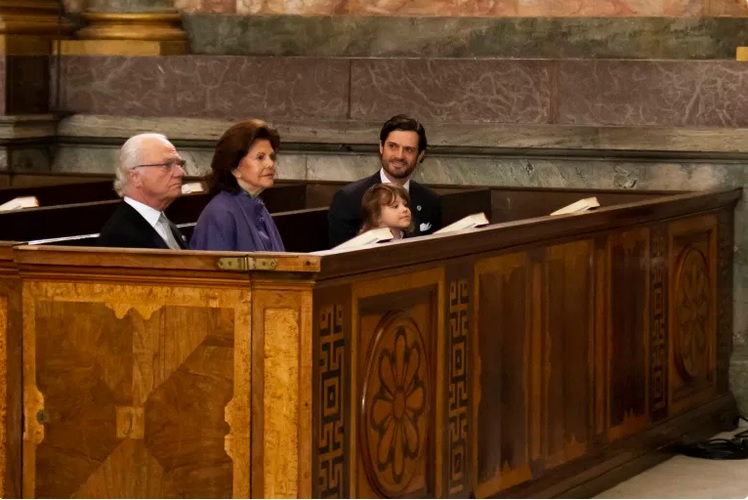
NordenBladet – Members of the Swedish Royal Family attended a Te Deum* at the Royal Chapel in Stockholm Palace on Sunday at noon to mark the birth of Prince Julian.
Due to the pandemic, those in attendance were limited to King Carl XVI Gustaf, Queen Silvia, Prince Carl Philip, proud big brother Prince Alexander, Princess Sofia’s sister, Lina, and Sofia’s parents, Erik and Marie Hellqvist. Sofia’s parents were able to travel from Älvdalen to meet their new grandson and attend the ceremony.
Crown Princess Victoria and Prince Daniel of Sweden just recently recovered from COVID-19 and were unable to attend the service. They had planned to attend before contracting the virus; the couple are now healthy but followed doctor recommendations to not participate on Sunday, according to Svenskdam.
The media was not allowed to attend the religious service due to the pandemic, and images were only released after the Te Deum had concluded.
Lead pastor Johan Dalman lead the service that began at noon; a small lunch followed, but the Royal Court has not released any information regarding the gathering.
The christening for Prince Julian will take place in a few months time. How the pandemic will impact the ceremony is not yet known.
___________________________ The “Te Deum” (/tiː ˈdiːəm/, Latin: [te ˈde.um]; from its incipit, Te Deum laudamus, Latin for ‘Thee, O God, we praise’) is a Latin Christian hymn traditionally ascribed to AD 387 authorship, but with antecedents that place it much earlier. It is central to the Ambrosian hymnal, which spread throughout the Latin Church with other parts of the Milanese Rite in the 6th to 8th centuries. It is sometimes known as the “Ambrosian Hymn”, although authorship by Saint Ambrose is unlikely. The term “Te Deum” can also refer to a short religious service (of blessing or thanks) based upon the hymn.
Authorship of the hymn is traditionally ascribed to Saint Ambrose (died 397) or Saint Augustine (died 430). In 19th-century scholarship, Saint Hilary of Poitiers (died 367) and Saint Nicetas of Remesiana (died 414) were proposed as possible authors. In the 20th century, the association with Nicetas has been deprecated, so that the hymn, while almost certainly dating to the 4th century, is considered as being of uncertain authorship. Authorship of Nicetas of Remesiana was suggested by the association of the name “Nicetas” with the hymn in manuscripts from the 10th century onward, and was particularly defended in the 1890s by Germain Morin. Hymnologists of the 20th century, especially Ernst Kähler (1958), have shown the association with “Nicetas” to be spurious. It has structural similarities with a eucharistic prayer and it has been proposed that it was originally composed as part of one.
The hymn was part of the Old Hymnal since it was introduced to the Benedictine order in the 6th century, and it was preserved in the Frankish Hymnal of the 8th century. It was, however, removed from the New Hymnal which became prevalent in the 10th century. It was restored in the 12th century in hymnals that attempted to restore the praiseful intent of the rule of St. Benedict.
In the traditional office, the “Te Deum” is sung at the end of Matins on all days when the Gloria is said at Mass; those days are all Sundays outside Advent, Septuagesima, Lent, and Passiontide; on all feasts (except the Triduum) and on all ferias during Eastertide.
Before the 1961 reforms of Pope John XXIII, neither the Gloria nor the Te Deum were said on the feast of the Holy Innocents, unless it fell on Sunday, as they were martyred before the death of Christ and therefore could not immediately attain the beatific vision.
In the Liturgy of the Hours of Pope Paul VI, the “Te Deum” is sung at the end of the Office of Readings on all Sundays except those of Lent, on all solemnities, on the octaves of Easter and Christmas, and on all feasts. A plenary indulgence is granted, under the usual conditions, to those who recite it in public on New Year’s Eve.
It is also used together with the standard canticles in Morning Prayer as prescribed in the Anglican Book of Common Prayer, as an option in Morning Prayer or Matins for Lutherans, and is retained by many churches of the Reformed tradition.
The hymn is in regular use in the Catholic Church, Lutheran Church, Anglican Church and Methodist Church (mostly before the Homily) in the Office of Readings found in the Liturgy of the Hours, and in thanksgiving to God for a special blessing such as the election of a pope, the consecration of a bishop, the canonization of a saint, a religious profession, the publication of a treaty of peace, a royal coronation, etc. It is sung either after Mass or the Divine Office or as a separate religious ceremony. The hymn also remains in use in the Anglican Communion and some Lutheran Churches in similar settings.
NordenBladet — Restaurants and other food and beverage service businesses must remain closed to customers until 18 April 2021 in regions where it is necessary to stop the escalation of the COVID-19 epidemic.
The now agreed closure of restaurants extends the closure that started on 9 March, ensuring a seamless continuation of the closure in regions where it is necessary due to the epidemic situation. Unlike during the closure agreed earlier, restaurants may open for business in Åland and South Ostrobothnia starting on 29 March. The same applies to Lapland with the exception of the municipality of Kittilä. In North Savo and in North Karelia, restaurants must be closed to customers starting on 29 March. However, restaurants can still sell food for takeaway or delivery. During the closure, restaurants and cafés are allowed to sell portions directly to the customer for takeaway or deliver them either themselves or using other service providers.
Closure of restaurants essential due to the epidemiological situation
Restaurants must be closed to customers in the following regions and the following municipality:
1) Uusimaa
2) Southwest Finland
3) Satakunta
4) Kanta-Häme
5) Pirkanmaa
6) Päijät-Häme
7) Kymenlaakso
8) South Karelia
9) South Savo
10) North Savo
11) North Karelia
12) Central Finland
13) Ostrobothnia
14) North Ostrobothnia
15) Kittilä
The following regions do not fall under the closure requirement: Åland, South Ostrobothnia, Central Ostrobothnia and Kainuu. In the region of Lapland, restaurants may be open with the exception of the municipality of Kittilä.
Particular consideration to closure requirements in Lapland With the exception of Lapland, restaurant closures are imposed on a region-wide basis. In its reply to the Government, Parliament concluded that a sparsely populated region with long distances requires a more thorough consideration. Based on the opinion of Parliament and health authorities’ statement, restaurants must be closed in Kittilä. In all other municipalities in Lapland, restaurants may open for business beginning on 29 March.
Grounds for closure examined weekly
The Government will amend the decree and impose and lift closure restrictions in line with the development of the epidemiological situation in any given region. In regions where food and beverage service business are allowed to stay open to customers, establishments must observe provisions laid down in the Communicable Diseases Act and issued by virtue of the same Act. In such regions, restaurants must close at 23.00 and stop the serving of alcoholic beverages at 22.00.
Closure affects all food and beverage service businesses, with the exception of staff restaurants
The food and beverage service businesses to be closed down include cafés, restaurants, bars and nightclubs that are open to the public. The closure applies to outdoor terraces, too. However, the sale of takeaway meals is allowed during the closure.
The only restaurants exempt from the closure are restaurants not open to the public. Therefore, the closure does not affect canteens in residential homes for older people or staff restaurants that are not open to other customers, for example. The business models and operating principles of businesses providing food and beverage services to staff and students may vary considerably. If a restaurant is open to the public, it must be closed.
Support scheme for restaurants under preparation
The Ministry of Economic Affairs and Employment is preparing a support scheme for the reasonable compensation of businesses affected by the current closure measures. The proposal for the support scheme is currently under consideration by Parliament and will be implemented as part of business cost support. The extension to the closure of restaurants will be taken into account in the further preparation of the support scheme. Companies would apply for the compensation at the State Treasury. Applications for the compensation could be accepted from the beginning of May.
Deliberations on the act and decree
On 28 March 2021, Parliament approved and the President of the Republic confirmed an act, which will temporarily close restaurants and other food and beverage service businesses to customers. The act and the decree concerning the matter will enter into force at midnight between Sunday 28 March and Monday 29 March. On the same day, the Government issued a decree on the regions to be affected by the closure. In principle, food and beverage service business will remain closed to customers in the regions where the epidemic is in the acceleration or community transmission phase. The assessment of necessity and decisions are based on the expert evaluation of the Finnish Institute for Health and Welfare.
NordenBladet — At the presidential session on Friday 26 March, the President of the Republic appointed three new Ambassadors.
The President of the Republic appointed Counsellor for Foreign Affairs Sari Rautio to serve as Head of Mission at Finland’s Embassy in Madrid, starting on 1 September 2021. Rautio will move to Madrid from the Ministry, where she has worked as Director of the Unit for Security Policy and Crisis Management since 2018. Before that she has held various positions in the Political Department of the Ministry for Foreign Affairs and in Finland’s missions abroad. In 2015–2018, she worked as Director of the Unit for European Common Foreign and Security Policy in the Ministry; in 2012–2015, as Finland’s representative in the EU’s Political and Security Committee (PSC/COPS) in Brussels; and in 2010 and 2012, as Adviser to both the Under-Secretary of State for political affairs and to the Director General of the Political Department. Her posts in the Diplomatic Service include service in Moscow and Addis Ababa. Rautio joined the Ministry for Foreign Affairs in 2001. She holds a Master’s degree in Social Sciences.
Embassy in Abuja, starting on 1 September 2021. Pylvänäinen will move to Abuja from the Ministry, where she has worked as Director of the Unit for Arms Control since 2017. In 2015–2017 she headed the European Common Foreign and Security Policy Team and, in 2005–2008, the Persian Gulf Team. Her experience of work in the Diplomatic Service includes posts in The Hague, Berlin, Bucharest and the Permanent Mission of Finland to the UN in New York. Pylvänäinen joined the Ministry for Foreign Affairs in 1998. She holds a Master’s degree in Social Sciences.
The President of the Republic appointed Counsellor for Foreign Affairs Antti Kaski to serve as Head of Mission at Finland’s Embassy in Bogotá, starting on 1 July 2021. Kaski will transfer to Bogotá from Berlin, where he has served as Deputy Head of Mission since 2017. In 2015–2017, he worked as Director of the Unit for Policy Planning and Research. In the Diplomatic Service, he has held posts in Berlin, Geneva, Brussels and Vienna. Kaski joined the Ministry for Foreign Affairs in 1998. He holds a Master’s degree in Social Sciences.
NordenBladet — On 26 March 2021, the Finnish Radiation and Nuclear Safety Authority (STUK) granted a fuel loading permit to Teollisuuden Voima Oyj’s Olkiluoto 3 nuclear power plant in Eurajoki. The use of the new unit is considered to start when the first batch of fuel is loaded into the reactor, after which the unit will be connected to the main grid in phases and become part of the Finnish and Nordic electricity markets. According to the company, regular commercial electricity production at the plant will start in February 2022.
The Finnish Government granted an operating licence under section 20 of the Nuclear Energy Act to the Olkiluoto 3 nuclear power plant unit on 7 March 2019. The licence will remain in effect until 31 December 2038. For the past two years, Teollisuuden Voima (TVO) has conducted system testing to finalise the plant. “With Finland’s industry electrifying, we need significantly more clean and reliable electricity. STUK’s fuel loading permit for Olkiluoto 3 is a decisive step towards large-scale production of clean electricity, which is estimated to reduce Finland’s greenhouse gas emissions by several million tonnes. What is more, the share of Finnish electricity production that is emissions-free will already rise to 90%,” says Minister of Economic Affairs Mika Lintilä.
“The most important thing with nuclear power is to ensure the safety of the power plant. During the construction and commissioning of the plant, safety has not ever been, and will not be, compromised. As licence holder of the plant, TVO is responsible for its safety, while STUK is in charge of supervision,” minister Lintilä adds.Under the terms of the operating licence, the Ministry of Economic Affairs and Employment must confirm that the company has arranged to undertake the costs of nuclear waste management in accordance with the provisions of chapter 7 of the Nuclear Energy Act. In February 2021, TVO provided the State with a collateral to cover its waste management obligation when the plant’s operations start. The collateral has been transferred to the State Treasury for safekeeping. Olkiluoto 3 is the first nuclear power plant in the world to have a fully designed and operational waste management system ready at the commissioning stage. The spent fuel of the plant will be placed in the bedrock of Olkiluoto in Posiva’s final disposal facility – the first of its kind in the world. The plant’s planned operating life is at least 60 years. However, the unit’s technical life may be considerably longer.With a power generation capacity of 1,600 megawatts, Olkiluoto 3 will become the largest power plant in the Nordic and Baltic countries and the largest nuclear power plant in Europe. When it operates at full capacity, the plant can produce approximately 13 terawatt hours (TWh) of electricity per year. Olkiluoto 3 will increase the annual domestic electricity production to nearly 80 TWh. At the same time, the share of nuclear power in Finland’s electricity production will rise to more than 40%. According to the energy industry, approximately 66 TWh of electricity was produced and 81 TWh was consumed in Finland in 2020.
NordenBladet — More than 200 million people across the globe need humanitarian assistance due to conflicts, natural disasters and the COVID-19 pandemic. The provision of humanitarian assistance is one of the most concrete ways of responding to crises and disasters. Finland grants a total of EUR 69.6 million to humanitarian work carried out by the UN organizations, the International Red Cross and Red Crescent Movement, and Finnish civil society organisations.
In its humanitarian action, Finland emphasises the rights of women and girls, disability inclusion, and school meals.The majority of the funding now granted by the Ministry for Foreign Affairs will be channelled to UN organizations. Through its core funding, Finland supports food security (EUR 8 million to the World Food Programme, WFP); emergency shelters for refugees and their protection and education (EUR 7 million to the UN Refugee Agency, UNHCR, and EUR 5 million to the UN Relief and Works Agency for Palestine Refugees, UNRWA); and the coordination of humanitarian action (EUR 2.5 million to the UN Office for the Coordination of Humanitarian Affairs, OCHA). In addition, funding will be used to respond to sudden disasters and underfunded protracted crises (EUR 8 million to the UN Central Emergency Response Fund, CERF) and to disaster risk reduction (EUR 1 million to the UN Office for Disaster Risk Reduction, UNDRR).
“The coronavirus pandemic has further accentuated the importance of predictable and flexible humanitarian funding. The best way to ensure rapid and timely delivery of assistance in sudden disasters is to decide on funding early in the year,” stresses Minister for Development Cooperation and Foreign Trade Ville Skinnari. Finland grants not only core funding but also funding for the regional and thematic work conducted by UN agencies. WFP will use Finland’s funding to improve food security in the Sahel and Afghanistan (EUR 4 million) and to strengthen the food security of persons with disabilities (EUR 1 million); UNHCR will support refugees in South Sudan and its neighbouring countries (EUR 2 million), Tigray in Ethiopia (EUR 2 million) and Syria and its neighbouring areas (EUR 5 million); and UNFPA will improve the reproductive health services for women and girls in Syria (EUR 2 million). The International Red Cross and Red Crescent Movement is an important humanitarian partner for Finland. The EUR 13 million now granted to it will be distributed between core funding (EUR 3 million to the International Committee of the Red Cross, ICRC) and thematic programmes as follows: ICRC’s emergency assistance to Yemen (EUR 2.7 million), South Sudan (EUR 2 million), Burkina Faso (EUR 1.2 million), Afghanistan (EUR 1 million) and Ukraine (EUR 0.8 million) as well as work by the Red Crescent in Syria (EUR 1.1 million).
These programmes will strengthen the protection, health services, food security and water supply of the most vulnerable people. EUR 10.2 million is granted to humanitarian work by Finnish civil society organisations. The projects will be implemented by Fida International, Finn Church Aid, Finnish Refugee Council, Save the Children Finland, Plan International Finland, Finnish Red Cross and World Vision Finland. Civil society organisations’ projects support, for example, water supply and sanitation, the education of persons with disabilities, as well as child protection, food security and safe reopening of schools. Civil society organisations have an important role in supporting local humanitarian actors and strengthening their capacity to respond to crises. Besides several African countries, this year the projects of Finnish civil society organisations will be supported in Yemen, Myanmar and North Korea as well.Additionally, Finland funds the EU’s humanitarian assistance through its contribution to the EU budget. The European Union, together with its Member States, is the world’s largest donor of humanitarian assistance.
NordenBladet – Norway begins its Easter holiday on Friday while the country is in the third wave of the pandemic, and everyone is living under strict infection control measures. However, people are allowed to travel to private holiday homes; this was not allowed during Easter of last year. Therefore, the Royal Court announced on Thursday afternoon that the royals would travel to their cabins in the mountains this Easter.
The King and Queen will again spend the holiday at the so-called “Prince Cabin” in Sikkilsdalen, after being at Kongsseteren in Oslo last year. From Kongsseteren last year, in the early stages of the pandemic, the King and Queen spoke to the nation in a holiday greeting and asked the people to trust the authorities and meet the future with a fighting spirit.
Traditionally, the royal couple travels to the Norwegian mountains on the Friday before Palm Sunday. The cabin called “Prinsehytta” (English: The Prince’s Cabin) is usually used by the King and Queen during the Easter festivities. His Majesty also uses the cabin on his annual hunting holiday during the autumn. The cabin is relatively basic and is sheltered from the public and media. There, the Royal Family usually use their time to go skiing and to relax.
It is not confirmed what Princess Martha Louise will do during Easter, but it is expected that she will stay in her private home just outside the capital of Oslo. The Crown Prince’s family will travel to their cabin in Uvdal. On Thursday, the volunteers from the Red Cross met at Sem in Asker, where they were presented with the Red Cross’ plans for emergency preparedness at Easter. This event was attended by Crown Prince Haakon and Crown Princess Mette-Marit. During the event, the Crown Princess said: “It is no secret that this will be a very difficult Easter for many. We really appreciate the work that the volunteers do and that there is a contingency for all those who are struggling.”
The announcement that the royals will not celebrate Easter together is not surprising. It has been several years since Crown Prince Haakon and Crown Princess Mette-Marit, together with their children, travelled with the King and Queen to Sikkildalen. The Crown Prince Couple bought two areas in Uvdal in 2007, and the following year their private cottage was built there.
NordenBladet — In February–March 2021, the Employment and Economic Development Offices (TE Offices) defined 37 occupations as shortage occupations nationwide. A year ago, before the effects of the coronavirus epidemic started to show, there were 60 such occupations. In the autumn of 2020, 31 of the estimated 200 occupations suffered from labour shortage. In other words, the number of shortage occupations has risen slightly from the assessment in the autumn.
According to an assessment carried out by the TE Offices in February
–March, 37 of the 200 occupations were surplus occupations. The number of surplus occupations has increased from the 25 recorded a year before. The coronavirus epidemic has not had a significant effect on the surplus of labour. Changes in the surplus of labour are small and trend-like.These are the findings of the Occupational Barometer published by the Ministry of Economic Affairs and Employment. The report is based on estimates provided by TE Offices regarding the near-term outlook for labour shortage or surplus in key occupations. The Barometer includes 200 professions included in the International Standard Classification of Occupations (ISCO 4), which represents just under half of the occupations with most workers.
Largest shortage in health and social services sector
There is a significant shortage of skilled labour in the health and social services sector. The shortage is most acute among nurses, senior social work specialists, speech therapists, practical nurses and early childhood educators.The healthcare and social welfare sector accounts for two-thirds of the occupations on the top 15 list of shortage occupations. However, new occupations from outside the healthcare sector have emerged, including earth moving machine operators and roofing installers. Oral hygienists remain on the list too.Changes to the list of top 15 surplus occupations have been even less drastic than in shortage occupations. Secretarial occupations in general continue to show labour surplus. ICT technicians are a new group on the top 15 list of surplus occupations.
Labour market demand and supply best balanced in Satakunta and LaplandThe share of occupations where the demand and supply of labour are in balance was the highest in Satakunta and Lapland, and the lowest in Central Finland and Kainuu. Kainuu has a proportionately large number of shortage occupations whereas Central Finland suffers from a relative large number of surplus occupations.The next estimate of employment outlook in different occupations will be prepared in autumn 2021.
NordenBladet — In 2021, Finland acts as the chairing country of Nordic and Baltic countries cooperation, NB8. This year’s first NB8 meeting of Foreign Ministers will be on Friday, 26 March.
Due to the COVID-19 situation, the meeting will take place virtually.Under the leadership of Finland’s Foreign Minister Pekka Haavisto, the Ministers will discuss, among other things, topical foreign and security policy questions, recovery from the COVID-19 crisis, and UN matters.
NordenBladet — The Government of Estonia decided on today’s (March 25) meeting to allocate 2.5 million euros from the reserves for the organisation of FIA Rally World Championship round taking place in Estonia this year. Via international broadcasting, this major sports event is taken to hundreds of millions of people in 155 countries.
“Last year the first ever WRC round in Estonia was so successful that it has been included in the WRC calendar for 2021 and 2022 as well. The government supports the event as we believe in the success of the Rally Estonia team, who has led the project professionally for 11 consecutive years,“ said Anneli Ott, Minister of Culture. “It is also noteworthy that last year not a single infection was detected at a rally event, and the organisers are cooperating effectively with the Health Board to ensure that the participants and guests could safely enjoy the competition,” she added.
The WRC round represents an opportunity to promote Estonia, its culture and history, and it also has a positive effect on the economy. “This is a major sports event that brings the world’s top racers and teams, who are followed by millions of fans all over the world, to compete on the fast-paced gravel roads of South Estonia,“ the minister added.
The Government supports the organisation of the WRC round, as it is not possible to finance it in the requested amount from the 2021 incentive for international culture and sports events. The reason for this is that the economic impact of the event is expected to decrease this year due to the restrictions connected to the spread of Covid-19. Therefore, the project did not meet the incentive requirements. The allocated support is not considered state aid, as the supported event is an official competition of the world championship round which belongs to the system of international sporting events of a sports federation. The total budget for organising WRC Rally Estonia is 4.4 million euros.
Last year, the WRC Rally Estonia was held in Estonia for the first time. Despite the restrictions related to Covid-19, the event had over 26,000 visitors from Estonia and abroad. This was also the first WRC round that was organised after the coronavirus outbreak. Live broadcasts were produced all over the world, which took the most important sports event held in Estonia to 740 million people.
Rally Estonia is the official FIA Rally World Championship round for 2021 that will be held in Tartu and in Tartu county and the roads of Otepää, Elva, Kanepi, Kambja, Mustvee and Peipsiääre from 15 to 18 July 2021.