Reklaam

Helena-Reet Ennet

Helena-Reet Ennet
4698 POSTS 0 COMMENTS

Denmark: Queen Margrethe and Crown Prince Frederik conduct Denmark’s first-ever digital Council of State

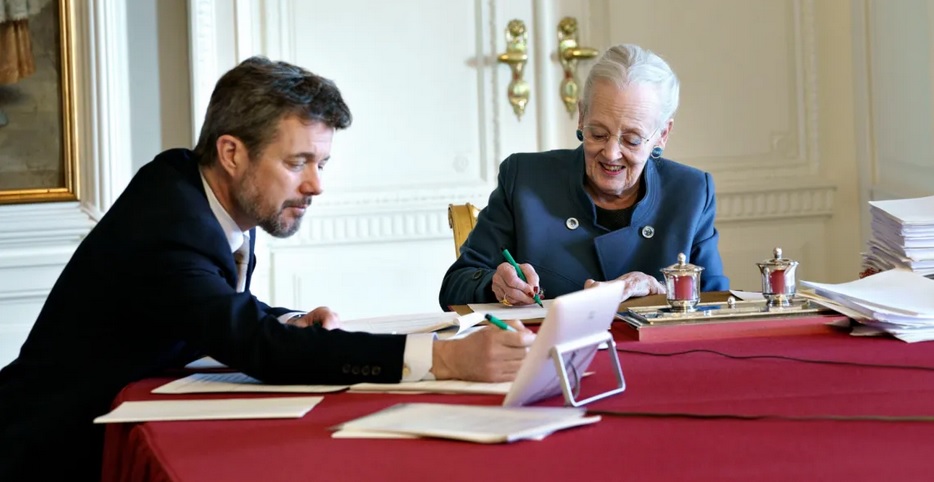
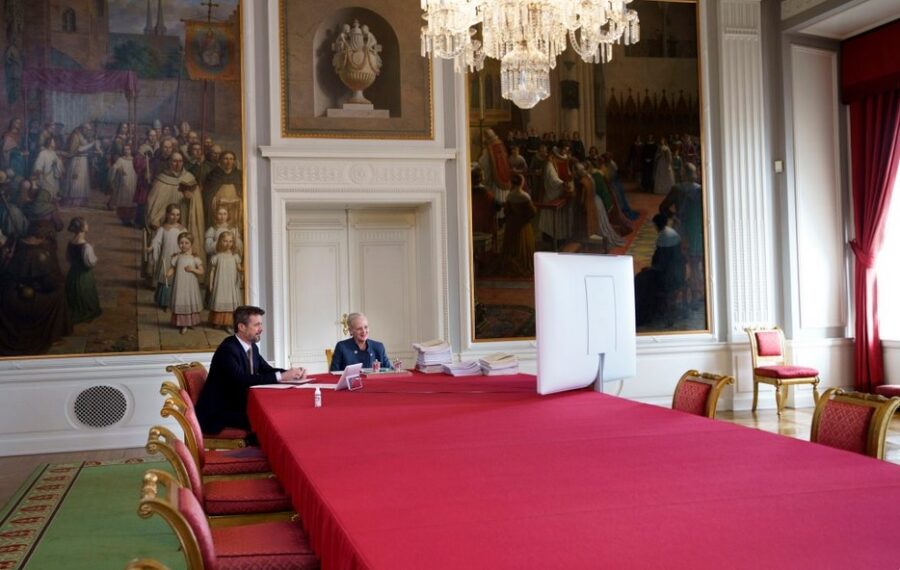
NordenBladet – On Tuesday, history was written in Denmark when Queen Margrethe conducted the Council of State digitally for the first time. From the Council of State Hall at Christiansborg Palace in downtown Copenhagen, the Queen conducted the meeting Tuesday morning. At her side was Crown Prince Frederik. As in Norway and Sweden, it is also common in Denmark that the heir to the throne is a regular participant in the Council of State.

At Tuesday’s Council of State, more than 250 cases and 52 new laws were processed. The Danish Royal Court shared photos from the historic session on Facebook and Instagram, showing mother and son while talking to the Danish government via a large screen. Crown Prince Frederik brought his iPad with him while Queen Margrethe took her notes by hand.

Many people noticed a particular photo that was shared on Instagram. The picture showed Queen Margrethe’s writing tools which consisted of a writing set in silver and a red book marked “Council of State”. The last thing in the picture is a fairly ordinary, green marker, which, according to the Danish press, is supposed to be the Danish queen’s favourite writing tool. This fairly common pen is only used in work contexts. If the Queen is out on a public visit and will write in a guest book, she always has a gold ballpoint pen with her.

The Council of State is made up of all ministers in the government and is the government’s body where all laws and important government measures are dealt with. The main content of the meetings is to ratify the bills passed by the Parliament, as well as to present the bills to the Queen that the government intends to present in the future. Denmark is a bit late compared to the other Scandinavian monarchies. King Harald of Norway and King Carl XVI Gustaf of Sweden have both carried out digital Council of State meetings through large parts of the pandemic.
Photos: Keld Navntoft, Kongehuset
Denmark: Queen Margrethe attends scaled-down military parade in Copenhagen

NordenBladet – Queen Margrethe II of Denmark has visited the military camp of the Royal Danish Lifeguard in Copenhagen for a special tradition. Her Majesty started her visit, on March 17th, by attending an impressive military parade by several regiments from the Royal Lifeguard. The parade was completed with fewer people present than usual due to the situation with coronavirus.

Queen Margrethe was in a good mood, wearing an elegant royal blue outfit with a small hat. Representatives from the Danish Defence, some generals and members of the royal court participated in the event, which took place outdoors in sunny weather. A small pavilion, with a roof, had been made for the Queen.

Following the parade, Her Majesty handed over the prestigious “Queen’s Clock” to one guard for his exceptional service to the crown and his excellent companionship. The presentation of the “Queen’s Clock” to a soldier from the Royal Life Guard has been a tradition since 1970, when Frederik IX first handed over a clock at a parade. “The King’s Clock” changed its name to “The Queen’s Clock” at the change of throne in 1972, and Queen Margrethe has since continued the tradition.

It was soldier and royal guard, Jeppe Nørhave Illum, who received the 2021 clock. The “Queen’s Clock” is an honour bestowed on the guard selected by the guard company as the best of the service period at the end of the service. The guard is appointed by the superiors and comrades, who in the selection emphasize both good military service and camaraderie.

The Royal Life Guards are an infantry regiment of the Danish Army, founded in 1658 by King Frederik III. The primary task is to provide a number of soldiers from the Guard Company to serve as a guard unit to the Danish monarchy. The Royal Life Guards provide a permanent guard at the Amalienborg Palace, Kastellet fortress, Rosenborg Castle and the garrison of Høvelte. On occasions, a guard is kept at Fredensborg Palace, Marselisborg Palace, Gråsten Palace, Christiansborg Palace and other locations where the Danish Royal Family spends their time.

Finland: Costs of Al-Hol assignment EUR 395,000

NordenBladet — To date, the costs incurred by Finnish authorities for the repatriation of 20 Finnish children and their mothers from northeast Syria amount to approximately EUR 395,000. The assignment began in 2019.

The Ministry for Foreign Affairs organised the most recent repatriation in December 2020. At the time, all the costs incurred were not immediately clear. The Ministry for Foreign Affairs has made a comprehensive analysis of the costs of the assignment so far.

The authorities’ travel expenses account for approximately EUR 199,000 of the total costs. The sum covers travel tickets, accommodation and daily allowances. Chartered transport costs amounted to approximately EUR 118,000. To ensure the security of the operations, the Ministry does not disclose the share of security costs. For reasons of security, it is not possible to itemise the share of smaller expenses from the total costs.Each assisted person has been charged their own travel expenses to Finland and the price of their travel documents. Indirect costs incurred by public authorities, such as their travel and accommodation expenses or expenses arising from security arrangements are not charged from citizens.

The assistance assignment is not over. Based on the Government Resolution of 19 December 2019, the activities led by the Ministry for Foreign Affairs continue in compliance with the provisions of the Constitution of Finland and international treaties.

The security situation in the al-Hol camp has deteriorated during the winter. Unknown perpetrators have assassinated more than 40 people during the first months of 2021, most of them in the Iraqi part of the camp. Seven children and two women died in a tent fire at the end of February. Children in the annex for foreign nationals do not have access to adequate healthcare or education. The growth environment in the camp is characterised by a radical ideology and absence of future prospects.

The camps in northeast Syria constitute a long-term security risk also for Europe. The longer the children are kept in a radicalising environment without education or protection the graver the risks. There are no perfect solutions. For Finland’s security, the worst option is to leave the children in the camps.


Finland: Prime Minister Marin to speak with several EU leaders

NordenBladet — On Thursday 18 March, Prime Minister Sanna Marin will attend a video meeting with the President of the European Council and the leaders of five other EU Member States.

Their meeting is in preparation for the European Council meeting to be held in Brussels on 25 and 26 March. Topics on the agenda will include the EU’s actions to manage the COVID-19 pandemic, the single market, industrial policy and the digital transformation, along with the situation in the Mediterranean and EU-Russia relations. Along with Prime Minister Marin, the Prime Ministers of Poland, Luxembourg, Belgium and Malta and the Chancellor of Austria will also participate in tomorrow’s small group meeting, which was convened by European Council President Charles Michel. President Michel is organising similar meetings for other groups of countries.


Finland: Higher profile for Finland’s international crisis management

NordenBladet — In its recent report, the Parliamentary Committee on Crisis Management proposes that the level of ambition in Finnish crisis management should be raised. This requires commitment to more active and diverse participation, enhanced effectiveness and deeper cooperation between those involved in crisis management.

The Parliamentary Committee was tasked to produce an up-to-date overview of developments in and needs of international crisis management and of the environment where Finland participates in crisis management, as well as to present recommendations for future participation in crisis management and for measures that would improve its effectiveness. Finland’s participation in military crisis management has been on the decline. As for civilian crisis management, the objective has already been to raise the strength of Finland’s civilian crisis management force to at least 150 specialists.

“In future, the most important decisions relating to crisis management will be related to our capacity to respond to the changes and needs in the operating environment. The Parliamentary Committee has a clear common message. The report conveys a strong political will to maintain the high profile in crisis management that Finland has in international contexts as well as to ensure sufficient resources for both practical participation in crisis management tasks and the development of activities,” says Johanna Sumuvuori, State Secretary to the Minister for Foreign Affairs.

The Committee emphasised the fact that participation in crisis management is part of Finland’s foreign, security and defence policy.  By participating in international crisis management, Finland contributes to security and bears responsibility for maintaining international peace and security and the rules-based international system.  Through crisis management, Finland also exercises influence in international organisations and in relation to partner countries.   Participation in international crisis management improves the security of Finns. It can also have a positive impact on our internal security and help to improve our national preparedness and capabilities.

The Parliamentary Committee gives five recommendations, according to which Finland should continue active and diverse participation in crisis management; set quantitative and qualitative objectives for participation; select geographic focus areas based on the development of the operating environment; enhance the effectiveness of crisis management; and strengthen the comprehensive approach to crisis management both nationally and internationally (coordination between crisis management, development cooperation, humanitarian assistance and mediation).

The Parliamentary Committee on Crisis Management is one of the five parliamentary committees appointed by the Government. According to its promise, the Government is committed to taking account of long-term objectives and to engaging in systematic parliamentary cooperation between the Government and Parliament. To fulfil this promise, the Government appointed five parliamentary committees to support the objective to strengthen transparency, inclusion and broad knowledge base during preparation. Representatives from all parliamentary parties and from central interest groups and non-governmental organisations were invited as committee members. The parliamentary committees are responsible for preparing major structural reforms over future electoral terms. Parliamentary committee work ensures a cross-sectoral approach and continuity across electoral terms. The purpose is to produce proposals for solutions and policies within agreed timeframes in ways that guarantee commitment to them.


Finland: Support for Myanmar to be reassessed

NordenBladet — Together with the European Union, Finland has firmly condemned the military coup in Myanmar against its civilian government and urged restoration of the civilian government. The military authorities are demanded respect for human rights, the rule of law, freedom of assembly, and freedom of expression, including peaceful protests. The armed forces’ violence against protesters is strongly condemnable.

The EU is preparing targeted sanctions against the military authorities of Myanmar. Finland supports sanctions as part of efforts to exert influence on the military leadership behind the coup.

“The sanctions should be carefully targeted to avoid causing further suffering for the civilian population. Finland is concerned about the possibility of setbacks in human development in Myanmar,” says Minister for Development Cooperation and Foreign Trade Ville Skinnari. Finland is currently reviewing the preconditions of continuing development cooperation in Myanmar in order to make sure that the results of our long-term work there will not be destroyed.  Until now, Finland has committed to supporting Myanmar’s peace process, strengthening gender equality, developing the education sector, and promoting sustainable management of natural resources especially in the forest sector. The political situation is uncertain and unpredictable, and both the Finnish Embassy in Yangon and the Ministry for Foreign Affairs in Helsinki are following developments in Myanmar carefully. It is clear that we will not continue to channel funding for development cooperation to a state budget administered by the armed forces nor to the administration in power during the state of emergency.  Finland has suspended funding to cooperation with the administration, and disbursements to cooperation partners have not been made after the coup.

“Finland has supported democracy development in Myanmar respecting the principles of sustainable development and collaborating with reliable partners.  If working conditions in the country will allow the organisations to stay, it is possible that development cooperation can continue. The cooperation will continue provided that the results of our work will benefit the people of Myanmar,” says Minister Skinnari. Finland will discuss with the EU, the other Nordic countries, international organisations and other donors to reach agreement on a common policy and shared principles. Myanmar has been one of Finland’s partner countries since 2012. In recent years, Finland’s development cooperation in Myanmar, guided by the priorities set out in the Country Strategy, has been approximately EUR 16 million a year. Additionally, support has been channelled through humanitarian assistance, the EU, civil society organisations, higher education institutions, development finance institutions, and financial instruments used in the private sector.


Finland: Prime Minister Marin and Indian Prime Minister Modi discuss deepening cooperation in the fields of digitalisation and sustainable development

NordenBladet — Prime Minister Sanna Marin and Indian Prime Minister Narendra Modi held a remote bilateral meeting on 16 March 2021. In their first meeting, the prime ministers had an extensive discussion on how to deepen concrete cooperation between their countries and addressed a number of key international issues.

Prime Minister Marin highlighted the importance of equality – in particular the realisation of the rights of women and girls – for society and the economy. Prime Minister Marin told Prime Minister Modi about Finland’s human rights-based approach to foreign policy and Finland’s candidacy for membership in the UN Human Rights Council in 2022–2024.

Prime Minister Marin also emphasised the role of high-quality education in society. India is currently reforming its education system, and there is great potential for cooperation between Finland and India in this sphere.

The Prime Ministers discussed deepening bilateral relations in the fields of trade and investment, science, innovation and sustainable development. Finland and India have many partnerships that aim to promote sustainable development and digitalisation, among other objectives.

In their discussion, the prime ministers found opportunities for closer cooperation in fields such as new technologies and the digital transformation, including in the development of 6G technology, quantum computing and artificial intelligence. Finland and India have a great deal to offer each other in these areas.

The Prime Ministers discussed the fight against climate change, both as an international theme and from the perspective of climate initiatives in India and Finland. The joint declaration by Finland and India issued in connection with the meeting mentions, among other things, India’s initiative on the International Solar Alliance (ISA), which aims to promote the use of solar energy, and Finland’s joint initiative with Chile on the Coalition of Finance Ministers for Climate Action.

The discussion also touched on UN reforms. In this context, Prime Minister Marin affirmed Finland’s support for India’s efforts to become a permanent member of the UN Security Council.

Another item on the agenda was the partnership between the EU and India, a topic the prime ministers will have the opportunity to discuss next at the upcoming India-EU27 Leaders’ Meeting to be held in Porto on 8 May 2021. The prime ministers also briefly discussed regional issues, such as the situations in Myanmar and Afghanistan, Arctic cooperation and Africa.


Finland: Digital green transition discussed at the meeting of Nordic and Baltic ministers and Commissioner Margrethe Vestager

NordenBladet — The first meeting of the Nordic Council of Ministers for Digitalisation during Finland’s 2021 Presidency of the Nordic Council of Ministers discussed the digital green transition and decided on the priorities for cooperation over the next four years. According to Minister Paatero, the Nordic and Baltic countries can serve as an example for mitigating climate change through a value-based, inclusive digital transformation that also boosts competitiveness.

Minister of Local Government Sirpa Paatero chaired the meeting of the Nordic Council of Ministers for Digitalisation (MR-DIGITAL) on 16 March. The meeting was attended by ministers from the Nordic and Baltic countries and Executive Vice-President Margrethe Vestager of the European Commission. The ministers and Commissioner Vestager discussed the digital green transition and the role to be played in this transition by the countries of the region.In the discussions, Minister Paatero highlighted that the Nordic countries are leaders in public sector digitalisation in the EU, and that measures to tackle the pandemic have accelerated digitalisation, with large numbers of people working remotely, for example. The impact of remote working on transport emissions will be assessed by autumn. Finland’s strategy for reforming public governance sees digitalisation as a key to both environmental protection and more flexible working. The public sector must also lead the way in the procurement of sustainable and clean solutions. The Nordic and Baltic countries can work together in this.Addressing the meeting, Minister Paatero also emphasised the shared Nordic values and the fact that by taking the lead and working together, the countries of the region can play a bigger role than their size would suggest in the search for solutions to the most urgent of global challenges.

“The Nordic welfare model combined with high technology and the responsible and sustainable use of natural resources serves as a foundation on which we can build our competitiveness in the future.”, says minister Paatero.

In the debate, Commissioner Vestager highlighted the EU’s Recovery and Resilience Facility (RRF), for which measures are being prepared in all EU Member States. She emphasised that the RRF is a key instrument for bringing the EU out of the current crisis. The purpose of the RRF is also to help the economies of EU countries to become more flexible and to promote digital development to ensure a dual transition to sustainability and digitalisation.

Finland’s 2021 Presidency of the Nordic Council of Ministers marks the start of a new four-year term for the Nordic Council of Ministers for Digitalisation (MR-DIGITAL). The meeting approved a roadmap for the coming years, which defines the priorities for cooperation and sets out packages of measures. These packages include Nordic Baltic eID cooperation to promote interoperability between digital identity systems of the Nordic and Baltic countries, and a Finnish Presidency project to promote cross-border data exchange between public authorities.


Celebrate Nordic Day with us!

NordenBladet — The Nordic Council of Ministers (NCM) is celebrating its 50th anniversary in 2021. In tribute to this, NCM will organise five debates on Nordic Day, 23 March.

NCM will delve deeper into five topical themes prioritised by the Finnish Presidency of the Nordic Council of Ministers 2021 – Nordic solutions related to gender equality, freedom of movement, the circular economy, freedom of expression and culture. We will highlight Nordic collaborative contributions and discuss what the Nordic region means to key Nordic players. What do we want the Nordic region to look like in the future?The first of the five debates will focus on online hate and threats. Online abuse has become a commonplace phenomenon in the Nordic countries and risks silencing voices in the digital public space. In 2021, the Finnish Presidency and the Nordic Council’s Committee for Welfare in the Nordic Region will focus on digital abuse and online threats, approaching the theme from the perspective of equality. If possible, these topics have gained even more relevance during the ongoing pandemic. 23 March1–2 p.m. What can the Nordic countries do to make the Internet a safer place?
The options available to the Nordic countries to make the Internet a safer place will be discussed by politicians, researchers, organisations, and young Nordic people. The participants, including Thomas Blomqvist, Minister for Nordic Cooperation and Equality, Annika Hambrudd, Minister for Equality, Åland, Hanna Onwen-Huma, Senior Specialist at the Ministry of Social Affairs and Health, Lisa Kaati, Head of Research at the Swedish Defence Research Agency, and Eva Biaudet, Chair of the National Council of Women of Finland, will discuss digital abuse from the perspective of equality. Welcome to join us! Facebook event:Nordic day: What can the Nordic countries do to make the Internet a safer place?The event will be held Swedish and Finnish. Nordic Day 2021 (Norden.org) #Nordensdag       #Norden2021


Faroe Islands: Faroese labor force remains Europe’s most active

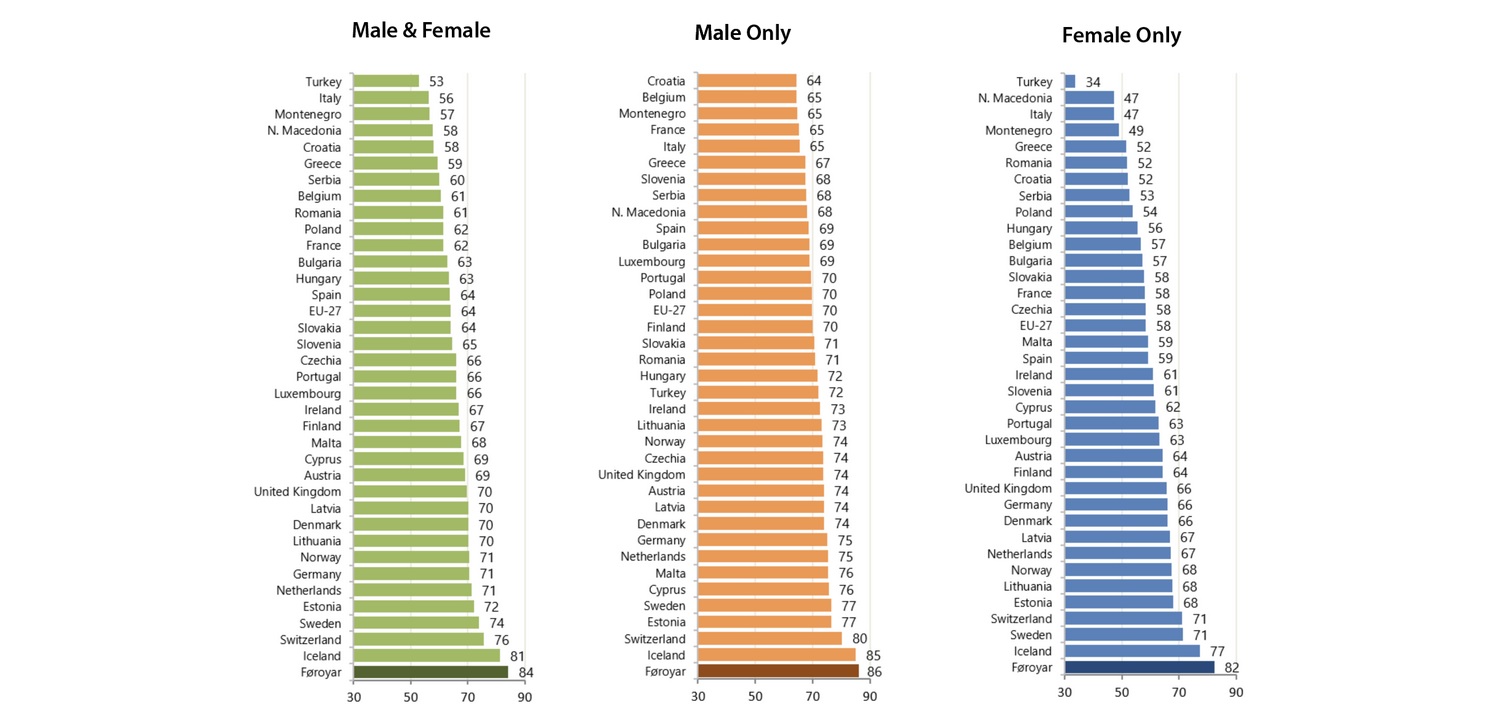
NordenBladet – With more than 84 percent of the nation’s working-age population part of the labor force, the population of the Faroe Islands still has the highest activity rate in Europe. According to a recent labor force survey published by Statistics Faroe Islands, the activity rate in the island nation is measured at 84.3 percent averaged over both sexes, or 86.1 pc. for men and 82.4 pc. for women.

The international measurement of the labor force in percentage of the working-age population counts the section of the population aged between 15 and 74 who are capable of participating in work, Statistics Faroe Islands noted.

“This is the highest activity rate in Europe, and this applies to men, women, young and old alike,” the government agency said in a statement.

The Faroese labor force has increased by just over 2,000 people in the past five years, spread evenly across the two genders, with the labor force also slightly increasing in 2020.

These are some of the key findings of the labour force survey conducted by Statistics Faroe Islands in November 2020. A detailed report with analysed figures can be found in the Statbank, the online statistical resource provided by the agency.

According the survey, the Vágar region has the highest activity rate for men, at 89 percent, and Sandoy the lowest, at 75 pc. For women, the Suðurstreymur and Norðstreymur regions have the highest activity rate, at 84 pc., and Sandoy the lowest, at 78 pc.

“In comparison, the average activity rate in Denmark and the United Kingdom is approximately 70 percent,” Statics Faroes said.

“As previous labor force surveys have also shown, the Faroe Islands are again confirmed to have the biggest labor force in Europe relative to the population. Only Iceland comes close in this respect.”

Included in the labor force are all employed individuals, including employees, independent traders, employers, unemployed people available for work and individuals who carry out unpaid work for family businesses. Not included in the labor force are young full-time students, people unavailable for work due to disease or reduced ability and people who have left the labor market due to age or other limitations. In statistical terms, these groups are classified as being part of the inactive population.

The chart below, compiled by Eurostat, compares the Faroe Islands with 35 other European nations.

With an 84-percent activity rate averaged over both sexes, the Faroe Islands are in the lead, followed by Iceland, at 81 pc., Switzerland at 76 pc., and Sweden at 74 pc.

Whereas the average activity rate for the 27 EU member nations (excluding the UK) is 64 pc., the European nations with the lowest activity rate are Turkey and Italy, at 53 pc. and 56 pc. respectively.

For men, the Faroe Islands lead the way with an activity rate of 86 pc., followed by Iceland at 85 pc. In Denmark, the corresponding figure is 74 pc. The EU average is 70 pc., with the lowest activity rate for men in Croatia, Belgium, France and Italy, all within the 64-66 pc. range.

At 82 pc., Faroese women have by far the highest activity rate in Europe, with Iceland taking second place at 77 pc. Denmark’s activity rate for women is at 66 pc., compared with an EU average of 58 pc. Turkish women have the lowest activity rate at 34 pc., followed by Italy’s 47 pc.

In all countries except for the Faroe Islands, the activity rates for women are significantly lower compared to men. In the Faroe Islands, the difference is only 4 pc. In Iceland and Denmark, it’s 8 pc., and the average difference in the EU is 12 pc. By far the greatest activity rate difference between the two sexes is in Turkey, with 72 pc. for men and 34 pc. for women.