Reklaam

Helena-Reet Ennet

Helena-Reet Ennet
4698 POSTS 0 COMMENTS

Finland: Draft government proposal for family leave reform completed

NordenBladet — The Government has completed and published its draft proposal for the family leave reform. The draft proposal will be circulated for comments between 19 February and 2 April 2021. “The family leave reform is, first and foremost, about promoting the interests of the child. The new family leave model will treat every child equally, irrespective of the type of the family. It would encourage families to share childcare responsibilities more equally, thus giving both parents a good start for building a close relationship with their child,” says Minister of Social Affairs and Health Aino-Kaisa Pekonen. 

The Government has made specifications to the model of daily allowance days, giving each parent a quota of 160 daily allowance days (There are six daily allowance days per week). In all, parental allowance would be paid for 12.8 months per child. Parents would be allowed to transfer up to 63 daily allowance days of their quota to the other parent. For the final stage of pregnancy, there would be a pregnancy allowance of 40 daily allowance days. This would mean that all in all, daily allowance days would amount to more than 14 months. Single parents would have the right to use the parental allowance quotas of both parents. Twins, triplets and other multiple-birth children would form the only exception to this model — the quota of daily allowance days for their parents would increase by 78 daily allowance days per second child and every child thereafter.

Under the new model of family leave, parents could use daily allowance days until the child reaches the age of two. Daily allowance days could be used in several periods. Only pregnancy allowance days would have to be used in a single continuous period and started 14–30 days before the estimated due date. All parents who have custody of their child would have an equal right to daily allowance regardless of whether they are biological or adoptive, custodial or non-custodial and regardless of the gender of the parent. As a result of the reform, the total number of family leave days would increase slightly from the current level. Family leaves now consist of the mother’s maternal allowance period (105 working days or approximately 4.2 months) which starts before the estimated due date , the father’s paternal allowance period (54 working days or approximately 9 weeks) and the parental allowance period which may be taken by one of the parents or shared between the parents (158 working days or approximately 6.3 months).

Investment in parenthood and wellbeing of families and children
The aim of the reform is to encourage parents for a more balanced use of family leaves. This would mean above all that fathers would use their right to family leaves more than they do at present. If this objective was reached, the overall costs of family leaves to society would increase together with the total number of daily allowance days used by fathers.

“We will implement a family leave reform that supports the wellbeing of families. The reform will be an investment. It is about the income of families at an important stage of their lives, ” says Minister Pekonen.

Towards a more equal working life
The reform would implement both the objectives of the Government Programme and the changes resulting from the EU’s Work-life Balance Directive. These changes would aim to promote gender equality in working life and facilitate the reconciliation of work and family life.

“Gender equality in working life is influenced not only by laws and regulations but also by attitudes. We want to encourage fathers to take more family leave than they do at present. A more equal sharing of family leaves between both parents would benefit many families and the whole society as equality progresses,” says Minister of Employment Tuula Haatainen.

The key amendments to the Employment Contracts Act are related, for example, to the names of family leaves and periods in which parental leave could be taken. As a new element, the reform would introduce the right to carers’ leave, which is based on the Work-life Balance Directive. It is intended for situations where, for example, a relative needs help suddenly. Each worker would have the right to take unpaid carers’ leave for up to five days per year.

Reform would be taken into account in early childhood education and care In future, the right to early childhood education and care would start at the beginning of the calendar month when the child turns nine months. The right to the same early childhood education and care place would be maintained when the child stays at home with the parent during the parental leave and does not attend early childhood education and care for that reason. The requirement for this would be that the period of absence lasts without interruption for a maximum of 13 weeks and the early childhood education and care place has been informed of the period of absence beforehand. By amending the Act on Client Fees in Early Childhood Education and Care, it would be possible to make sure that no client fees would be charged for this period.“In future, children would maintain the right to same early childhood education and care place that they attended before, even if their parents decided to use their family leaves more flexibly.   Continuous and safe relationships are important preconditions for the development and wellbeing of children, and this will also be ensured as part of the family leave reform,” says Minister of Education Jussi Saramo.

Reform prepared through cooperation
A working group led by the Ministry of Social Affairs and Health prepared the family leave reform, and a working group led by the Ministry of Economic Affairs and Employment was responsible for the preparations related to the Employment Contracts Act. The working group of the Ministry of Social Affairs and Health included representatives not only from the relevant ministries and agencies but also from labour market organisations. The working group carried out its work within the framework of the Government Programme. It was not, however, able to reach full consensus on all issues.

Draft government proposal (in Finnish)
Presentation material for the press conferenceAnimation about the family leave reform


 

Finland: Timo Sysiö appointed as Press Counsellor in Beijing

NordenBladet — The Ministry for Foreign Affairs of Finland has appointed Timo Sysiö to the post of Press Counsellor at the Embassy of Finland in Beijing. The three-year term will start on 1 August 2021.

Sysiö will move to Beijing from the Embassy of Finland in Ankara, where he is currently Second Secretary responsible for communication, country branding and Team Finland coordination. Sysiö has studied and worked in East Asia and Southeast Asia for over ten years. In 2017, he worked as Event Coordinator for the Suomi Finland 100 Singapore (SF100SG) programme and as Consular Services Coordinator at the Embassy Beijing. Sysiö has graduated with a Master of Arts degree at the University of Hong Kong.

“I’m looking forward to being able to use my professional skills in the geographical area that is close to my heart. As part of the strong Team Finland network in China, I will work to increase our visibility especially in sectors which have an influence also on Finland’s economy and society,” Sysiö says.

The Press Counsellor is responsible for communications and tasks related to country image. The Press Counsellor also takes part in Team Finland activities and works in close cooperation with the Consulates General of Finland in Hong Kong and Shanghai.


Finland: Human rights and sustainable development at the core of a call for proposals for international non-governmental organisations

NordenBladet — The Ministry for Foreign Affairs of Finland (MFA) opens a call for proposals for international non-governmental organisations (INGOs). The application round will run from 15 February to 26 March 2021.

The Ministry for Foreign Affairs allocates development cooperation funds for use by INGOs. To be eligible for support, the organisations’ development cooperation activities must promote the attainment of Finland’s development policy priorities, the goals of the 2030 Agenda for Sustainable Development, and the realisation of human rights. Additionally, development cooperation projects carried out by INGOs must take into account the human rights-based approach to development.

Human rights are an important part of Finland’s foreign and development policy; Finland is committed to promoting them. The call for proposals includes many themes that advance the realisation of human rights.

Applications should focus on the following themes: promoting sexual and reproductive health and rightspromoting tax justice and transparency in Sub-Saharan Africaending impunity for human rights violationssupporting human rights defendersstrengthening the implementation of economic, social and cultural rightsbusiness and human rightspromoting sexual and reproductive health and rights in Afghanistan to reduce maternal mortality.

Applications will be accepted from 15 February until 26 March 2021. Applications together with their attachments should be received by the Ministry for Foreign Affairs no later than at 16.15 (Finnish time/EET) on Friday 26 March 2021. Applications that arrive after the due date and time will not be considered.

The call for proposals, the application form, the terms and conditions of the call, and further information can be accessed at Support for International Non-governmental Organisations (in English). A joint call for applications for INGOs is announced approximately once every two years. The amount of funding available and the themes of the calls are decided separately each time. Different units at the Ministry for Foreign Affairs may additionally organise more limited application rounds for INGOs when necessary. The 2021 Call for Proposals for International Non-governmental Organisations (INGOs)


Finland seeks membership of UN Human Rights Council

NordenBladet — Finland is seeking membership of the UN Human Rights Council (HRC) as the Nordic representative in the Group of Western European and other States in 2022–2024. The membership campaign slogan: ”A Diverse World, Universal Human Rights”, underscores the universal nature of human rights. The election will take place at the UN General Assembly in October 2021.Finland has been dedicated to promoting human rights for decades. By standing for candidacy in the HRC, Finland is demonstrating its continuing commitment to human rights-based foreign and security policy.  The candidacy for membership of the HRC is mentioned in the Government Programme of Prime Minister Marin’s Government, too.The themes of the Finnish campaign are the rights of women and girls, new technologies and the digital transformation, climate change, and education as a human right. In its campaign, Finland also emphasises efforts to defend multilateralism from increasing attempts to undermine it and the need to promote civil societies’ engagement and participation in the UN’s activities. ”As a member of the Human Rights Council, Finland wants to stand in a common front with countries defending human rights, aiming to find sustainable solutions for global challenges. Climate change and pandemics are further increasing inequality and global interdependency. The importance of defending human rights will grow in global contexts,” says Minister for Foreign Affairs Pekka Haavisto.The HRC, established in 2006, is the most central UN body that promotes human rights. The Council is made up of 47 Member States elected for three years at a time, based on an equitable geographical distribution of seats. Finland served as a member of the HRC in 2006–2007. At present, Finland has an observer status in the HRC.  More information:Paula Parviainen, Chief Specialist, tel. +358 295 350 425. The Foreign Ministry’s email addresses are in the format [email protected]Campaign video (Youtube)Campaign website (um.fi)Follow on Twitter #FIforHRC

Source: Valtioneuvosto.fi

Helena-Reet: in ERM (Estonian National Museum) in Tartu and at my sister’s birthday + Valentine’s Day!

NordenBladet – The week has passed in a blink of an eye. The keywords are tasks at home, ceramics, and writing-illustrating the children’s book “His Highness Mouse the First”, also the daily publishing of articles, developing the collaboration networks for NordenBladet + OHMYGOSSIP websites.

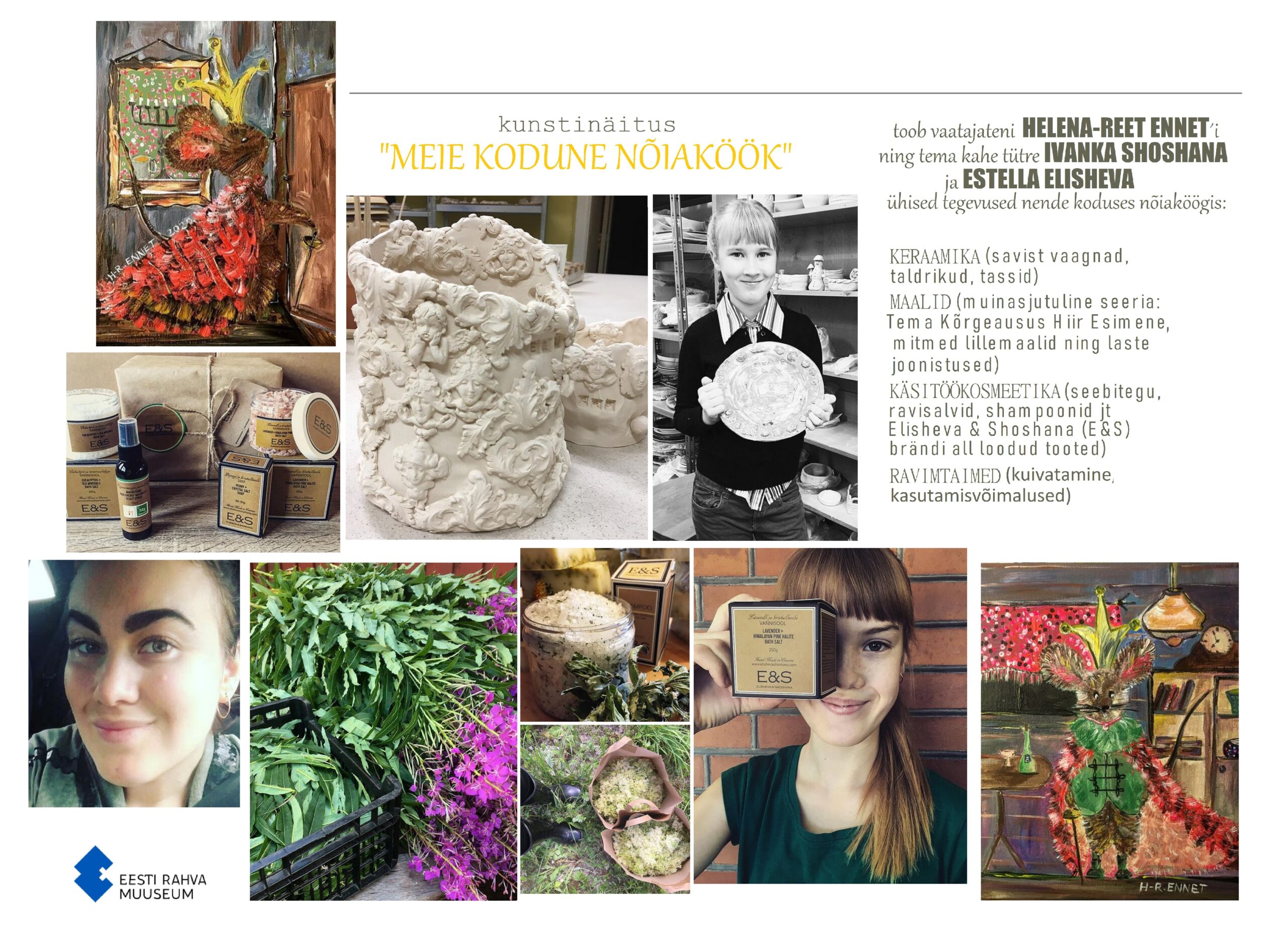
On Friday I transported the first set of works (ceramics) to the Estonian National Museum (ERM), where with my daughters Estella Elisheva and Ivanka Shoshana we will display an exhibition “Our home’s witch kitchen”. For that purpose there are constant preparations ongoing. The plan is to launch the book “His Highness Mouse the First” by the time the exhibition opens. This challenge is accompanied by the goal of illustrating the entire book by myself, and not in any ordinary manner, but with an individual angle. First I will make acrylic paintings, and then scan them to the computer… This will then result in an illustrated book as well as a number of acrylic paintings. The upcoming art exhibition will be built on four pillars – ceramics, paintings, Elisheva & Shoshana handicraft cosmetics, and herbs.

For the first time I approached the ERM museum building from the backside, from the loading area for goods, more precisely from the side. I suddenly felt so important, as well as insignificant at the same time. The large entrance where one can transport goods with full size trucks, and me with my car, with a few boxes of handicrafts. This is really the proper comparison – handicraft is indeed exclusive, it takes time to prepare and it then never comes in large quantities. Nearly half of the ceramics works to be displayed at the exhibition have already been transported to the museum repository at the Estonian National Museum. On the spot we also held a meeting to discuss the exhibition hall plan – I outlined my current conception on the paper board (these lines of thought still need to be elaborated on, and then conveyed to the project partners in ERM at earliest convenience, so that the project staff members on their side can commence building up the carcass design for the exhibition (walls, partition ceiling, shelves, etc).

After the ERM project meeting we headed to my younger sister’s place, she lives in Tartu. In the afternoon we celebrated her birthday – dined, wined, discussed all aspects of the world as we know it, conversed about the exhibition, about real estate, about our future plans… Ivanka was busy drawing pictures all evening, and also enjoyed a hot bath. We actually agreed on a common bedtime at 23 pm already… We finalized the evening with a warm cup of camomile tea along with the film Legally Blonde, which we didn’t complete due to dear Sandman bringing an exceptionally early dream to everybody. Hahaa

(after the gallery blog continues)


The week also accommodated lots of baking as always, but there is just not enough capacity to take pictures of everything. Here I will add pictures from two dinners.

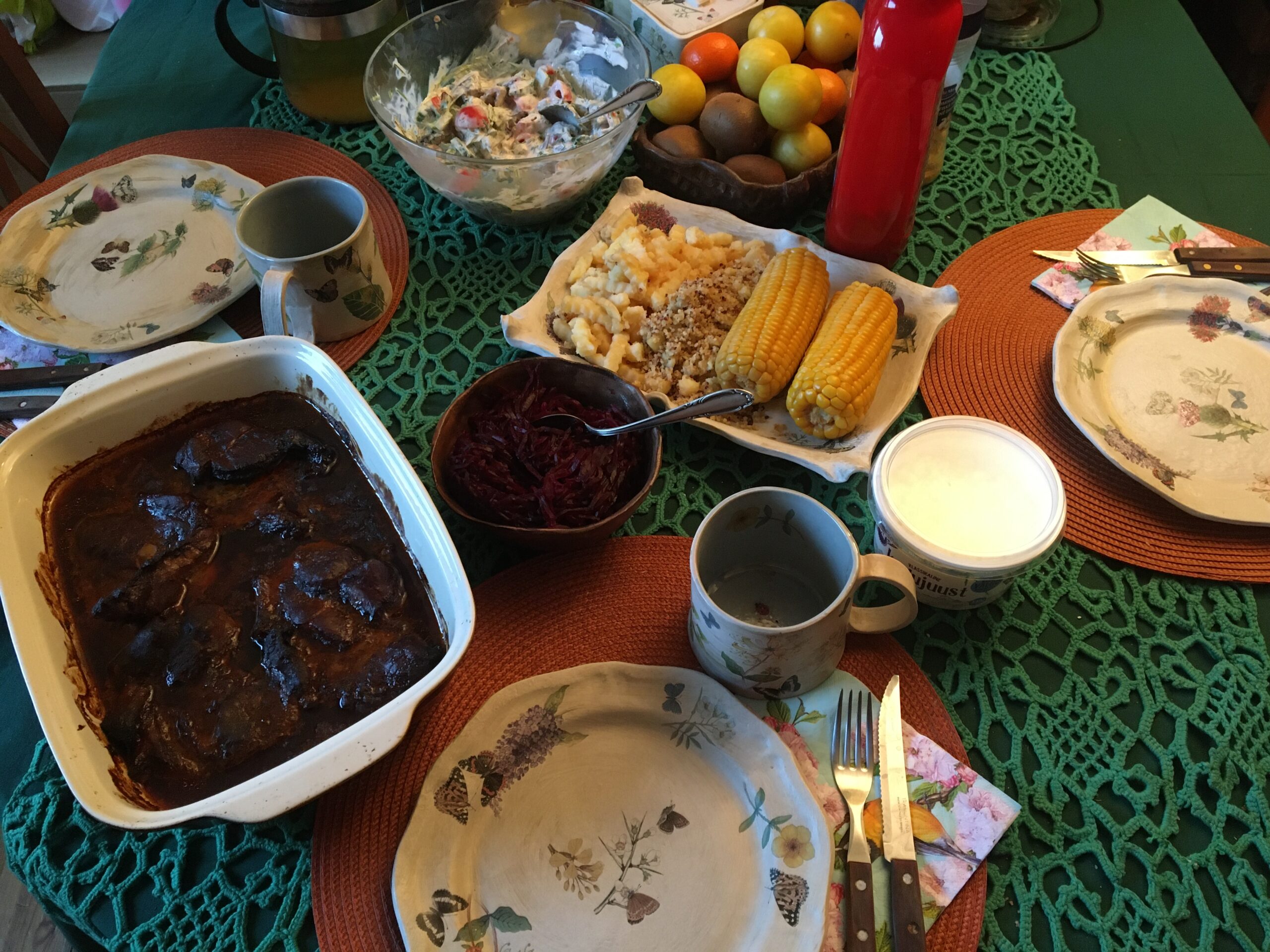
Dinner version 1.
Oven meat (Rakvere grilled meat in blueberry marinade) with french fries or quinoa. Accompanied by fresh salad in sour cream dressing, grated beet and/or corn torch.

Dinner version 2. (today on Valentine’s Day)
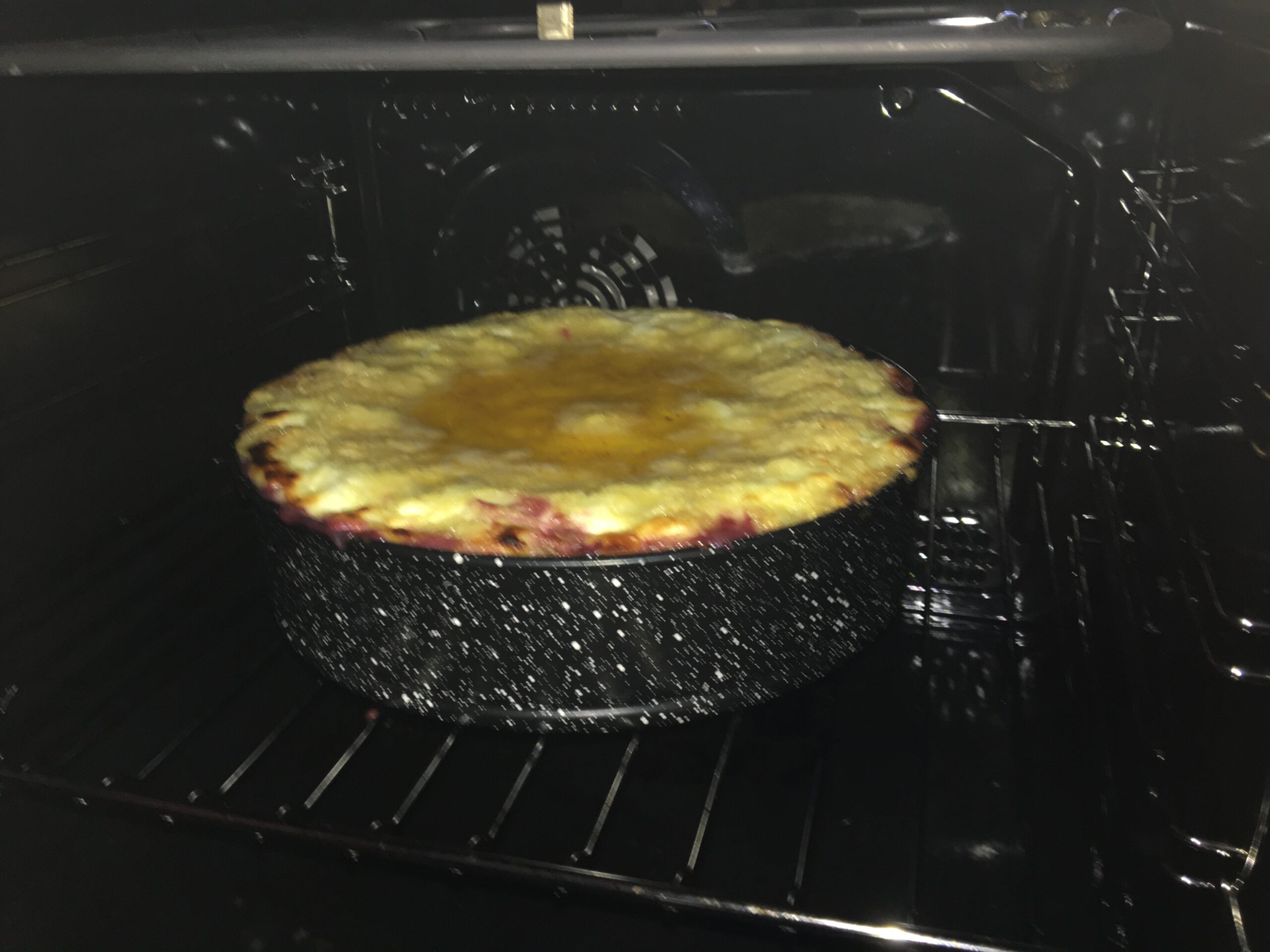
I prepared in oven Bimar’s fried and quick-frozen potato pancakes and Vici breaded fish fingers, these I garnered with onion and sour cream dressing. For dessert there was raspberry-curd cake with vanilla sauce, almonds and coating.

Happy Valentine’s Day my dear friends and all readers of the blog!
Hugs!


Norway becomes biggest electricity exporter in Europe

NordenBladet — In the second half of 2020, Norway became the biggest net exporter of electricity in Europe, sending a fifth of its power generation abroad, states Bloomberg.

Norway surpassed France to take the number one spot due to a boost in output as a precaution to avoid the country’s dams from bursting due to unusually wet weather in 2020.

Alena Nispel, an analyst at the energy consultancy, Enappsys, “Norwegian power prices remained low, which made it an attractive economic proposition for other countries to meet their electricity demand by taking some of the excess from Norway.” Nispel followed by stating that the country’s lead “could remain for some time, especially with neighboring countries such as Denmark relying on Norway for supplies.”

According to Bloomberg, Norway’s role as a power exporter comes even as it pushes to electrify everything from transport to heating and industry. Around five million Norwegian consumers use about the same amount of power as 10 million in neighboring Sweden.


Finland: European Commission requests more information from Finland on its retail sale license system for beverages containing up to 5.5% alcohol by volume

NordenBladet — On 11 February 2021, the European Commission requested that Finnish authorities provide further information on the regulation of retail sales of beverages containing up to 5.5% alcohol by volume. The request is related to the so-called EU Pilot mechanism between the Commission and a Member State.

The request for information is based on complaints received by the Commission. In particular, these complaints concern the principle of free movement of goods in connection with distance selling of alcohol online.

Finnish authorities will respond to the Commission’s request by 14 April 2021.Among other things, the Commission has requested Finland to explain whether retail sale licenses are available to retailers in other Member States wishing to conduct distance sales of alcoholic beverages containing up to 5.5% alcohol by volume. In addition, the Commission has asked Finland to provide clarification on the Finnish system of retail sales of alcohol. The Commission also requests information about Finland’s plans to implement the proposals made by a working group of the Ministry of Social Affairs and Health in April 2018 to develop the regulation of cross-border sales of alcoholic beverages. According to the working group’s proposal, both domestic and foreign operators could sell alcoholic beverages online as long as the alcohol content by volume did not exceed 5.5%. Such alcoholic beverages would be distributed from retail premises in Finland, not by post or a transport operator.

The Commission also requests further information on the processing of tenders submitted to Alko. EU Pilot is a dialogue mechanism for the Commission and Member States

The European Commission monitors the Member States’ compliance with EU law. The request for information received by Finland is part of the informal EU Pilot mechanism between the Commission and a Member State. The mechanism enables the Commission to obtain information from a Member State on, for example, national provisions and their practical application. The Ministry of Social Affairs and Health publishes the Commission’s request, because misleading information concerning the issues in the Pilot mechanism has been presented in public. The Commission has agreed to make the request public.


Finland: Consultation begins on national implementation of EU directive on access to financial information

NordenBladet — The Ministry of the Interior has prepared legislative amendments to implement the EU directive on access to financial information at national level. The directive contains rules to facilitate the use of information held in bank account registries by the authorities for the purpose of preventing, detecting, investigating or prosecuting certain offences.

Work on the legislative project has progressed and a consultation on the national implementation of the directive will now be launched. Powers will be granted to authorities responsible for detecting and investigating serious offences According to the directive, each Member State must designate the competent authorities empowered to access and search its national centralised bank account registry. Under the directive, access to bank and payment account registries may be granted to authorities competent for the prevention, detection, investigation and prosecution of serious offences.

The government proposal not only designates the authorities that would have direct access to the bank and payment accounts control system as set out in the directive, but it also proposes that the current number of authorities authorised to use the bank and payment accounts control system should be extended. Within the meaning of the directive, access would be granted to the police, the Finnish Security and Intelligence Service, Customs, the Border Guard and prosecutors. In addition, provisions are now proposed in national legislation under which the number of authorities accessing the system be extended to those authorities that already have the right to access information held in the system on the basis of the existing regulation, but which still partly obtain the information even manually. At present, only the competent authorities under the Act on Preventing Money Laundering and Terrorist Financing are allowed to access the bank and payment accounts control system when they perform tasks related to money laundering.

Centralised bank account registries mean the centralised automated mechanisms, such as central registries or central electronic data retrieval systems. They allow competent authorities to search electronically information on bank and payment accounts as well as on their holders and beneficial owners.

In addition to extending the number of competent authorities, the government proposal suggests adding technical solutions, such as the development of an application that would facilitate the implementation of the extension to be integrated in the bank and payment accounts control system.

The directive also lays down provisions on the exchange of information between Financial Intelligence Units and with Europol. As required by the implementation of the directive, it is also proposed that the powers of the Financial Intelligence Unit be extended to cover offences under the Europol Regulation. In Finland, the Financial Intelligence Unit operates under the National Bureau of Investigation.In the work, particular attention has been paid to the right to privacy and the protection of personal data guaranteed by the Constitution and the requirements of data protection provisions.

The directive must be implemented into national law by August 2021The directive relates to the Fifth Anti-Money Laundering Directive, which requires Member States to put in place centralised bank account registries or data retrieval systems allowing the timely identification of the persons holding bank and payment accounts and safe-deposit boxes. In Finland, the Fifth Anti-Money Laundering Directive was implemented, among other things, by means of the Act on the Bank and Payment Accounts Control System, which entered into force on 1 May 2019. Its provisions on the bank and payment account data retrieval system and on the bank and payment account registry have been applied since 1 September 2020.

The directive was adopted on 20 June 2019 and Member States must bring into force the acts, decrees and administrative regulations necessary for ensuring compliance with the directive no later than 1 August 2021. The proposed acts are intended to enter into force as soon as possible, with the exception of the provisions necessary for the technical development of the system proposed for the Act on the Bank and Payment Accounts Control System, which are intended to enter into force on 1 March 2022.


Finland: New Ambassadors to Bern, Hanoi, Nairobi and Tehran

NordenBladet — At the presidential session on Friday 12 February, the President of the Republic appointed new Ambassadors to Bern, Hanoi, Nairobi and Tehran.

The President of the Republic appointed Counsellor for Foreign Affairs Valtteri Hirvonen to serve as Head of Mission at Finland’s Embassy in Bern, starting on 1 September 2021. Hirvonen will move to Bern from the Ministry, where he has held the post of Director for Occupational Wellbeing since 2018. In 2014–2018, he served as Finland’s Ambassador in Reykjavik. His career in the Diplomatic Service includes posts also in Canberra, Mexico City, Warsaw, Tokyo and Pyongyang. Hirvonen joined the Ministry for Foreign Affairs in 1988. He holds a Master of Arts degree.

The President of the Republic appointed Counsellor for Foreign Affairs Keijo Norvanto to serve as Head of Mission at Finland’s Embassy in Hanoi, starting, starting on 1 September 2021. Norvanto will move to Hanoi from Tehran, where he has served as Head of Mission since 2017. In 2014–2017, he served as Deputy Director General of Communications of the Ministry for Foreign Affairs. His career in the Diplomatic Service includes posts in New Delhi, London and Riyadh. Norvanto joined the Ministry for Foreign Affairs in 1997. He holds a Master’s degree in Social Sciences.

The President of the Republic appointed Counsellor for Foreign Affairs Pirkka Tapiola to serve as Head of Mission at Finland’s Embassy in Nairobi, starting on 1 September 2021. Tapiola will move to Nairobi from Bangkok, where he has been Head of the EU Delegation  to Thailand since 2017. He has also worked as Head of the EU Delegation to Moldova and,  in 2004–2009, he served as Senior Advisor to the then High Representative Javier Solana.  His career in the Finnish Diplomatic Service includes posts in Bangkok and Kyiv. He has also served in the OSCE Mission in Riga, Latvia. Tapiola joined the Ministry for Foreign Affairs in 1994. He holds a Master’s degree in Political Sciences (International Relations).

The President of the Republic appointed Counsellor for Foreign Affairs Kari Kahiluoto to serve as Head of Mission at Finland’s Embassy in Tehran, starting on 1 September 2021. Kahiluoto will move to Tehran from Hanoi, where he has worked as Head of Mission since 2017. In 2014–2017, he served as Chief of the Secretariat for Nordic Cooperation. In 2013–2014, when the Finnish mission to Syria was temporarily based in Beirut, Kahiluoto served as the Finnish Ambassador to Syria . In the Diplomatic Service, he has also worked as Finland’s Permanent Representative to the UN Conference on Disarmament in Geneva and served in Beijing and at Finland’s Mission to NATO in Brussels. Kahiluoto joined the Ministry for Foreign Affairs in 1986. He holds a Master’s degree in Social Sciences.
 

Estonia: The laureates of the achievement awards for culture and sport were announced

NordenBladet — On February 11th, the government decided that the Lifetime Achievement Awards for Culture will be awarded to Eha Komissarov, Tiit Pääsuke and Enn Säde. The Lifetime Achievement Awards for Sport will be awarded to Õnne Pollisinski and Gunnar Paal. The government’s decisions are based on the proposals made by the respective commissions.

“The Culture and Sports Awards are the highest recognition through which the government expresses its gratitude and recognizes the people of culture and sports. These people have enriched and passed on our national idea and have been an inspiration to many of our compatriots with their achievements, “said Minister of Culture Anneli Ott.

Culture awards

Lifetime Achievement Award winner, art historian and curator Eha Komissarov has worked at the Art Museum of Estonia since 1973, and during this century been one of the creators and promoters of the Kumu Art Museum’s programme. She has been a teacher and mentor to many younger artists and curators and and actively supported the organization of the Tallinn Print Triennial as well as other important art events and undertakings. According to those who nominated her, she can be considered to be the mother of Estonian contemporary art – how we see art and what we understand to be art has been largely shaped and influenced by Komissarov. She was nominated for the State Lifetime Achievement Award by the Estonian Centre for Contemporary Art.

Lifetime Achievement Award winner, painter Tiit Pääsuke will celebrate his 80th jubilee birthday in December of this year. Last year, a survey exhibition of his work called Nostalgiata opened at the Tartu Art Museum. According to those who nominated him, Pääsuke is a living legend among our painters. He has been a teacher and keeper of traditions for a long time. He was also nominated for the State Lifetime Achievement Award by the Estonian Academy of Arts, the Estonian Artists’ Association, the Art Hall Foundation, and Tartu Art Museum, as well as Kadri Mälk and Jaan-Eik Tulve.

Lifetime Achievement Award winner, sound engineer and sound director Enn Säde has worked on 25 feature films and 80 documentaries. Among many others, these include feature films like Tuulte pesa, Naerata ometi, TV-miniseries Lindpriid, and the documentary Nõialoom. According to those nominating him, Säde’s work has significantly impacted the next generation of filmmakers. He was nominated by the Association of Estonian Film Journalists, Estonian Film Institute, Black Nights Film Festival, Estonian Filmmakers Association, Sõprus Cinema, Estonian Film Industry Cluster, as well as Rein Maran, Toivo-Peep Puks and Rein Raamat.

The amount of each Lifetime Achievement Award for Culture is €64,000.

Five annual national culture prizes will be awarded. The recipients are Jiři Tintěra, for his work in the city of Valga; the artist Flo Kasearu, for her solo exhibitions; as well as art historian, curator and playwright Eero Epner, for his work in all these areas. The annual award will also be awarded to the prolific internationally renowned jazz musician Jaak Sooäär and art historians Epp Lankots and Triin Ojari, who have studied leisure culture in 20th-century Estonia.

The amount of the annual prize is €9,600. In the case of a creative team, the prize money will be divided among the team members.

Sports awards

Lifetime Achievement Award winner and swimming coach Õnne Pollisinski has made a long-term contribution as an Estonian underwater sports coach, leader of the relevant sport association, and developer of the sport. She has promoted swimming as a sport for Estonians with special needs. In addition, under Pollisinski’s guidance, Estonia has won many medals at title competitions. She was nominated by the Estonian Paralympic Swimming Association, and her nomination was supported by the Estonian Society of Patients with Spina Bifida and Hydrocephalus, the Estonian Underwater Association and the Down Syndrome Association.

Lifetime Achievement Award winner, journalist and sport leader Gunnar Paal will receive the award for his significant contribution as a sports leader and sports journalist. He was one of the managers of the Tallinn Sailing Regatta Press Center for the Moscow Olympic Games and the Secretary General of the Estonian Olympic Committee (EOK) from 1989 to 1997. Currently Paal is an honorary member of the Estonian Olympic Committee. He is a founding member of the Estonian Olympic Academy and has written several works on Estonian sports and the Olympic movement. He was nominated by the Estonian Olympic Academy.

The amount of each Lifetime Achievement Award for Sport is €40 000. 

The annual prizes for sport will be awarded to Kelly Sildaru for her gold medals in the Junior World Championships and Winter X Games in slopestyle and volleyball coach Avo Keel taking the Latvian team to the finals of the European Championship. The winners of annual awards also include the following: Urmo Aava, for organising the first WRC Estoniatrainer-of-the-year Anna Levandi; rally driver Ken Torn, for coming in first in the final round of the ERC3 and ERC3 Junior season; and Natalja Inno and Peeter Lusmägi for successful organisation of a sports week.

The amount of each annual prize is €9,600. In the case of a sports team, the prize money will be divided among the team members.

The national culture and sports prizes, along with the national science prizes and the Ferdinand Johann Wiedemann Language Prize, will be awarded on February 23rd, the eve of Estonian Independence Day, in the hall of the Estonian Academy of Sciences.