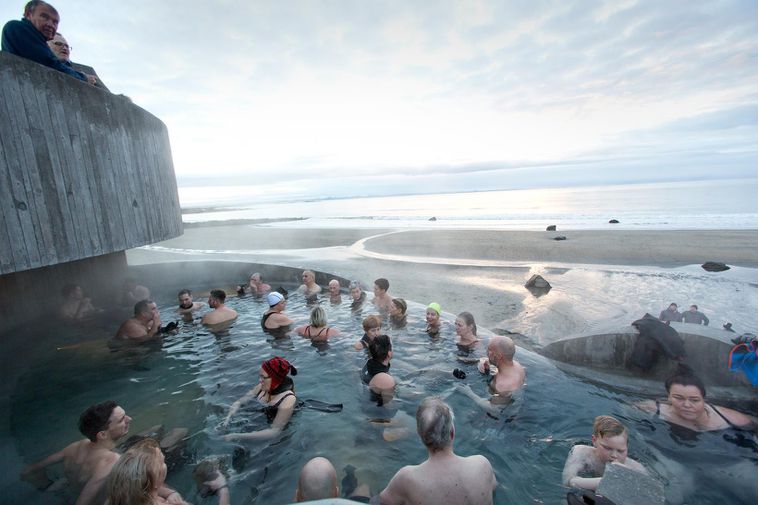
NordenBladet – The natural pool Guðlaug on Langisandur beach, in Akranes, West Iceland, has been nominated for the 2022 Mies van der Rohe Award – the European Union Prize for Contemporary Architecture, mbl.is reports. The prize is awarded every other year by the EU and the Fundació Mies van der Rohe, Barcelona.
It recognizes and commends excellence in European architecture in conceptual, social, cultural, technical and constructive terms. In April, 2022, the winners will be announced.
Guðlaug was designed by Basalt architects, while Mannvit was in charge of engineering design.
Admission to the pool is free, and it has proven ideal for sea swimmers. The pool opened to the public on December 8, 2018, and was visited by about 30,000 guests in 2019.
The structure includes an observation deck, reminiscent of the prow of a ship, a warm pool that enjoys shelter from the wind, and a shallow pool, mixed with seawater. The view from the pool of Faxaflói bay and Reykjavík is spectacular.
In the video below, you can see, step by step, how the project developed.
Featured image: From Guðlaug, before COVID-19 spread to Iceland. (Photo/Facebook)
NordenBladet – This year marks the 30 years since King Olav V died and his son took over as Norway’s new king. The official announcement of King Olav’s death, on January 17 1991, was given by the King in Extraordinary Council of State at the Palace at midnight. On January 18, King Harald gave his first speech as monarch, in which he remembered his father and asked for the support of the people in the duty that now lay before him. A few days later, on 21 January, King Harald gave his oath to the Constitution.
In the days before the funeral of King Olav, heads of state and royals from all over the world arrived in Oslo. Heads of state from over 150 nations were represented at the funeral. Royals from all monarchies around the world were represented. From Great Britain, The Prince of Wales and The Princess Royal participated; they were personal guests of Crown Prince Haakon and lived at Skaugum during their time in Norway in 1991. The Danish and Swedish royals lived at the castle in Oslo. The then King of Spain, Juan Carlos, even flew the plane that took him and Queen Sofia to Oslo. From the Soviet Union came the nation’s vice president, Gennady Yanayev.
On 30 January 1991, King Olav V was laid to rest. A large crowd followed King Olav to his final resting place. More than 100,000 Norwegians stood along the streets in Oslo while the King’s coffin was taken forward slowly. The participants have since said that they have never experienced such a sad atmosphere before or after. The whole of Oslo was quiet, the only thing you could hear were horseshoes against the ground, the church bells and cannon shots in the distance.
The funeral took place in Oslo Cathedral, where Bishop Andreas Aarflot officiated. Prime Minister Gro H. Brundtland said in her speech during the funeral: “King Olav was the king of the whole people. He became a role model for us all through his tireless efforts, through his secure leadership and through his true warmth. The children have said it so simply, he was the kindest king in the world.”
After the ceremony, the coffin of the monarch was brought to the Castle Church at Akershus Fortress, where the final burial took place. King Olav was then laid to rest in the Royal Mausoleum, by his wife’s side. He and Crown Princess Martha are now in the same sarcophagus. In the sarcophagus next to it are his mother and father, King Haakon VII and Queen Maud.
Losing King Olav was a great sorrow for the Norwegian people. King Olav was a much-loved monarch, largely due to his efforts for Norway during World War II. Otherwise, King Olav was very traditional and old-fashioned in many ways. All school children in Norway were gathered in auditoriums that day and watched the funeral on national television. When the funeral was going on, all traffic in Norway was stopped. Cars stopped on the side of the highways and heard the funeral on the radio while buses, trains and planes were halted in respect for the King. All churches all over Norway rang their bells, both the day after King Olav’s death and the day he was buried. All shops in Norway were closed in respect between 11am and 2pm on the day of the funeral.
From the day King Olav died until the funeral, the King’s Flag was flown at half mast and mourning ribbons were attached. After the ceremony at Akerhus Fortress, the royals returned to the palace in Oslo. According to old tradition, the mourning ribbons were removed and the flag of the King was raised to the top the moment King Harald came out on the balcony with his family. It was a powerful and poignant moment, showing that King Olav’s reign was officially over and that King Harald’s time had begun. When the royals came out on the balcony, people spontaneously started shouting “Long live the King” before singing the national anthem and then the royal anthem.
NordenBladet — Finland strengthens its support for education in developing countries as a donor of the Global Partnership for Education (GPE). At the virtual Educa goes digital event on Friday 29 January, Minister for Development Cooperation and Foreign Trade Ville Skinnari informed that Finland will allocate EUR 25 million to GPE’s next replenishment for 2021-2025.
GPE is the largest global fund dedicated to supporting education systems in developing countries. It gives grants for the development of the education sector in lower-income and fragile countries. The majority of the grants are given to countries in Sub-Saharan Africa.Finland has collaborated with GPE before. In 2013–2016, Finland supported the fund by a total of EUR 6 million. At the end of 2020, Finland allocated EUR 2 million to GPE’s response to the COVID-19 pandemic to be used for supporting continuity of learning in developing countries in the emergency caused by the pandemic. The support focuses on ensuring the continuity of learning and return to school especially for girls and other children in vulnerable position.
“Given the international interest that our good expertise and education system attract, Finland can play a role in advancing the sustainable development goal of the UN 2030 Agenda on quality education in different parts of the world. Finland wants to work towards the common goal of providing quality education for the most vulnerable children and youth,” said Minister Skinnari at Educa.
Finland considers that it is particularly important to support access to education for girls and children with disabilities and to develop teacher training.GPE aims to raise USD 5 billion in development finance during the next five years. The funding will be used to strengthen education systems comprehensively, to improve the quality of teaching, and to promote the education of girls and the most marginalised children in more than 70 developing countries.
The countries receiving grants from GPE are required to be able to provide sufficient national funding for the education sector as well as to promote gender responsive and equitable education sector plans. GPE’s work is based on partnerships with developing countries, donors, development finance institutions, organisations and the private sector..
NordenBladet — At the presidential session on Friday 29 January, the President of the Republic decided to appoint new Ambassadors to Stockholm and Beijing and a new Consul General to Los Angeles.
The President of the Republic appointed Counsellor for Foreign Affairs Maimo Henriksson to serve as Head of Mission at Finland’s Embassy in Stockholm, starting on 1 September 2021. Henriksson will move to Stockholm from the Foreign Ministry’s Department for Russia, Eastern Europe and Central Asia, where she has worked as Director General since 2016. Before that, in 2015–2016, she served as Chief of Protocol. In 2010–2014, Henriksson worked as Finland’s Ambassador in Oslo. Her career in the Diplomatic Service includes posts in Budapest and Moscow. Henriksson joined the Foreign Ministry in 1989. She holds two university degrees: Master of Laws and Master of Science in Economics and Business Administration.
The President of the Republic appointed Counsellor for Foreign Affairs Leena-Kaisa Mikkola to serve as Head of Mission at Finland’s Embassy in Beijing, starting on 1 September 2021. Mikkola will move to Beijing from the Ministry’s Department for Africa and the Middle East, where she has worked as Director General since 2017. In 2016–2017, she served as Senior Adviser responsible for monitoring the situation in Syria. In 2011–2016, Mikkola worked as Finland’s Ambassador in Tel Aviv. Her career in the Diplomatic Service includes posts in the Permanent Representation of Finland to the EU in Brussels and the Embassies of Finland in Canberra, Athens and Budapest. Mikkola joined the Ministry for Foreign Affairs in 1992. She holds a Master of Laws degree.
Okko-Pekka Salmimies
The President of the Republic appointed Counsellor for Foreign Affairs Okko-Pekka Salmimies to serve as Consul General at Finland’s Consulate General in Los Angeles, starting from 1 September 2021. Salmimies will move to Los Angeles from the Finnish Institute of International Affairs, where he is currently Visiting Senior Fellow. In 2016–2020, he served as Ambassador for Team Finland. In 2013–2016, Salmimies worked as Ambassador and Head of Mission at the Permanent Delegations of Finland to the OECD and to UNESCO in Paris. In the Diplomatic Service, he has also held posts in Paris and Brussels. Salmimies joined the Ministry for Foreign Affairs in 1997. He holds a Master’s degree in Social Sciences.
NordenBladet — Minister for Development Cooperation and Foreign Trade Ville Skinnari will participate in a panel discussion on sustainable investments, organised by the World Economic Forum (WEF) on Friday 29 January. The annual WEF “Davos Agenda” is organised virtually from 25 to 29 January.
Minister Skinnari will attend a panel discussion focusing on global investment flows and on how to mobilise investments to achieve the sustainable development goals (SDGs). The COVID-19 pandemic has decreased foreign direct investments (FDI) by more than 40 per cent, which has a severe impact on the future prospects of sustainable growth. The key question at the event is what changes are needed to restore global investments and to get them back on track.
NordenBladet – On Thursday, His Royal Highness Crown Prince Frederik of Denmark visited the emergency services in the Danish capital of Copenhagen. The employees here have been on the front lines since the outbreak of the pandemic last year and they have taken care of the citizens of the region.
Crown Prince Frederik’s rather informal visit was divided into two parts. First, His Royal Highness had a look at the vehicles that the ambulance service uses when they pick up COVID-patients. He talked for a long time with the ambulance workers who are working to fight the virus every day. The Crown Prince then went to the switchboard, which receives calls from all over the Copenhagen area, but which in recent months has been used a lot by people calling in when they suspect an infection of COVID-19. The Crown Prince learned more about how the work here is done to determine whether it is COVID-19 and what further action is taken.
The Crown Prince also learned about the mobile test centres that are sent to areas with a high concentrations of infected people. His Royal Highness came with the following statement after his visit: “In addition to driving out into residential areas to establish pop-up test centres, it is also the Emergency Management Agency that drives out to nursing homes and the socially disadvantaged to test citizens for COVID-19. In total, emergency response, test centres and mobile devices can test more than 50,000 a day. I would like to thank the Emergency Management Agency for their efforts.”
In addition to the established Danish corona hotline, the Emergency Management Agency has also developed a chatbot that helps citizens assess whether or not to call if they need COVID-related medical help, to call their own doctor or to just stay home when symptoms occur.
NordenBladet – Some parts of Iceland tremble more than others, and last year, a total of 22,000 tremors registered on the Reykjanes* peninsula, Southwest Iceland, Morgunblaðið reports. Most of those were less than 3 in magnitude. This continuous seismic activity began in the town of Grindavík on January 26 last year. This was followed by an inflation of the surface – first by a couple of centimeter, then more, presumably due to magma accumulating under the surface.
“There is more seismic activity on the Reykjanes peninsula than we’ve seen before,” states Kristín Jónsdóttir, earthquake hazards coordinator at the Icelandic Met Office. It is the largest seismic activity since digital measurements began in 1991.
The activity has for the most part been concentrated in the area from the southwestern tip of Reykjanes to Kleifarvatn lake in the east, but during the past few months, the activity and source of the tremors have been moving farther east, toward Krýsuvík. On October 20 last year, the source of an earthquake of magnitude 5.6 was not far from Djúpavatn lake.
The tectonic plate boundary of the Reykjanes Ridge runs from west to east across the Reykjanes peninsula. This is where the North-American tectonic plate meets the Eurasian one, sparking the idea for the so-called Bridge Between Continents near Sandvík, popular among tourists.
On average, the plates move away from each other by about one cm a year, but during the past semesters, the movement in certain areas in Reykjanes has been up to 16 cm (6 in).
Kristín assumes that pressure is building up in the earth between Kleifarvatn lake and Bláfjöll mountains, which can only be released in a large earthquake. Two such, of magnitude 6.3 and 6, occurred in 1929 and 1968. Their source was near Brennisteinsfjöll mountains, east of Kleifarvatn lake.
Björn Oddsson, geophysicist and program director for the Department of Civil Protection and Emergency Management, states that the Reykjanes peninsula is constantly being monitored. A phase of uncertainty (the lowest alert phase) will remain in place there while seismic activity is above average.
____________________________
*Reykjanes is a small headland on the southwestern tip of Reykjanesskagi in Iceland. The region is about 9 km (5.6 mi) from Iceland’s international airport.
There was a prolonged period of constant volcanic activity on the peninsula, the Reykjanes Fires, from the 10th to the 13th century; between 1210 and 1240 about 50 square km of land were covered in lava. The area is fed by five volcanic systems; geological evidence suggests that they seem to activate in a coordinated way about every 1,000 years.
In the twelve weeks from 21 January 2020, after centuries of relative inactivity, there were more than 8,000 earthquakes and about 10 cm of land uplift due to underground magma intrusions on the peninsula, leading to concerns of a new phase of activity which could cause disruption for centuries.
As the name means “smoking peninsula” connected to volcanic activity, there are also other peninsulas by this name in Iceland, e.g. the peninsula of Reykjanes in Ísafjarðardjúp.
NordenBladet — Finland has granted a million euros to UN Women for its peacebuilding activities in Syria. The project, which is entitled Supporting Syrian Women’s Engagement in the Syrian Political Process: Building a Constituency for Peace, aims to support women’s engagement in and influence on political processes in Syria. The project runs from October 2020 until December 2021.Geir O. Pedersen, United Nations Special Envoy for Syria, meets the Syrian Women’s Advisory Board (WAB) in Geneva in 2019.
Finland has funded the project via UN Women since 2017. The project has four pillars: supporting political processes, grassroots dialogues, international coordination, and gender-related research and analysis in Syria. Sustainable and fair peace cannot be achieved without women’s participation.
The Syrian conflict has lasted for almost a decade. The conflict cannot be resolved by military means but the political process and peacebuilding requires the Syrian people’s engagement. The peacebuilding project, implemented by UN Women, fosters dialogue between women from various backgrounds and contributes to women’s participation in the political process.
The UN Secretary-General has appointed a Special Envoy for Syria to mediate the peace process. The Special Envoy is assisted by the Syrian Women’s Advisory Board (WAB), which brings women’s perspectives to the political process and supports, for example, the Syrian Constitutional Committee’s (SCC) work. Thanks to the advocacy work done by the Advisory Board for several years, almost 30 per cent of the members of the Constitutional Committee are now women. The project supports the work of the WAB and its contacts with grassroots level actors.
Women’s participation contributes to peace
The UN has tried to increase women’s participation in the peace talks. Finland supports its objectives. In its mediation projects, Finland has come to the same conclusion as is stated in the UN Resolution 1325 (Women, Peace and Security), according to which women’s participation in peace talks contributes positively to the promotion and maintenance of peace. Studies show that women’s inclusion increases the likelihood that peace agreements are implemented.
Finland participates in three different projects relating to mediation in the Syrian conflict. In addition to the project implemented by UN Women, Finland supports a project implemented by Berghof Foundation and a joint project by the Finnish Evangelic-Lutheran Mission (FELM) and the Common Space Initiative (CSI). The mediation projects aim at supporting Syrian grassroots level actors’ and influencers’ peacebuilding efforts by means of producing background material for their work, offering training, organising discussion events for Syrian people, and establishing contacts for them with significant external actors. Finland has also supported the International, Impartial and Independent Mechanism (IIIM) since its establishment. IIIM, a body operating under the UN, assists in the investigation and prosecution of persons responsible for the most serious crimes and aims to bring the perpetrators to justice and to ensure justice for victims.
NordenBladet — On Thursday 28 January, the Government appointed Antti Pelttari, Master of Laws, to continue in his post as the Director of the Finnish Security and Intelligence Service. The post will be filled for the period from 1 March 2021 to 28 February 2026.
Antti Pelttari has served as the Director of the Finnish Security and Intelligence Service since 2011. His leadership experience is mostly concentrated in the Ministry of the Interior’s branch of government and he has extensive skills in implementing development projects related to the remit of the Finnish Security and Intelligence Service. As the Director of the Finnish Security and Intelligence Service, Pelttari has been responsible for the organisational change of the Finnish Security and Intelligence Service in connection with the entry into force of the civilian intelligence legislation when the status, operational nature and role of the Service transformed from a police organisation into a security and intelligence organisation. As the Director, Pelttari has also been responsible for a number of other development projects in the Finnish Security and Intelligence Service, such as the information system reform and the premises project.
“National security issues will become increasingly important in Finland due to, for example rapid digitalisation and the continuing instability of the international situation. The Finnish Security and Intelligence Service plays an important and, in my opinion, growing role in maintaining Finland’s national security. My main task, together with others working here, is to continue the transformation of the agency, which is well under way, into Finland’s security and intelligence service. Our aim is that the information produced by the Service will better support the decision-making of the Finnish state leaders in foreign and security policy and the activities of the authorities in protecting national security,” says Pelttari.
Pelttari served at the Ministry of the Interior as the State Secretary in 2009–2011, the Director General of the International Affairs Unit in 2005–2008 and a Senior Ministerial Adviser in 1996–1998. Between 1998 and 2005, Pelttari worked as a Committee Counsel in Parliament’s Foreign Affairs and Defence Committees. From 1993 to 1996, Pelttari served as a Legal Officer in the Legal Department of the Ministry for Foreign Affairs.
The Director of the Finnish Security and Intelligence Service is in charge of the operations of the Finnish Security and Intelligence Service and ensures that the tasks of the Service are carried out effectively, appropriately and efficiently. In addition, the Director of the Finnish Security and Intelligence Service is responsible for, among other things, ensuring the general operating conditions of the Service, agreeing with the Ministry of the Interior on the performance targets and appropriations of the Service, and establishing the operational strategy and the priorities of the activities. The Director is also responsible for operationally important development projects, international contacts and stakeholder cooperation.A comprehensive security clearance has been conducted on the Director of the Finnish Security and Intelligence Service and a non-compete agreement has been concluded with him under the Act on Public Officials in Central Government.
NordenBladet — The Government proposes that the provisions on the Average Adjuster be reformed and included in the Maritime Act. The aim of the proposal is to clarify the initiation process of matters that are to be referred to the Average Adjuster as well as the involved indemnity schemes.
The Government submitted its proposal to Parliament on 28 January 2021.In future, the Average Adjuster would be appointed by the Government instead of the Ministry of Transport and Communications. The office of the Average Adjuster would be considered comparable to the office of a district court judge.
The Average Adjuster is a traditional part of the maritime law and insurance system in the Nordic countries. The relevant provisions are laid down in the countries’ national maritime legislation. In Finland, the duties are carried out on a secondary basis.In future, a replacement of the Average Adjuster would also have to be appointed. The deputy would be responsible for those matters referred to the Average Adjuster in which the Adjuster is unable to act.
The responsibilities of the Average Adjuster would continue to include the following:
1. indemnity adjustments drawn up under ship insurance
2. amount and division of ship manager’s responsibilities in certain cases
3. settlement of disputes relating to charter parties on distance freight and
4. indemnity adjustments concerning particular or general averages.
In future, disputes concerning ship insurance would no longer require an indemnity adjustment by the Average Adjuster in order for the matter to be submitted to a court of law for decision, unless the ship is used as a merchant vessel for business purposes.
The Average Adjuster would issue an indemnity adjustment by virtue of ship insurance, if so agreed in the terms of the insurance contract. In other cases, the parties to a ship insurance contract could, however, request for an expert statement from the Average Adjuster.
Next stepsA preliminary debate will be held on the proposal now submitted by the Government to Parliament. The timetable for the debate will be listed on Parliament’s website (upcoming plenary sessions).
After the referral debate, the proposal will be sent to the Transport and Communications Committee. Once the committee’s report is ready, the matter will be discussed in a plenary session again.The Act is scheduled to enter into force on 1 June 2021.