NordenBladet —Today, the Riigikogu passed the Act under which, in the future, local governments will resolve extra-judicial place name disputes instead of the Place Names Board. The Board will give its weighted positions in name disputes where necessary.
The Act on Amendments to the Place Names Act (186 SE), initiated by the Government, also provides more clearly for the status of place name to preclude cases where a name is intended to give a named feature a legal status, that is, to change the regime of the rights and obligations of the named feature. The names of the persons who have acted against the establishment of the Republic of Estonia, the maintenance of constitutional order or the restoration of Estonia’s independence may no longer be established as commemorative names, that is, place names established in the memory or honour of persons. In the event of a conflict, the names authority will have to change the place name.
Amendments are also made to the procedure for the establishment of the Place Names Board. In the future, the Minister of Public Administration will establish the statutes of the Place Names Board, and the number of the members of the Place Name Board will no longer be determined at the level of Act. At present, the Board may have 11-15 members.
In the future, the Land Board who was the authorised processor of the register up to now will maintain the place names register instead of the Ministry of Finance. The functions of the authorised processor of the register are assigned to the information technology centre of the Ministry of the Environment. On the basis of that, in the future, the Minister of the Environment will also establish the statutes of the register.
During the debate, Eerik-Niiles Kross took the floor on behalf of the Estonian Reform Party Faction.
76 members of the Riigikogu were in favour of passing the Act and there was one abstention.
NordenBladet —Under the Resolution of the Riigikogu “The Use of the Defence Forces in the Fulfilment of the International Commitments of the Estonian State in Operation ‘Sentinel’ of the International Maritime Security Construct” (211 OE), initiated by the Government, the mandate will be in force until 31 December 2021.
In summer 2019, the United States of America launched an initiative to establish the International Maritime Security Construct IMSC, which aims to ensure the freedom of navigation and security of vessels in the Strait of Hormuz and to promote a rule-based international order. In order to achieve this, IMSC has launched the operation Sentinel in the Strait of Hormuz region.
Estonia’s priority is international relations based on international law and rules, including the ensuring of freedom of navigation. By participating in the operation, Estonia will make its contribution to increasing stability and security in the Middle East region. Estonia will contribute with a staff officer at the operation headquarters in Bahrain. By participating in operation “Sentinel”, Estonia will continue bilateral cooperation in international missions with its strategic partners, the United States of America and the United Kingdom.
The expenses of the participation in the operation will be covered from the budget of the area of government of the Ministry of Defence.
84 members of the Riigikogu were in favour of passing the Resolution.
One Bill passed the second reading
The Bill on Amendments to the Public Holidays and Days of National Importance Act and the Estonian Flag Act (277 SE) (consolidated Bills 131 SE, 132 SE and 172 SE), initiated by the Government of the Republic, members of the Riigikogu Jüri Jaanson, Signe Kivi, Signe Riisalo, Toomas Kivimägi, Mart Võrklaev, Annely Akkermann, Kaja Kallas, Liina Kersna, Vilja Toomast, Yoko Alender, Andrus Seeme and Andres Sutt and the Social Democratic Party Faction, will amend the Public Holidays and Days of National Importance Act by including the Children’s Day, celebrated on 1 June, in the list of days of national importance. The list of flag days set out in the Estonian Flag Act will also be amended by adding the Children’s Day and the Grandparents’ Day. The Grandparents’ Day is already now celebrated as a day of national importance in Estonia on the second Sunday of September every year, but not as a flag day.
During the debate, Tarmo Kruusimäe (Isamaa) and Helmen Kütt (Social Democratic Party) took the floor.
One Bill passed the first reading
Under the Bill on Amendments to the Income Tax Act (213 SE), initiated by the Social Democratic Party Faction, sole proprietors and natural persons may additionally deduct up to 5,000 euro, instead of the current 2,877 euro, during a period of taxation from their income derived from the sale of self-produced agricultural products after the deductions allowed have been made.
The explanatory memorandum notes that the tax incentive established for private forest owners will need to extend analogously to Estonian farmers as well.
The Riigikogu rejected a draft Resolution at the first reading
The purpose of the Draft Resolution of the Riigikogu “Making a Proposal to the Government of the Republic to Draw Up Legislative Amendments to Solve the Problem of the Long-term Care Burden” (224 OE), submitted by the Social Democratic Party Faction, was to make a proposal to the Government to prepare legislative amendments in order to resolve the problem of the long-term care burden so that human-centred provision of care would be ensured to all who need help.
During the debate, Heljo Pikhof (Social Democratic Party), Urmas Espenberg (Estonian Conservative People’s Party) and Hele Everaus (Reform Party) took the floor.
35 members of the Riigikogu voted in favour of passing the Resolution. The support of at least 51 members of the Riigikogu was needed to pass the Resolution.
NordenBladet —Chairman of the National Defence Committee Andres Metsoja thinks that in ensuring security, the military and civilian systems should always be viewed together. “Agencies tend to sit on different benches and it is quite complicated to find a common ground,” Metsoja admitted. “Today’s meeting was first of all necessary for giving the ministers an opportunity to explain the changes planned in their area of responsibility.” In Metsoja’s opinion, harmonisation of positions is the only solution for moving forward.
Member of the National Defence Committee Johannes Kert emphasised the importance of forwarding recognised maritime surveillance pictures to NATO. He said it was necessary for NATO maritime forces so that they could react in our defence. “The current situation of Estonia’s maritime defence inevitably makes Estonia the weakest link in the NATO chain,” Kert explained. “As we are not able to send recognised maritime surveillance pictures to NATO today, NATO cannot timely react in our defence. The defencelessness of the West Estonian islands is a problem also to other Baltic and Baltic Sea member states of NATO and the European Union.”
Kert pointed out that it was necessary to end wasting of maritime resources and unite performance of the functions of the state at sea into one navy. “The most effective opportunity would be to unite maritime agencies under the composition of the navy with the resources and means they use today, optimise the use and development of capabilities under one leadership,” Kert said, and added that this was generally done in the NATO countries.
Prime Minister Jüri Ratas, Minister of Economic Affairs and Infrastructure Taavi Aas, Minister of the Interior Mart Helme and representatives of the Ministry of Defence and the Government Office gave explanations to the Committee. Referring to the discussion in the Security Committee of the Government of the Republic, the Prime Minister said that the Government considered it important to ensure the maritime security and safety of the country. The budget strategy for 2021–2024 provides for allocating additional resources for capability development in the areas of government of both the Ministry of the Interior and the Ministry of Defence. It is planned to develop a common organisational management organisation by 2022, which would ensure more effective use of the ships and other resources of the Defence Forces, the Police and Border Guard Board and the Maritime Administration for national defence purposes. It also means that in the future there will be compatible communications systems, common trainings and joint exercises.
NordenBladet —Under the Bill on Amendments to the Organic Farming Act and the Plant Propagation and Plant Variety Rights Act, in the future, persons who sell unpacked organic products in small quantities, for example small organic shops, will be exempt from the obligation to be in the possession of a certificate.
It will be sufficient to notify the Agricultural and Food Board in order to obtain the exemption. It is an option granted by the EU, under which Member States can grant exemptions to operators that sell unpacked organic products to the final consumer, provided that they do not produce, prepare, store other than in connection with the point of sale, or import such products from a third country, or subcontract such activities to another operator.
The sale of unpacked organic products must not exceed 5 000 kg per year; such sales must not represent an annual turnover in relation to unpacked organic products exceeding EUR 20 000; or the potential certification cost of the operator exceeds 2 % of the total turnover on unpacked organic products sold by that operator.
In order to prevent fraudulent use of the indications referring to organic farming, the bases for the repeal of decisions on recognition will be changed and the fine for knowingly placing on the market non-organic products with an indication referring to organic farming will be increased.
The Bill on Amendments to the Organic Farming Act and the Plant Propagation and Plant Variety Rights Act (260 SE), initiated by the Government, will bring the Act into conformity with the EU organic farming Regulation and the establishment of a new agency, the Agricultural and Food Board, on the basis of the Agricultural Board and the Veterinary and Food Board.
NordenBladet —At their meeting today, President of the Riigikogu (Parliament of Estonia) Henn Põlluaas and Speaker of the National Assembly of Hungary László Kövér spoke about the bilateral relations between their countries and cooperation at the European Union level.
“We have very much in common, not only in history, but also in political and security issues,” Põlluaas said. “Such meetings contribute to the deepening of our bilateral relations even more. Our common duty is to look not only to the past, but also to the future, so that we could represent the interests of our countries in the best way.”
At their meeting, Põlluaas and Kövér discussed issues related to the European Union immigration policy and the need to protect traditional European Christian values, as well as the payment conditions of the European recovery fund and the multiannual budget of the European Union.
Regarding tolerance and freedoms, both Speakers were of one mind that all parties had to have equal rights. “It is not acceptable that different positions are forced on nation states that rely on traditional European Christian values,” Põlluaas emphasised.
The Speaker of the National Assembly of Hungary pointed out that although the bilateral relations were close and mutual cooperation was further strengthened by having related languages, much could still be done in developing of economic relations,
Chairman of Estonia-Hungary Parliamentary Group Anti Poolamets also participated in the meeting.
At the Riigikogu, Kövér also had a meeting with Chair of the European Union Affairs Committee Anneli Ott, with whom the Conference on the Future of Europe, the recovery fund, the Multiannual Financial Framework and the importance of the role of the national parliaments in making decisions were discussed.
In the afternoon, President of the Riigikogu Henn Põlluaas and Speaker of the National Assembly of Hungary László Kövér laid flowers at the Memorial to the Victims of Communism at Maarjamäe. On Tuesday, Kövér will be on Saaremaa Island.
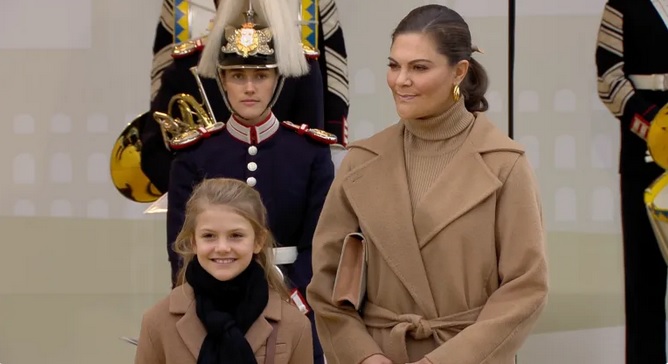
NordenBladet – On Sunday, Princess Estelle joined her grandfather, King Carl XVI Gustaf and mother, Crown Princess Victoria, at the inauguration of the new Slussbron in Stockholm. The new bridge connects the areas of Stadsholmen and Södermalm in the capital.
The Slussbron is part of a larger redevelopment project in the city. The bridge itself is the largest single component in the traffic area. The entire project is expected to be completed by 2025.
The King gave a speech before cutting the ribbon to officially open the bridge. His Majesty said: “The new bridge is an important milestone, in the Slussen project and in Stockholm’s history. And when it now opens to traffic, it links not only north and south but also today’s and tomorrow’s Stockholm.”
He has followed in the footsteps of his great-grandfather in opening a new bridge in the area as King Gustaf V opened the Klöverblads bridge in October 1935. Gustaf V was accompanied by his son, Crown Prince Gustaf Adolf (Carl Gustaf’s grandfather) and Prince Gustaf Adolf (Carl Gustaf’s father) on that day, and the King pointed to the similarities with that day and Sunday.
He said: “Ladies and gentlemen: In October 1935, the so-called Klöverblads bridge was inaugurated by my great-grandfather, King Gustaf V. Also present at that time was my grandfather Gustaf Adolf, who was then Crown Prince, as well as my father, Prince Gustaf Adolf.
“And today, 85 years and ten days later, I stand here in the company of my daughter, the Crown Princess and little Princess Estelle, ready to inaugurate the new Slussbron – or Guldbron as it has come to be called.”
“We are very happy to be able to participate in this solemn occasion. And very soon, when the ribbon is cut, we will be able to cross the bridge in the company of representatives of the next generation of Stockholmers,” the King added.
Carl Gustaf concluded his remarks saying about the bridge, “May it be of benefit and joy to many generations of residents of the capital and visitors.”
Later, the King got some help from eight-year-old Estelle and Crown Princess Victoria when he cut the ribbon on the bridge. The young royal helped hold the ribbon as her grandfather officially cut the ribbon and declared the bridge open. The King, Crown Princess and Princess Estelle then crossed the new bridge alongside students from Hammarby IF and Bollstanäs SK.
Due to the ongoing pandemic, attendance at the event was limited; there was a live stream online so those at home could follow along. The full ceremony can be viewed here: https://guldfestslussen.se/
Featured image: The Crown Princess Victoria and Princess Estelle look on as the King gives his speech. Photo: Screenshot/Fair Use
NordenBladet —Today, Speaker of the National Assembly of Hungary László Kövér arrives on a two-day visit to Estonia.
This morning, he will meet with Prime Minister Jüri Ratas at Stenbock House (seat of the Government of Estonia), and later with President of the Riigikogu (Parliament of Estonia) Henn Põlluaas and Chair of the European Union Affairs Committee of the Riigikogu Anneli Ott at Toompea Castle.
In the afternoon, President of the Riigikogu Henn Põlluaas and Speaker of the National Assembly of Hungary László Kövér will lay flowers at the Memorial to the Victims of Communism at Maarjamäe.
During the visit, Mr. Kövér will present Trivimi Velliste Commander’s Cross of the Hungarian Order of Merit on behalf of the Hungarian State. Vice-President of the Riigikogu Helir-Valdor Seeder will also participate in the meeting.
On Tuesday, Kövér will be on Saaremaa Island. He will meet with Chair of Saaremaa Municipality Council Tiiu Aro and Mayor of Saaremaa Municipality Mikk Tuisk, and visit Kuressaare Castle, St. James Church in Pihtla and Kaali Meteorite Crater visitor centre.
It is a return visit of the Speaker of the National Assembly of Hungary. President of the Riigikogu Henn Põlluaas visited the Hungarian Parliament last year in October.
NordenBladet —Recent videoconferences of the Parliamentary Assembly of the Council of Europe (PACE) focused on artificial intelligence, human rights and academic freedom of higher education institutions.
Head of the Estonian Delegation to PACE Maria Jufereva-Skuratovski said that the main topics of discussions at yesterday’s virtual meeting of the enlarged Standing Committee had been the challenges of artificial intelligence and its threats to fundamental freedoms. The role of artificial intelligence in policing and criminal justice systems and on labour market, and the legal aspects of autonomous vehicles were also discussed.
In her speech at the Assembly, Jufereva-Skuratovski said that various measures had been taken to protect the personal data of users, but it was also necessary to create a so-called “moral machine”. “It is a collection of measures and rules that should become the fundamental principles for the operation of artificial intelligence,” Jufereva-Skuratovski explained. She added that the moral machine had to comply with humanity, principles of the rule of law and the European Convention on Human Rights. In Jufereva-Skuratovski’s opinion, the moral of machines should become a support and a guarantee for the safe and effective development of the relations between the humans, the machines and the environment, and for the future.
The main topics of today’s videoconference were the new crackdown on political opposition and social opposition in Turkey and protection of Turkish citizens by the European Court of Human Rights. The dangers connected with the profession of lawyer, and the need to protect lawyers were also discussed. Besides that, the gender dimension of foreign policy, and threats to the autonomy academic freedom of higher education institutions in Europe were spoken about.
Jufereva-Skuratovski pointed out in her today’s speech that her political group in the PACE, the Alliance of Liberals and Democrats for Europe, supported the creation of a platform for the protection of lawyers and drafting of a European convention on the profession of lawyer. As a positive example, she pointed out Estonia, where lawyers were protected, which showed that we had a country that respected democracy, human rights and principles of the rule of law.
Besides Jufereva-Skuratovski, members of the Estonian Delegation to PACE Urmas Reitelmann, Raivo Tamm and Vilja Toomast attended the videoconference.
Pace is the oldest international parliamentary assembly in Europe that held its opening session on 10 August 1949. The task of the Council of Europe is to protect the fundamental values of its member states: human rights, the principle of the rule of law, and democracy.
NordenBladet —The President of the Riigikogu Henn Põlluaas met with the President of the National Council of Switzerland Isabelle Moret today to discuss friendly bilateral relations, Estonia’s e-governance experience, and cooperation in international organisations.
“Estonia has always viewed Switzerland as a bastion of democracy,” Põlluaas said. “We share the same values and cooperate in international organisations.”
Põlluaas explained the telework options in the Riigikogu and described Estonia’s
e-governance services. He added that Estonia would be delighted to share its experiences in developing digital services with Switzerland.
Moret said that although Estonia is a young democracy, it is modern, and can teach Switzerland a lot about e-services.
Both Põlluaas and Moret highlighted excellent bilateral relations and mutual support for each other in international organisations. Moret was happy that Switzerland has the opportunity to join the NATO Cooperative Cyber Defence Centre of Excellence in Tallinn.
The President of the National Council summarised Switzerland’s relations with the EU Member States. She described Switzerland as very open in its relations with Europe, committed to its relationship with the European Union, and ready and willing to develop this further. The last referendum showed that more than 60 percent of the Swiss support the free movement of people between Switzerland and the European Union.
The parties also talked about international relations, including migration, the situation in Belarus, and relations with Russia.
Other MPs who took part in the meeting were the Chairman of the Estonia-Switzerland Parliamentary Group Anti Poolamets, and member of the Foreign Affairs Committee Valdo Randpere. The schedule also includes meetings with the Estonia-Switzerland Parliamentary Group, and the Deputy Chairman of the European Union Affairs Committee Riina Sikkut.
NordenBladet – The Government has decided to allow more family members from outside the EU/EEA to visit relatives in Norway. Grandparents are among those who will now be able to visit. The rules on entry quarantine remain unchanged.
‘I hope this will be an early Christmas gift for all those who have been missing their loved ones. Many children have contacted us and asked whether their grandparents could be allowed to come to Norway. It is therefore good news that Monica is now amending the regulations to ease entry restrictions,’ Prime Minister Erna Solberg said, referring to Monica Mæland, the Minister of Justice and Public Security.
‘Today I am happy to announce that we will be granting exemptions from entry restrictions for more family members. I know, for example, that there are many children who have looked forward to being able to have their grandparents visit. The Prime Minister has made it very clear to me that we must make this possible, and now we are,’ Ms Mæland said.
She added: ‘I emphasise that those concerned must still undergo quarantine, and it is important that they also follow all other infection control rules while visiting Norway.’
The Ministry of Justice and Public Security is in the process of making the necessary regulatory changes. The amended regulations enter into force on 21 October. The regulations and a related administrative circular will include further details on who now will be permitted to travel to Norway.
Under the new rules, exemptions from entry restrictions will be granted for the following foreign nationals:
children and stepchildren over age 21 of a person resident in Norway
parents and step-parents of children over age 21 resident in Norway
grandparents and step-grandparents of a person resident in Norway
grandchildren and step-grandchildren of a person resident in Norway
children of established romantic partners (i.e. children of romantic partners as defined in section 3q of the Regulations relating to entry restrictions for foreign nationals out of concern for public health, which applies to romantic relationships of at least nine months’ duration in which the parties have met each other physically)
a spouse, registered partner, cohabitant or child of a Norwegian national who resides abroad, and who travels on a visit to Norway with the Norwegian national
EEA nationals and their family members residing in third countries
It should be emphasised that the entry restriction rules are in addition to the general rules pertaining to entry contained in the Immigration Act. This means that despite any removal of entry restrictions, the general requirements on travel documents, visas etc. will remain fully in force. Those who are required to have a visa to travel to Norway may still experience practical challenges related to the ability of diplomatic and consular missions and application centres to process applications and issue visas in some countries due to closures or reduced operating hours stemming from infection control measures. However, the vast majority of these locations abroad are now fully or partially open, and it is possible for most people who satisfy the conditions for travelling into Norway to submit an application. In the few places where application centres are not open, the Foreign Service does its utmost to facilitate application submissions in other ways.
‘The Government is working constantly to find the right balance between infection control and other important social considerations. Looking forward, if the infection situation allows it, we will gradually continue opening up for entry by additional groups of foreign nationals who would qualify for entry into Norway under normal circumstances. It is important that this opening occurs gradually and in a controlled manner,’ Ms Mæland said.