Reklaam

Helena-Reet Ennet

Helena-Reet Ennet
4698 POSTS 0 COMMENTS

Denmark: Crown Princess Mary speaks at “10 Years of Action” conference for UN development goals

NordenBladet – Crown Princess Mary spoke at Wednesday’s ‘A Decade Back – 10 Years of Action’ conference, discussing how to achieve a series of world goals as set out by the United Nations.

Speaking from Christiansborg, Crown Princess Mary joined in with experts assembled by the 2030 Network—a group organised by the Folketing, the Danish Finance Committee’s parliamentary working group and the 2030 Panel—to discuss how best to utilise the next decade in order to achieve the 17 world goals created by the UN’s Agenda for Sustainable Development.

In her speech, Crown Princess Mary noted the work that Denmark and the world have done to advance the goals but said that greater work that still needs to be done and that progress and development has been slow.

“Five years ago, we were all thrilled that the world agreed to adopt the world goals. We had been given a promising plan. It was not a plan aimed at developing countries like the MDGs. No, it was a plan that applies to everyone. And there was agreement on the 169 action-oriented sub-goals,” Crown Princess Mary said in her speech.

“The world goals are ‘a plan of action’. In my speeches at the time, I referred to the plan as ‘the most ambitious global vision in history’. Expectations were high. And by setting a time frame of 15 years, the world gave itself a trailing edge, and with it a necessary time pressure.

“And a lot has happened in five years, and there has been good progress in several areas. But in relation to some goals, the development is slow and in some cases, there have even been setbacks. And it is clear to everyone that development is not going fast enough.”

Crown Princess Mary continued, talking about how the COVID-19 pandemic has disrupted development on these goals: “According to the UN’s Sustainable Development Report 2020, the pandemic has slowed down development in many areas, and in a number of areas even decades. And the pandemic has hit the world’s poorest and most vulnerable the hardest. For example. the pandemic is projected to push 71 million people back to extreme poverty, marking the first increase in global poverty since 1998.

“One of the advances I have otherwise been so happy to see is in relation to the fact that more children have gained access to schools and more young people to education. That progress has also contributed to, among other things, reducing child marriages, and the positive development is now threatened by COVID19 – which has kept 90% of all school children out of school due to school closures. COVID19 – you could say – has made the need for a common plan even greater.”

Crown Princess Mary then spoke about Denmark’s achievements in advancing progress: “Today’s conference is about how we can best spend the next 10 years. It is about common solutions. And it is about the concrete action and the investments that are needed. And about what we can do in Denmark.

“Because the numbers look different for Denmark. And right now, Denmark is considered one of the countries closest to meeting the world’s goals – perhaps even the country closest to it, because we have a strong society that over generations has reached where we are today.

“With that comes a responsibility. The eyes of the world rest on us. And we must take that responsibility and use the Danish platform to inspire, motivate and help others reach out for the world goals. And then we have to work with the areas where we also continue to have challenges.”

The Royal House noted: “For the past five years, the Crown Princess has been deeply involved in the work for the dissemination and achievement of world goals – both in Denmark and abroad. In particular, Her Royal Highness has focused on world goal 5 on gender equality, and as patron of the UN Population Fund, UNFPA, the Crown Princess has followed and taken part in the fund’s work closely.”

Crown Princess Mary ended her speech reminding attendees that it is okay to make mistakes to advance progress and how COVID-19 has shown the world that adaptability and drive can push us forward.

“When you embark on a project worldwide such as achieving the 2030 goals, you make mistakes. But our mistakes are important if we learn from them and tell about them,” she said.

“In recent months, we have seen how Covid-19 has shut down communities – all over the world. From one day to the next. Unfortunately, as I said, it has rolled back developments in a number of important areas of the world. And it has had enormous costs for people, for the economy and for development.

“But it has also shown us that it is actually possible to change ingrained habits from one day to the next. We need to learn something from that. If we can better understand how, we can motivate people to change behavior, we can better accelerate our solutions.

“Covid-19 has shown that communities around the world are able to act together and resolutely when the problems and consequences are clear to us.

“We need this newfound drive for the next 10 years. The coming decade will define the future for all of us.”
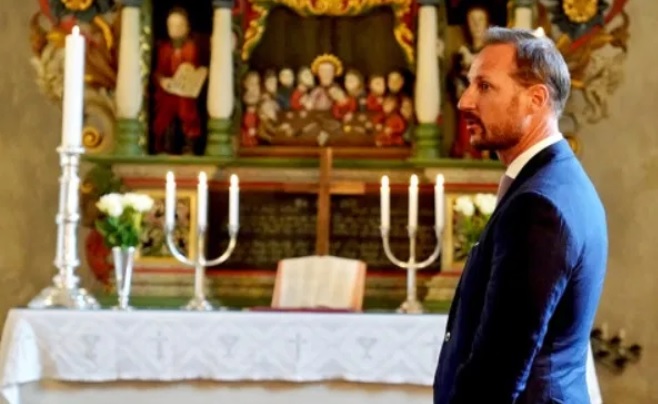
Norway: Crown Prince Haakon celebrated Rygge Church’s 900th anniversary

Norway – Crown Prince Haakon has celebrated Rygge Church’s 900 years anniversary. During the visit to the church, the Crown Prince saw the portal that dates the church to the year 1120. Rygge church is thus the Norway`s oldest church that is still in use.

The current altarpiece in Rygge church came into place in 1740. Between 1786 and 1867 the church was privately owned by local wealthy farmers. The baptismal font is estimated to be from the year 1225 and the pulpit is from 1675. The oldest church bell that is still in use dates from the beginning of the 15th century.

On the church hill, on September 8th, the Crown Prince met Bishop Atle Sommerfeldt, Priest Tor Bjørn Osberg and parish priest Ingvild Osberg. On the way to the church, the local trumpeter, Stian Omenås, played the anniversary fanfare in honour of the Crown Prince`s arrival.

Rygge church is a single-ship church from the Middle Ages, and in 1967 the church went through a major restoration. Mayor Hanne Tollerud opened the exhibition with pictures from the anniversary book and the bishop welcomed the Crown Prince for a tour inside the stone church.

The church is an important institution for many people. A 900th anniversary tells a lot about the church’s place in Norway’s history. The church anniversary is also part of Moss city’s 300th anniversary and the celebration of the amalgamation of municipalities in south-east Norway.


Rygge church in Kirkegrenda* village. Photo: Wikimedia Commons.

Recent research indicates that it may have been King Sigurd Jorsalfare who started construction of the church in 1120. Sigurd Jorsalfare ruled the Norwegian kingdom from 1103 together with his brothers, Olav Magnusson and Øystein. From 1123, he was sole king of Norway. He is otherwise famous for leading the Norwegian Crusade to Jerusalem, and was the first European king to personally participate in a crusade.

Crown Prince Haakon of Norway visited the old curch just before he started on a tour on Tuesday this week which will see him travel around large parts of Norway to see how the coronavirus pandemic has affected the country. The journey will eb partly done on board the royal yacht “KS Norge”. The first stop on the journey was Østfold, Norway’s southeastern region.

Featured image: Crown Prince Haakon celebrated Rygge Church’s 900th anniversary (Simen Sund, Det kongelige hoff)

____________________________________

*Kirkegrenda is a village in the municipality of Rygge in Østfold, Norway. Its population (SSB 2005) is 294.

The village was built up around Rygge Church (Rygge kirke), hence the name Kirkegrenda which means church hamlet. Rygge church is a medieval era church. The church belongs to Vestre Borgesyssel deanery in Diocese of Borg. Rygge church is one of the county’s better preserved medieval stone churches. The Romanesque church was built around the year 1170. Rygge church was originally a chapter church, which had income from a larger area than a parish and contained several villages. The building material is stone and brick. The building is characterized by the use of large stones, partly of granite, with parts of the facade carved, including large parts of the north portal. It has long nave and lower and narrower choir. The church was restored in 1967.


Denmark: Crown Prince Frederik and Crown Princess Mary attended Flag Day comemmorations

NordenBladet – Crown Prince Frederik and Crown Princess Mary attended Flag Day commemorations at Kastellet in Copenhagen on the first weekend of September.

Flag Day, which honours the Danish soldiers, foreign ministry and emergency services personnel who have been sent abroad for military or other missions, was established in 2009 and has been attended by members of the Danish Royal Family every year since 2011.

Upon arrival, Crown Prince Frederik inspected the troops while Crown Princess Mary walked behind. At the wreath-laying ceremony, several dignitaries laid wreathes and spoke, including Prime Minister Mette Frederiksen and the Minster of Defence, Trine Bramsen.

Other dignitaries who laid wreathes, according to the Royal House, included “the Folketing, the Government, the Armed Forces, the Police, the Danish Emergency Management Agency, the Defense Attachés, Danish Veterans, Danish Soldiers and Navy Associations, the Armed Forces’ Main Cooperation Committee, the Police Association and the Emergency Management Association.”

According to the Danish Armed Forces’ website, Flag Day is “the day when Denmark’s emissaries are recognised for the efforts they have made and where the fallen are remembered. The day includes everyone who is or has been sent out from the Armed Forces, the Emergency Management Agency, the Police, the Ministry of Foreign Affairs and the Health Service.”

Crown Prince Frederik and Crown Princess Mary also observed a flypast of F-16 jets and a performance of the song ‘I Was Born in Denmark’ by singer Pernille Rosendahl. Following the outdoor service, the couple attended a church service at Holmen’s Church.

The monument at the Kastellet (or Citadel, in English), was opened by Queen Margrethe in 2011 and includes an inscription that reads “A Time— A Man— A Place.” It honours the efforts of Danish personnel since 1948 and was inaugurated on Flag Day in 2011.

Crown Prince Frederik and Crown Princess Mary usually attend the Flag Day service in Copenhagen, while Prince Joachim and Princess Marie attend events outside the capital city. However, since the couple moved to France, they have not taken part in events.

Flag Day also typically includes speeches from military personnel at the Christiansborg Castle Square, however this portion of the event had to be cancelled due to COVID-19 restrictions. Instead, video greetings were pre-recorded and shared online.

Featured image: Denmark’s Crown Prince Couple (FRANKIE FOUGANTHIN (OWN WORK) VIA WIKIMEDIA COMMONS)

Sweden: Queen Silvia receives Butterfly Prize for her work towards addiction issues and drug-free policies

NordenBladet – Queen Silvia received the Butterfly Prize on Monday for her work towards addiction issues and drug-free policies from an organisation in Sweden.

The Butterfly Prize is awarded by the Women’s Organisations’ Co-operation Council on Alcohol and Drug Issues, and Queen Silvia’s citation read: “…for her many years of work and personal commitment to the drug issue and for children’s right to a drug-free upbringing. The Queen’s commitment to exploited children is innovative and has given the issues increased attention.

“Throughout her interest in substance abuse issues, HM Queen Silvia has raised the issue of addiction both nationally and internationally.

“Thanks to the Queen’s knowledge and efforts to influence attitudes, new opportunities to improve public health have been opened up. The Queen remains a source of inspiration and support for girls and women of all ages, with different social backgrounds. HM Queen Silvia contributes to a society where health and care are in focus.”

Queen Silvia accepted the prize via video call and delivered a speech. Her Majesty first thanked the organisation, saying, “I will wear this fine necklace with pride.”

She continued: “The butterfly award goes, of course, not only to me, but also to all employees and enthusiasts in Mentor and Childhood. Two foundations that I have founded and which both work for children’s and young people’s right to a safe and positive upbringing.

“When I, together with the WHO, founded Mentor 25 years ago, it was, among other things, to prevent drug abuse among young people. The many trips that the King and I had made, both in Sweden and abroad, had opened my eyes to how brutally alcohol and drugs harm children and young people. Directly and indirectly. Worldwide. And in all social classes.

“Also in Childhood’s work against sexual abuse, we see how children’s vulnerability increases in environments where there is abuse.

“Today’s young people face great challenges. Mental illness is increasing. Drugs and alcohol can be a dangerous consolation. Police also report that drug use among our young people is increasing during the coronavirus pandemic. These are reports that we must take very seriously.

“Working on these issues requires time, patience, and perhaps most importantly: cooperation. Therefore, it feels especially nice to receive this award from an organisation that works as broadly and long-term as you do.

“Ladies, we have a lot left to do, and I’m glad we’re doing it together.”

The Butterfly Prize is awarded in the form of a butterfly necklace, which Queen Silvia wore during the video call with representatives from women’s unions and groups, medical professionals and more.

Featured image: HM Queen Silvia of Sweden (Anna-Lena Ahlstrom/Kungliga Hovstaterna)

Denmark: Crown Princess Mary attends summit on building back after COVID-19

NordenBladet – Crown Princess Mary attended the opening of a summit in Copenhagen that brought together people and organisations with ideas of how to rebuild following the COVID-19 pandemic.

Hosted at BLOX, a “national and international gathering place that engages people in architecture, design and sustainable urban development through exhibitions, events, business development and new partnerships,” the Build Back Better Summit discussed how sustainable partnerships must work together as urbanisation increases, especially now due to the pandemic, according to its official website.

Crown Princess Mary attended the Summit along with other urban development professionals to discuss sustainability. According to BLOX’s website, “In 30 years, up to 70 percent of the earth’s population will live in a big city. It creates great challenges and it requires that we think new and sustainable in our urban development. A need that COVID-19 has helped to put at the forefront.”

The United Nations introduced the idea of Build Back Better in 2015 as part of its efforts to discuss safe rebuilding following disasters. UN representatives spoke at the Summit, as well as the Director of the World Health Organization’s European branch, who told guests that “we need courage and cooperation” to rebuild, and that the necessary measures for a better future are political rethinking, sector cooperation, delivery on the Sustainable Development Goals and healthcare development.

Before the Summit began, Crown Princess Mary received a tour of the BLOX facilities, which are located in Copenhagen. The facilities provide a “national and international gathering place that engages people in architecture, design and sustainable urban development through exhibitions, events, business development and new partnerships.”

Two new partnerships were discussed at the Summit: one with Milan, Italy, and one with a number of Latin American countries.

According to the BLOX website, the main topic of discussion was how “Caring is no longer enough. We need to build better afterwards – and we need to do it together.”


Photo: Instagram/@detdanskekogehus


Sweden: King and Queen of Sweden return to their Royal Palace after pandemic isolation

NordenBladet – King Carl XVI Gustaf and Queen Silvia are now back at the Royal Palace in Stockholm after an absence of almost six months caused by the coronavirus pandemic.

As the virus took hold, the royal couple moved to Stenhammar Palace, about 120 kilometres southwest of Stockholm. King Carl XVI Gustaf, 74, and Queen Silvia, 76, have been based there through the spring and summer. It was from here that the King gave his televised address to Sweden as the pandemic worsened. The royal couple have been seen working at the palace regularly, holding video calls.

They returned to the Royal Palace as September got under way, underlining its role as the official home of the Head of State. The King and Queen will continue to use video and digital meetings to carry out engagements but they also plan to hold audiences and events at the Palace, observing social distancing and safety measures necessitated by the ongoing coronavirus pandemic.

The first of those events took place on September 2nd when the couple held a meeting with Carl-Henrik Heldin, Chair of the Nobel Foundation, and the organisation’s Director, Lars Heikensten. The King and Queen were photographed sitting at the head of the meeting table with their guests spread away from them.

Queen Silvia also held a meeting, alongside Crown Princess Victoria and Prince Daniel, with representatives from the Swedish Ministry of Foreign Affairs and Swedish Civil Contingencies Agency to hear about ongoing work in Beirut following the explosion there in August which killed at least 190 people and left many thousands injured.

On the same day, Prince Carl Philip oversaw the prizegiving for the ‘Thinking Hand’ arts competition at the Royal Palace. The contest celebrates young artists working in visual mediums.

Denmark’s Royal Family’s funding increases

NordenBladet -Denmark`s social democratic minority government presented on Monday its proposal for the Danish state budget, where an increase in the salary for the Queen Margrethe was included. The Danish government’s budget proposal for next year shows that Queen Margrethe can count on almost 90 million Danish crowns in appanage. The Danish government will give 89.3 million Danish crowns in salary to the queen. However, 1.3 million of the salary is set aside for Princess Benedikte, the Queen’s younger sister.

This is an increase from the previous year. The money will not only cover expenses for clothing and other personal expenses, but also royal banquets, state visits and the running and maintenance of several castles. However , the Queen’s salary increases have received attention. From 2005 to 2018, the appanage increased by 40 percent.

In general, however, there will be less money for the rest of the royal family. This is because Countess Alexandra, Prince Joachim’s ex-wife, no longer receives an annual benefit of 2.6 million crowns because her youngest son Prince Felix has turned 18 years old.

If you compare the costs of the Danish royal family with other European royal families, they are quite low. This has been a tradition in Denmark for a long time. At the end of the 19th century, the Danish royal family was in fact one of Europe’s poorest royal families.

The appanage to the Queen covers the Court Marshal’s and the Cabinet Secretariat’s costs for staff, operations, administration, properties and grants for the Royal Orders. According to the Civil List Act, the state makes a number of castles and equipment available to the Queen. The expenses for the state-owned castles are paid for by the state and not the royals.

Under the Royal Danish Income Tax Act, the Queen, the Crown Prince and Princess, Prince Joachim, Princess Marie and Princess Benedikte are exempt from paying income tax, and under the Motor Vehicle Registration Act, they are also all exempt from paying registration taxes and green taxes.

The Queen, the Crown Prince and Princess, Prince Joachim, Princess Marie and Princess Benedict are subject to the general rules for payment of inheritance tax and gift tax as well as property taxes.

President of the Riigikogu on the withdrawal of Russian troops from Estonia: It’s a victory we should celebrate

NordenBladet — The President of the Riigikogu Henn Põlluaas made a statement on the 26th anniversary of the withdrawal of the Russian troops, saying that for Estonia this also meant the termination of World War II and the end of the more than 50-year presence of occupation forces.

“Today we have reason to be happy and celebrate the withdrawal of the Russian troops from Estonia. However, having learned from history, which the Kremlin is trying to rewrite, and considering the reality of today and the intense international situation, we must be in heightened readiness to defend our freedom and independence unconditionally,” Põlluaas said. “We are a member of the NATO, we are no longer alone like we were when the Soviet occupation forces marched into Estonia. Estonia will never again surrender.”

The President of the Riigikogu added that thanks to Estonia’s determination, Russia’s economic collapse, and a strong pressure from the West, particularly USA and several international organisations, the troops had been finally withdrawn. By that time, Russian troops had already been withdrawn from Eastern Europe; Estonia was the last of the Baltic states to see the troops leave.

The President of the Riigikogu has seen no change in the geopolitical ambitions of the Kremlin, or in its relations with neighbouring countries. “They have publicly declared their intention to restore the Soviet Union era empire and spheres of influence. All this is clear from the military aggressions in Georgia and Ukraine, the occupation and annexation of Crimea, and the military bases in several former Soviet republics or countries of the so-called socialist block. And of course from interfering in domestic matters of other countries,” Põlluaas said.

The last Russian units left Estonia on 31 August 1994. This completed the process of the restoration of the independence of the Republic of Estonia. This meant that the occupation, which had started in June 1940, was finally over.


Iceland: Reykjavik International Film Festival goes ahead in September

NordenBladet — This year RIFF will explore new technology and use it to bring quality cinema to an even wider audience in Iceland. There will be online screenings to movie lovers across the country to Keflavík, Ísafjörður and Akureyri as well as those who can normally not attend the festival such as those at sea, at hospitals and in prisons.

This year guests will also be able to enjoy Q&A’s, discussions and more with online events. Industry Days will be held in the Nordic House and special screenings in Bíó Paradís.  Other events will be planned according to the current situation.

This year´s programme will be filled with high quality films related to current and controversial topics. European films will be highlighted due to the 33rd European Film Awards being presented in Iceland this December.

“It´s a great honour for Reykjavik to host this big event and RIFF aims to build a bridge between RIFF and EFA with screenings of quality, European films until December. ” New head of Programming is Frédéric Boyer.

Boyer has been the Artistic Director of the Tribeca Film Festival since 2012, and of the Les Arcs European Film Festival since 2009. Prior to that, he was the Artistic Director of the Director´s Fortnight at Cannes for two years, after 6 years as a senior programmer in the Fortnight´s Selection Committee.

Guests will be able to access the films through Festival Scope. The platform is used by many well-known film festivals such as CPH DOX and Locarno Film Festival.


Finland: Jarkko Eloranta re-elected SAK President

NordenBladet – Jarkko Eloranta was elected the President of the Central Organisation of Finnish Trade Unions (SAK) again. The Delegates of the organization at its Council held on Tuesday anonymously re-elected Eloranta as the President for the second term, said a SAK press release on Thursday.

In his speech to the Delegate Council Eloranta voiced concern about the future of the Finnish labour market model which is based on negotiations and contracts.

He pointed out that the employers’ federation EK has tried for many years to undermine the range of contracts between labour market parties, like discontinuing the national labour market pacts, terminating the labour market federations’ joint agreements and now a determination to end the pay-related unemployment fund system.

“Now, we have to ask ourselves is what is the actual agenda of the employers”, Eloranta said.

“The main issues that are left up for joint cooperation are the collective agreements and the labour pension system. And we certainly have to ask the question if the employers are not already sowing seeds for the future,” he added.

Jarkko Eloranta has been SAK President since 2016 and the new term will last until 2024. Before SAK he was the president of JHL, the Trade Union for the Public and Welfare Sectors since 2011.

The council also elected Katja Syvärinen as the new Vice President unanimously.

Her predecessor Matti Huutola will retire. Syvärinen has been a member of Parliament 1999–2003.

SAK is a confederation of 17 trade unions in industry, the public sector, transport, private services and culture. At the beginning of 2020 these unions had a total of 880,574 members. SAK was established in Tampere in the year 1907.