NordenBladet —At its today’s sitting, the Constitutional Committee of the Riigikogu (Parliament of Estonia) decided to submit a Bill amending the Riigikogu Rules of Procedure and Internal Rules Act for legislative proceedings. The Bill will enable to conduct the plenary sittings of the Riigikogu by remote attendance.
Chairman of the Committee Paul Puustusmaa said that although the Committees of the Riigikogu had held their sittings via electronic means during the emergency situation, such an option was not available to the plenary sittings according to current legislation, and thus the members of the Riigikogu had to be physically present at Toompea to attend sittings.
“The present outbreak of the coronavirus has shown that when such circumstances occur, it is important that it would be possible to hold sittings also by remote attendance,” he pointed out the need for the amendment. “Pursuant to the Constitution, the efficient functioning of the Riigikogu as a constitutional institution has to be ensured, and this also applies to the cases when the Riigikogu is not able to come together in the Session Hall at Toompea due to compelling reasons.”
The amendment would enable the Riigikogu to convene in the remote attendance format with the help of electronic means, and continue its regular work, i.e. initiating of Bills, conducting proceedings on them, holding of Question Times, submitting of interpellations, appointing higher state officials to office.
Hanno Pevkur, whom the Committee appointed to present the Bill, said that pursuant to the Bill, the Board of the Riigikogu would make the decision on holding a sitting by remote attendance for serious reasons and establish the requirements for conducting of such a sitting and the procedure for opening the sitting. Pevkur added that, pursuant to the motion, the electronic sitting could be conducted if more than half of the members of the Riigikogu were present.
Remote voting is already being used in the lower houses of the parliaments of Belgium and Spain. In connection with the current COVID-19 pandemic, the parliaments of Cyprus, Latvia, Poland and Slovenia have started to work for allowing remote voting at plenary sittings or conducting plenary sittings by remote attendance.
NordenBladet —At its meeting today, the National Defence Committee heard about the plan of the consortium of Estonia’s defence companies to take part in an Estonian, Finnish, and Latvian joint procurement of armoured vehicles, as well as to start producing these vehicles if possible.
The Chairman of the Committee Andres Metsoja said that the companies outlined their plans to the Committee, and the Committee decided to support the project. “This is a step in the right direction,” Metsoja said. “This is a large scale project, and international cooperation with Latvia and Finland would have an extensive impact.”
Metsoja believes that Estonia’s defence companies would create completely new capabilities. “It is clear to us that all this should be carried out with the support of the government and the parliament,” Metsoja explained. “At the same time, we must critically review the needs of Estonia’s national defence in light of the decrease in economic indicators and the consequent possible reduction in the defence budget.”
Member of the Committee Alar Laneman recommends further efforts in developing defence industry as part of Estonia’s defence capabilities, and using the synergy thus generated. “The Committee consensually supported Estonian defence companies because the value of the consortium project surpasses the proposed armoured vehicle. The project would increase our knowledge, skills, employment, and indirectly – our economy and industry,” Laneman said.
The defence industry consortium project was presented to the Committee by the Estonian Defence Industry Union Chief Executive Tarmo Ränisoo, Director of the Centre for Defence Investments Kusti Salm, and representatives of AS Milrem and Milrem Robotics, AS Cybernetica and Baltic Marine Group AS.
The Committee was told that there have been discussions on the possibility of acquiring the licence of the Finnish defence company Patria for producing armoured vehicles in Estonia, managing the supply chain along with designing the necessary modifications, and ensuring their life cycle. However, it is also an option for the Estonian consortium to develop its own 6×6 armoured vehicle based on the needs of our Defence Forces. In both cases, the project would have a clear positive impact on Estonia’s economy and defence capabilities.
NordenBladet – Handicraft is no longer considered just a grandmother’s hobby. Among fashion gourmands, knitted, crocheted and embroidered items are highly priced, from sweaters to mittens. Also at fashion weeks you can see more and more knitted, embroidered and crocheted fashion.
If we talk about the history of knitting, we should start with needle weaving or nålbinding*. Nalbinding is an ancient yarn technique. Today, people often associate it with the Vikings and Scandinavia, and in Finland it is considered a special feature of Eastern Finland, although nalbinding has been used in other parts of the world aswell.
However, it is true that a rich selection of words related to needle binding come from Finland: neulakinnastekniikka (nalbound mitten technique), kinnasneula (nalbinding needle), Karelian nieglomus (item made using nalbinding technique), etc. The oldest surviving nalbound item dates from Israel from around 6500 BC. Some fragments also come from Denmark and China. The dead buried in the Tarim River basin found in China about 1000 years ago were wearing nalbound clothes. Later, this type of handicraft spread all over the world: to Peru, Egypt, England and elsewhere. Today, nalbinding is still practiced among the Pemon Indians of Venezuela.
As it was not customary in Finland to burn the dead in ancient times, and the ground there does not preserve textiles well, the first nalbound items date back to around the first millennium BC: mitten fragments from Eura, Mask, Köyliö and Kekomäki, and two different mittens, from Tuukkala, reports neulakintaat.fi. However, the second oldest mittens have survived from the 19th century. In Joutseno, couples wishing to marry had to pay in cash or in nalbound mittens, whereas mittens knitted with needles were not accepted. The reason may be that it is almost impossible to undo the stitches of a nalbound item. Women, and even men, made not only grey work mittens, but also white party mittens, decorated with red and green loops, fringes (in western Finland) and yarn pendants (in eastern Finland), which were customary to give as a thank-you note. Black-and-white mittens or mittens with round decorations were considered Sunday mittens. The jouhikas or fishermen’s work mittens were made from strong animal hair, and in West Karelia men had to make mittens themselves.
Advertisement
Choose the colour (s) you like and order a beautiful and unique hand-knitted Elisheva & Shoshana knitting (Hat 22.- / Scarf 26.- / Set 42.- ). The order will be completed in about 10 days. Send us your request: info@elishevashoshana.com
At the end of the 19th century, it was assumed in Parikkala that a well-equipped household would have 20 pairs of nalbound socks and mittens. The needles were kept very well and passed on. Items knit in this technique were mostly not sold (everyone could make them), but there were exceptions. At the beginning of the 20th century, the imaginary border of nalbinding tradition went through Sipoo, Tampere and Kokkola: the technique was known to the east of the imaginary border, whereas the Åland Islands were the only point of reference for nalbinding in the west. The imaginary border kept moving eastwards and during the Second World War such mittens were already known as Karelian mittens. Although knitting and crocheting became increasingly popular and the skill of nalbinding began to be forgotten, the needle binding technique was still very popular until the 1950s. Later, however, the two aforementioned techniques took over the Finnish handicraft world, and nalbound mittens were worn by forest workers and reindeer herders alone, who soon began to prefer waterproof mittens bought from shops.
According to the data of the Estonian Sheep Conservation and Breeding Society, the oldest nalbound textile fragments in Estonia date from the 12th to the 13th century. Although over time the technique was forgotten, mittens of this kind still retained their place in wedding rituals. The fragments of the needle binding technique found in Estonian burial sites are mostly spun from coarse yarn, but there is one big difference with Finland: while Estonian mitten fragments have strong aging marks and nalbound mittens were commonly known as felts or felt mittens, a survey conducted in Finland in 1957 revealed that almost no one felted the mittens. Of course, it can be that mittens were turned into felt also in Finland hundreds and hundreds of years ago, simply not being the case anymore. About a dozen nalbound mittens from the 18th and 19th centuries have been stored in Estonia. When you type in keywords “nõelkinnas” (nalbound mitten) and “nõelkindad” (nalbound mittens) in the Estonian museum database MUIS, you will find more modest items than those of our northern neighbours, but in several pairs you can notice colourful wrist parts and the beginning of the Finnish style. Today, interest in nalbinding has started to grow again in Estonia, Finland and elsewhere. Courses and trainings are offered (see, for example, bone processing course / needle binding course on the kultuur.ee website or the needle binding course for beginners at Räpina Horticultural School) to keep this type of handicraft alive.
For each of the previous sections, you could witness the victory of knitting with needles over needle binding. It really was like that. There is not much information on the formation of knitting with needles. It is believed to have evolved from needle binding in Roman Egypt, where stockings and socks were made. However, places and times are difficult to identify because the exploration site does not mean that the fragment originated there and it is often difficult to date the fragments. The first knits to be dated are 13th century Spanish pillows and Egyptian socks. Richard Rutt, a researcher of the history of knitting, has argued that in the past people knitted only in circle, and although in the past it was possible to knit purl stitches for heels, they were used as decoration only from the middle of the 16th century. By the 19th century, flat knitting had become completely common. Today, knittings are produced on machines, but knitting is a widespread hobby all over the world and an important part of almost every culture. There are hundreds of variations in knitting techniques and they vary from region to region. For example, Haapsalu lace and specific types of kiri mittens and chains come from Estonia. In recent years, thousands of different knittings have become fashionable, which has also inspired enthusiasts.
Crocheting is significantly younger than the previous two techniques. It was not until the 16th century that the technique developed as we know it today. There are three theories about the origins of crocheting: its emergence in Arabia and its spread along trade routes, its development among the South American tribes (rite-related crafts) or its emergence in China (the origin of ancient crocheted dolls). However, you can be quite sure of the fact that this type of handicraft evolved from the tambour embroidery technique and spread in Europe in the 19th century as a way of making lace, helping the Irish to survive the famine. Gradually, crocheting also reached Estonia (for making the wrist part of mittens; bags and blanket edges) and became less elaborate over the decades. Today, in addition to knitting, crocheting is one of the most common handicraft techniques in the world, and there are also huge regional variations. For example, Dolce & Gabbana, Rodarte, OHMYGOSSIP Couture, Moschino, Versace and Chanel have used crochet in their collections.
All these handicraft techniques have a long history, but they have reached the modern day and even the catwalk. Let us not consider them obsolete, but admire their beauty and take them up without letting them be forgotten.
________________________________________________ * Nålbinding is a handicraft technique in which textile objects (especially mittens and socks, but also hats, sweaters, etc.) are made of yarn by forming loops and intertwining them with the help of a needle with a single bone or wooden blunt end.
Nalbinding is a likely precursor to loop knitting and crocheting.
The nalbinding technique also allows the use of shorter pieces of yarn and therefore does not require complex spinning technologies.
Probably the nalbinding technique was already known in the Stone Age. In Estonia, the first archaeological finds in the nalbinding technique with remains of objects from the 12th–13th century. From the 17th century onwards, knitting with needles spread in Estonia and the nalbinding technique was forgotten over time, but nalbound mittens made in this way sometimes remained a ritual object in wedding customs. In recent years, those interested in history and handicraft have begun to revive the nalbinding technique.
NordenBladet — Today, the Riigikogu passed an Act which enables the payment of a higher allowance to foster parents, and creates the possibility to pay the social benefit for a child with a disability for children with orphan diseases.
The major amendments proposed in the Act on Amendments to the Social Welfare Act, the Social Benefits for Disabled Persons Act and the Labour Market Services and Benefits Act (146 SE), initiated by the Government, concern the social rehabilitation service, the alternative care service and foster parent allowances, the payment of allowances to children with orphan diseases, the identification of disabilities and the degree of severity of disabilities, and mitigation of the coping difficulties arising from emergency situation.
The Act creates flexibility that will enable to increase the number of children reared in a foster family and in a family of a family home or substitute home, in the interests of children. This is possible in the case when children of one family need to be placed or there is another situation where an opportunity for children to be reared together needs to be ensured. Flexibility in terms of the number of children may also be important in the current emergency situation. The Act also amends the minimum amount in which local governments are required to support foster families upon caring for one child. The minimum allowance or fee for foster parents is doubled compared to the current rates.
The Act creates the possibility for the Social Insurance Board to begin to pay the social benefit for a child with a disability for children with orphan diseases, to compensate for additional costs related to the disease, also in the case when they do not have a developed disability. The aim is to provide for a state allowance for children with orphan diseases who do not have the characteristics of a developed disability but who need financial support in order to prevent a disability.
With the amendments to the Social Benefits for Disabled Persons Act, medical experts of the Social Insurance Board are given the possibility to identify a person’s disability and the degree of severity of the disability in persons of working age on the basis of their health data. At present, applicants need to describe the restrictions they are experiencing by spheres of activities in order for the degree of severity of their disability to be identified. In addition, in the case of a child with a severe or profound disability whose condition is constant and unchanging or progressive, the duration of the degree of severity of the disability can be identified for until he or she attains working age. At present, the degree of severity of disability is determined for one to three years.
The amendment to the Labour Market Services and Benefits Act will enable the Estonian Unemployment Insurance Fund to use counselling of the unemployed by telephone or through the information system of the Estonian Unemployment Insurance Fund, instead of inviting them to face-to-face counselling, in justified cases. In addition, the Act provides for the implementation of financial measures in extraordinary situations to mitigate the coping difficulties arising from the emergency situation in the case of specifically vulnerable target groups.
49 members of the Riigikogu voted for the passing of the Act.
NordenBladet —The Bill that would give the Defence Forces additional rights in performing background checks and implementing authorisation for use of human intelligence sources passed the first reading in the Riigikogu today.
The Bill on Amendments to the Estonian Defence Forces Organisation Act and the Chancellor of Justice Act (152 SE), initiated by the Security Authorities Surveillance Select Committee, provides for increasing the right of the Defence Forces to conduct background checks to the extent that would ensure meeting the initial objective of the check, i.e. verifying a person’s suitability to serve or be employed in the Defence Forces or to cooperate with the Defence Forces. Pursuant to the planned amendments, the Defence Forces will be able to perform acts that go beyond the current verification against registers in order to obtain the information needed for background check. The Defence Forces will be given the right to use covert measures for collecting information for circumstances assessed within the framework of background checks, ensuring that the collection of information is concealed.
The Bill will give the Defence Forces a new task: collection and processing of information to protect the restricted military area of the Defence Forces and prevent threats. For that, it is provided that in the case of persons posing a direct threat to the restricted military area of the Defence Forces, the Defence Forces can verify personal data, and do it covertly, use shadow information and covert measures as well as monitor the person secretly. The Bill establishes more specific and effective guarantees for interfering with the fundamental rights of a person that ensure the observance of notification obligation.
The Bill also amends the Chancellor of Justice Act. At least every two years, the Chancellor of Justice will perform a surveillance of the legitimacy of failure to notify persons of the activities pursuant to the Defence Forces Organisation Act.
The Supreme Court declared the Act on Amendments to the Estonian Defence Forces Organisation Act, passed by the Riigikogu on 29 May 2019, to be in conflict with the Constitution.
One Bill was dropped from the proceedings of the Riigikogu.
The Bill on Amendments to the Health Insurance Act (162 SE), initiated by the Social Democratic Party Faction, provided for amending the Health Insurance Act in order to ensure sickness benefit from the first day of sick leave in the case of suspicion of communicable disease.
The explanatory memorandum to the Bill notes that the Health Insurance Act currently in force does not enable to pay sickness benefit for staying at home because of suspicion of communicable disease. The current Act provides that no sickness benefit is paid for the first three days of sick leave; from the fourth day to the eighth day the benefit is paid by the employer in the amount of 70% of the average salary of the employee, and from the ninth day, the sickness benefit is paid by the Estonian Health Insurance Fund in the amount of 70% of the average salary of the previous calendar year on the basis of the daily income of the employee.
The lead committee moved to reject the draft Resolution at the first reading. 53 members of the Riigikogu voted in favour of the motion and five voted against. Thus, the Bill was rejected and it was dropped from the proceedings.
NordenBladet —Minister of Foreign Affairs Urmas Reinsalu will give the Foreign Affairs Committee of the Riigikogu (Parliament of Estonia) an updated overview of the emergency situation and its impact on foreign policy at the public sitting of the Committee today.
“In recent weeks, we have been in contact with the Foreign Minister and the Ambassadors of Estonia in various foreign countries via a video bridge at the sittings of the Committee. Such a frequent and operational exchange of information is invaluable in the current situation,” Chairman of the Foreign Affairs Committee Enn Eesmaa said.
Deputy Chairman of the Foreign Affairs Committee Marko Mihkelson noted that the Committee hoped that, at the sitting, the Minister would provide them with the latest information about the ongoing situation, returning home of the citizens of Estonia, and the international policy decisions of recent times. “The Minister’s overviews of the emergency situation and the latest international developments make an excellent basis for discussion and finding answers to questions that are necessary for shaping the foreign policy of Estonia in the present complicated situation,” he added.
At the sitting of the Committee, the Minister of Foreign Affairs will also present Estonia’s positions at the video conference of the European Union foreign affairs ministers (development) that will be held on 8 April.
Public sitting of the Foreign Affairs Committee starts at 11 a.m. and it will be streamed online.
NordenBladet – Authorities recommend people to keep a distance of 1–2 meters to avoid catching the virus, but according to a recent study, the virus can infect people as far as 4.5 meters. The virus also remains viable in the air for 30 minutes, so people should wear face masks. A study conducted by leading Chinese epidemiologists shows that the virus can survive days on surfaces. Therefore a person who comes in contact with a surface and then touches their face can become infected, the South China Morning Post reports.
The virus survival on surfaces depends on temperature and material, for example, at 37 C it can survive for 2–3 days on glass, fabric, metal, plastic and paper.
The study calls into question the authorities’ recommendation to keep 1–2 meters away from other people. A study published in the scientific journal Practical Preventive Medicine states that in an enclosed air-conditioned space, the coronavirus spreads beyond 1–2 meters. The study points out that the virus remains viable on the bus even when the passenger has already left.
Scientists also warn that the virus will remain viable for more than 5 days in human stools and body fluids. The study supports the recommendation to wash hands and wear face masks in public places because of the risk of airborne infection. Scientists recommend wearing a face mask for the duration of a bus ride.
The researchers’ study is based on January 22 bus rides during the Chinese New Year. The patient was already sick when they sat in a 48-seat bus. The patient did not communicate with other passengers, but by the time the bus arrived to the next city, 7 passengers had already become infected. These included not only the passengers sitting near the patient zero, but also those sitting 6 rows away, at 4.5 meters. All of them were diagnosed with the coronavirus, including one person who did not develop symptoms of the disease.
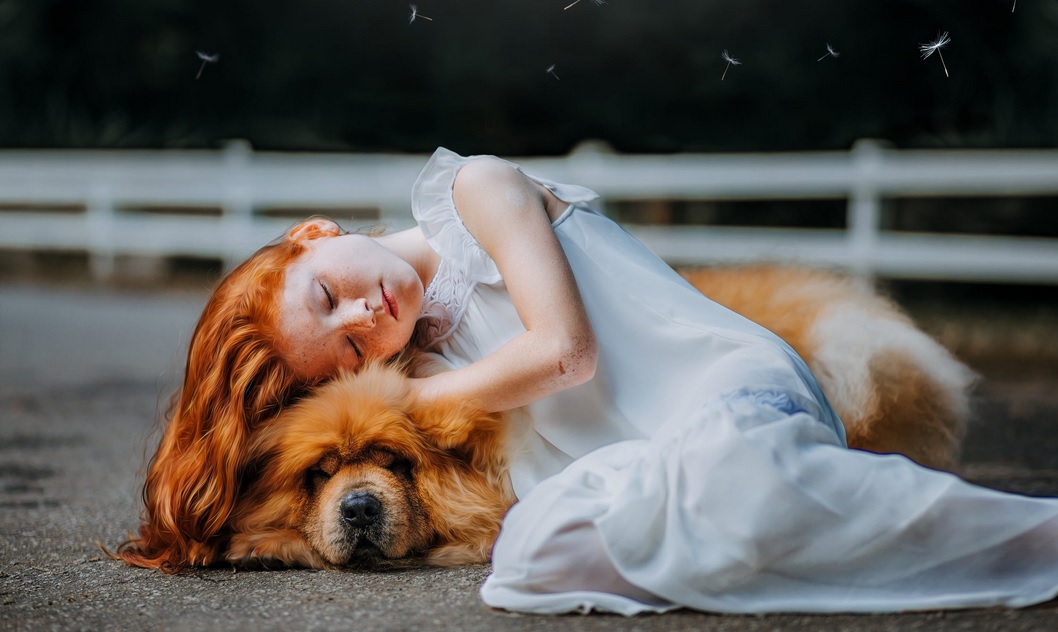
NordenBladet – Have you heard the saying that dogs don’t belong in bed? A recent Mayo Clinic study shows quite the opposite: sleeping with your dog is good for you. The purpose of the study was to determine whether the dog’s presence in the bedroom disturbs people’s sleep or not.
The study included 40 healthy adults with no sleep problems and dogs at least 6 months old. Participants were studied for 7 days.
The results showed that the participants slept much better with their dog. The size of the pet and their night time movement did not play a role here.
One of the authors of the study was Dr. Lois E. Krahn, who said that people tend to think that pets should not be let in the bedroom because they interfere with our sleep. The results showed that sleeping with a dog is a good idea as it gives us a sense of security and calms us down.
Today’s pace of life and lifestyle have led people to work most of the day, so they come home and see their pets only in the evening. People are often away for the whole day. Therefore, it is understandable that people want to spend as much time as possible with their pet while at home. One way to do this is to sleep together in bed.
Dog owners no longer have to worry about whether or not to allow their pet to bed — sleeping with your dog is good for your health. The better you feel, the happier you are!
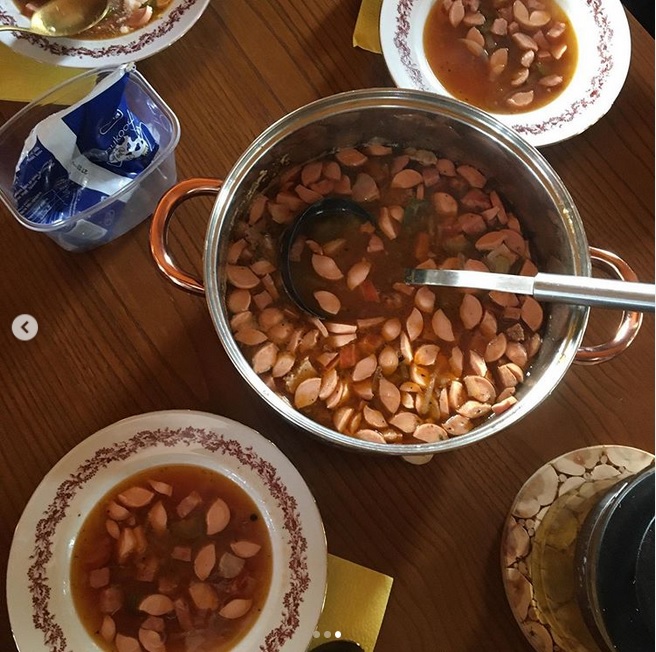
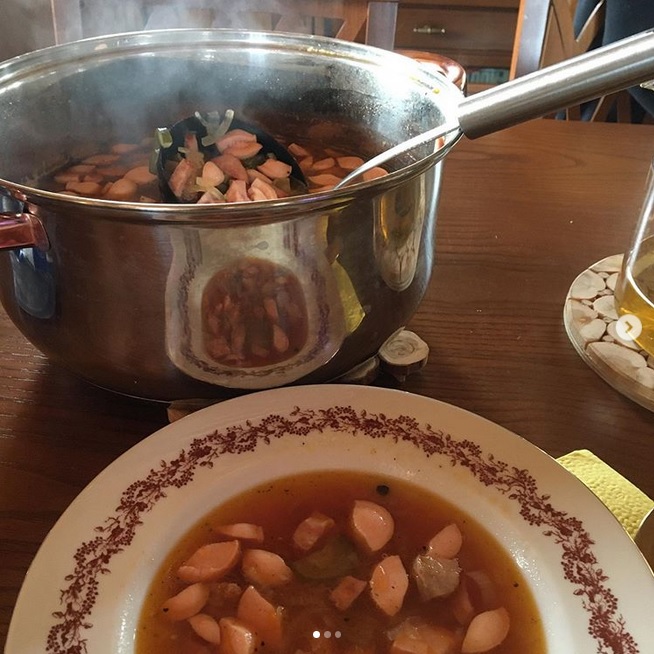
NordenBladet – Solyanka is a Russian national dish that is very popular in Estonia as well. I make solyanka from different meats, but solyanka is also very tasty when prepared with chicken, fish or mushrooms. The best soup is made when you don’t follow the exact recipe, but you do what’s left in the fridge from previous meals. There are a lot of onions in the Estonian-style solyanka, but there is no definite rule here. If you like, you can also add potatoes and carrots.
You will need:
400–500 g of onions (approx. 4–5 onions)
3 cloves of garlic
4 tablespoons of oil
2 tablespoons of flour
150 g of concentrated tomato paste
1–1.5 l of hot beef broth (2 bouillon cubes can also be dissolved in hot water)
3 bay leaves
10 grains of black pepper
4 sour pickles or marinated pickles
300 g of wieners
300 g of half-smoked sausage
50 g of olives
If you wish, leftovers / shashlik from the previous day
For serving:
sour cream 20%, green onion, dill
Preparation (40–50 min):
Chop the onions and fry in heated oil in a soup pot and mix with flour. Add heated water, a pinch of salt, bay leaves, pepper and braise for about 15 minutes. Now add the tomato purée, chopped garlic and pitted olives, mix everything well and let braise for a few minutes. Then put in a pot pickles and minced meat (wieners, smoked sausage, shashlik). Mix everything well and let it boil. Then reduce the heat and let it braise for a while.
Members of the Foreign Affairs Committee of the Riigikogu (Parliament of Estonia) adopted a statement in support of the unity of the European Union and NATO and the solidarity between the Member States.
“Unity of the European Union and NATO makes it easier to overcome the crisis
The current situation is one of the greatest challenges in the history of the European Union and its Member States. The Foreign Affairs Committee of the Riigikogu is happy to note that, in recent weeks, the European Union and its institution have comprehended the depth of the crisis, and have increased their proactivity and decisiveness in combating the spread and the consequences of coronavirus COVID-19.
We acknowledge and support the joint efforts of the European Union in public health, scientific research, economy and other spheres that are critical under the circumstances of the ongoing crisis. We welcome North Macedonia as a new NATO member state, and we underline the importance of the open doors policy in ensuring the viability of the European Union and NATO.
For Estonia, membership in the European Union and NATO has been invaluable for both security and economic development. Protection of the value space of the West has to be the priority of the Allies today. Protection of dignity, freedom, democracy, equality, the principle of the rule of law and human rights is essential. The European Union must jointly resist all attempts to use a state of emergency to restrict the freedoms and the rights of its citizens.
Since its accession, Estonia has been a reliable and constructive member state and cooperation partner of the European Union and NATO, and we wish to be that also in the future. The present challenge is complicated for all our partners and allies, but when we rely on strong trans-Atlantic relations, the hardships can be overcome faster through common efforts and coordinated cooperation.”
Before adopting the statement, the Foreign Affairs Committee heard the overview about the emergency situation measures in the United Kingdom by Estonian Ambassador Tiina Intelmann, the report on Estonia’s activities as the non-permanent member of the UN Security Council by Permanent Representative of Estonia to the United Nations Sven Jürgenson, and the survey of the situation in Hungary by Estonian Ambassador Kristi Karelsohn.