NordenBladet —At their meeting today, President of the Riigikogu (Parliament of Estonia) Henn Põlluaas and Speaker of the Riksdag (Parliament of Sweden) Andreas Norlén emphasised the excellent relations between the two countries and discussed the security of the Baltic Sea region.
Põlluaas believes that the relations between Estonia and Sweden are excellent and close. “We cooperate bilaterally every day, and stand for common aims in international organisations,” Põlluaas said. “Estonia and Sweden have similar principles in regard to the issues relating to Russia and the increase of the influence of China.”
According to the President of the Riigikogu, Estonia is interested in having even closer relations in the areas of digital cooperation, security and cyber defence, and would like international cooperation to continue regionally, between the Nordic Countries and the Baltic States, and in the UN and the European Union. He thanked Sweden for its contribution to Estonia’s UN Security Council membership campaign.
The meeting with the Speaker of the Riksdag and the delegation accompanying him was also attended by Chairman of the Foreign Affairs Committee of the Riigikogu Enn Eesmaa, and Yoko Alender and Valdo Randpere, Chair and Deputy Chair of the Estonia-Sweden Parliamentary Group.
At the meeting, the security situation in the Baltic Sea region, the threat Russia poses to the region and the impact of information operations were discussed. The importance of the Arctic region and the increasing global influence of China were spoken about as well. The discussions also touched upon the creation of 5G network and the tunnel planned between Tallinn and Helsinki.
The meeting was followed by the discussion panel “Digital technology: managing possibilities and risks to our democracy” (video recording). Besides the Speaker of the Riksdag, member of the National Defence Committee of the Riigikogu and the European Union Affairs Committee of the Riigikogu Oudekki Loone and member of the Foreign Affairs Committee of the Riigikogu and the European Union Affairs Committee of the Riigikogu Keit Pentus-Rosimannus participated in the discussion panel. The panel was moderated by Liisa Past, Chief National Cyber Risk Officer at the Government Office of Estonia.
NordenBladet —A Bill passed the first reading the in the Riigikogu. It provides for the right of competent authorities to prohibit goods from being placed on the market and to require withdrawal of goods from the market in Estonia in pursuance of the procedure provided for in the directly applicable EU Regulation.
Based on the Regulation, competent authorities must clearly justify restriction on market access. This can be done for example on the basis of overriding reasons of public interest, and it must be evaluated whether the restrictions are proportionate to the aim pursued.
According to the principle of mutual recognition, products that have been placed on the market in a Member State under the rules in force there must be allowed to be freely placed on the market in EU Member States also when different requirements have been established for them in the country of destination.
For example, the Consumer Protection and Technical Regulatory Authority, the Health Board, the Maritime Administration, the Agricultural Board, the Environmental Inspectorate, the Road Administration and the Veterinary and Food Board will be the competent authorities on the basis of the legislation regulating the sector. In addition, the Act regulates the obligation of these authorities to exchange information with the competent authorities of other Member States.
The Bill on Amendments to the Product Conformity Attestation Act (125 SE), initiated by the Government, will implement in Estonia the new directly applicable EU Regulation that replaces the Regulation that was in force before and concerns the mutual recognition of the conformity of goods marketed in another Member State. The Regulation helps stimulate trade in goods in the European single market and speed up and enhance the work of competent authorities in the evaluation of goods. The implementation of the new Regulation will make it simpler for Estonian economic operators to take their products to the EU market.
The Minister of Population Riina Solman replied to the interpellation concerning cooperation between the Government and civil society (No. 19).
During the open microphone, Marika Tuus-Laul and Lauri Läänemets took the floor.
NordenBladet —At its sittings yesterday and today, the National Defence Committee of the Riigikogu (Parliament of Estonia) discussed the National Defence Bill with the stakeholders and relevant agencies. The Bill aims to establish a uniform and comprehensive framework for preparation for and resolution of crisis situations.
Chairman of the National Defence Committee Andres Metsoja pointed out that the Bill was very extensive, covering practically the whole society, and therefore the Committee decided to engage as many interest groups as possible in the proceedings on the Bill.
“In two days, we have heard the positions of different agencies and organisations, and I can assure you that the discussion has been very constructive and we have reached consensus on proceeding with the Bill,” Metsoja said.
Deputy Chairman of the Committee Kalle Laanet explained that the National Defence Bill would establish the legal framework that ensured the security of the state and constitutional order during a crisis or in defence situations. “Today we discussed mainly how leadership should be built up in crisis or defence situations, so that vital services would not be interrupted,” Laanet said. “The obligations proceeding from law do not apply only to the Defence Forces, but extend to all state authorities. All agencies have clear roles, and this requires sound management.”
The National Defence Committee proposed the Ministry of Defence to prepare a model for resolving of defence situations.
According to the Bill, Estonia relies on comprehensive national defence under which representatives of both the national defence sector and the civil sector contribute to the national defence according to their competence to manage possible non-military and military security threats.
Pursuant to the Bill, in order to resolve a defence situation or to protect public order, the state may need to take into use or expropriate objects held by the civil sector or to impose one-off work obligations on persons and to involve them in law enforcement.
During the two days of discussions, the representatives of the Office of the President of the Republic, the Government Office, the Ministry of Defence, the Ministry of Justice, the Ministry of the Interior, the Defence Forces, the National Audit Office, Bank of Estonia, the Estonian Reserve Officers’ Association, the Association of Estonian Cities and Municipalities, the Union of Electricity Industry of Estonia, the Estonian Security Association, the Estonian Water Works Association and the Estonian Defence Industry Association participated in the sittings of the National Defence Committee.
Motions to amend the National Defence Bill (112 SE) can be submitted until 26 February.
NordenBladet —Today, at the sitting starting at 10 a.m., the Riigikogu (Parliament of Estonia) will discuss foreign policy as a matter of significant national importance. Minister of Foreign Affairs Urmas Reinsalu and Chairman of the Foreign Affairs Committee Enn Eesmaa will make reports.
In his speech, Minister of Foreign Affairs Urmas Reinsalu will discuss Estonia’s foreign policy success, and the importance of international and regional cooperation. The minister will speak of Estonia’s recently attained membership in the UN Security Council, and Estonia’s presidency in the Baltic Council of Ministers and in the Nordic-Baltic cooperation format NB8. He will also speak of NATO and EU cooperation, the Eastern Partnership, Estonia’s contribution to development cooperation and humanitarian aid, and Estonia’s objectives and positions in the European Union and in relationships with Great Britain.
In his speech, the Chairman of the Foreign Affairs Committee will highlight the global foreign policy developments and will give an overview of the activities of the committee. According to Eesmaa, over the last couple of years, Estonia has risen to a high foreign policy orbit, which is testified by Estonia’s participation in regional partnership processes and initiatives as well as in the work of the UN Security Council.
The chairman of the committee will also discuss the importance of international diplomacy and foreign service, the development of the Eastern Partnership and transatlantic relations, the preparation of the document “Estonian Foreign Policy Development Plan 2030”, Estonia’s cooperation with the United Kingdom, and the statement of the Riigikogu calling on the Government to support the preservation of authentic historical memory.
The reports will be followed by questions to the speakers and comments from factions.
The foreign policy debate will be the first item on the agenda for the sitting. The sitting will be broadcast live on the Riigikogu website.
NordenBladet — Agenda for the 4th Working Week (8 February 2020-14 February 2020) of the 3rd Session of the Riigikogu Plenary Assembly
Monday, 10 February
1. Bill on Amendments to the Product Conformity Attestation Act (125 SE), initiated by the Government of the Republic
First reading
Report by Taavi Aas, Minister of Economic Affairs and Infrastructure
Report by Annely Akkermann, member of the Economic Affairs Committee
2. Interpellation concerning cooperation between the Government and civil society (No. 19), submitted by members of the Riigikogu Lauri Läänemets, Jaak Juske, Helmen Kütt, Riina Sikkut, Katri Raik, Jevgeni Ossinovski, Raimond Kaljulaid, Indrek Saar and Heljo Pikhof on 15 January 2020
Reply by Riina Solman, Minister of Population
Tuesday, 11 February
1. Foreign policy debate as a matter of significant national importance, initiated by the Foreign Affairs Committee
Report by Urmas Reinsalu, Minister of Foreign Affairs
Report by Enn Eesmaa, Chairman of the Foreign Affairs Committee
2. Bill on Amendments to the Fishing Act (136 SE), initiated by the Rural Affairs Committee
First reading
Report by Heiki Hepner, member of the Rural Affairs Committee
Wednesday, 12 February
1. Bill on the Ratification of the Agreement between the Republic of Estonia and Guernsey for the Elimination of Double Taxation with respect to Taxes on Income and the Prevention of Tax Evasion and Avoidance (116 SE), initiated by the Government of the Republic
Second reading
Report by Kersti Sarapuu, member of the Finance Committee
2. Bill on Amendments to the Sport Act and Amendments to Other Associated Acts (105 SE), initiated by the Government of the Republic
Second reading
Report by Kristina Šmigun-Vähi, member of the Cultural Affairs Committee
Thursday, 13 February
1. Bill on Amendments to § 19 of the Status of Members of the Riigikogu Act (121 SE), initiated by the National Defence Committee
First reading
Report by Madis Milling, member of the National Defence Committee
Report by Hanno Pevkur, member of the Constitutional Committee
On Monday, 10 February, after all items on the agenda have been discussed, the time for unscheduled statements begins, to continue until no further requests for the floor are made, but not longer than until 12 midnight.
On Wednesday, 12 February, from 12 noon to 2 p.m., Question Time takes place.
NordenBladet – During the weekend me and my kids visited Estonian National Museum’s fairy tale exhibition “Once upon a time” (see pictures and videos from the visit to the museum HERE) and I read that ENM is arranging also this year the contest “Own exhibition”. This is a contest where the winner will be entitled to organize own exhibition at ENM! Therefore ENM is awaiting ideas from those individuals, organizations, and civil society that do not curate exhibitions and do not do museum work day to day. What a great opportunity!
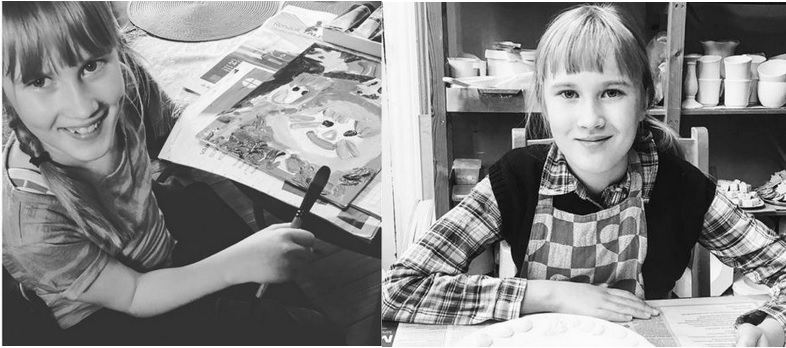
The theme of the exhibition is collaboration. Since for a while now I’ve had the idea to arrange a personal exhibition for Ivanka Shoshana (I’ve written about it some time ago HERE), then this would suit ideally – we are applying for ENM exhibition space together – hers as well as my ceramics and paintings. Whether the opportunity smiles, we will see, but it is worth to give it a try! I believe for some reason that this is a wonderful idea! The world hosts a number of children that are disabled (with special needs), and the mothers who raise an autistic child know that it is a great blessing when the child finds a hobby. The capacity of autistic children to communicate can be incomplete, but oftentimes they excel in other faculties. When you find an activity that your child likes, you wish to inspire them to get better at those activities, encourage them to grow and develop along that activity. When autistic persons find themselves a hobby, they can achieve good results. Ivanka Shoshana has several hobbies: she likes to pose (she is a model for our E&S cosmetics and art brand, and co-creates content for social media), she loves to paint, although just a few years ago she refused to hold the pencil (yet once I bought her acrylic and oil paints and professional canvases, she immediately wished to paint!), she loves ceramics (now already over a year she has been taking private clay classes) and she also likes music (we have a piano at home that she more and more often uses to play songs by memory).
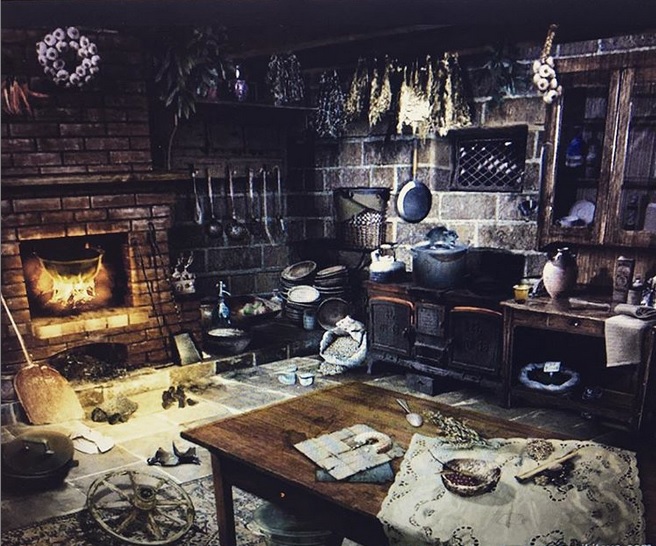
Should my competing idea “Our domestic witch kitchen” win, the museum guests would see a tiny bit of Estonian farm kitchen and exciting activities that are done at the long homely table. The kitchen is not merely a place where one messes around with pots and pans, keeps food and where the family meets for the meal. The kitchen is the heart of the home where a lot more takes place – it is the long table at which many common activities are done. The kitchen is a magical place that invites to create and engage together. For the exhibition “Our domestic witch kitchen” I would reveal some aspects of my home environment.
My youngest daughter is a child with special needs – autistic. In order to involve her more in the daily life, I founded the brand “Elisheva & Shoshana”. The aim was to do something good (protect animals and nature, consume less, consume only the natural and quality products) and do something with my darling daughters – Estella Elisheva (13) and Ivanka Shoshana (11). I wanted us to have our “own project” together. Now the family has a tradition of doing handicraft together – flowing and burning clay pots, vases, plates and cups; painting on different canvases with acrylic paints, but also tying together herbs and hanging them to dry above the oven, and preparing home made cosmetics (soaps, bath salt, etc) together. Doing things together is great and it offers to the soul – every one of us is the artist of own life, and peaceful home environment creates happiness!
With the exhibition we would display paintings and ceramics made by ourselves. Also, we would compile an exposition of herbs and would reveal some simple ways of preparing home made cosmetics.
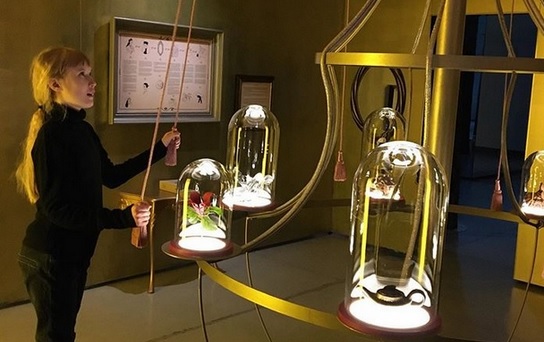
NordenBladet – Yesterday, on 8th February, ERM opened a new exhibition. Hundreds of fairy tales, dozens of magical objects and numerous strange encounters – the Estonian National Museum exhibition ‘Once Upon a Time…’ takes visitors on a journey through a magical forest and the underworld to meet holograms of heroes in the exhibition hall and guides them out of hell via an eight-metre laser corridor.
“By autumn of the year before last,” said Katrin Sipelgas, Head Curator and originator of the exhibition concept, “I had thought about fairy tales for so long that I finally decided to turn them into an exhibition. The original versions of the same stories that have become popular thanks to contemporary fairy tale films were told in our farmhouses 100 years ago or even earlier. This is why the Estonian National Museum is the perfect place for fairy tales.” Several creatives have contributed to making this exhibition a reality, incl. film director Jaak Kilmi, writer Andrus Kivirähk, folklorists Risto Järv and Ülo Valk, animator Priit Tender and historian David Vseviov.
No fairy tale is complete without magical objects. But where can we find them? Coincidentally, Katrin Sipelgas’ travels have taken her to faraway lands from South America to Indonesia. “I have travelled back with Aladdin’s lamp, a magic mirror and seven-league boots in my suitcases,” said Sipelgas. Moreover, a few months ago, a shipping container arrived at the museum full of decorations that did not fit into a suitcase – giant twisted tree roots to serve as the roof of the underworld and a number of flying carpets.
The Estonian National Museum’s collections include fairy-tale items that have now been moved from the depths of the storage room into display cases. The most exciting of these is a pot of money that was dug up by Nikolai Bergwald in 1933 when clearing a field at Ugametsa farm in Viljandi County. The copper cauldron was filled with jewellery and coins. The exhibition also features a peculiar bearded mask that was made 80 years ago in Hiiumaa. The Estonian Literary Museum contributed a dozen exciting books.
‘Once Upon a Time…’ will take visitors on a journey along which they encounter everything a hero might in a fairy tale; heroes are represented in the exhibition hall by holograms. As in any fairy tale, visitors will face trials and find resolutions. Be it a card came with devils in the underworld or a fight with a dragon. In order to escape hell, visitors must pass through an eight-metre laser corridor.
The fairy tale exhibition ‘Once Upon a Time…’ will remain open in the Estonian National Museum temporary exhibitions hall (A-entrance) from 8 February to spring 2021. More information on the exhibition can be found on the Estonian National Museum Website.
“The term fairy tale seemingly refers to a time long past,” explains Risto Järv, Folklorist and Curator (Estonian Literary Museum), “but the contents of these stories can be easily transferred to the present day. The poetry of fairy tales allows listeners and readers, adults and children alike, to easily relate to fairy tale heroes and heroines. These are current stories about the problems and struggles of contemporary people and how to overcome them.”
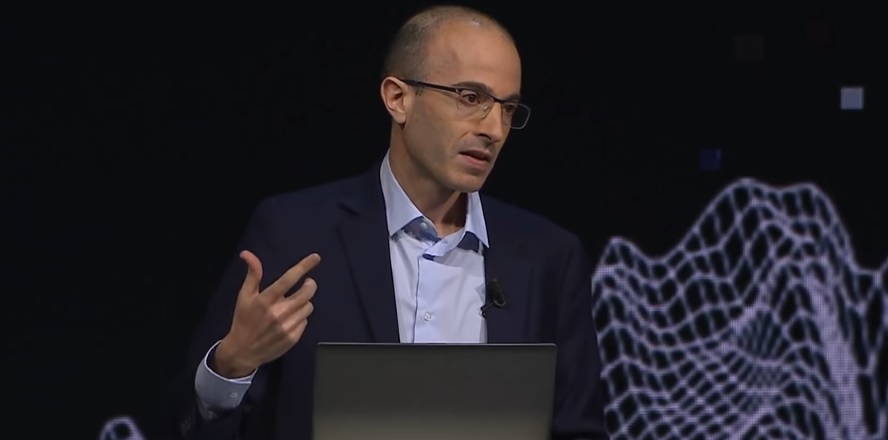
NordenBladet – Prof. Yuval Noah Harari (43) takes to the Congress Hall stage at the World Economic Forum annual meeting to speak about how nuclear war, ecological collapse and technological disruption pose an existential threat to human civilization. Directly after, he explores the challenges of the 21st century and how to address them before it is too late with Dutch Prime Minister, Mark Rutte, moderated by Orit Gadiesh.
Historian Yuval Noah Harari offers a bracing prediction: just as mass industrialization created the working class, the AI revolution will create a new unworking class.
The most important question in 21st-century economics may well be: What should we do with all the superfluous people, once we have highly intelligent non-conscious algorithms that can do almost everything better than humans?
This is not an entirely new question. People have long feared that mechanization might cause mass unemployment. This never happened, because as old professions became obsolete, new professions evolved, and there was always something humans could do better than machines. Yet this is not a law of nature, and nothing guarantees it will continue to be like that in the future. The idea that humans will always have a unique ability beyond the reach of non-conscious algorithms is just wishful thinking. The current scientific answer to this pipe dream can be summarized in three simple principles:
1. Organisms are algorithms. Every animal — including Homo sapiens — is an assemblage of organic algorithms shaped by natural selection over millions of years of evolution.
2. Algorithmic calculations are not affected by the materials from which the calculator is built. Whether an abacus is made of wood, iron or plastic, two beads plus two beads equals four beads.
3. Hence, there is no reason to think that organic algorithms can do things that non-organic algorithms will never be able to replicate or surpass. As long as the calculations remain valid, what does it matter whether the algorithms are manifested in carbon or silicon?
True, at present there are numerous things that organic algorithms do better than non-organic ones, and experts have repeatedly declared that some things will “for ever” remain beyond the reach of non-organic algorithms. But it turns out that “for ever” often means no more than a decade or two. Until a short time ago, facial recognition was a favorite example of something that babies accomplish easily but which escaped even the most powerful computers. Today, facial-recognition programs are able to identify people far more efficiently and quickly than humans can. In 2004, professor Frank Levy from MIT and professor Richard Murnane from Harvard published research on the job market, listing those professions most likely to undergo automation. Truck driving was given as an example of a job that could not possibly be automated in the foreseeable future. A mere 10 years later, Google and Tesla can not only imagine this, but are actually making it happen.
In fact, as time goes by, it becomes easier and easier to replace humans with computer algorithms, not merely because the algorithms are getting smarter, but also because humans are professionalizing. Ancient hunter-gatherers mastered a very wide variety of skills in order to survive, which is why it would be immensely difficult to design a robotic hunter-gatherer. Such a robot would have to know how to prepare spear points from flint stones, find edible mushrooms in a forest, track down a mammoth, coordinate a charge with a dozen other hunters and use medicinal herbs to bandage any wounds. However, a taxi driver or a cardiologist specializes in a much narrower niche than a hunter-gatherer, which makes it easier to replace them with AI. AI is nowhere near human-like existence, but 99 percent of human qualities and abilities are simply redundant for the performance of most modern jobs. For AI to squeeze humans out of the job market it need only outperform us in the specific abilities a particular profession demands.
As algorithms push humans out of the job market, wealth and power might become concentrated in the hands of the tiny elite that owns the all-powerful algorithms, creating unprecedented social and political inequality. Alternatively, the algorithms might themselves become the owners. Human law already recognizes intersubjective entities like corporations and nations as “legal persons.” Though Toyota or Argentina has neither a body nor a mind, they are subject to international laws, they can own land and money, and they can sue and be sued in court. We might soon grant similar status to algorithms. An algorithm could then own a transportation empire or a venture-capital fund without having to obey the wishes of any human master. Before dismissing the idea, remember that most of our planet is already legally owned by non-human intersubjective entities, namely nations and corporations. Indeed, 5,000 years ago much of Sumer was owned by imaginary gods such as Enki and Inanna. If gods can possess land and employ people, why not algorithms?
So what will people do? Art is often said to provide us with our ultimate (and uniquely human) sanctuary. In a world where computers have replaced doctors, drivers, teachers and even landlords, would everyone become an artist? Yet it is hard to see why artistic creation would be safe from the algorithms. According to the life sciences, art is not the product of some enchanted spirit or metaphysical soul, but rather of organic algorithms recognizing mathematical patterns. If so, there is no reason why non-organic algorithms couldn’t master it.
In the 19th century the Industrial Revolution created a huge urban proletariat, and socialism spread because no other creed managed to answer the unprecedented needs, hopes and fears of this new working class. Liberalism eventually defeated socialism only by adopting the best parts of the socialist program. In the 21st century we might witness the creation of a massive new unworking class: people devoid of any economic, political or even artistic value, who contribute nothing to the prosperity, power and glory of society. This “useless class” will not merely be unemployed — it will be unemployable.
In September 2013, two Oxford researchers, Carl Benedikt Frey and Michael A. Osborne, published “The Future of Employment,” in which they surveyed the likelihood of different professions being taken over by computer algorithms within the next 20 years, and they estimated that 47 percent of US jobs are at high risk. For example, there is a 99 percent probability that by 2033 human telemarketers and insurance underwriters will lose their jobs to algorithms. There is a 98 percent probability that the same will happen to sports referees. Cashiers — 97 percent. Chefs — 96 percent. Waiters — 94 percent. Paralegals — 94 percent. Tour guides — 91 percent. Bakers — 89 percent. Bus drivers — 89 percent. Construction laborers — 88 percent. Veterinary assistants — 86 percent. Security guards — 84 percent. Sailors — 83 percent. Bartenders — 77 percent. Archivists — 76 percent. Carpenters — 72 percent. Lifeguards — 67 percent. There are, of course, some safe jobs. The likelihood that computer algorithms will displace archaeologists by 2033 is only 0.7 percent, because their job requires highly sophisticated types of pattern recognition and doesn’t produce huge profits and it is improbable that corporations or government will make the necessary investment to automate archaeology within the next 20 years.
Of course, by 2033 many new professions are likely to appear — for example, virtual-world designers. But such professions will probably require much more creativity and flexibility than current run-of-the-mill jobs, and it is unclear whether 40-year-old cashiers or insurance agents will be able to reinvent themselves as virtual world designers (try to imagine a virtual world created by an insurance agent!). And even if they do so, the pace of progress is such that within another decade they might have to reinvent themselves yet again. After all, algorithms might well outperform humans in designing virtual worlds, too. The crucial problem isn’t creating new jobs. The crucial problem is creating new jobs that humans perform better than algorithms.
Since we do not know how the job market would look in 2030 or 2040, today we have no idea what to teach our kids. Most of what they currently learn at school will probably be irrelevant by the time they are 40. Traditionally, life has been divided into two main parts: a period of learning, followed by a period of working. Very soon this traditional model will become utterly obsolete, and the only way for humans to stay in the game will be to keep learning throughout their lives and to reinvent themselves repeatedly. Many, if not most, humans may be unable to do so.
The coming technological bonanza will probably make it feasible to feed and support people even without any effort from their side. But what will keep them occupied and content? One answer might be drugs and computer games. Unnecessary people might spend increasing amounts of time within 3D virtual-reality worlds that would provide them with far more excitement and emotional engagement than the drab reality outside. Yet such a development would deal a mortal blow to the liberal belief in the sacredness of human life and of human experiences. What’s so sacred about useless bums who pass their days devouring artificial experiences?
Some experts and thinkers, such as Nick Bostrom (TED Talk: What happens when our computers get smarter than we are?), warn that humankind is unlikely to suffer this degradation, because once artificial intelligence surpasses human intelligence, it might simply exterminate humankind. The AI would likely do so either for fear that humankind would turn against it and try to pull its plug, or in pursuit of some unfathomable goal of its own. For it would be extremely difficult for humans to control the motivation of a system smarter than themselves.
“Artificial intelligence is getting smarter by leaps and bounds — within this century, research suggests, a computer AI could be as “smart” as a human being.”
Even preprogramming an AI system with seemingly benign goals might backfire horribly. One popular scenario imagines a corporation designing the first artificial super-intelligence and giving it an innocent test such as calculating pi. Before anyone realizes what is happening, the AI takes over the planet, eliminates the human race, launches a campaign of conquest to the ends of the galaxy, and transforms the entire known universe into a giant supercomputer that for billions upon billions of years calculates pi ever more accurately. After all, this is the divine mission its Creator gave it.
_________________________________________________
Yuval Noah Harari (born 24 February 1976) is an Israeli historian, philosopher, and a professor in the Department of History at the Hebrew University of Jerusalem. He is the author of the popular science bestsellers Sapiens: A Brief History of Humankind (2014), Homo Deus: A Brief History of Tomorrow (2016), and 21 Lessons for the 21st Century (2018). His writings examine free will, consciousness, intelligence and happiness.
Harari writes about the “cognitive revolution” occurring roughly 70,000 years ago when Homo sapiens supplanted the rival Neanderthals, developed language skills and structured societies, and ascended as apex predators, aided by the agricultural revolution and accelerated by the scientific method, which have allowed humans to approach near mastery over their environment. His books also examine the possible consequences of a futuristic biotechnological world in which intelligent biological organisms are surpassed by their own creations; he has said “Homo sapiens as we know them will disappear in a century or so”.
Yuval Noah Harari was born in Kiryat Ata, Israel, in 1976 and grew up in a secular Jewish family[3] with Lebanese and Eastern European roots in Haifa, Israel. Harari is gay and in 2002 met his husband Itzik Yahav, whom he calls “my internet of all things”. Yahav is also Harari’s personal manager.They married in a civil ceremony in Toronto in Canada. The couple lives in a moshav (a type of cooperative agricultural community of individual farms), Mesilat Zion, near Jerusalem.
Harari says Vipassana meditation, which he began whilst in Oxford in 2000, has “transformed my life”. He practises for two hours every day (one hour at the start and end of his work day), every year undertakes a meditation retreat of 30 days or longer, in silence and with no books or social media, and is an assistant meditation teacher. He dedicated Homo Deus to “my teacher, S. N. Goenka, who lovingly taught me important things”, and said “I could not have written this book without the focus, peace and insight gained from practising Vipassana for fifteen years.” He also regards meditation as a way to research.
Harari is a vegan, and says this resulted from his research, including his view that the foundation of the dairy industry is breaking the bond between mother cow and calf.As of January 2019, Harari does not have a smartphone.
Harari is interested in how Homo sapiens reached their current condition, and in their future. His research focuses on macro-historical questions such as: What is the relation between history and biology? What is the essential difference between Homo sapiens and other animals? Is there justice in history? Does history have a direction? Did people become happier as history unfolded?
Harari regards dissatisfaction as the “deep root” of human reality, and as related to evolution.
In a 2017 article, Harari argued that through continuing technological progress and advances in the field of artificial intelligence, “by 2050 a new class of people might emerge – the useless class. People who are not just unemployed, but unemployable.” He put forward the case that dealing with this new social class economically, socially and politically will be a central challenge for humanity in the coming decades.
Harari has commented on the plight of animals, particularly domesticated animals since the agricultural revolution, and is a vegan. In a 2015 Guardian article under the title “Industrial farming is one of the worst crimes in history” he called “[t]he fate of industrially farmed animals one of the most pressing ethical questions of our time.”
Harari summed up his views on the world in a 2018 interview with Steve Paulson of Nautilus thus: “Things are better than ever before. Things are still quite bad. Things can get much worse. This adds up to a somewhat optimistic view because if you realize things are better than before, this means we can make them even better.”
Harari wrote that although the idea of free will and the liberal values helped consolidate, it “emboldened people who had to fight against the Inquisition, the divine right of kings, the KGB and the KKK”, it has become dangerous in a world of a data economy, where, he argues, in reality there is no such thing, and governments and corporations are coming to know the individual better than they know themselves and “if governments and corporations succeed in hacking the human animal, the easiest people to manipulate will be those who believe in free will.” Harari elaborates that “Humans certainly have a will – but it isn’t free. You cannot decide what desires you have… Every choice depends on a lot of biological, social and personal conditions that you cannot determine for yourself. I can choose what to eat, whom to marry and whom to vote for, but these choices are determined in part by my genes, my biochemistry, my gender, my family background, my national culture, etc – and I didn’t choose which genes or family to have.”
NordenBladet – Queen Margrethe II was, once again, accompanied by her younger sister, Princess Benedikte, for a major engagement in Copenhagen. The princess joined Margrethe at the official opening of a new permanent feature at the Amalienborg Palace which will showcase glittering items made by one of the most famous jewellers in the world.
The Faberge Room is home to over 100 exhibits including a sapphire and diamond tiara that belonged to the sisters’ grandmother, Queen Alexandrine. The new display will be a permanent part of the Amalienborg Museum. Several of the items in it belonged to Alexandrine who was herself a descendant of Tsar Nicholas I of Russia whose Imperial Family were famous patrons of the Faberges.
The Queen of Denmark and Princess Benedikte were presented with flowers as they arrived for the official opening on February 7th 2020. They then toured the exhibition which features items made between 1860 and 1917 and puts a focus on the close relationship, at the time, between the Danish and Russian ruling houses. Among the display is a gold egg, thought to have inspired the famous range of jewelled eggs created by Carl Faberge in the late 19th century.
There are also some personal items on show including a golden picture frame in the shape of a heart which was presented by Queen Louise of Denmark to her husband, King Christian IX, to mark their 50th wedding anniversary. It contains a portrait of the queen at the time of her marriage, opposite another from the time of the couple’s golden wedding anniversary.
Several of the items in the exhibition have been loaned by the Danish Royal Family, with Princess Benedikte and her younger sister, Queen Anne-Marie of Greece, contributing items. However, the ownership of the famous tiara in the display still isn’t known. The sapphire diadem was presented to Alexandrine for her wedding in 1898 and passed to the family of her younger son, Prince Knud. It was eventually sold at auction in 2018 although news about who bought the gems wasn’t revealed. Given its inclusion in the exhibition, speculation that it has been rebought by the Danish Royal Family has begun again.
Princess Benedikte has accompanied her sister on a string of engagements in recent times and has been a great support to her, in private and public, since the death of her husband, Prince Henrik, in 2018.
NordenBladet – The Norwegian Royal Court announced in December that His Royal Highness Crown Prince Haakon would visit Kenya and Mozambique in February of 2020. This morning, a new statement from the royal court stated that the visit to Kenya had been cancelled. This announcement comes just one week before the Crown Prince was scheduled to travel to Africa.
The statement from the royal court said: “The Kenyan authorities have cancelled all official programs and declared national mourning after former President Daniel arap Moi death’s on 4 February 2020. Unfortunately, the Crown Prince’s official visit to Kenya next week cannot be carried out as planned and is therefore postponed. The visit to Mozambique on 12 and 13 February 2020 goes as planned.”
The Crown Prince was set to arrive in Kenya on 10 February. A Norwegian business delegation was preparing to have an important part of the programme in Kenya. In addition, a meeting with President Kenyatta was scheduled. This would have been the first-ever official royal visit from Norway to Kenya. Minister of Development Dag-Inge Ulstein and Minister of Digitisation Nikolai Astrup will accompany the Crown Prince on his journey which will now only be to Mozambique.
On 12 February, the Crown Prince will arrive in Mozambique. Mozambique and Norway have worked together for a number of years, in areas such as energy, fisheries and the sea, good governance and support for civil society. The partnership with Mozambique includes development, political dialogue and business cooperation. The Crown Prince visited Mozambique previously in 2002.
Crown Prince Haakon will meet President Nyusi, various representatives of the authorities and key partners for Norway in energy cooperation, civil society, gender equality and the UN family. Electrification is central to bilateral cooperation, and the Crown Prince will be present as the village electrification network is expanded. Mozambique has some of the world’s largest natural gas resources, and Norway has for a long time worked with Mozambique to build a good management regime for gas and oil. This collaboration will also be on the programme during the visit, along with climate and ocean issues.