NordenBladet — Minister for European Affairs Tytti Tuppurainen and French Secretary of State for European Affairs Clément Beaune will meet in Helsinki on Tuesday 16 November.In their meeting, the ministers will discuss topical EU matters including the economy, the EU’s Strategic Compass for security and defence cooperation, the rule of law and climate and energy policy. The French Presidency of the Council of the EU, which will start in January 2022, will also be on the agenda. Minister Tuppurainen and Minister Beaune will also visit the University of Helsinki, where they will discuss the future of the European Union with students.
NordenBladet — Minister of Economic Affairs Mika Lintilä will visit the United States on 15–16 November. This is his first visit since the outbreak of the COVID-19 pandemic. During his visit, Minister Lintilä will discuss energy, bioeconomy and digitalisation with high-level representatives of the US administration and of the states. He will also meet Finnish companies operating in the United States, and speak at a bioeconomy conference.Minister of Economic Affairs Mika Lintilä will speak at an international bioeconomy conference on sustainable wood biomass production in Finland. Wood biomass is used for a number of purposes, such as renewable chemicals, bio-based products and biofuels.“We need a global bio-based economy. Finnish companies have much to offer in terms of solving global challenges. The United States is an important partner for us, and I believe we can engage in deeper cooperation in fields such as biofuels,” Minister Lintilä says. During his visit, Minister Lintilä will also meet representatives of Finnish companies operating in the United States to hear what is happening in the local markets.Minister of Economic Affairs to meet high-level representatives of the statesThe Minister will visit the State of Virginia and discuss, among other things, possibilities for cooperation in 6G research with Governor Ralph Northam. The Minister will also visit the Virginia Tech campus, the home of the Commonwealth Cyber Initiative research, development and innovation network.“This is an extremely fast-advancing technology, and to remain at the cutting edge, small countries like Finland need to build networks with the leading international research institutes,” Minister Lintilä says. Minister Lintilä will meet Member of Congress Paul Tonko to discuss clean energy objectives and actions taken in the United States. He will also meet high-level representatives of the States of Maine and Michigan. Finland has bioeconomy working groups in both states, coordinated by Business Finland and the Embassy of Finland in Washington DC. The objective of this cooperation is to open up new commercial opportunities for Finnish businesses. The United States is one of Finland’s most important trading partners, and cooperation with individual states plays an important role in exports promotion.
NordenBladet — On 15 to 16 November 2021, Minister of Defence Antti Kaikkonen will attend the EU Foreign Affairs Council meeting and the Steering Board meeting of the European Defence Agency (EDA) in Brussels. On the first day of the meeting, foreign and defence ministers will discuss the first draft of the Strategic Compass, the evaluation and steering document for the EU’s security and defence cooperation, at their joint session. On the second day of the meeting, defence ministers are to discuss the effectiveness and lessons learned from the EU’s training operations. The ministers will receive an overview of the Coordinated Maritime Presences (CMP), military mobility and progress made in implementing the EU’s permanent structured cooperation. In addition, the defence ministers will discuss cooperation between the EU and NATO with NATO Secretary General Jens Stoltenberg. On the EDA Board, ministers will discuss the EDA’s support for defence sector innovation in the Member States, including transformational technologies. The ministers will adopt, among other things, the basic principles for cooperation with third countries and a negotiating mandate to establish an administrative arrangement between the EDA and the United States.
NordenBladet – The laureate of the Black Nights Film Festival (PÖFF) Lifetime Achievement Award is actress Elle Kull. The actress will receive the award on Friday at 6 p.m. at the opening ceremony of the festival.
Kull, who is turning 70 next year, will receive the award for outstanding roles in nearly 30 films and television productions. Minna in “Ukuaru”, Laura in “Pisuhänd”, Maria Marmor in A Ballade of Two Homes (“Kahe kodu ballaad”), Irma in “Rudolf and Irma” Catherina Wycken in “Reik’s Teacher”, Dora in “Ask the Dead About the Price of Death (“Surma hinda küsi surnutelt”) and a girl in “Promenade” are only a few of the projects she has participated in.
She is the only Estonian actress to have also received the award of the best film actress in the Soviet Union in 1975, for her role in “Ukuaru”.
“Elle Kull has both freshness and purity of youth, fidelity to nature, the depth of material perception and the impulsivity of experience. She has a rare sense of truth. She is like a sensitive membrane that perceives the slightest lie and fake,” an Estonian director Leida Laius who discovered Kull from the second year of the Estonian Theater and Music Academy and invited her to play in “Ukaru.”
“Ukuaru” also opened the door for other Soviet film studios for Kull, for example, she starred in Lithuanian director Almantas Grikevičius’ “Times of Farm Empire”, as well as in Russian, Belarusian, Ukrainian, Uzbek and Armenian films, seen by as many as 15 million people.
Kull was a long-time president of the Estonian National Committee of the UNICEF Children’s Fund, and she has been involved in charity work for a long time.
From November 29, the PÖFF online cinema will also show the films “Ukuaru” and “Ask the Dead About the Price of Death”.
The winner of the second Lifetime Achievement Award, which is traditionally a foreign filmmaker, will be announced by PÖFF during the festival.
Last year, Alar Kivilo and Margarethe von Trotta received the PÖFF Lifetime Achievement Award.
The Black Nights Film Festival will take place on November 12-28.
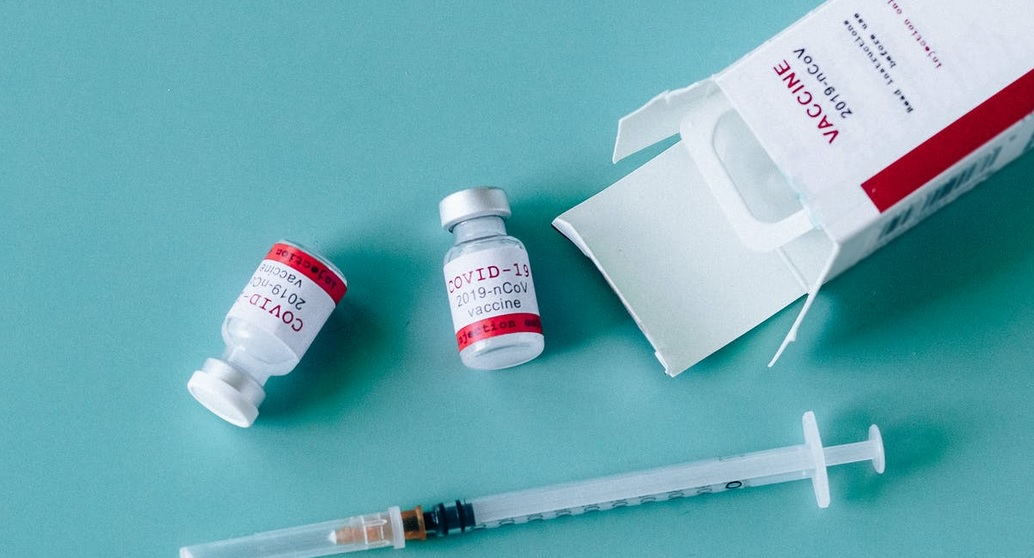
NordenBladet – The government on Thursday decided to allow people to get AstraZeneca and Janssen coronavirus vaccine booster doses five months after receiving the second shot, down from the recent six months. The European Medicines Agency (EMA) sales permit for the vaccines prescribes a waiting period of six months. The Estonian State Agency of Medicines said that how to solve problems caused by side-effects in this case still needs to be analyzed.
The booster dose waiting period has been changed three times in the last month in Estonia. While people were initially told they need to wait eight months after getting their second shot, this was shortened to six months in late October, with people vaccinated using AstraZeneca and Janssen vaccines told two days ago that waiting five months is enough. The vaccines’ marketing authorization issued by the European Medicines Agency prescribes a six-month break from the second dose.
“Data from Israel clearly shows that a five-month vaccination interval proved successful at preventing severe cases,” said Marje Oona, member of the Estonian immunoprophylactic expert committee.
“The European Medicines Agency failed to consider data from Israel. The immunoprophylactic committee can, based on Estonia’s epidemiological situation, decide that it is sensible to offer booster doses of AstraZeneca and Janssen vaccines after five months,” Oona said.
She said there is no conflict with EMA as national expert bodies can issue recommendations based on the epidemiological situation in the country. Oona gave the example of Finland that decided in spring people need to wait longer for third doses of the Pfizer vaccine.
“On the other hand, we have no reason to believe the vaccine is somehow more dangerous when administered a little sooner. It is a question of effect – whether the immune response is triggered at the right time or whether it is created too soon, when the person still has antibodies,” said Ott Laius, head of the pharmaceutical safety department of the State Agency of Medicines.
Laius said existing data suggests third doses produce the same side-effects as the previous ones. Serious side-effects require the person to turn to the manufacturer after which the state and the pharmaceutical manufacturer will decide how to solve the problem for the person.
Laius could not say what effect Estonia’s decision of a shorter waiting period could have on such resolutions.
“It needs to be determined now. It requires calm deliberation and decisions,” Laius said.
Information available to ETV news program “Aktuaalne kaamera” suggests a major immunization center has offered booster doses to people who got their second shot a mere four and half months ago. Marje Oona said that while there is no additional risk involved, such conduct is not practical either.
“The resulting immunity might not be as strong after a shorter waiting period, which I why I would recommend against getting these shots with short intervals,” she said.
NordenBladet — Completed late on Saturday, the Glasgow Climate Change Conference has successfully reinforced commitment to the objectives of the Paris Agreement.Countries were urged to update their emission reduction targets and long-term low-carbon development plans by as soon as next year. Progress towards the 1.5 degree target set in the Paris Agreement will be reviewed on an annual basis in future.“The decision keeps the 1.5 degree target within our reach. The clock is ticking, and the next few years will be crucial. This is why we need to keep up continual pressure to improve climate measures specifically in the 2020s, and this latest decision to require annual updating will do that”, explains Krista Mikkonen, Minister of the Environment and Climate Change.After more than five years of work, the Conference completed the rules of the Paris Agreement, which Minister Mikkonen views as evidence that the countries of the world can work together to find solutions for combating the climate crisis.Room for improvement remains in rules governing market mechanismsThe rules of the Paris Agreement were now completed with rules on international market mechanisms. These rules seek to prevent counting of the same emission reductions towards the national targets of more than one country, and to ensure that emission reduction projects are additional to other measures. The compromise achieved nevertheless still allows limited use of old emission reduction units earned under the Kyoto Protocol until in 2030. The European Union and Finland advocated an alternative that would have entirely prohibited the use of units from the previous period towards Paris Agreement commitments.“While the rules of the mechanism are far from perfect, they do enable us to avoid double counting. The outcome enables the development of market-based emission reduction solutions between countries, with implementation no longer solely dependent on the voluntary carbon market. Many details still need to be worked out later”, observes Ministerial Adviser Tuomo Kalliokoski.Unprecedented funding pledges for developing countries to adapt to climate changeAdapting to climate change was a more prominent agenda item in Glasgow than at previous climate change conferences. Countries announced pledges to the Adaptation Fund amounting to an unprecedented USD 356 million, in support of adaptation to climate change. Developed countries made a commitment to double their financial contributions to developing countries for climate change adaptation from 2019 levels by the year 2025, and to seek an increase in the share of financing for climate change adaptation to half of all public climate financing. The countries also agreed that five per cent of sales revenues generated through the international market mechanism would be transferred to the Adaptation Fund.“It is unfortunate that the pre-Paris firewall remains in funding, with obligations solely for developed countries”, says Outi Honkatukia, a lead negotiator for climate finance for the EU.The countries agreed on the next steps for determining the climate change finance target for public and private funding after 2025. The Santiago Network of Experts on Climate Change Damage and Loss will be strengthened. Developed countries were also urged to finance its work. This will be discussed in greater detail at future conferences.A two-year Glasgow–Sharm el-Sheikh work programme seeks to give substance to the global adaptation goal. The Paris Agreement imposes a clear numerical target only for tackling climate change.“Measuring emission reductions is easy, but we have no indicators for successfully adapting to climate change. We are now working together to correct this failing”, explains Minister Mikkonen, who negotiated on adaptation issues on behalf of the European Union.Reporting rules ensure that countries communicate their actions and emissions transparently and consistentlyThe parties also agreed on the tables whereby countries will report their emission trends, their actions and their financing. The rules also strengthen and clarify reporting of emissions and actions in developing countries. Support was promised for developing countries in meeting their reporting obligations.Future national emission reduction commitments should be issued in a commensurable way. The target year for the nationally determined contributions to be communicated in 2025 should be the same for everyone: 2035. This will also facilitate monitoring and assessment in achieving the common objective, and five-yearly reviews under the Paris Agreement.“We shall have a clearer idea of the pace of progress towards our goal when all countries report their emissions in a uniform and transparent manner”, says Marjo Nummelin, Finland’s Chief Negotiator for Climate Change.First UN reference to decarbonisation, role of nature conservation and ecosystem restoration highlightedThe countries pledged to accelerate decarbonisation and to end inefficient fossil fuel subsidies. The decision also emphasises the role of nature conservation and ecosystem restoration in achieving the objectives of the Paris Agreement.“This is the first time that decarbonisation has been mentioned in a UN text. It is an important signal, even if we had hoped for a stronger pledge. I also consider it important that the decision highlights nature conservation and restoration. The climate and environmental crises cannot be solved as separate issues – this should also be acknowledged ahead of the major biodiversity conference in Kunming”, Minister Mikkonen observes.Besides its final conclusions, the Glasgow conference published a series of initiatives to reduce emissions. The subjects of the initiatives and declarations joined by Finland include halting deforestation, and reducing emissions from transport and emissions of methane gas. These initiatives support international efforts to reduce emissions and encourage countries to ramp up their own national commitments.The next Climate Change Conference will be held one year from now in Egypt.
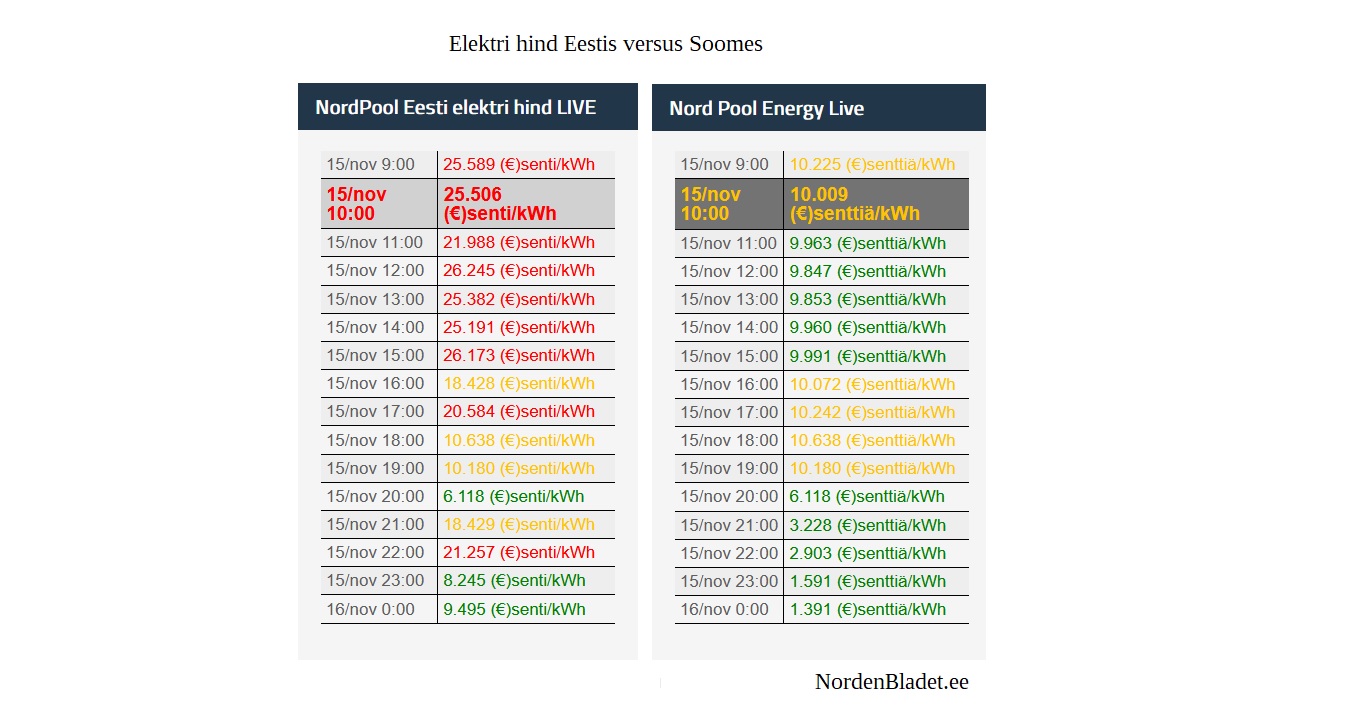
NordenBladet – NordenBladet launched today, on November 15, a new app that allows visitors of our websites keep track of daily electricity prices at any chosen time
Electricity tariffs will be displayed on NordenBladet’s front page and sitewide on the right side of the page in the form of a table. You can check the exact price of electricity during one full hour until the next. The Estonian site (NordenBladet.ee) publishes Estonian electricity prices, the Finnish language site (NordenBladet.fi) publishes electricity prices of Finland.
PRICE GUIDE*:
? Red – the day’s highest prices
? Yellow – the day’s typical price
? Green – the day’s most profitable price
(prices in the table are given before/without value-added tax)
Estonia and Finland belong to the Nord Pool Spot electricity market trade region. Besides Estonia and Finland, the NordPool also involves Sweden, Norway, Denmark, Latvia and Lithuania. In the Nord Pool Spot, electricity prices will be determined separately for every hour of the day and separately for every region. Each country has the minimum of one price zone, countries with larger territories may have several zones.
Electricity’s market value will be calculated by Nord Pool electricity stocks individually for every hour. For each hour, all electricity production offers beginning with the most inexpensive will be ranked, and all electricity demand offers will be ranked beginning with the most expensive. In the intersection of these two lines the price of electricity will be shaped.
__________________________________ ATTENTION! * Electrical grid level depends on the electrical network service provider and the location of every individual consumer’s electrical substation. The price guide has been designed based on Nord Pool data in a supporting manner, with the aim of simplifying the price market overview – NordenBladet will not accept responsibility regarding your electricity consumption!
NordenBladet – Tallinn will be awarded the UNESCO City of Music title from 2022. Last year, Mayor of Tallinn Mihhail Kõlvart (Center) said Tallinn would apply for the title as the capital is the largest center of music culture in Estonia, where song and dance festivals, as well as major international festivals and concerts, take place.
Tallinn’s application was accompanied by the creation of Tallinn Music Strategy 2022-2025, which offers new opportunities for creating and enjoying music.
The main focus of the strategy is to support the development and growth of the city’s music industry.
On Monday, Kõlvart said: “A strong musical tradition has been closely embedded in our cultural heritage throughout the centuries, and therefore the title of UNESCO Music City is extremely gratifying.”
Artistic Director of the Tallinn Philharmonic Society Tõnu Kaljuste said it is not only great news to musicians, but is of great significance for the entire city.
“I believe that any international recognition is a small dose of praise for every musician, giving both delights to the heart and strength for the future. I hope that it will have the same effect on the city in which we live, play and sing. The UNESCO City of Music is a high recognition, congratulations to us all!”
The UNESCO Network of Creative Cities, which includes the Cities of Music, was launched in 2004 with the aim of highlighting the role of culture and creativity in sustainable urban development.
In addition to Tallinn, the newly designated Cities of Music include Abu Dhabi (United Arab Emirates), Batumi (Georgia), Belfast (Ireland), Huancayo (Peru), Ibagué (Colombia), Kharkiv (Ukraine), London (Canada), Port Louis (Mauritius) , Recife (Brazil), Santiago de Cuba (Cuba) and Xalapa (Mexico).
NordenBladet – As of Sunday morning, 542 patients with the coronavirus were being treated in Estonian hospitals of whom 428 required treatment for severe COVID-19. Of those, 313 or 73 percent were unvaccinated and 115 or 27 percent had completed their immunization cycle, NordenBladet.ee mediates.
Hospitals opened 35 new treatment cases. Five people with the coronavirus died.
A total of 4,544 tests were analyzed in the last 24 hours of which 561 returned positive. Of those who tested positive, 369 were unvaccinated and 196 had completed the cycle, Health Board data reveals.
Vaccine doses administered in the last day came to 2,115 all of which were first shots. By Sunday morning, 113,655 people had received additional or booster doses. Total vaccination coverage is at 58.2 percent.
In all, 1,673 people with the coronavirus have died in Estonia.