NordenBladet —The Bill on Amendments to the Citizenship Act (58 SE), initiated by the Government of the Republic, passed the first reading in the Riigikogu. The aim of the Bill is to ensure the possibility to acquire Estonian citizenship under a simplified procedure to minors who were born in Estonia and whose parents (or grandparents) have resided in Estonia before the restoration of the independence of the Republic of Estonia. The Minister of the Interior Mart Helme presented the Bill.
The Bill provides that a minor who is born in Estonia or who immediately after birth settles permanently in Estonia with a parent or parents who are permanent residents of Estonia, and who holds a long-term residence permit or the right of permanent residence, and one of whose parents is not recognised as its citizen by any state under legislation in force, and whose other parent is a national of another country, will acquire Estonian citizenship at the request of his or her legal representative if a parent or a grandparent of the minor was a resident of Estonia as at 20 August 1991.
The Bill sets a requirement that, with regard to such person of another nationality, the Resolution of the Government of the Republic on the granting of Estonian citizenship will enter into force as of the day following the day on which the certificate to the effect that the person has been released from the citizenship of the other state is submitted to the governmental authority authorised by the Government of the Republic.
During the debate, Jevgeni Ossinovski (Social Democratic Party), Taavi Rõivas (Reform Party) and Andrei Korobeinik (Centre Party) took the floor. They discussed various aspects related to the granting of Estonian citizenship, and dual citizenship.
The Minister of the Interior Mart Helme also took part in the debate.
The Reform Party Faction moved to reject the Bill at the first reading. The result of voting: 30 members of the Riigikogu in favour, 53 against. The Bill remained in the legislative proceedings.
At its today’s sitting, the European Union Affairs Committee of the Riigikogu (Parliament of Estonia) heard the representatives of energy-intensive companies and green companies, who gave an overview of the challenges and opportunities that would accompany achieving of carbon neutrality in Estonia by 2050.
Chair of the Committee Anneli Ott believes that the approach to carbon neutrality should be integrated, and not sector-based. “Besides energy, it is also necessary to deal with the transport sector, with housing and agriculture sectors. These sectors influence the daily life of people more than the technological changes in individual large enterprises,” Ott said. “Unfortunately, at the moment there is no agreement and understanding in the society that the use of climate-friendly solutions means a change not only for businesses, but for all people,” she added.
Ott explained that the entrepreneurs had pointed out that it would be impossible to achieve zero emissions in the cement and energy industries of the European Union until there had been a technological revolution in the carbon emission sequestration technologies. “The entrepreneurs emphasised that global agreements are necessary for achieving carbon neutrality. If efforts are made only in the European Union, there is a risk that large concerns will move their production facilities outside the Union,” Ott summarized the problem of energy-intensive companies. She added that at the same time, more and more green technology development projects that focused on circular economy and provided smart possibilities for energy saving emerged in Estonia.
Managing Director of Kunda Nordic Tsement Meelis Einstein, Chairman of the Board of Viru Keemia Grupp Ahti Asmann, CEO of Cleantech ForEst Erki Ani and Head of Regulatory Affairs and Compliance Department at Eesti Energia Andres Tropp delivered reports at the sitting.
The European Union Affairs Committee of the Riigikogu started a series of parliamentary hearings this autumn in order to prepare a resolution with which Estonia will participate in the European Union negotiations on 2050 climate targets. The next parliamentary hearing at the European Union Affairs Committee will take place on 27 September, when the Committee will discuss meeting of Estonia’s 2020 and 2030 climate targets with Minister of the Environment Rene Kokk.
NordenBladet —At today’s sitting, the Riigikogu heard the summary of the annual review by Chancellor of Justice Ülle Madise. The Chancellor of Justice noted that the range of topics was wide, from taxes, banking and supervision of surveillance to environmental protection, heritage conservation, the rights of children and young people, and the concerns of disabled people.
In her report, Ülle Madise pointed out, among other things, the regulations of cities and municipalities that created problems for people after the administrative reform. She described a situation where, within the boundaries of a large local government formed after the reform, uniform rules of property maintenance had been established, and it had been prohibited for a person who lived several kilometres away from other households to cultivate their garden and dry their laundry outdoors without special permission. The Chancellor of Justice said that a number of situations like that had occurred. She thanked cities and municipalities for correcting such mistakes quickly and without judicial intervention.
Madise said that the agency of the Chancellor of Justice also spoke out when undesired results became apparent in practice in an Act or Resolution, and needed solution. “For example, tax burden increases for a person when they receive their redundancy payment or maternity benefit at the end of the year, or when a family with many children receives a grant from “KredEx” to renovate their housing, and they receive it as a natural person and not through an apartment association,” the Chancellor of Justice brought examples. She expressed the hope that such mistakes would be corrected quickly.
The Chancellor of Justice said that people often asked why officials were indifferent and did not make well-considered and sensible decisions. In Madise’s opinion, the greatest problem is the weakness of the front line of officials. She pointed out that, in offices and inspectorates, schools and hospitals, child protection and care homes, more often than not, specialists did not have a supportive working environment, equitable recognition or a salary consistent with their responsibility. In Madise’s words, a clever, active and decisive person is needed in an office where the official has discretionary power, listens to people’s worries and must make specific decisions under diverse circumstances. The Chancellor of Justice noted that the monthly salary of a front-line official who for example had to identify environmental pollution was currently around 900 euro.
Madise expressed concern about the mindset that everyone could be punished without any proof or justification, without the state having to compensate for the damage in the event of an error. The Chancellor of Justice said that they had therefore stood against the too wide reversed burden of proof in banking, the granting of an almost unrestricted and uncontrolled right to collect data to the prison service, and the intent to sell the health data of Estonian people to agencies abroad. Madise said that, thanks to Riigikogu’s intervention, in several cases plans that had been in conflict with the Constitution in the opinion of the Chancellor of Justice had not been realised.
During the debate, Heljo Pikhof (Social Democratic Party), Mihhail Lotman (Isamaa), Kaja Kallas (Reform Party) and Jaanus Karilaid (Centre Party) took the floor on behalf of factions.
NordenBladet —Prime Minister Jüri Ratas replied to the interpellation concerning connection with islands (No. 1), submitted by members of the Riigikogu Kalle Laanet, Heiki Kranich, Vilja Toomast, Urmas Kruuse, Hele Everaus, Madis Milling, Heidy Purga, Yoko Alender, Andres Sutt, Taavi Rõivas, Hanno Pevkur, Kaja Kallas, Toomas Kivimägi, Urve Tiidus, Jüri Jaanson, Signe Kivi, Kristina Šmigun-Vähi, Ants Laaneots, Andrus Seeme, Johannes Kert and Annely Akkermann on 13 May.
The interpellators referred to the fact that the residents of Saaremaa had already some time ago informed the Ministry of Economic Affairs and Communications of their wish to have more flights on Tallinn–Kuressaare route, and with a bigger aircraft, because the 19-seat aircraft was too small to seat all who wanted to travel, and thus the ferry remained the only means of transport to the mainland. Ferry is more time-consuming compared to flight. The interpellators wished to know how and with what activities the Prime Minister was going to fulfil the promise that a good air service with a larger aircraft would begin to operate between large islands.
Ratas explained that 5.53 million euro had been planned for air services in 2019, including the air services to the island of Ruhnu. For the next periods, 5.73 million euro pear year have been planned for flight connections with islands in the national budget strategy, and this must ensure that the flight connection between Saaremaa and the mainland improves when a larger aircraft is put into service on the Kuressaare route. As an amendment to the Public Transport Act entered into force on 1 January 2018, the tasks of the public service contracts in air traffic were transferred from the Ministry of Economic Affairs and Communications to the Road Administration.
Ratas noted that the challenging of the public procurement influenced the organisation of air traffic. The decision of the Road Administration to refuse to qualify “Regional Jet OÜ” had been in conflict with the requirements of the Public Procurement Act with regard to Tallinn–Kuressaare–Tallinn, and had been repealed. In order to prevent suspension of the route licence from 1 June this year, the Road Administration considered the hierarchical measures provided for in the Public Transport Act to prevent the risk of disruption of the service, and made a proposal to extend the contract to the current carrier on Tallinn–Kuressaare–Tallinn route. It is very important that this connection would not be disrupted. By agreement, the contract was extended until a new carrier is found, but not for longer than two years. That ensured uninterrupted provision of service on the air routes.
Ratas emphasised that it was important to make every effort to ensure that we would have a better air service as well as a better ferry connection by the high season of the following year. “We must find a solution, the best solution to the residents of Saaremaa and people living on the islands of Abruka, Vilsandi, Muhu and Kesselaid, so that people would be able to fly from Kuressaare to Tallinn if they wish. Two flights on Kuressaare–Tallinn route from Monday to Friday, and two flights on Tallinn–Kuressaare route; on Saturday and Sunday, too, but then there is one flight,” the Prime Minister explained.
The Minister of Education and Research Mailis Reps replied to the interpellation concerning the availability of translation of Estonian Sign Language (No. 2).
At today’s sitting, member of the Riigikogu Marko Šorin took his oath of office.
NordenBladet – A Government of the Unionist Party (Sambandsflokkurin), the People’s Party (Fólkaflokkurin) and the Centre Party (Miðflokkurin), took office on September 16.
The Government is headed by Bárður á Steig Nielsen, chairman of the Unionist Party.
The Ministers of the Government:
– Jørgen Niclasen (Fólkaflokkurin), Deputy Prime Minister and Minister of Finance
– Kaj Leo Holm Johannesen (Sambandsflokkurin), Minister of Health
– Jacob Vestergaard (Fólkaflokkurin) Minister of Fisheries
– Jenis av Rana (Miðflokkurin), Minister of Foreign Affairs, Education, Research and Culture
– Elsebeth Mercedis Gunnleygsdóttur (Fólkaflokkurin), Minister of Social Affairs
– Helgi Abrahamsen (Sambandsflokkurin), Minister of Trade and Environment
In its first session on September 14 since the election of 31 August, the Faroese Parliament Løgtingið appointed Bárður á Steig Nielsen, chairman of the Unionist Party, as the Prime Minister of the Faroe Islands.
In his address to the Parliament the Prime Minister said:
“Fourteen days ago, the people of the Faroe Islands chose a new course – a course where we get back on track, a course with security and stability. The Centre Party, the People’s Party and the Unionist Party have now set this course.“
“The world is experiencing great change. On a domestic level, the demands on us as a society become ever greater. Considering these demands and challenges we need to commit to long-term political agendas as well as tangible innovation and reforms.”
The government’s main priorities, in heading for economic, financial, social and regional stability, are:
– Responsible economic policies and growth
– Emphasis on health-care security and sustainability
– Emphasis on innovative and sustainable energy solutions and environmental policies
– Focus on innovation and long-term solutions that also restrict centralisation trends
– Restructuring of the public pensions systems primarily to benefit those who do not have other income streams to rely on.
The Parliamentary election
Parliamentary elections were held in the Faroe Islands on 31 August. The governing centre-left coalition, consisting of three parties, lost three seats and, thereby, the combined majority of the 33 seats that make up the Løgting (Faroese parliament).
Parties on the right or centre-right, Sambandsflokkurin (The Union Party), Fólkaflokkurin (The People’s Party) and Miðflokkurin (The Centre Party), have a combined total of 17 seats, enough to form a new government coalition.
10 new parliamentarians were elected, five of them being younger than 28. A representative from Tjóðveldi (The Republican Party), Hervør Pálsdóttir, became the youngest woman ever to be elected, aged 23.
Voter turnout across the whole country was 88.8 percent.
Election results 2019:
– Fólkaflokkurin (The People‘s Party), 24.5 percent, 8 seats
– Sambandsflokkurin (The Union Party), 20.3 percent, 7 seats
– Javnaðarflokkurin (The Social Democratic Party), 22.1 percent, 7 seats
– Sjálvstýri (The Self-Government Party), 3.4 percent, 1 seat
– Tjóðveldi (The Republican Party), 18.1 percent, 6 seats
– Framsókn (Progress), 4.6 percent, 2 seats
– Miðflokkurin (The Centre Party), 5.4 percent, 2 seats
– Framtakið fyri rættinum at velja kannabis (The Cannabis Party), 0.9 percent, 0 seat
– Føroyaflokkurin (The Faroese Party), 0.5 percent, 0 seat
For more information about the Government of the Faroe Islands visit www.government.fo
NordenBladet – The Danish royal residence of Amalienborg Palace in Copenhagen will soon be closed to all car traffic as part of moves to reduce the threat of a terror attack. The Danish news-agency “Ritzau” confirmed the details from Copenhagen City Council and the Danish Royal Court.
The move means that cars will no longer be able to drive into Amalienborg Palace square, according to the Royal Court. However, pedestrians and cyclists may continue to access the area as they do now.
There will be a total of 52 steel barriers set up to block the four entrances to the Palace Square on the basis of a safety recommendation from Danish police. An additional 13 steel gates will prevent cars from passing through the area around the castle.
“We must, of course, ensure that it is safe and secure to move in the square, and we have therefore decided to establish a permanent security of the palace site”, said Nikolaj Jensen, Deputy Director of Amalienborg castle to Danish media.
The Danish Royal Court and Culture Board states that the purpose of the ban is to increase security when larger crowds gather at the site. There are major events in the Royal House, such as the Queen’s birthday, but also on weekdays, large crowds gather at the square. After trucks and other vehicles were used in attacks overseas, the Danish Royal Court has decided to close the square for all normal car traffic.
Amalienborg is one of the most visited sights in Copenhagen and thousands of tourists from Denmark and abroad travel in the area especially during the summer months, at royal birthdays and to see the Royal Life Guard perform their daily change of guard ceremony.
Amalienborg is the home of the Danish Royal Family and consists of four identical classical palace façades with rococo interiors around an octagonal courtyard. In the centre of the square is an equestrian statue of Amalienborg’s founder, King Frederick V. Amalienborg was originally built for four noble families; however, when Christiansborg Palace was damaged by fire in 1794, the Royal Family bought the palaces and moved in.
Amalienborg (Amalienborg Slotsplads 5, 1257 København K, Denmark) is the home of the Danish royal family, and is located in Copenhagen, Denmark. It consists of four identical classical palace façades with rococo interiors around an octagonal courtyard (Danish: Amalienborg Slotsplads); in the centre of the square is a monumental equestrian statue of Amalienborg’s founder, King Frederick V.
Amalienborg was originally built for four noble families; however, when Christiansborg Palace burned on 26 February 1794, the royal family bought the palaces and moved in. Over the years various kings and their families have resided in the four different palaces.
History
The first palaces on the site
The Frederiksstaden district was built on the former grounds of two other palaces. The first palace was called Sophie Amalienborg. It was built by Queen Sophie Amalie, consort to Frederick III, on part of the land which her father-in-law Christian IV had acquired outside of Copenhagen’s old walled city, now known as the Indre By district, in the early 17th century when he had been king. Other parts of the land were used for Rosenborg Castle, Nyboder, and the new Eastern fortified wall around the old city.
It included a garden, a replacement for the “Queen’s Garden” which had been located beyond the city’s western gate Vesterport, an area today known as Vesterbro, and which had been destroyed under siege from Sweden in 1659.
Work on the garden began in 1664, and the castle was built 1669-1673. The King died in 1670, and the Queen Dowager lived there until her death on February 20, 1685.
Four years later on April 15, 1689 Sophie Amalie’s son King Christian V celebrated his forty-fourth birthday at the palace with the presentation of a German opera, perhaps the first opera presentation in Denmark, in a specially-built temporary theatre. The presentation was a great success, and it was repeated a few days later on April 19. However, immediately after the start of the second performance a stage decoration caught fire, causing the theatre and the palace to burn to the ground, and about 180 people lost their lives.
The King planned to rebuild the palace, whose church, Royal Household and garden buildings were still intact. Ole Rømer headed the preparatory work for the rebuilding of Amalienborg in the early 1690s. In 1694, the King negotiated a deal with the Swedish building master Nicodemus Tessin the Younger, who spent some time in Copenhagen that summer reviewing the property. His drawing and model were completed in 1697. The King, however, found the plans too ambitious and instead began tearing down the existing buildings that same year, with the reclaimed building materials used to build a new Garrison Church.
The second Amalienborg was built by Frederick IV at the beginning of his reign. The second Amalienborg consisted of a summerhouse, a central pavilion with orangeries, and arcades on both side of the pavilion. On one side of the buildings was a French-style garden, and on the other side were military drill grounds. The pavilion had a dining room on the groundfloor. On the upper floor was a salon with a view out to the harbour, the garden and the drill grounds.
Development of Frederiksstaden by Frederick V
Amalienborg is the centrepiece of Frederiksstaden, a district that was built by King Frederick V to commemorate in 1748 the tercentenary of the Oldenburg family’s ascent to the throne of Denmark, and in 1749 the tercentenary of the coronation of Christian I of Denmark. This development is generally thought to have been the brainchild of Danish Ambassador Plenipotentiary in Paris, Johann Hartwig Ernst Bernstorff. Heading the project was Lord High Steward Adam Gottlob Moltke, one of the most powerful and influential men in the land, with Nicolai Eigtved as royal architect and supervisor.
The project consisted of four identical mansions (see below), built to house four distinguished families of nobility from the royal circles, placed around an octagonal square. These mansions (now called Palaces) form the modern palace of Amalienborg, albeit much modified over the years.
As a royal residence
When the Royal Family found itself homeless after the Christiansborg Palace fire of 1794, the palaces were empty for long periods throughout the year, with the exception of the Brockdorff Palace, which housed the Naval Academy. The noblemen who owned them were willing to part with their mansions for promotion and money, and the Moltke and Schack Palaces were acquired in the course of a few days. Since that date successive royal family members have lived at Amalienborg as a royal residence and kings have lent their names to the four palaces; Christian VII’s Palace, Christian VIII’s Palace, Frederick VIII’s Palace and Christian IX’s Palace.
A colonnade, designed by royal architect Caspar Frederik Harsdorff, was added 1794-1795 to connect the recently occupied King’s palace, Moltke Palace, with that of the Crown Prince, Schack’s Palace.
The four palaces
According to Eigtved’s master plans for Frederikstad and the Amalienborg Palaces, the four palaces surrounding the plaza were conceived of as town mansions for the families of chosen nobility. Their exteriors were identical, but interiors differed. The site on which the aristocrats could build was given to them free of charge, and they were further exempted from taxes and duties. The only conditions were that the palaces should comply exactly to the Frederikstad architectural specifications, and that they should be built within a specified time framework.
Building of the palaces on the western side of the square started in 1750. When Eigtved died in 1754 the two western palaces had been completed. The work on the other palaces was continued by Eigtved’s colleague and rival, Lauritz de Thurah strictly according to Eigtved’s plans. The palaces were completed in 1760.
The four palaces are:
Christian VII’s Palace, originally known as Moltke’s Palace
Christian VIII’s Palace, originally known as Levetzau’s Palace
Frederick VIII’s Palace, originally known as Brockdorff’s Palace
Christian IX’s Palace, originally known as Schack’s Palace
Currently, only the palaces of Christian VII and Christian VIII are open to the public.
Royal Guard
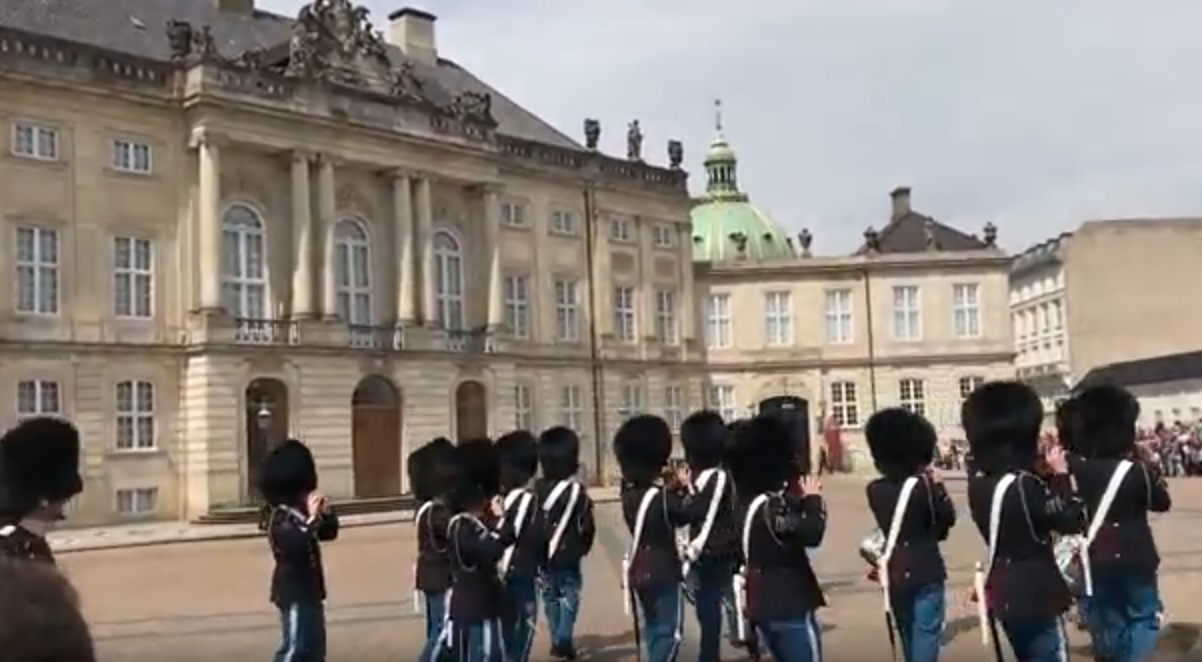
Amalienborg is guarded day and night by Royal Life Guards (Den Kongelige Livgarde). Their full dress uniform is fairly similar to that of the Foot Guards regiments of the British Army: a scarlet tunic, blue trousers, and a navy bearskin cap. The guard march from Rosenborg Castle at 11.30 am daily through the streets of Copenhagen and execute the changing of the guard in front of Amalienborg at noon. In addition, post replacement is conducted every two hours.
When the monarch is in residence, the King’s Guard (Kongevagt) also march alongside the changing of the guard at noon, accompanied by a band that plays traditional military marches. The Guard Lieutenant (Løjtnantsvagt) is always alerted when Prince Henrik or another member of the royal family are reigning in absence of the Queen. There are three types of watches: King’s Watch, Lieutenant Watch and Palace Watch. A King’s Watch is when Her Majesty the Queen takes up residence in Christian IX’s Palace. A Lieutenant Watch is when Crown Prince Frederik, Prince Joachim, or Princess Benedikte, takes the place as regent, when the monarch is unable to. A Palace Watch is when no member of the royal family is in the palace, and it is the smallest one.
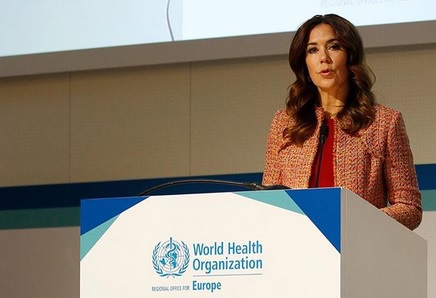
NordenBladet – Crown Princess Mary of Denmark put vaccination at the heart of her agenda as she spoke at the World Health Organisation Regional Committee for Europe’s 69th session on its opening day Monday.
“I am honoured to once again have the opportunity to speak to you,” Mary started.
“Time goes by quickly and while preparing for this meeting I realized just how quickly it does go, as this is now my fifteenth year as Patron of the WHO Regional Office for Europe, and for ten of those years I have had the distinct pleasure of working together with the Regional Director, Dr Zsuzsanna Jakab.”
Dr. Jakab will step down during the session and her successor will be chosen. Mary continued, talking about the progresses made in health care and research in her time as patron.
“Health 2020 has proven to be a powerful tool to build political consensus and drive intersectoral action for health. Indeed, Health 2020 has placed the Region in an advantageous position to deliver on the 2030 Agenda for Sustainable Development, and leave no one behind in health, or in life.”
Health 2020 is an initiative launched by the WHO Europe Region that “aims to support action across government and society to ‘significantly improve the health and well-being of populations, reduce health inequalities, strengthen public health and ensure people-centred health systems that are universal, equitable, sustainable and of high quality.’”
It was adopted at the WHO Regional Committee for Europe session in 2012. At the time, Mary said that she would focus on three specific areas outlined in the Health 2020 documents: immunization, antimicrobial resistance, and maternal and child health.
Speaking on Monday, Mary added: “Throughout my years as Patron, advocating for immunization has been a priority, and a personal conviction. Every child born deserves an equal opportunity to lead a healthy life, and this includes receiving all recommended vaccines.
“We have safe and effective means to eliminate many diseases, including measles and cervical cancer, thereby preventing suffering from diseases that can permanently alter or take lives.”
Immunization factors into 14 of the 17 Sustainable Development Goals set out by the United Nations for its 2030 Agenda for Sustainable Development.
Speaking about sexual and reproductive health services, Mary said that they have the ability to “dramatically improve lives” but are included unevenly and fragmented across the European Region.
“In too many instances, there is a failure to deliver quality and comprehensive access to information and services. Countries and health systems that do not prioritize sexual and reproductive health and rights, that do not empower girls or address gender equality, will struggle and likely fail to meet the Sustainable Development Goals.
“I urge you to intensify efforts to smooth the path towards expanding coverage and providing universal access to sexual and reproductive health services, so girls and women can contribute fully and equally to sustainable development and achieve their own full potential.”
Speaking about the goals for the session, Mary said, “Through implementing Health 2020; improving health equity and the wider conditions that influence health; and building effective, integrated primary health care covering immunization and sexual and reproductive services, I am certain that you will extend universal health coverage, deliver GPW 13, and speed progress towards achieving the Sustainable Development Goals. Ultimately, this means you will improve lives, hand-in-hand with the child, young person, woman or man who risks falling behind. You will enable people in the European Region to prosper and thrive.”
Other speakers on the first day of the session included Dr. Jakab and Dr Tedros Adhanom Ghebreyeus, the WHO Director-General.
NordenBladet – Security professionals share their knowledge on how to understand if there are secret cameras installed in the accommodation and how to protect yourself if you suspect you are being monitored.
When Nealie and Andrew Barker and their five children checked into a house through home-rental service Airbnb in March, they soon made an unsettling discovery that interrupted their European vacation. “We just found a camera hidden in a smoke alarm case in the private living room of a listing. We were traveling with children,” Nealie Barker wrote in a Facebook post. “The host admitted to the concealed camera over the phone only after presented with our irrefutable proof.“
Multiple Airbnb travelers have reported finding hidden cameras in their vacation rentals. Under Airbnb rules, hosts must disclose if they are actively recording on the property, and hosts are not allowed to use surveillance devices in bedrooms and bathrooms, even if they do disclose it. But what about the cameras that are not being disclosed?
Here are some sensible things you can do to make sure you are not being secretly watched during your Airbnb stay, according to security experts.
1. Look for objects out of place Look for things in unusual places, said Carrie Kerskie, the CEO of Griffon Force, a Florida-based group that advises clients on identity theft and personal privacy concerns, like hidden cameras. “If you see a smoke detector in a place that looks kind of odd, if there are two of them kind of right next to each other, that could be a red flag,” Kerskie said.
2. Shine a light to pick up the reflection of lenses One easy practice is turning off the lights in a room and using a light to slowly scan where you suspect a camera may be. “[Cameras] have a lens that is like glass,” Kerskie said. “If you’re looking at a clock radio that is next to the bed and you see an unusual spot that’s reflecting more than just the surface of it, that could be a sign.”
“If you turn off the lights and shine a [light] over a suspected device, you will most likely get a reflection off the lens,” said Andrew Barker, who found the hidden camera in his family’s Airbnb rental. “It is helpful but could also create false positives where something shiny in the device gives off a reflection and it isn’t actually a hidden camera.”
3. Scan the Wi-Fi network This is how Barker, who works as an IT consultant, said he discovered the hidden camera in his family’s Airbnb rental. On his travel blog, he outlined how renters can use a network scanner app that will list the devices that are connected on the network, along with their IP addresses and their manufacturers. In Barker’s case, his suspicions were aroused when a manufacturer was named “IPCAMERA.”
Of course, if the hidden camera is being powered by a private network that you do not have access to use, a scan of your host’s Wi-Fi network will not pick it up. Understanding that not every hidden camera operates the same is part of the security challenge.
4. Unplug and cover your suspicions If you suspect you’re being watched but can’t confirm it, one simple low-tech, low-cost solution to this anxiety is covering up objects of concern. “If you have suspicions about something in the room, like, for example, an alarm clock, it’s very simple to take a piece of clothing out of your suitcase and drape it over the alarm clock,” Plaxe said. “If there’s a lens there, it’s not going to capture any images of you with your T-shirt sitting over it.”
You can also unplug objects that do not need to be plugged in. Some hidden cameras need a plugged-in power source to function.
NordenBladet – Queen Margrethe of Denmark spent last week visiting areas of Germany inhabited by many Danes who has lived there for almost 1000 years. In a newly given interview with a German newspaper, Queen Margrethe says that she thinks it is bad that the Danes in Denmark know little or nothing about the Danes in Germany and their current situation as a minority.
Her Majesty said to the German newspaper: “I am actually sorry for this lack of knowledge in Denmark. It is also one of the reasons why I do not fail to greet the German-Danes in my yearly New Year speech. Then people can at least hear it. I really hope that people will continue to understand what South Schleswig is.”
She continued: “It has been a long time since I went to school, so times have changed and people are less aware of the situation in South Schleswig. It can also be seen from the fact that it has made sense to create a new large Danish school a few years ago in Schleswig. There is still a strong connection to Denmark”.
The Queen recalls that next year will mark 100 years since the peaceful transfer of Danish territories back to Denmark. Many Danes still live in today’s Germany. Queen Margrethe says that being Danish doesn’t end just because you are not in Denmark. “I think it is very important to come up to 2020 right now. It is a year of branding, and I would like to emphasize the connection that exists between the German-Danes and Denmark in connection with the celebration in the rest of Denmark, that being Danish does not end at the border. On the other hand, there are also people who feel deeply connected to Denmark and who use and know the language.”
In 1920, the former German state of Schleswig became a part of the Danish kingdom again. This happened after a referendum on Schleswig’s transition from German to Danish rule in 1920. The referendum was held as a result of the Versailles Peace Treaty that marked the end of the First World War. The 1919 Versailles Peace Treaty decided that a referendum should be held in Schleswig in two rounds, one in northern Schleswig and one in the middle part of Schleswig. While the northern parts voted to become Danish with 74%, middle Schleswig voted to continue as part of Germany with 80%.
The reunion day, June 15, and the voting day February 10, are still celebrated by Danes in Schleswig and the Danes who still live in what is part of Germany today. In 2018, it was estimated that of the 450,000 living in German-controlled Schleswig, 50,000 of them were ethnically Danish. They have their own churches, schools and Danish cities as well as their own flag and political party which still campaigns for this part of Schleswig to become a part of Denmark.
NordenBladet —At the festive opening of the Riigikogu autumn session, the President of the Riigikogu Henn Põlluaas and the President of the Republic Kersti Kaljulaid made speeches.
Põlluaas spoke of several important anniversaries celebrated this year, of which the crowning point had been the celebration of the centenary of the parliament. He recalled the progress of the independent Estonia, and the political events connected with it, through the prism of historical events. Põlluaas also highlighted the issues relating to the commencement of the work of the new Riigikogu.
“Because of the prolonged coalition negotiations, our spring session was short. This situation must definitely be improved now. During the coming months and years, we need to make strong efforts to adopt and implement decisions and principles to improve the life in Estonia through legislative measures,” Põlluaas said.
“In jubilee years we habitually look into the past, and this is indeed what I have done. However, we eventually reach from the past to the future through the current moment. We must leave a beautiful, stable and successful Estonia to our children and grandchildren. The Riigikogu must actively contribute to the solution of long-term problems. To achieve this, the Riigikogu needs to have more initiative, be more aware of its role and independence, and pass only high-quality and expedient laws. This will definitely help increase trust in the Riigikogu. The number and scope of the challenges that we need to solve in legislative drafting is high. It is a hard, but definitely inspiring work,” Põlluaas noted.
He expressed hope that work in the Riigikogu would be more cooperative and mutually understanding, because together we can do much more for Estonia than we have done so far, in confrontation. “I wish all of you a good start of the new season, common sense, fruitful discussions and respect for your colleagues,” Põlluaas said.
Kaljulaid discussed the topical issues in the organisation of Estonian state affairs and the expectations for the Riigikogu to resolve them.
“I am worried by our prospects. The horizon. Or more specifically – what is beyond the horizon. There are so many threads we should be pulling on right now. Threads which lead to new opportunities, to new finds that help create growth and development. Also threads, which have been created by our previous aspirations, previous hopes and our desire to meet these expectations,” the President said. She analysed the urgent tasks facing the society, and presented her vision for solving them.
“You in this hall are the ones who are directly responsible for making sure these questions get answered. You are free to design the answers but only as long as you abide by the constitution approved by the Estonian people. You are free in your decisions but not completely – according to the constitution, you must keep in mind the expectations of all people in Estonia, rather than those of your voters,” Kaljulaid stressed.
“You are the wardens of the rule of law – this is a bigger responsibility than simply being a legislator. You cannot escape this duty or hide behind a group identity or your political affiliation. Do your decisions address questions important in society? I believe they do. Can the Estonian people continue to trust their constitution and the promises secured by law, even if they are long term? You can bring hope and security, but you can also bring cynicism and the belief that every one of us, including those in this hall, only stand for their own interests or those of a small circle of people,” the President said.
Kaljulaid wished that caring and benevolence would win. “It is all up to you. Good luck!”
The Concert Choir of Veronika Portsmuth Choir Academy, conducted by Veronika Portsmuth, who performed at the opening sitting, created a festive atmosphere.