Reklaam

Helena-Reet Ennet

Helena-Reet Ennet
4698 POSTS 0 COMMENTS

Faroe Islands: Tórshavn to become William Heinesen Icon City

NordenBladet – In 2014, the Hans Christian Andersen Foundation* took the initiative to form an active network of interesting European Icon cities, focusing on the significance of icons for a modern city, how to develop icons in an urban context and its impact on the modern identity of a city.

A number of European cities have taken part or are connected to the network, for instance Kassel (The Grimm Brothers), Salzburg (Mozart), Malaga (Picasso), Vimmerby (Astrid Lindgren), Skien (Henrik Ibsen), Rungstedlund (Karen Blixen) and Stratford Upon Avon (Shakespeare). Each city has chosen to honour an important and well-known artist that has a special connection to the city.

Tórshavn, the capital of the Faroe Islands, plans to join the network and has chosen one of the Faroe Islands’ most famous authors and painters, William Heinesen**, as its icon.

The idea behind a European Icon City is to strengthen the city’s identity and to function as a part of the city’s cultural tourism. One such example is in Odense, Denmark, in which Odense Council and Syddansk University collaborate in promoting Odense as the H.C. Andersen Icon City. There is great interest from the city’s guests to walk in H.C. Andersen’s footsteps in Odense, to see his birthplace, read his poems or stories and be informed about the great author’s life and work in general.

Bergur Rønne Mobert, an expert in William Heinesen’s work, believe there is great potential in highlighting William Heinesen’s work even more.

“A greater focus on William Heinesen’s work would benefit the cultural tourism of Tórshavn, and it would also attract larger research conferences to the city,” says Bergur. “William Heinesen the person, and his work in general, has had incredible importance for Faroese culture and society, and continues to have to this day. Becoming a William Heinesen Icon City would help ensure that future generations are familiar with one of the country’s greatest artists and authors.”

Tórshavn Council, the University of the Faroe Islands and the H.C. Andersen Foundation have said they will continue to work together in an effort to make Tórshavn a William Heinesen Icon City.

_______________________________________
* The Hans Christian Andersen Foundation combines research, tourism and events. The foundation is responsible for cooperation and coordination of the work involved in exploiting the Hans Christian Andersen brand at local, national and international levels. The executive committee of Hans Christian Andersen Foundation Odense is made up of representatives from the Ministry of Culture, the Ministry of Industry and Growth, the Municipality of Odense, the University of Southern Denmark (SDU), the Region of Southern Denmark, and Development Funen. The executive committe of Hans Christian Andersen Foundation Odense has laid down three main tracks for work on Hans Christian Andersen.
Research and reports

SDU has implemented a research project that is to clarify the relevant aspect of Andersen’s importance today as a cultural icon, ‘brand’, myth and historical figure. The knowledge that emerges from the project is to help indicate new tools and new ideas for exploiting Andersen within tourism, culture and events. Among other things, the research project is to clarify Andersen’s importance in Denmark, and a cooperation has also been entered into with Chinese researchers at Fudan University, Shanghai, which has already resulted in a book about the present-day importance in China of Hans Christian Andersen.
Events

Here, one of the aims is to support and contribute to the Hans Christian Andersen Festivals that are held in Odense in August and that bring together a wide selection of local, national and international names and cultural events in Odense, thereby raising it up to a national/international level. The festival features a host of activities, with games, robots, theatre, music and literature for all ages and target groups.
Tourism

There is considerable potential for exploiting the Hans Christian Andersen brand to attract more tourism – especially international tourism. In cooperation with national tourism organisations and operators, the foundation is to select particular areas for special focus and implement initiatives on the basis of existing Andersen offers. Furthermore, a sophisticated, target effect is to be developed on the basis of research and reports on such topics as the relation between Denmark and China.

** Andreas William Heinesen (15 January 1900 – 12 March 1991) was a poet, novel writer, short story writer, children’s book writer, composer and painter from the Faroe Islands.

The Faroese capital Tórshavn is always the centre of Heinesen’s writing and he is famous for having once called Tórshavn “The Navel of the World”. His writing focuses on contrasts between darkness and light, between destruction and creativity. Then following is the existential struggle of man to take sides. This is not always easy, however, and the lines between good and bad are not always clearly defined.

Heinesen was captivated by the mysterious part of life, calling himself religious in the broadest sense of the word. His life could be described as a struggle against defeatism with one oft-quoted aphorism of his is that “life is not despair, and death shall not rule”.

As he was born and raised before the Faroese language was taught in the schools, he wrote mainly in Danish but his spoken language was Faroese. All his books were later translated into his native Faroese.

He published his first collection of poetry when he was 21 and he had three more published before he wrote his first novel Blæsende gry (Stormy Dawn) in 1934. He read every single one of the chapters to the painter Sámal Joensen-Mikines, as he was worried that his Danish was not good enough. That was followed up with Noatún (1938). Noatún has a strong political message – solidarity is the key to a good society. His next book The Black Cauldron (1949) deals with the aftermath of decadent living combined with religious hysteria. In The Lost Musicians (1950) Heinesen leaves the social realism of his earlier works behind, instead giving himself over to straightforward storytelling. Mother Pleiades (1952) is an ode to his imagination. Its subtitle is “a Story From the Beginning of Time”.

Heinesen was not content with writing only novels. In the fifties he began writing short stories as well. Most of them have been printed in these three collections entitled The Enchanted Light, Gamaliel’s Bewitchment and Cure Against Evil Spirits (1969). In the novel The Good Hope, his main character the Rev. Peder Børresen is based on the historical person Rev. Lucas Debes. When Heinesen was asked how long it had taken to write it, he answered “Forty years. But then I did other things in between.”

He was awarded the Danish literary prize Holberg Medal in 1960.

He received The Nordic Council’s Literature Prize in 1965 for his novel Det gode håb (The Good Hope), published in 1964. In the story Heinesen had the difficult task of reproducing 17th-century Danish. He succeeded, and won the prize. It is widely considered his best work.

When there were rumours that William Heinesen was about to receive the Nobel Prize for literature in 1981, he wrote to the Swedish Academy and renounced his candidacy. Later he explained why:

The Faroese language was once held in little regard – indeed it was suppressed outright. In spite of this, the Faroese language has created a great literature, and it would have been reasonable to give the Nobel Prize to an author who writes in Faroese. If it had been given to me, it would have gone to an author who writes in Danish, and in consequence Faroese efforts to create an independent culture would have been dealt a blow.

He was awarded with the Faroese Literature Prize in 1975.

In 1980 on his 80th birthday Heinesen was appointed “Tórshavn’s Citizen of Honour” by his home town.

In 1980 he received the Danish Critics Prize for Literature (Kritikerprisen).

In 1984 he received the Children’s Books Prize of Tórshavn City Council (Barnabókaheiðursløn Tórshavnar býráðs)

In 1985 he was awarded the Karen Blixen Medal from the Danish Academy.

In 1987 he was awarded the Swedish Academy Nordic Prize (“little Nobel”).
Norway: Crown Prince Haakon inspects Royal Guard at Akershus Fortress

NordenBladet – His Royal Highness Crown Prince Haakon of Norway inspected the Royal Guard at Akershus Fortress* on Friday morning. There were two significant changes in this year’s program for the annual inspection. First, the King was not present. Secondly, the inspection was held at the grand Akershus Fortress and not at the military camp at Huseby, where the Royal Guards have their headquarters.

Sven Gjeruldsen, Assistant Communications Manager at the Royal Court in Oslo, informs Royal Central’s Senior Europe Correspondent, Oskar Aanmoen that this is not the first time the Crown Prince conducted the inspection alone. He further explained that the King had a private program abroad and that this was the reason why he could attend this year’s inspection. It is not known what the King is doing or what country he is visiting.

A spokesman from the Royal Life Guard told Royal Central the reason for the inspection taking place at the fortress is because of construction work going on at Huseby military camp.

Still, without his father, the Crown Prince inspected the Royal Guard with the same perfection as his father, His Majesty King Harald. After arrival, His Royal Highness inspected the more than 800 guards.

The Royal Guard has an armed guard presence at all the royal residences in Norway and is part of the permanent defence of Oslo each day of the year.

Two of the guards received a special honour during the inspection by His Royal Highness. The Crown Prince awarded “The King’s Clock” to the best guard of the year, who has excellent skills in field discipline, guard and attitude.

After handing out an honorary watch and sword, the guards walked in front of the Crown Prince in a parade before they had had a short musical performance for the regent.

Traditionally, the inspection takes place in early June of each year. Hundreds of soldiers stood up when the Crown Prince arrived at the fortress. The inspection of His Majesty The King’s Guard is an open event, and like all other years, there were many school children and kindergarten children in attendance. Several hundred children came to watch the soldiers and to see the Crown Prince.

The changing of the guard in front of the Royal Palace by the Royal Guard takes place daily at 13:00 hours. In the summer, the changing of the guard is also often expanded with music in the form of parades and sometimes a drill show. The locations where the Royal Guards have a permanent guard service are at the Royal Palace, Skaugum, Bygdø royal estate (when in use), Akershus Fortress and Huseby military camp.

The inspection of the Royal Guard takes place on a historically important day for Norway and the Norwegian Royal Family. On this day (7 June) in 1905, the union between Norway and Sweden was dissolved. This meant that Oscar II was no longer king over Norway; he was only the King of Sweden.

The dissolution of the union was rooted in a referendum held in August 1905, and in November of the same year, the Norwegians, with 79% of the votes, elected Prince Carl of Denmark to be their king. On 25 November that year, he travelled to Norway as King Haakon VII. He founded the dynasty that still governs Norway today as he was crowned King of Norway in 1906. King Haakon VII is the great-grandfather of Crown Prince Haakon, who will one day become King Haakon VIII.

________________________

* Akershus Fortress (Norwegian name: Akershus festning) is a great place to discover Oslo’s history and enjoy a summer day.

The building of Akershus Castle and Fortress was commenced in 1299 under king Håkon V. The medieval castle, which was completed in the 1300s, had a strategical location at the very end of the headland, and withstood a number of sieges throughout the ages. King Christian IV (1588-1648) had the castle modernised and converted into a Renaisssance castle and royal residence.

Guided tours of the fortress are available to the public in summer, and start at the Fortress Visitor Centre. Guided tours for groups are also available.

The fortress area is a popular venue for major events, including concerts, public holiday celebrations and ceremonies.


Denmark: Queen Margrethe hosts gala dinner to celebrate Prince Joachim’s 50th birthday

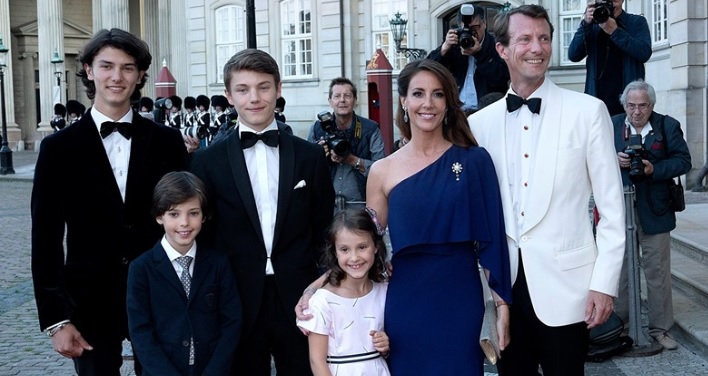
NordenBladet – On 7 June, Prince Joachim of Denmark celebrated his 50th birthday. In the evening, Queen Margrethe hosted a gala dinner at Christian VIII’s Palace to celebrate her youngest son’s birthday. For the first time, the Queen’s eight grandchildren attended a gala dinner. Only Prince Nikolai had attended an official dinner before, as he is the only one of the Queen’s grandchildren who is over 18.

Other royal guests included Princess Alexandra and her new husband Count Michael Ahlefeldt-Laurvig-Bille as well as Prince Nikolaos and Princess Tatiana of Greece. Princess Benedikte was not able to be at the dinner as she is attending the Danish Championships in Dressage and Para-Dressage from 7 June to 10 June.

Prince Joachim’s ex-wife Countess Alexandra also attended the dinner as well as close friends of Prince Joachim and Princess Marie such as Charles-Henri Keller, Prince Henrik’s nephew, and Francois Zimeray who isFrance’s former ambassador to Denmark. Prince Joachim’s former private assistant Søren Bo Bojesen and Princess Marie’s former lady-in-waiting Britt Siesbye and her husband Oscar Davidsen Siesbye were also there.

The Prinsens Musikkorps was in charge of the music for the evening and they performed the Prins Joachims March as well as several other classics such as Charles Aznavour’s For Me Formidable, Frank Sinatra’s Fly Me To The Moon, Nina Simone’s My Baby Just Cares For Me and G.D. Weiss’s Can’t Help Falling In Love With You. On 3 June, Prince Joachim, Princess Marie, and Crown Prince Frederik attended a birthday charity concert reflecting Prince Joachim’s love for music.

To celebrate his birthday, Prince Joachim also gave an exclusive interview to Danish magazine Billed-Bladet. In this interview, he talked about how important his wife and his family is for him and he said he would like his birthday dinner to be a celebration of their family: “I would not be here today and would not have been who I am today if it was not for my wife and children. The five of them are my everything and will always be.”


Photo: Facebook/Det danske kongehus
Featured image: Prince Joachim, Princess Marie, Prince Nikolai, Prince Felix, Prince Henrik and Princess Athena (Keld Navntoft, Kongehuset ©️)

Faroe Islands: Entrepreneur of the Year 2019 goes to Faroese software company FarPay

NordenBladet – Faroese software company, FarPay, has been awarded the title of Faroese ‘Entrepreneur of the Year 2019’. The company, which started in 2015 and currently employs 11 people, creates software for processing and shipping invoices, payment and follow-up, making it easy to charge money with modern payment solutions, and easy for customers to pay.

The Faroese Prime Minister, Aksel V. Johannesen, attended the awards ceremony in Runavík to hand the award.

He said: “This year’s winner is a company that has prospered in the Faroese and Danish market. The company has the potential to develop in markets all over the world, and, as such, the company has great importance for the Faroese business sector and community. The team behind FarPay were quick to see an opportunity in digitalising the transfer of money.”

The judges said they see great potential in FarPay and were impressed by the quick turnover achieved by the company in the short time since it started.

Faroe Islands: Faroese athletes to compete at International Island Games in Gibraltar

NordenBladet – 100 Faroese athletes will compete in 10 sports at the International Island Games in Gibraltar in July.

The Games started in the 1980s with the idea of providing athletes from various islands an opportunity to compete internationally, and to forge links between different islands. Islands with similar history, heritage and geography were invited and, in the summer of 1985, the first ever games were held on the Isle of Man. The games were originally meant to be held once, but the massive success of the first event meant another competition was held two years later, this time in Guernsey. The Faroe Islands have hosted the Games once, in 1989.

The International Island Games has gone from 700 participants, 15 islands and seven sports in 1985 to 2500 participants, 24 islands and 14 in 2019.

The Games are held every other year and the host island choses between 12 and 14 of 18 different sports. This year’s host nation, Gibraltar, has chosen 14 sports, including athletics, badminton, cycling, squash, swimming and table tennis. The Faroe Islands will compete in basketball, judo, table tennis, shooting, tennis, swimming, badminton, athletics, triathlon and cycling. The participating countries include Bermuda, Cayman Islands, Gotland, Greenland, Jersey, St. Helena and the Faroe Islands.

This years’ Games will be held from July 6-12.

More info: https://www.iiga.org/

Crown Princess Mary of Denmark and Princess Mabel of Orange Nassau attended the Women Deliver Conference

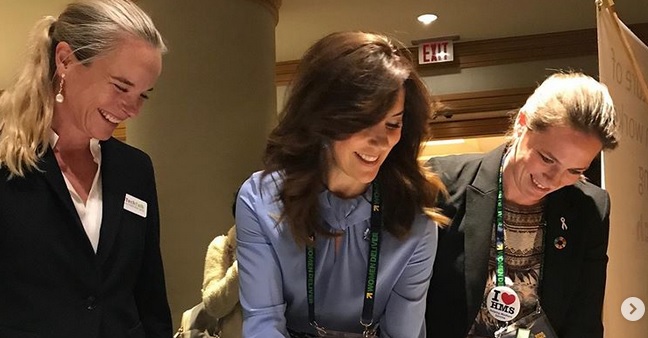
NordenBladet – Crown Princess Mary of Denmark and Princess Mabel of Orange Nassau attended the Women Deliver* Conference this week in Vancouver, Canada. The Conference, held every three years, unites world leaders, experts and activists to discuss issues surrounding gender equality and women’s rights. The theme of this year’s Conference was “Power. Progress. Change.”

“Let’s agree that less bad will never be good enough,” Crown Princess Mary said in a speech on Tuesday about equal rights among genders.

The release of the Equal Measures 2030 2019 Sustainable Development Goals Gender Index coincided with her speech. This Index tracks the state of gender equality in 95% of the world’s women and girls – 129 countries – and the findings are that 40% of them “live in countries failing on gender equality,” according to the Index’s website.

Crown Princess Mary said that “If you cannot see it, you cannot fix it. Data makes the invisible visible. You can’t close the gender gap without closing the data gap, and gaps in data make it difficult to monitor the progress of women and girls.”

https://www.instagram.com/p/ByVo_TlAPwE/?utm_source=ig_web_copy_link

Princess Mabel was lauded by the President of Ethiopia, Sahle-Work Zewde, the first female Ethiopian president, for her work to end child marriage with the Girls Not Brides campaign.

“My presence here is a direct consequence of the reform agenda that has been implemented in Ethiopia,” said President Zewde.

“Forty per cent of Ethiopian girls are married before the age of 18. This is something terrible.” She continued that she was able to break free of this cycle but that if it’s going to change in her country, “the social norms must change at the base.”

Princess Mabel was active on Twitter throughout the week, tweeting and retweeting speeches and quotes, as well as facts as they were revealed by the speakers.

Women Deliver “champions gender equality and the health and rights of girls and women,” per its official website.

“Our advocacy drives investment – political and financial – in the lives of girls and women worldwide. We harness evidence and unite diverse voices to spark commitment to gender equality. And we get results. Anchored in sexual and reproductive health, we advocate for the rights of girls and women across every aspect of their lives. We know that investing in girls and women will deliver progress for all.”

______________________

* Women Deliver is well-known for hosting global conferences that bring together people from across a multitude of sectors, issues, and cultures. Held every three years, Women Deliver conferences are fueling stations where organizations and individuals leave re-energized, knowledgeable, connected, and challenged to think outside the box.
More details on the Women Deliver 2019 Conference can be found at WD2019.org

Photo: Den Danske Ambassade

Sweden: Princess Madeleine’s husband Chris O’Neill misses National Day festivities

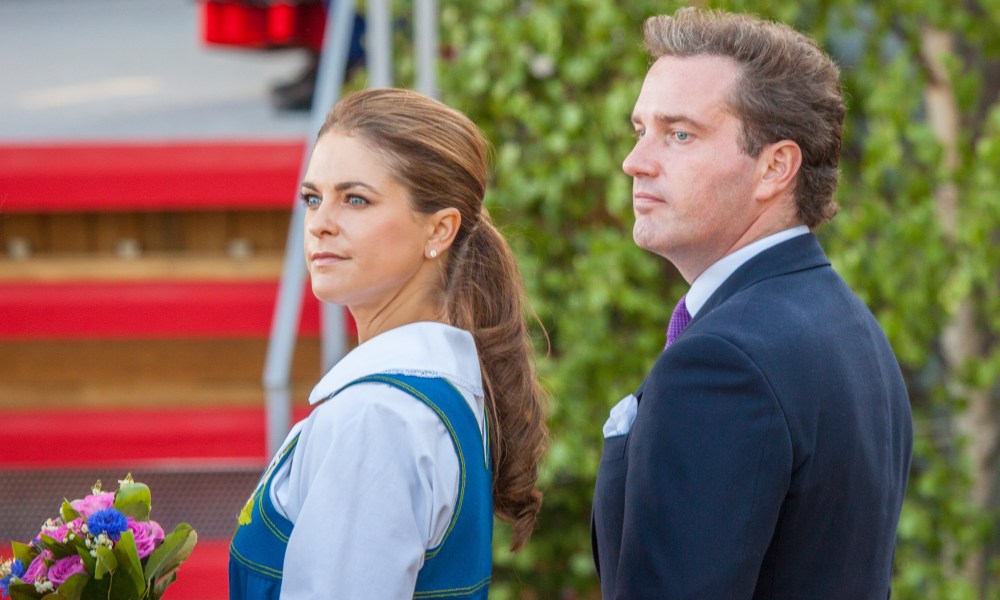
NordenBladet – Christopher O’Neill, the husband of Princess Madeleine of Sweden, has not been able to participate in the National Day* festivities in Sweden today. The father of three was scheduled to attend this year’s celebrations but had to cancel last minute.

Chris O’Neill was supposed to join his wife, Princess Madeleine of Sweden for the National Day festivities at Skansen, central Stockholm this afternoon. After the National Day concert, Chris would also be joining the Royal Family for the reception at the Royal Palace. However, the Swedish Royal Court has taken his name off the calendar.

Princess Madeleine travelled to Sweden earlier this week with her youngest daughter, one-year-old, Princess Adrienne. The Princess was in Sweden to launch her children’s book “Stella och hemligheten”. Meanwhile, her husband would continue to work and leave their home in Florida for Sweden with the other two children, Princess Leonore and Prince Nicolas later in the week.

However, Chris had to cancel his plans to fly with the two oldest children to Sweden. Princess Leonore and Prince Nicolas have fallen ill and are, therefore, not able to fly. Both children have a high fever and an inflammation of the middle ear, the Royal Court has confirmed to Expressen.

Christopher, Princess Leonore and Prince Nicolas will travel to Sweden as soon as the children feel better and can make the long flight. Princess Madeleine and the children will spend most of the summer months in Sweden while Chris O’Neill will alternate between his job in Florida and Sweden.

In the past, Chris O’Neill often was unable to make it to the National Day celebrations due to work commitments. This year he had cleared his agenda for the important event, but sadly his plans had to be cancelled.

The husband of Princess Madeleine is scheduled to join the family for the birthday celebrations of Crown Princess Victoria on the 14th of July in Öland, Sweden.

________________________

* National Day of Sweden (Swedish: Sveriges nationaldag) is a national holiday observed in Sweden on 6 June every year. Prior to 1983, the day was celebrated as the Swedish Flag Day (Swedish: Svenska flaggans dag). At that time, the day was renamed the Swedish national day by the Riksdag.

The tradition of celebrating this date began 1916 at the Stockholm Olympic Stadium, in honour of the election of King Gustav Vasa in 1523, as this was considered the foundation of modern Sweden.

Some question the validity of this as a national holiday, as it was not observed as a holiday until decades later. However this event does signify the end of the Danish-ruled Kalmar Union, so in a sense it is a marking of Swedish independence, though the event occurred so long ago that it does not have as strong of a presence in the social consciousness as does, for example, the Norwegian Constitution Day, Syttende Mai.

In 2005 it became an official Swedish public holiday, replacing Whit Monday. This change led to fewer days off from work (more working-days) as 6 June will periodically fall on the weekend, unlike Whit Monday, which was always celebrated on a Monday. This has in turn led to complaints from some Swedish unions.

Featured image: Princess Madeleine of Sweden and her husband Chris O’Neill (Bengt Nyman (CC BY 2.0) via Wikimedia Commons)

Estonia: A Bill restricting the use of hazardous substances passed the second reading in the Riigikogu

NordenBladet — The Bill on Amendments to the Waste Act, the Act on Amendments to the Waste Act, and the Act on Amendments to the Waste Act and Other Associated Acts, initiated by the Government, which will bring the Waste Act into conformity with European Union law, passed the second reading at today’s plenary sitting of the Riigikogu.

The Bill (15 SE) will amend the Act on the basis of the relevant European Union directive on waste electrical and electronic equipment (WEEE). Based on the directive, the Waste Act will be amended by introducing the term “waste electrical and electronic equipment”, and the terms “medical device” and “in vitro diagnostic medical device” will be specified.

The Bill will amend the provisions of the Waste Act on the restriction of the use of certain hazardous substances in electrical and electronic equipment. It will also amend the provisions concerning the placing on the market thereof which are connected with the hazardous substances used in equipment.

In the European Economic Area, it is prohibited to place on the market electrical and electronic equipment and its components containing lead, mercury, hexavalent chromium, cadmium and, starting from 22 July 2019, also certain phthalates.

The Bill will specify the definition of components of electrical and electronic equipment which also covers cables and spare parts for its repair, its reuse, updating of its functionalities or upgrading of its capacity.

The committee made three technical motions to amend the Bill, and moved to include the Bill in the agenda for the sitting of the Riigikogu on 12 June for the third reading.


Source: Parliament of Estonia


Sweden: Princess Estelle and Prince Oscar of Sweden wish everyone a happy National Day!

NordenBladet – Today festivities all over Sweden are taking place as the country celebrates Nationaldagen or its National Day*. Of course, the Swedish Royal Family is out in full force to join in the celebrations. Princess Estelle and Prince Oscar have already wished everyone a happy National Day with three new photos, as is the tradition.

On the 6th of June, Sweden celebrates its National Day. On this day the Swedes remember the election of King Gustaf Vasa which is considered the moment on which modern Sweden was founded. On this day, the country officially split from Denmark.

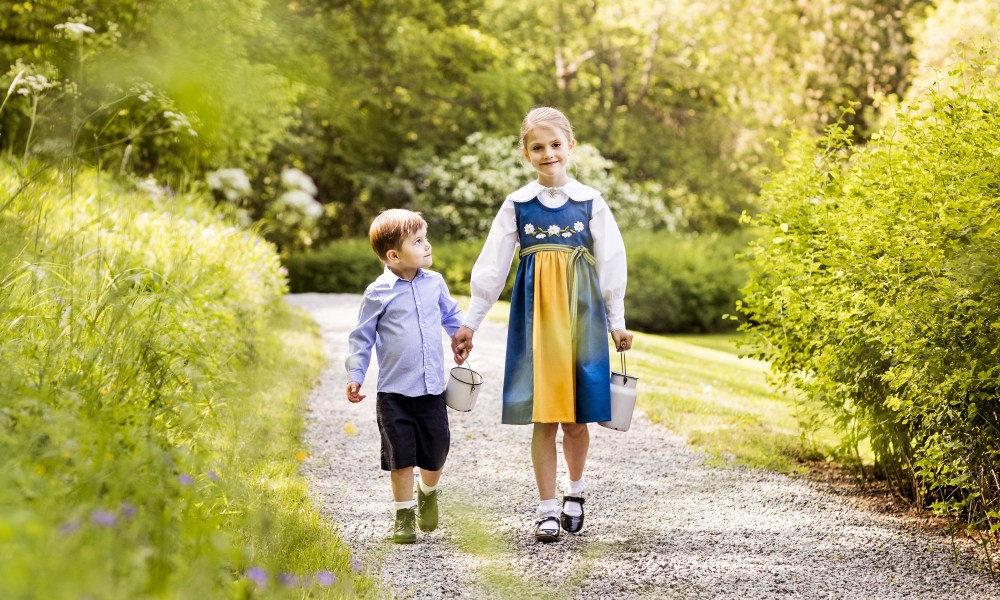
This morning, Princess Estelle and Prince Oscar sent everyone their National Day greetings as the Royal Court released three new pictures of the children of Crown Princess Victoria and Prince Daniel. In the photographs, Princess Estelle can be seen wearing Sweden’s National Costume, designed by her grandmother Queen Silvia.

The images were taken in the gardens of Haga Palace, the home of the Crown Princess Family. The Swedish Royal Family established this new tradition of releasing pictures of the children of Crown Princess Victoria on the morning of the National Day after the birth of Estelle.

This morning, Prince Carl Philip and Princess Sofia opened the gates of the Royal Palace of Stockholm to visitors. In honour of National Day, visitors are able to visit the Palace for free. There are different activities for children; there is music, food and an information stand about the World Childhood Foundation. In the information stand of the WCF, the children’s book of Princess Madeleine, “Stella och hemligheten” was sold. The Princess also signed the copies of the book in the late afternoon.

Meanwhile, King Carl XVI Gustaf and Queen Silvia celebrated National Day in Dalarna. The King and Queen first visited Borlänge, where they were shown around in Alice Lund Textiles and met with the people who had gathered to see them. They ended their visit to Dalarna in Ludvika where they officially welcomed new Swedish citizens during a ceremony with music and speeches. Then, the Royal Couple lunched with invited guests.

In the early afternoon, Crown Princess Victoria and Prince Daniel stepped out of their home, Haga Palace to join in the festivities in honour of the National Day with their neighbours. In Haga Park, a big, early summer concert was held with participants of the Royal Opera and school children. The Crown Princess Couple also saw a ballet performance, and the Crown Princess gave a speech.


The King and Queen during the National Day celebrations in Dalarna. (Photo: Sara Friberg, Kungl. Hovstaterna)

Later today, the King, Queen, Crown Princess Couple, Prince Couple and Princess Madeleine will attend the traditional National Day Concert in Skansen. They will arrive by horse and carriage, and it is expected that Princess Estelle and Prince Oscar will join their parents in the carriage.

This evening, the King and Queen will host guests for a reception to end the National Day festivities.


2x Princess Estelle and Prince Oscar at Haga Castle (Photo: Linda Broström, Kungl. Hovstaterna)
___________________
* National Day of Sweden (Swedish: Sveriges nationaldag) is a national holiday observed in Sweden on 6 June every year. Prior to 1983, the day was celebrated as the Swedish Flag Day (Swedish: Svenska flaggans dag). At that time, the day was renamed the Swedish national day by the Riksdag.

The tradition of celebrating this date began 1916 at the Stockholm Olympic Stadium, in honour of the election of King Gustav Vasa in 1523, as this was considered the foundation of modern Sweden.

Some question the validity of this as a national holiday, as it was not observed as a holiday until decades later. However this event does signify the end of the Danish-ruled Kalmar Union, so in a sense it is a marking of Swedish independence, though the event occurred so long ago that it does not have as strong of a presence in the social consciousness as does, for example, the Norwegian Constitution Day, Syttende Mai.

In 2005 it became an official Swedish public holiday, replacing Whit Monday. This change led to fewer days off from work (more working-days) as 6 June will periodically fall on the weekend, unlike Whit Monday, which was always celebrated on a Monday. This has in turn led to complaints from some Swedish unions.

Featured image: Princess Estelle and Prince Oscar (Photo: Linda Broström, Kungl. Hovstaterna)

Faroe Islands: Celebrations take place as Faroese flag turns 100

NordenBladet – The Faroese flag was shown in public for the first time on 2 June 1919 in Fredensborg, a town 30 km north of Copenhagen. To celebrate the centennial anniversary of this historic happening, seven Faroese wooden ships docked in Copenhagen this past Sunday, 2 June 2019. The celebrations included a parade, memorial ceremony, a church service in Fredensborg, speeches, singing and the opportunity for people to step on board the ancient ships, some of which date back to 1884.

The Faroese Association of Wooden Sailing Ships, or Felagið Føroysk Træseglskip, has organised the centennial celebrations. The ships and their crews departed the Faroe Islands on 16 May and have visited several Danish towns on their way to Copenhagen, including Odense, Fyn, Århus, and Helsingør. The visits have included art exhibitions, musical performances, samples of Faroese food and lectures about Faroese design and tourism in the Faroe Islands. In each location, people had the opportunity to step on board the ships to experience first hand the living and working conditions of crews in ancient days, when the ships fished in waters surrounding Iceland and Greenland.

About the flag
The Faroese flag is called Merkið, meaning “the banner” or “the mark”. It was designed in 1919 by Jens Oliver Lisberg and other students in Copenhagen. The first time Merkið was raised in the Faroe Islands was on 22 June 1919, in Famjin, the home village of Mr. Lisberg, during a wedding.

On 25 April, 1940, the British government, who were occupying the Faroe Islands during the Second World War, approved the flag for use by Faroese vessels. April 25 is still celebrated as Flag Day (“Flaggdagur”) and is a national holiday. Merkið was finally recognized by the Danish Government as the national flag of the Faroe Islands in the Home Rule Act of 23 March, 1948. The original flag is displayed in the church in Famjin on the island of Suðuroy.

The flag of the Faroe Islands is an offset cross, representing Christianity. It follows the traditions of other Nordic flags, such as Dannebrog (Flag of Denmark).