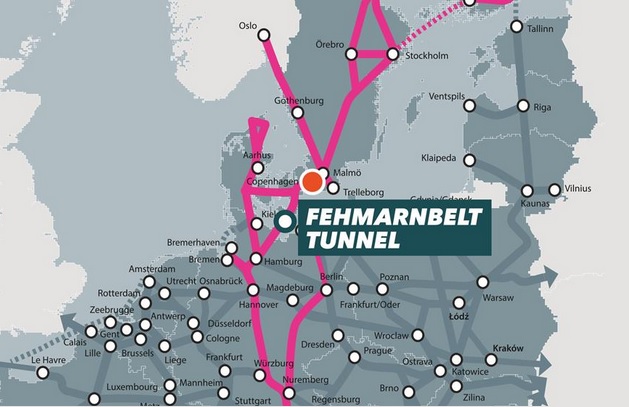
NordenBladet —The world’s longest combined rail and road tunnel linking Denmark and Germany is expected to be built by 2029.The tunnel, called The Fehmarnbelt Tunnel, will be built of two double-lane motorways and two electrified rail tracks stretching across the Baltic Sea. The tunnel will connect Rødbyhavn on the Danish island of Lolland and Puttgarden in northern Germany.
Via the tunnel, the journey between the two countries should take seven minutes by train and ten minutes by car. The tunnel will help travelers avoid a 160-kilometer trip through Denmark’s mainland.
Furthermore, Denmark is planning on building high-speed electric rail lines to and from the tunnel, with trains continuing into the borders of Sweden, Norway, and Finland.
The project is expected to cost €10 billion.
Image: When the Fehmarnbelt tunnel is completed, the journey between Rødbyhavn and Puttgarden will take seven minutes by train and 10 minutes by car. Road users and train passengers will save about one hour each way compared to the ferry crossing. The Fehmarnbelt link will be open 24 hours a day as a tunnel is not affected by wind or weather. https://femern.com/
NordenBladet —According to a market report published by CBRE, investments in Finland’s real estate dropped by 58% in Q4 2022. The report indicates that the fall was caused by global inflationary pressure and rising interest rates.
A total of 973 million Euros were invested in real estate, with over a quarter of that total invested in office real estate, roughly 270 million. Almost 200 million Euros were invested in the health care real estate, and the remaining of the value was invested in residential real estate.
Despite this drop, investments in the first half of 2022 were the highest on record, reaching up to 4.53 billion Euros.
The report states that Finland should expect to see a drop in investments of about 5–10% for the first half of 2023.
The report does offer some more optimism, claiming, “There are several deals in the pipeline for the Finnish market, and the market activity is expected to pick up in 2023 from the [second half] of 2022 despite the weakened economic outlook and high uncertainty.”
NordenBladet —A series of earthquakes starting from Friday 10th February has prompted the discussion about possible volcanic activity at the Reykjanes Peninsula in the southwestern tip of Iceland.
In an announcement by the Icelandic Meteorological Office, a series of five earthquakes larger than magnitude 3 were recorded, with the two largest reaching a magnitude of 3.6.
Volcanologist Þorvaldur Þórðarson notes that the cause of these earthquakes could be due to under-surface magma movement in the area.
This movement has suggested that the once inactive volcanic area in Reykjanes is now active.
The region is roughly nine kilometres from Keflavik International Airport. Þórðarson pointed out that if there was an eruption in the area, it affect the operations of airport.
Presentations were made by Member of the Riigikogu, former Minister of Finance and Director General of the Tax Board Aivar Sõerd, entrepreneur Ruth Oltjer, and tax expert Hannes Udde.
Member of the Riigikogu Aivar Sõerd began his report with the latest Tax Competitiveness Index of OECD member states compiled by the US think tank Tax Foundation, where Estonia ranked at the top for the ninth year running. “Estonia’s tax code stands out positively with its simplicity and uniformity. The think tank also highlights that Estonia’s tax system supports economic growth and favours investments,” Sõerd said, adding that Estonia’s tax code was really not in need of a fundamental change or an overhaul. “However, no tax code is or will be absolutely perfect. All well-functioning tax systems need to be analysed regularly and reshaped in case of need to adjust to changes in the economic environment,” he explained.
Sõerd listed the weak points of the Estonian tax system, which included hiding the actual employment relationships under the cover of private limited companies but also the tax exempt income system from 2018 which made the tax exemption rate of tax payers dependent of their annual incomes. “The core element of this tax system is the income range of EUR 1,200–2,100, where the tax exempt income starts to drop abruptly, reaching zero at the EUR 2,100. I very much believe that this system does not suit Estonia because our salaries grow fast, incomes grow fast, and also the inflation has grown fast. Yet the EUR 1,200–2,100 range has been fixed in the law. This range, which has also been called “tax hump”, has remained unchanged for six years although as incomes grow, more people each year are moving into the higher taxation zone,” he said. “Take teachers’ salaries, for example. The average pay of a teacher rises to EUR 2,048 this year; but with this amount, the tax exempt amount is no longer EUR 654 but only EUR 38 because the tax hump formula swallows up most of it.”
The founder of the pharmaceutical company Chemi-Pharm Ruth Oltjer spoke on behalf of industrial companies. She described the situation as a roller-coaster ride where the key words are the war, rise in the prices of raw materials, interruption of the earlier supply chains, and subsidies paid to companies by European countries, which weakens the position of Estonian businesses compared to those from Germany or the UK, for example. Oltjer emphasised the importance of a healthy industrial sector, as 80–90 % of Estonia’s GDP rests on export, which is turn comes mostly from our processing industry companies.
“Estonian entrepreneurs see our taxes as fair, which is why businesses are not taken out of Estonia. It is easy to pay taxes, but also to levy these. As a result, the tax revenue remains in Estonia. I do not feel that the current tax system is in any way harmful for Estonia’s business community or the state as a whole,” she affirmed. Oltjer underlined the “Don’t play with taxes” principle which is fundamental in tax systems. “Changing taxes has such a profound impact on businesses that if this step is taken, it should be announced at least six months ahead, or even better – a year,” she said.
Estonia’s tax burden is 34%, or at the level of Central European countries. “I see no way of increasing this tax burden in any way,” she said, adding that she also struggled to see room for increasing the income tax of businesses. Oltjer also declared herself a proponent of eliminating fringe benefit taxes on sports and health expenses, and highlighted the boosting of research and development activities as particularly important.
The third presentation was made by tax expert Hannes Udde. During the debate, Reili Rand (Social Democratic Party), Jaak Aab (Centre Party), Heiki Hepner (Isamaa), Maris Lauri (Reform Party), Andres Sutt, Siim Kallas (Reform party), and Tarmo Kruusimäe (Isamaa) took the floor.
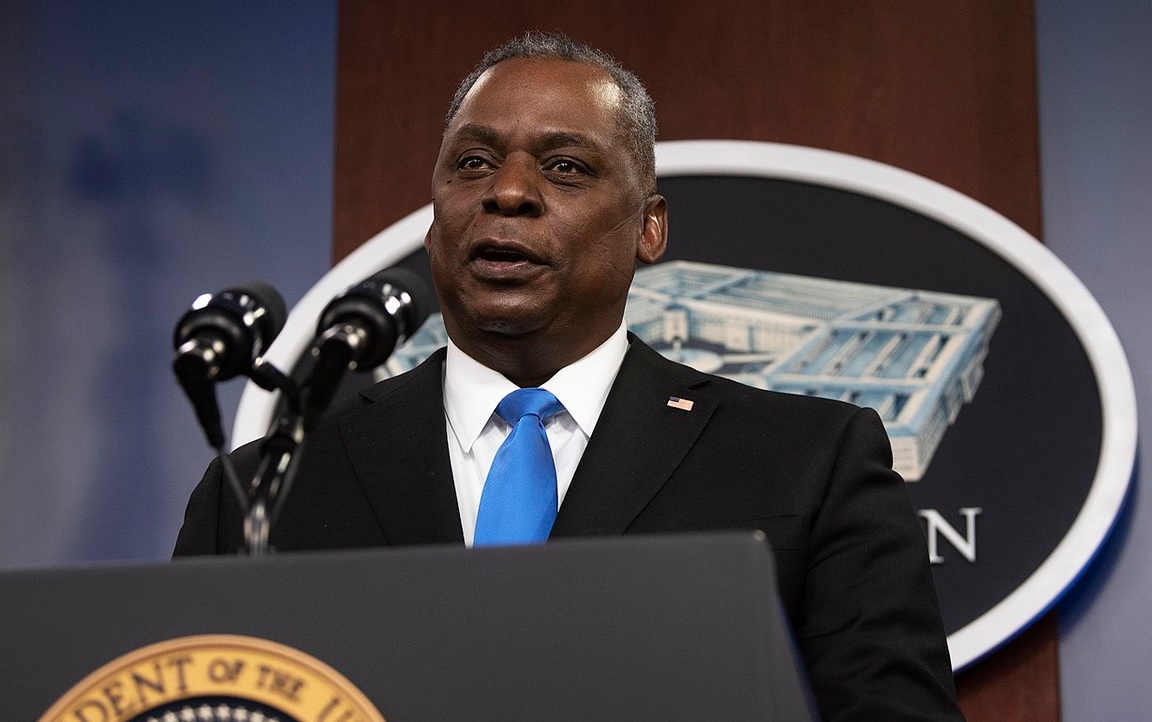
NordenBladet – On Thursday afternoon, United States Secretary of Defense Lloyd Austin arrived in Estonia to meet with Prime Minister Kaja Kallas and Minister of Defense Hanno Pevkur (Both Reform).
During his visit, Austin* is set to discuss support for Ukraine, defense cooperation between the U.S. and Estonia, as well as issues related to NATO.
_________________________
* Lloyd James Austin III (born August 8, 1953) is a retired United States Army four-star general who, since his appointment on January 22, 2021, has served as the 28th United States Secretary of Defense. He is the first African American to serve as the United States Secretary of Defense. Austin previously served as the 12th commander of United States Central Command (CENTCOM) from 2013 to 2016.
Austin was the 33rd vice chief of staff of the Army from January 2012 to March 2013, and the last commanding general of United States Forces – Iraq Operation New Dawn, which ended in December 2011. In 2013, Austin was appointed as the first Black commander of CENTCOM by President Barack Obama. He retired from the armed services in 2016 and joined the boards of Raytheon Technologies, Nucor, Tenet Healthcare, and Auburn University. On December 7, 2020, he was nominated for defense secretary by then-President-elect Joe Biden. He was confirmed by the United States Senate on January 22, 2021, by a vote of 93–2.
During the Russian war against Ukraine, the U.S. sent tens of billions of dollars in missiles, ammunition and other items to Ukraine. Austin said that he wanted to see “Russia weakened to the degree that it can’t do the kinds of things that it has done in invading Ukraine”. The New York Times reported that U.S. military may be providing real-time battlefield targeting intelligence to Ukraine. Austin said he “does not” believe that Russia’s invasion of Ukraine will result in a nuclear war.
Featured image: Secretary of Defense Lloyd J. Austin (Wikipedia/CC BY 2.0)
NordenBladet – The Faroe Islands offer a unique and rich cultural experience for tourists. The islands have a rich history and traditions that have been preserved over the centuries, offering visitors a glimpse into the past.
One of the most notable cultural aspects of the Faroe Islands is its traditional music, which is closely tied to the country’s Viking heritage. The Faroese song tradition, known as the “chain dance” (Faroese: Føroyskur dansur, Danish: Kædedans), is a unique form of music that is still performed today.
Additionally, the Faroese language, which is closely related to Old Norse, is a fascinating aspect of the country’s culture and history. Visitors can learn about the Faroese language and its evolution through the ages by visiting museums and cultural centers.
The Faroe Islands are also renowned for their traditional textiles, such as Faroese shawls, which are hand-knitted using centuries-old techniques. Visitors can learn about this traditional craft by visiting local workshops and watching demonstrations by skilled craftsmen and women.
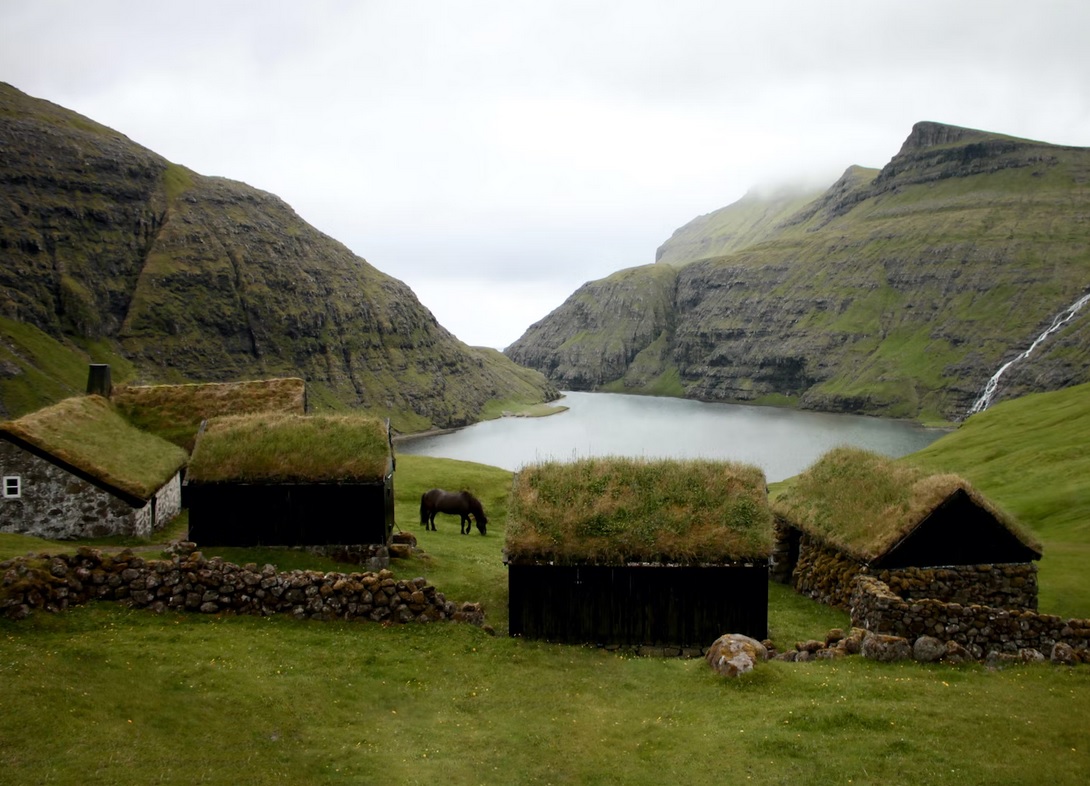
Photos: In the Faroe Islands, visitors can enjoy outdoor activities such as hiking, birdwatching, and fishing, as well as cultural experiences such as visiting museums and historic sites. (Unsplash)
The stunning natural beauty of the Faroe Islands, including its dramatic cliffs, breathtaking waterfalls, and breathtaking landscapes, is a testament to the country’s unique cultural heritage and its connection to the land.
Here are the 12 most famous attractions in the Faroe Islands:
1. Torshavn – the capital city, known for its amazing architecture and picturesque harbor. Torshavn is a small yet charming city that boasts a rich history, friendly people, and a unique architectural style. This city is the oldest and the smallest capital in the world and has remained largely unchanged for centuries, offering visitors a glimpse into the past.
The city’s history can be traced back to the Viking era, and its name literally means “Thor’s harbor.” Tórshavn was once a thriving center of commerce, and it played a key role in the region’s maritime trade. Today, Torshavn is still a hub of activity and is considered the cultural and economic center of the Faroe Islands.
2. Mykines Island – Mykiens Island is a popular destination for birdwatching, with thousands of seabirds nesting on its cliffs. Mykines is the westernmost of the 18 main islands of the Faroese Archipelago. It belongs to the oldest part of the Faroe Islands and was formed about 60 million years ago. Experience the extreme North!
3. Gjogv – a small village with a scenic gorge and a natural harbor. Gjógv is located on the northeast tip of the island of Eysturoy, in the Faroe Islands and 63 km (39 mi) north by road from the capital of Tórshavn. The village was named after a 200-metre (650 ft) long sea-filled gorge that runs north to the sea from the village.
The village church dates from 1929. It was the first one to be consecrated in the village and the first one to feature services in Faroese. Before that, the villagers walked to Funningur for church and burial services. On the opposite side of the road a sculpture stands as a memorial to fishermen lost at sea, bearing the names and ages of men from the late nineteenth to the mid twentieth century. The sculpture of a mother and two children looking out to sea was created by Fritjof Joensen.
Gjógv (Photos: 2 x Unsplash)
4. Vagar island & Mulafossur Waterfallin Gásadalur village (also written Gasadalur or Gåsedal) – a spectacular waterfall on the island of Vagar. The island of Vagar has much to offer. Whether you are interested in natural beauty, cultural heritage, or outdoor adventure, there is something for everyone on this beautiful and diverse island.
Múlafossur Waterfall (also known as Gásadalur Waterfall) is one of the most picturesque waterfalls in the Faroe Islands. It is located on the island of Vagar, near the village of Gásadalur (Gasadalur or Gåsedal). Photos: 2 x Unsplash
5. Vestmanna Cliffs – towering sea cliffs that offer stunning views of the surrounding ocean. The Vestmanna Sea Cliffs boat tour is one of the oldest tourist attraction and probably the highlight of a visit to the Faroe Islands. On a modern tourboat you sail into grottos, see birds and enjoy the 90 minutes cruise our of Vestmanna on Streymoy – the main island.
6. The Faroese National Museum – Tjóðsavnið (Tjóðsavn Føroya) is a museum dedicated to the history and culture of the Faroe Islands. The permanent exhibition at the National Museum offers an experience of the geology, botany, zoology, archeology, folk-life and history of the Faroe Islands.
Address: 6 Brekkutún, Hoyvík 188, Faroe Islands
7. Saksun – a picturesque village with a unique church and a stunning beach.
8. Gasadalur – a remote village with a breathtaking view of the surrounding mountains and the ocean.
Gásadalur (Danish: Gåsedal) is a village located on the west side of Vágar, Faroe Islands, and enjoys a panoramic view over to the island of Mykines. Gásadalur is located on the edge of Mykinesfjørður, surrounded by the highest mountains on Vágar. Árnafjall towers to a height of 722 metres to the north, and Eysturtindur to the east is 715 metres high.
9. The Faroese Parliament (The Løgtin) – a historic building that serves as the seat of the Faroese government. You can find a brief historical guide of Tinganes here: government.fo
10. Risin og Kellingin (Risin and Kellingin) – two towering sea stacks that are a popular hiking destination just off the northern coast of the island of Eysturoy in the Faroe Islands close to the town of Eiði. The name Risin og Kellingin means The Giant and the Witch (or Hag) and relates to an old legend about their origins. The Giant (Risin) is the 71m stack further from the coast, and the witch (Kellingin) is the 68m pointed stack nearer land, standing with her legs apart.
11. Streymoy island & Kvívík village – Streymoy (Danish: Strømø) is the largest and most populated island of the Faroe Islands. The capital, Tórshavn, is located on its southeast coast. Kvivik is an ancient settlement with remains of Viking-era longhouses and burial mounds.
12. The Nordic House (Faroese: Norðurlandahúsið) – a cultural center that hosts exhibitions, concerts, and other events. Erlendur Patursson (1913–1986), Faroese member of the Nordic Council, brought forward the idea of a Nordic cultural house in the Faroe Islands. A Nordic competition for architects was held in 1977, where 158 architects participated. Winners were Ola Steen from Norway and Kollbrún Ragnarsdóttir from Iceland. By staying true to folklore the architects built the Nordic House to resemble an enchanting hill of elves. The building is considered to be one of the most beautiful in Scandinavia. The house opened in Tórshavn in 1983. Upcoming events can be found here: https://www.nlh.fo
Map of Faroe Islands. The Faroe Islands are a self-governing territory of Denmark, located in the North Atlantic Ocean. (Photo: Wikimedia Commons, CC BY-SA 3.0)
Featured image: The Faroe Islands offer a unique and rich cultural experience for tourists, offering a fascinating look into the country’s history, traditions, and natural beauty. (Unsplash)
NordenBladet – Ivanka’s winter school holiday was spent mostly in Mõigu at granny’s and grandpa’s place, during that time I generated new ideas and Allan wrote code. Time goes by quickly and Christmas has turned into Valentine’s Day… yet life is still the same …school for some, work for some, a bit of rest once in a while, a little joy, a lot of tragedy.
To summarize it:
December 31st New Year’s Eve 2022: We spent New Year’s Eve at Allan’s friend’s Kairo’s place, there was also another friend Andres with his wife. The night was pleasant but since they needed to still move forward at night then everything was a bit hurried. I baked two kinds of salty pies and a big cake. One more cake I made for us at home and then also yet another one that was sent with Estella and Ivanka to Mõigu for grandma and grandpa. As usual, we watched New Year’s Eve’s TV-program, dined and raised champagne glasses all night long. We also had a little fun, especially while going to sleep. Allan decided to sleep with his suit shirt on, saying, “Man must look good even when sleeping“. Hahaaa ? ?
End of December and beginning of January were very beautiful in the garden. It was nice to look at the Nordic winter. Super beautiful! But that also had a down side – there was a lot of snow, it even broke big branches on big trees and there was a lot of plowing of the snow (we definitely need to buy a snow plowing bucket that we can attach to the garden tractor). Allan even joked that the Christmas songs a la “Snow is falling, snow is falling, hurray” are compiled by authors and composed by composers who live in the city in an apartment… hahaaa ? ? ?
Regarding Murimäe street’s snow plowing, there is already my painting from March 2021 named “His Highness Mouse the First,” number 15 from the mice-series (more about the painting on my art blog Elisheva&Shoshana HERE).
January 14th was Allan’s sister-in-law Tiina’s birthday that we celebrated one week earlier in Seaplane Harbour, where in the frame of the birthday program we also visited several exhibitions (“Hell on the Arctic Ocean” about Juminda disaster, Icebreaker Suur Tõll, etc). Everything was fine except for the fact that the birthday girl herself was missing since Otto had fallen ill :/
On January 15th my mother was taken to hospital in an ambulance and it turned out she has pulmonary embolism ???,
On January 22nd me and Allan celebrated our Love Day (already 2 years and 9 months together!) in Muuga Löwenruh. The food there is good, except for khachapuri. I was cold and so I sat all that time in Allan’s cardigan. Ivanka was also with us. We ate so well that back at home we ate the cheesecake and berry cake meant for the evening only the next day.
On January 27th we said good-bye to uncle Peeter at Pärnamäe crematorium.
Peeter Ennet, Image provided by: MTÜ Eesti Geoinformaatika Selts (ESTGIS)
There have also been all kinds of daily events… With Ivanka we have gone to clay class, also to Laulasmaa SPA, with Allan we have gone to Mustamäe 21+ SPA, Estella travelled on February 6th for two weeks to violin camp to Madeira. I have been sewing, reading and renovating the house, gone to massage, to the dental hygienist and to the beauty salon. In January we went to Õnnepalee (Tallinn Vital Statistics Department) to hand in the applications for marriage, we are planning our wedding trip, etc..
February 14th, Valentine’s Day
So yesterday was Valentine’s Day..
I prepared such a dinner table:
Santa Maria egg noodles, fresh salad (cabbage, tomato, sweet pepper, Fringilla mungoa-raddish sprouts, 3frutti baby spinach, Hansa Herbs basil, strawberries), for sauce Farmi sour cream and Santa Maria Crispy Chicken seasoning mix). Along with it also fresh green onion (Minu Maitse) and cottage cheese (Alma). For drinks Kadarbiku fresh carrot juice.
For Ivanka and Allan I got red tulips as a gift, as well as Super Summ lottery tickets.
Now I must stop, Ivanka and Allan will be home any minute. I’ll take a look at what is happening on the stock exchange market, will prepare supper and then me and Allan will head to Drama theatre to see the play “Strangers”.
(in my next blog I will talk more about the renovations, the sewing, and perhaps conclude something about last year’s events on the stock exchange market ?)
According to the draft Statement, the Riigikogu condemns the Russian Federation’s ongoing military aggression and expresses deep sympathy to the Ukrainian people whose close ones have fallen in the battles with the powerful aggressor or suffered in the genocide committed against the peaceful population. “The bravery of the Ukrainian people obliges the countries respecting democratic values to unity and continued cooperation for the victory of Ukraine. The Riigikogu calls on the international community to support Ukraine militarily, politically and economically more decisively than before in order to achieve this goal more quickly,” the draft Statement says.
According to the draft Statement, the Riigikogu supports the 10-point peace plan proposed by President of Ukraine Volodymyr Zelenskyy in November, which will help restore peace in Europe and prevent recurrence of aggression. “In order to implement the peace plan, the international community must help Ukraine restore its territorial integrity, hold the leaders of state and senior military officials of the Russian Federation accountable for acts of aggression and war crimes, and ensure compensation of war damages caused to Ukraine. Riigikogu calls on the countries of the world to tighten sanctions against the Russian Federation and underlines that sanctions must remain in full force until the peace plan is fully implemented,” Members of the Riigikogu point out in the draft Statement.
According to the draft Statement, the Riigikogu supports the establishing of the centre for prosecution of Russia’s crime of aggression by the European Union in The Hague and calls on the countries of the world to contribute in every way to the activities of the centre and to continue with efforts to set up an international special tribunal.
In the draft Statement, the Riigikogu condemns the attempts to admit athletes representing the Russian and Belarusian regimes to international competitions and the Olympic Games in violation of the principles of the Olympic Charter. “Neither the International Olympic Committee nor anyone else can remain neutral in regard to the war launched and the genocidal crimes committed by Russia’s terrorist regime – covering up these crimes with the Olympic flag is amoral and unacceptable,” the draft Statement says.
In the draft Statement, the Riigikogu calls on the Member States of the European Union to support Ukraine in implementing the reforms necessary for achieving the membership status of the Union as soon as possible and expresses support to Ukraine’s accession to the North Atlantic Treaty Organization at the first opportunity. “Peace and security in Europe are possible only after Ukraine’s victory over the aggressor. Estonia will continue to assist the state and the people of Ukraine with all means unwaveringly and steadfastly until this victory is achieved,” the drafters say in the Statement.
Since the beginning of the last year, the Riigikogu has adopted four Statements and one Communication to condemn the activities of Russia and express support to Ukraine. On 18 January, the Riigikogu passed the Statement in Support of the Territorial Integrity of Ukraine, initiated by 28 members of the Riigikogu; on 23 February, the Statement on the Aggression of the Russian Federation against Ukraine, initiated by 86 members of the Riigikogu; on 14 March, the Communication to the Parliaments of the Member States of the European Union and NATO to ask for their support for imposing additional sanctions and for Ukraine’s official application for the status of an EU candidate country, initiated by 28 members of the Riigikogu; on 21 April, the Statement on the War Crimes and Genocide Committed by the Russian Federation in Ukraine, initiated by 84 members of the Riigikogu, and on 18 October, the Statement on Condemning the Annexation of the Territory of Ukraine and Declaring Russia a Terrorist Regime, submitted by 85 members of the Riigikogu.
The Foreign Affairs Committee of the Riigikogu will discuss the sending of the draft Statement submitted today for debate and voting in the plenary assembly tomorrow afternoon.
Report by Minister of the Minister of Justice Lea Danilson-Järg on the implementation of “The Fundamentals of Criminal Policy until 2030” outlined the progress made in the enforcement of the fundamentals of criminal policy 2020 in recent years.
Danilson-Järg began by stating that, for obvious reasons, crime and criminal policy had not been among the most topical issues in national terms in 2022, as the main concerns were the rising cost of living and the international security situation. One reason for this is that in criminal policy, the matters in Estonia are largely under control, unlike, for example, our northern neighbours, who are struggling with increasing violence and organised crime.
“Last year, the situation in Estonia was even slightly better than the year before – crime rates fell a little, youth crime decreased, as did the number of prisoners. People’s subjective sense of security did fall slightly, but this probably reflects the impact of the more general uncertain situation. A survey of the population conducted at the end of last year shows that 71% of people felt safe in the dark in their neighbourhood, which is 4% less than a year earlier,” the Minister of Justice said.
In her opinion, the war in Ukraine had an impact on the criminal policy sector. “In March, the Government adopted sanctions in connection with the attack on Ukraine’s sovereignty and territorial integrity and imposed a prohibition on joining or assisting Russian or Belarusian armed forces or armed units,” the Minister explained. She added that we also rapidly prepared a Bill that prohibited public presentation of hostile symbols. “By today, several people have already been convicted for supporting the aggressor’s forces, one of whom tried to buy drones for the Russian army. These drones were confiscated and handed over free of charge to the Ukrainian troops. This would not have been possible without the Bills that had been drafted,” the Minister noted.
According to Danilson-Järg, last year an important step had been taken towards prevention, so that we would have to deal less with the consequences. “Dealing with prevention is more complicated, more indefinite; punishing for consequences seems to be simpler. However, prevention saves lives and in the long run costs less for the state and society,” the Minister explained. She pointed out that to better coordinate the prevention of risky behaviour, three governmental committees that had been working side by side for years had been merged. These were the Child Protection Council, the Offence Prevention Council and the Government Committee on Drug Prevention. Not to mention the fact that these committees were made up of the same ministers, they all aimed to prevent risky behaviour. From 2022, they have bee merged into the Prevention Council. The Council advises the Government in agreeing on prevention priorities, but also plays an important role in finding a common ground for action.
One of the main objectives of criminal policy, in particular prisons and probation, is the re-socialisation of offenders. “Yes, also punishing, but we have to think what will become after punishment,” the Minister of Justice underlined.
Speaking of the IT sector, the Minister of Justice said that last year almost 25% fewer computer crimes had been registered than a year before. This is the first time the number of computer crimes falls in the last decade. First and foremost, computer-related fraud decreased, but there were also fewer other computer crimes. “Hopefully this is a sign that, in addition to the good work of the police and the prosecution, information campaigns have borne fruit and people are more careful and know how to avoid becoming victims of fraud,” Danilson-Järg said.
The Minister said in conclusion that 2022 had been a busy year, when a number of important steps had been taken towards the objectives set out in the Fundamentals of Criminal Policy.
“This year, in 2023, the Ministry of Justice has made it a priority to prevent domestic violence, which often combines physical and psychological violence. Making criminal procedure and the activities supporting it more effective and quicker is also a priority. I will introduce the analysis and proposals for that to the Government in the coming weeks,” the Minister said.
Text of the report of Minister of Justice Lea Danilson-Järg.
Maris Lauri (Reform Party) took the floor during the debate.
One Act was passed at the third reading
The Act on Amendments to the Code of Criminal Procedure (684 SE), initiated by the Government, will bring Estonian law into conformity with three legal acts regulating the cooperation in criminal procedure between European Union Member States. As to two of the legal acts, the shortcomings have been pointed out in infringement proceedings initiated by the European Commission.
The amendments concern mainly the European Arrest Warrant regulation. The Act specifies the provisions on the circumstances precluding or restricting surrender of persons, provides that, upon recognition of European arrest warrants, the rights of Estonian citizens are equal with the rights of citizens of the European Union residing in Estonia on the basis of the permanent right of residence, amends the provisions on the postponement of surrender and temporary transfer and provides the final time limit of 60 days for execution of European arrest warrants and 30 days upon extension of surrender. The Act also specifies how consent regarding surrender and consent regarding an extension of surrender and further surrender is asked and amends the bases for temporary postponement of surrender by adding humanitarian considerations. In current law, only danger to the life of the person has been narrowly set out as the basis.
In addition, an implementing provision will be provided for in the Code of Criminal Procedure in connection with two extradition treaties entered into for the European Union, that is, the agreement on the surrender procedure between the Member States of the EU and Iceland and Norway, and the trade and cooperation agreement between the EU and the United Kingdom of Great Britain and Northern Ireland.
75 members of the Riigikogu supported the passing of the Act and one was against.
Two Acts which had been declared to be a matter of confidence were passed at the second reading
The purpose of the Act on Amendments to the Waste Act, the Packaging Act and the Tobacco Act (665 SE), initiated by the Government, is to reduce the quantity of waste generated, to encourage reuse and to reduce littering as well as to transpose a relevant EU directive.
The amendments arising from the directive concern the restrictions on the placing on the market of single-use plastic products, marking, consumption reduction, extended producer responsibility obligations, consumer awareness raising, product design requirements and separate collection. The objective is to reduce the impact of single-use plastic products on the environment, in particular the aquatic environment, and on human health, as well as to promote the transition to a circular economy with innovative and sustainable business models, products and materials.
According to the Act, it will be prohibited to place on the market both single-use plastic products and oxo-degradable plastic products. The prohibition will cover cotton bud sticks, cutlery, plates, straws, beverage stirrers, sticks for balloons and food and beverage containers and cups made of expanded polystyrene.
The Acts sets out how to reduce the consumption of single-use plastic food containers and cups for beverages by 2026. For example, from 1 January 2024, only reusable containers and cutlery will be allowed to be used to serve food and drink at public events.
The Acts specifies the requirements for separate collection of single-use plastic beverage bottles. By 2029, 90 per cent of such beverage bottles will have to be collected separately. Awareness raising measures will also be provided to incentivise responsible consumer behaviour and to reduce litter from single-use plastic products.
Minister of the Environment Madis Kallas presented a report.
During the debate, Erki Savisaar (Centre Party), Martin Helme (Estonian Conservative People’s Party), Toomas Jürgenstein (Social Democratic Party), Jürgen Ligi (Reform Party), Andres Metsoja (Isamaa), Mihhail Stalnuhhin,PeeterErnits (Estonian Conservative People’s Party), Kalle Grünthal (Estonian Conservative People’s Party) and Tarmo Kruusimäe (Isamaa) took the floor.
54 members of the Riigikogu supported passing of the Act and 20 were against.
The Act on Amendments to the State Secrets and Classified Information of Foreign States Act and the Public Information Act (410 SE), initiated by the Government, will ensure national security and foreign relations by protecting classified information from disclosure and becoming known to persons without the right to access.
The Act updates the requirements on processing classified information to establish regulation that follows the principles of modern information management and paper-free office and covers modern ways of information processing and information carriers. The requirements on processing of classified information currently in force have been drawn up mainly in regard to paper documents, therefore they cannot be applied to the full extent and reasonably to classified information processed electronically. On the basis of this, the rules on marking and destroying of classified information will be updated, bringing them into conformity with the requirements of the Archives Act. Marking of classified media with classification markings and the issues relating to check of the existing files will be regulated in more detail at the level of a Regulation of the Government of the Republic.
The Act extends the decision-making competence of the originator of information concerning premature declassification and extension of term of classification of information. The Government of the Republic as a collegial body will continue to decide on the extension of the term for the classification of such state secrets that are entered in a medium submitted to the Government of the Republic or government committee for adopting a decision.
Granting natural persons outside the services in the area of government of a ministry the right of access to a state secret classified as ‘restricted’ will also be made more flexible.
Minister of Justice Lea Danilson-Järg made a report.
During the debate, Taavi Aas (Centre Party), Henn Põlluaas (Estonian Conservative People’s Party) and Mihhail Stalnuhhin took the floor.
54 members of the Riigikogu supported passing of the Act and 15 were against.
During the open microphone, Tarmo Kruusimäe took the floor.
Video recordings of the sittings of the Riigikogu can be viewed at https://www.youtube.com/riigikogu.
(Please note that the recording will be uploaded with a delay.)
In his report, the Chairman of the Committee will give an overview of the foreign policy activities of the Riigikogu during the last year, at the heart of which was Russia’s aggression in Ukraine. Sutt points out that the key objective of the work of the Foreign Affairs Committee over the past year has been strengthening the unity of the allies.
Minister of Foreign Affairs Reinsalu will deliver the annual address on foreign policy to the Riigikogu. His speech will focus on Russia’s aggression in Ukraine and Estonia’s role in supporting Ukraine and influencing international policy.
The reports will be followed by questions to the speakers and comments by the representatives of political groups and members of the Riigikogu.
The sitting begins at 10 a.m., and will be streamed live on the Riigikogu home page and on Facebook as well as on ETV2.
The video recording of the sitting can be viewed on Riigikogu YouTubechannel.
(Please note that the recording will be uploaded with a delay.)