NordenBladet —The Minister of Economic Affairs and Infrastructure Taavi Aas replied to the interpellation concerning the financing of road construction (No. 4), submitted by members of the Riigikogu Aivar Sõerd, Andres Sutt, Taavi Rõivas, Kaja Kallas, Annely Akkermann, Kristina Šmigun-Vähi, Heiki Kranich, Jürgen Ligi, Riina Sikkut, Maris Lauri, Kalvi Kõva, Ivari Padar, Heljo Pikhof, Urmas Kruuse, Katri Raik and Jüri Jaanson on 16 September.
The interpellators wished information on infrastructure investments in the next year’s state budget. The interpellators asked on what considerations the Government had rejected the application of the Road Administration to allocate 5 million euro from the state budget every following year in order to plan and design new four-lane highways and to purchase lands for reconstructing the three main highways as four-lane highways.
Aas said that in spring the cabinet had decided to approve both the state budget strategy for 2020–2023 and the state budget for 2020 Bill with an overall national deficit. The Government was planning to come back to the saving on various costs as well as the content of the decisions on potential additional expenditure in the course of the autumn budget process after the Ministry of Finance would have released its summer economic forecast. Under the Government’s decision of 19 December, and the State Budget for 2020 Bill approved by the Government on 24 September and submitted to the Riigikogu, four million euro will be allocated next year for designing the reconstruction of the main highways as four-lane highways and for purchasing lands.
Aas explained that the investment possibilities of the state would be established in the course of the drafting of the state budget strategy and the annual budget. At present, a new road management plan is being drafted which will reflect the Government’s decisions regarding the state budget strategy for 2020–2023 and the state budget for 2020. Among other things, the volume of the preparation of projects will be increased by 4 million euro, and the volume of the surfacing of gravel roads will be increased by 10 million euro. “It must be noted here that the current state budget strategy does not contain the European Union 2021+ budgetary period funds as negotiations with the European Union institutions are still underway. The current road management plan for 2018–2022 was drafted in autumn 2018, based on the state budget strategy for 2019–2022 and the budget for 2019,” Aas said. He added that the road management plan also contained, among other things, the indicative need for financing national roads in 2023–2027. The indication gives an opportunity to better plan funds by years and, depending on the possibilities of the state, to implement sites earlier and to postpone them and to seek other funding alternatives. In addition, the possibilities of implementing larger road construction sites within the framework of public-private partnership cooperation are being analysed.
“We have examined the audit of the European Court of Auditors, and we will definitely take into account the observations and risks set out in the audit when preparing the public-private partnership projects. Relevant principles and instructions needed to implement public-private partnership projects are also already being developed in the Ministry of Finance in order to prevent, among other things, a situation where the risks set out in the audit would be realised in Estonia,” Aas said.
During the open microphone, Ruuben Kaalep took the floor.
NordenBladet – WOW air is rising from the ashes once again, but this time with a firm plan in place for its relaunch. At a press conference held this morning in Iceland, broadcast by Visir.is, details of a potential replacement have been revealed. Calling itself PLAY, the new Icelandic airline has some big ambitions and some solid goals.
Already the airline has chosen the A321 as its launch aircraft of choice. According to its new CEO Arnar Már Magnusson, this is a good fit for its initial destinations with good fuel efficiency. The airline is targeting both passenger and freight operations and will carry some 200 passengers per flight.
As with the old WOW air, the airline is talking about flying both east and west of Iceland, to the US and to Europe. However, the initial operations will focus on Europe with just a couple of A320s, with a view to growing the fleet to six by spring. Once it reaches that magic number, it says it will be investigating US routes with a view to being operational in time for the summer.
Although there is great work already being done, the CEO says that there are still many things left to do. The airline, he says, does not yet have it’s AOC, but is well on the way to getting one. The airline is yet to reveal a firm launch date but says it plans to start flying within Europe before the end of this year. By spring 2020, it expects to have six A320 family aircraft and to begin services to the USA.
While the airline has chosen red as its main livery color, it harks back to the boldness of the old WOW brand. The lettering too of the chosen name PLAY is somewhat characteristic of the former LCC.
With positivity in mind, the airline is planning to start selling tickets later this month. As part of a launch celebration, it will be giving away 1,000 tickets for free, although it’s not entirely clear how this will work just yet.
The airline is set to announce its first destinations within the next few days. It recommends interested passengers register on the mailing list at flyplay.com for announcements for routes and sales. Prices, it says, will vary by dates and destinations but, “PLAY will provide strong competition in the Icelandic market and strive to offer the best prices at any given time.”
The new airline’s website says that “the sky is our playground”, and describes its mission as,
“PLAY is a new Low Cost Airline operating to and from Iceland. PLAY will provide affordable travel in new Airbus aircraft. PLAY is in everything we do, with professionalism at the core. At PLAY, safety comes first, with our core principles being on-time performance, simplicity, happiness and low prices.”
Headed up by Arnar Már Magnusson as CEO, a previous employee of WOW air, PLAY says that the management team is made up of experienced aviation professionals. Included in the team are Þóroddur Ari who is co-owner and Sveinn Ingi who will be CFO.
Revealed at the press conference, the new airline has already received some $40m from an investment fund owned by Aislinn Whitley-Ryan, a descendant of the founder of Ryanair.
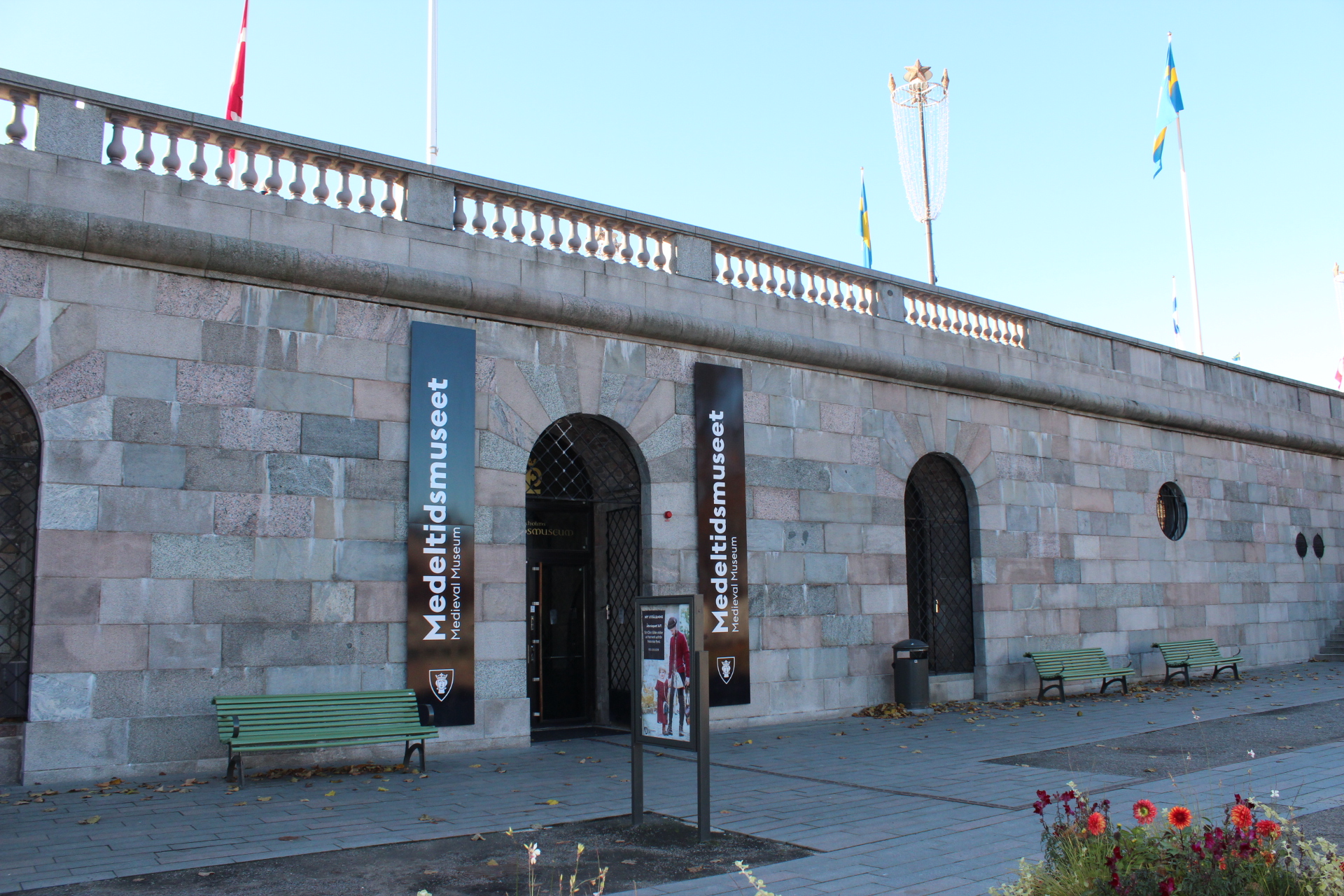
NordenBladet – The Medieval Museum is situated on the Helgeandsholmen island between the Royal Palace and the Opera. Entrance under Stockholm’s oldest stone bridge Norrbro. The exhibits tell of Stockholm’s emergence and the town’s development in the Middle Ages. The exhibition describes with compassion how people lived and made a livelihood.
The Medieval Museum (Stockholms Medeltidsmuseum) focuses on people and retells stories from the everyday life of medieval Stockholmers. Encounter the tales of Jöns Skomakare, Sketna Gertrud Syltekona, and many others. The museum includes Stockholm’s city wall from about 1520 preserved as a fixed ancient remnant 55 meters (180 feet) long. You will find the entrance to Norrbro, Stockholm’s oldest stone bridge. Free admission.
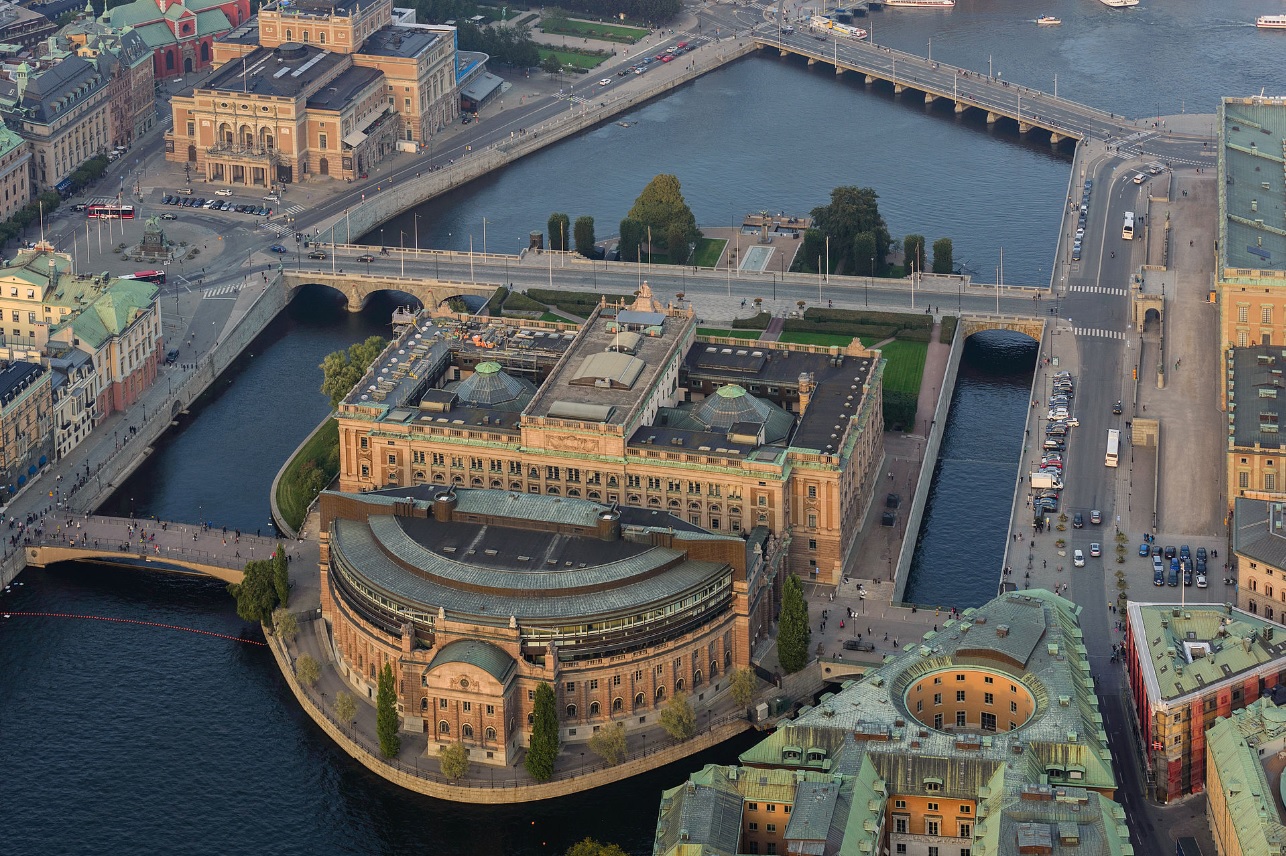
Getting to museum: Photo: Google maps Photo: Helgeandsholmen (Jan Ainali, CC BY-SA 3.0) Photo: Helgeandsholmen with the Riksdagen, aerial view (Arild Vågen, CC BY-SA 4.0)
Opening hours:
Monday: CLOSED
Tuesday: 12.00-17.00
Wednesday: 12.00-20.00
Thursday-Sunday: 12.00-17.00
Stairs and elevator leads down to Strömparterren, and the Museum’s entrance. The easiest way to get here is by foot or by public transport.
Public Transport:
Metro to Kungsträdgården or Gamla stan.
Bus 2, 43 and 76 to the Kungsträdgården. Bus 62 and 65 to Gustav Adolfs torg.
Parking:
There is no car parking near the museum.
Cloakroom and toilets:
Cloakroom and toilets are located to the right behind the reception desk.
Photography:
Photography is permitted without flash and tripod. Exceptions can be made for non-commercial use.
Stroller:
Strollers are welcome in the museum. No stroller parking available.
Eat and drink:
There is no cafe or restaurant in the museum. The café Kerstin och Britt at Strömparterren, outside the museum, is open during the summer season.
Smoking:
Smoking (including e-cigarettes) is not allowed in the museum or at the entrence.
Mobile Phones:
Please use your cell phone with consideration to other visitors.
Free WiFi:
Free WiFi is available in the musuem.
Foto: NordenBladet/Helena-Reet Ennet
____________________________________
About the museum:
The Medieval Museum is built around the findings from a major archaeological investigation during the 1970s. The museum is a part of the City of Stockholm.
History The museum came into existence after a major archaeological investigation which took place in advance of the rebuilding of the Riksdag (Swedish Parliament) and the building of garages under the present-day gardens of Riksplan. Among all the remains which came to light were parts of the Town Wall which Gustavus Vasa had built in the 1530s as well as the churchyard of the medieval Helgeandshuset (House of the Holy Spirit), which originally gave its name to the island.
The County Administrative Board decided that these remains should be preserved as permanent heritage monuments. This was how the Medieval Museum came about. The State bore the building costs while the City of Stockholm dealt with the fittings and fixtures, displays and running costs.
The “National Pit” The archaeological investigations on Helgeandsholmen from 1978—1980 are the most comprehensive so far undertaken in the inner city area of Stockholm. The investigations were carried out in connection with the rebuilding of the Riksdag in preparation for moving back to the island. Altogether an area of 8,000 square metres was investigated and when the project was completed a volume of some 50,000 metres of earth had been dug through and carried away. The excavations made it possible to follow the development of settlement in the area from the mid thirteenth century to the present day.
Most eye catching were the foundations of buildnings, above all from seventeenth century palaces, which had already come to light in the early stages of the work. Among the most remarkable finds, however, were the medieval churchyard of Helgeandhuset with some 7 metric tons of skeletons, and Gustavus Vasa’s town wall from around 1530. No less than 11 boats were also found. The excavations aroused great attention and debate in the press and were soon christened “Riksgropen” (the National Pit).
Photo from the air showing the dug out area in front of the Riksdag building.
The debate was mainly a matter of what one was to do with the cavity and the remains of the buildings after investigations had been completed. Originally the idea had been to have a garage for the Riksdag with a reception area for goods and workshops. Now it ended up with the most remarkable remains — the Vasa Wall and the churchyard wall — being preserved, and an underground museum being built around them.
The Medieval Museum opened for the first time in 1986. It was renovated and reopened in 2010.
Look also videos about The Medieval Museum: Just walking around Stockholm gives you a very clear glimpse into its medieval past, but in order to understand how the city thrived, prospered and defended itself, you will do no better than have a quick visit at this lovely free museum. We are sure you’ll walk right next to it while you’re walking around town on your first day really so, why not just walk in?!
NordenBladet – It seems Icelandic footballer Kolbeinn Sigþórsson was partying too hard and landed himself behind bars in Sweden after a rowdy night out. According to Swedish newspaper Expressen, one player in the Swedish league was arrested last night. They were initially withholding the name from the public, but Fréttablaðið confirmed that the jailbird was Sigþórsson.
According to the report, Kolbeinn apparently resisted arrest around 3:00 o’clock on Friday night and subsequently spent the night in jail. The AIK football club executives have not commented substantially, just saying that the matter will be handled internally.
“Going out for fun in this way is not according to our values,” the chairman of the company told Fréttablaðið. As for whether Kolbeinn will be in the final round on Saturday, we’ll just have to wait and see.
________________________________________
Kolbeinn Sigþórsson (born 14 March 1990) is an Icelandic professional footballer who plays as a striker for Swedish club AIK and the Iceland national team.
Before being signed by Ajax for a fee of €4.5 million in the summer of 2011, Kolbeinn came through Víkingur Reykjavik’s youth program. He then had a brief spell with HK Kópavogs in his home country and moved on to AZ Alkmaar in the Netherlands.
Before making his debut for the Icelandic national team, Kolbeinn played at under-17, under-19 and under-21 levels. With 26 goals, he is their joint top goalscorer of all-time.
His brother Andri Sigþórsson was also a professional footballer who now acts as his agent.
Featured image: Kolbeinn Sigþórsson (Wikimedia Commons)
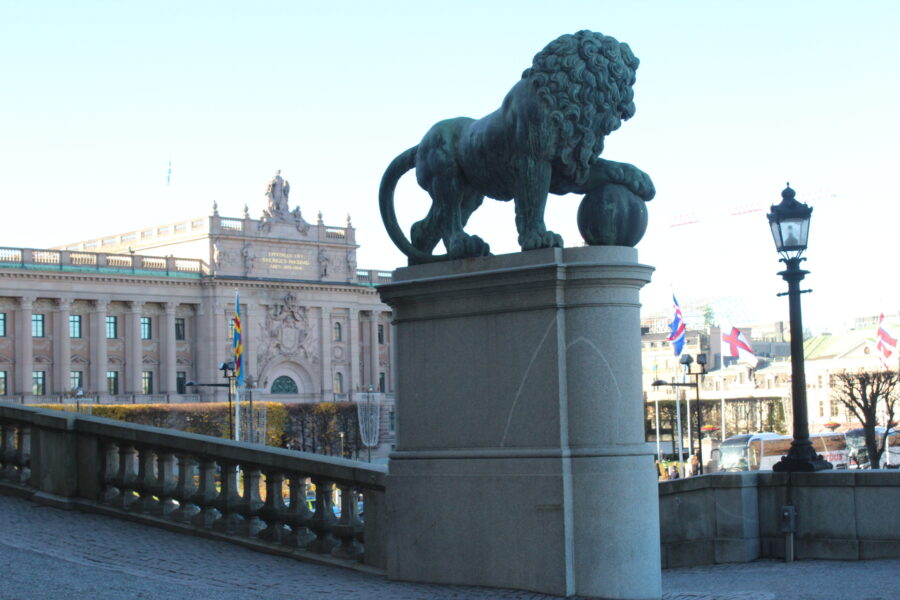
NordenBladet – Helgeandsholmen is a small island in central Stockholm, Sweden. It is located north of Stadsholmen, and east of Strömsborg, with which, together with Riddarholmen, it forms Gamla stan, the old town of Stockholm. Helgeandsholmen contains the Riksdag Building and the Museum of Medieval Stockholm, and is connected to neighbouring islands through three bridges: Riksbron, Stallbron, and Norrbro.
The terrace in the eastern end, called Strömparterren (“The Stream Parterr”), is a public park with a restaurant dating from 1832, while the flight of stairs leading down to the water is from 1807-1810. The quay west of the Riksdag Building once surrounded Sweden’s central bank Sveriges Riksbank and was thus named Bankkajen (“The Bank Quay”), while the streets on southern and northern sides are called Norra/Södra Helgeandstrappan (“The Northern/Southern Helgeand Stairs”), all of them named in 1925.
First mentioned in a letter written in Latin July 28, 1320 the name ‘Helgeandsholmen’, a corruption of Helige andens holme (“Islet of the Holy Spirit”), appears as in insula dicta helghaanzsholm (“on the island called Helgeandsholm”). At the time, helgeandshus (Old Swedish: hälgha ands hus. hälandzhus, helghanzhhws, hälianshus) was a name used for charitable institutions spiritual in nature, in Stockholm first mentioned in a testament from April 24, 1301 (domus sancti spiritus).
Photos: 7x NordenBladet / Helena-Reet Ennet Photo: Helgeandsholmen (Jan Ainali, CC BY-SA 3.0)
Foto: Google maps
History
A set of islets Though one regular shaped island today, Helgeandsholmen was until quite recently a set of islets. Before the start of extensive archaeological excavations in 1978, it was traditionally believed that the present island once encompassed three islets:
– A larger main island to the south, called Helgeandsholmen from the 14th century. The excavations, however, convincingly showed that during the early Middle Ages this island in fact consisted of two smaller islets, of which we know absolutely nothing.
– And, north of this major island, two smaller ones, once the property of the abbey at Klara:
– One called Barkarholmen (“Bark Islet”), suggesting there was a tanning business here as bark was an important raw material for tanning. This islet was also known as Klosterholmen (“Abbey Islet”).
– And, east of Barkarholmen, a rocky islet called Lilla Stockholm (“Little Log Islet”) in the 16th century, renamed Bryggeriholmen (“Brewery Islet”) during the 17th century (in reference to a brewery in operation 1641-45), and after that called Slaktarholmen (“Butcher’s Islet”) after a slaughterhouse operating there. Lilla Stockholm disappeared when Norrbro was finally completed in 1806.
The Helgeand House
As mentioned above, a charitable institution organized by a pious foundation was located on the island, receiving sick people, poor and elderly as well as foreigners, and accepting donations from burghers in city, through which the institution became an important landowner. The original Helgeandshuset (“The House of the Holy Spirit”) probably dates back to the 13th century but is not mentioned until 1301. Rebuilt after a fire in 1410, it was moved to Riddarholmen by King Gustav Vasa (1496–1560) in 1531. Though the appearance of Helgeandshuset is not known, it is believed to have resembled similar institutions elsewhere and thus consist of a hospital ward and a church surrounded by other buildings and a graveyard.
Norrbro
Originally, Norrbro stretched diagonally across Helgeandsholmen from (what is today) Mynttorget to Gustav Adolfs torg. Though not mentioned until 1288, the first bridge is believed to have been built with the foundation of the city in 1252. Like virtually all bridges during the Middle Ages, Norrbro was built in wood, at the time considered appropriate as bridges then easily could be dismantled during sieges.
Drawbridges are mentioned in 1318, and the general urban code from the mid 14th century prescribes six cities around Lake Mälaren – Arboga, Enköping, Sigtuna, Strängnäs, Västerås and Uppsala – to share the costs of maintenance with Stockholm, thus indicating the bridge wasn’t merely of interest to the city, but a vital part of the regional road system. These neighbouring cities gradually came to question this obligation however, and during the 16th and 17th centuries Stockholm was, bit by bit, to take charge of the bridge alone.
Until the 1640s, the width of the street varied from 10 to 20 ells (5.9-11.9 metres), but as the northern settlements were incorporated with the city in 1635, so was Helgeandsholmen, and the standard street width was regulated. Governor Klas Fleming (1592–1644) had Norrbro straightened out, in line with his own site on the street, and the width set to 24 ells (14.3 metres).
Norrbro was rebuilt as one of the city’s first stone bridges, the northern section completed in 1797, and the southern in 1806.
City gates and fortifications
An inner gate, Norreport, is mentioned south of Helgeandsholmen in 1409, and an outer gate in the 1460s, but was probably older than that. Both gates were eventually supplied with defensive towers. In the early 15th century, the walls were extended and a western tower added to the fortifications, the entire structure being outdated later that century and finally demolished by 1672.
Royal Stables
Probably established on the island as early as 1535, Royal Stables were at first accommodated in the former hospital ward, and by 1612 given a for the purpose suitable building. First relocated north of Helgeandsholmen in the 1640s, they were moved back again in 1680 to a building designed by architect Nicodemus Tessin the Elder (1615–1684). Destroyed by a fire in 1696, the stables were immediately rebuilt in the design of Nicodemus Tessin the Younger (1654–1728), a structure surviving different alternations until the beginning of the 20th century.
Historical canals
Over the years, several canals have passed through today’s Helgeandsholmen, most notably between and south of the two palaces described above. Before post-glacial rebound made the canals unnecessary, spring floods was a serious problem often forcing the reconstruction of bridges and other structures, but by the 17th century the first canal was scrapped, the second when the Parliament Building was built in the early 20th century.
17th century structures Needing access to a water mill, a royal workshop for the production of gun carriages, Lådmakaregården (“The Box Making Court”) was relocated to Barkholmen in the early 17th century, built on poles and reaching around Stockholmen. It was later demolished and replaced by the Gyldenklou House.
Having bought a site north of the Royal Stables in 1637, Klas Fleming had his private palace, Flemingska huset (“The Fleming House”), built after his own German-Dutch renaissance design, and, subsequently, the entire neighbourhood adapted to it. In 1696 however, the Crown bought the house to have it demolished for the extension of the stables.
During the 1640s, several people close to the Crown and Royal Court were allotted sites on Helgeandsholmen, and in 1645, Queen Christina donated the site north of The Fleming House to Anders Gyldenklou (-1665 ?), Secretary of the Chancellery, who had two buildings erected there, called Gyldenklouska huset (“The Gyldenklou House”), and subsequently sold to Lord High Chancellor (Riksdrots) Per Brahe (1602–1680). The palace, a Dutch renaissance structure four storeys tall with a stepped gable and called Braheska huset (“The Brahe house”) until its demolition, is often appearing next to the Fleming House in engravings and paintings from the 17th and 18th centuries. It was taken over by the Crown in 1696, and used for the royal administration after the fire at the Royal Palace in 1697. By 1770, the building was handed over to the Royal Stables, who used it for various purposes until its demolition in 1815.
Modern history
Completed in 1807-10, the semicircular space on Norrbro’s eastern side was first used as a storage space for fisheries, finally removed on the commands of the king in 1821. Ten years later, a park was established, at the time still with a canal passing through it. Opened to the public in 1832, it became the first municipal park in Stockholm. During the following 100 years, the park was furnished with various pavilions, bookstalls, and stages, and became a popular spot among the city’s society. By the 1930s however, the park had become abandoned and shabby, and it was therefore redesigned first in 1937-38, and then again following the archaeological operations in the 1970s.
A bazaar called Norrbro-basaren built on the western side of Norrbro in 1838-39, remained a vital social and commercial meeting place until its removal in 1903 for the creation of the small park in front of the Riksdag Building.
Photos: 2x NordenBladet /Helena-Reet Ennet
By the 1870s, the old Riksdag Building on Riddarholmen had become too small and was regarded as not representative enough, a problem also plaguing the Riksbank, then residing at the Järntorget square in Gamla stan. Helgeandsholmen was soon suggested as an appropriate site for both institutions, under the condition that the new structure didn’t overshadow the Royal Palace. The winning proposal from an architectural competition in the late 1880s was further developed by the architect Helgo Zettervall (1831–1907) assisted by Aron Johansson (1860–1936). The old buildings were demolished in 1893, and both institutions completed during 1897-1906. The Riksbank was moved to Brunkebergstorg in 1976, and the building taken over by the Riksdag.
Featured image: Helgeandsholmen with the Riksdagen, aerial view (Arild Vågen, CC BY-SA 4.0)
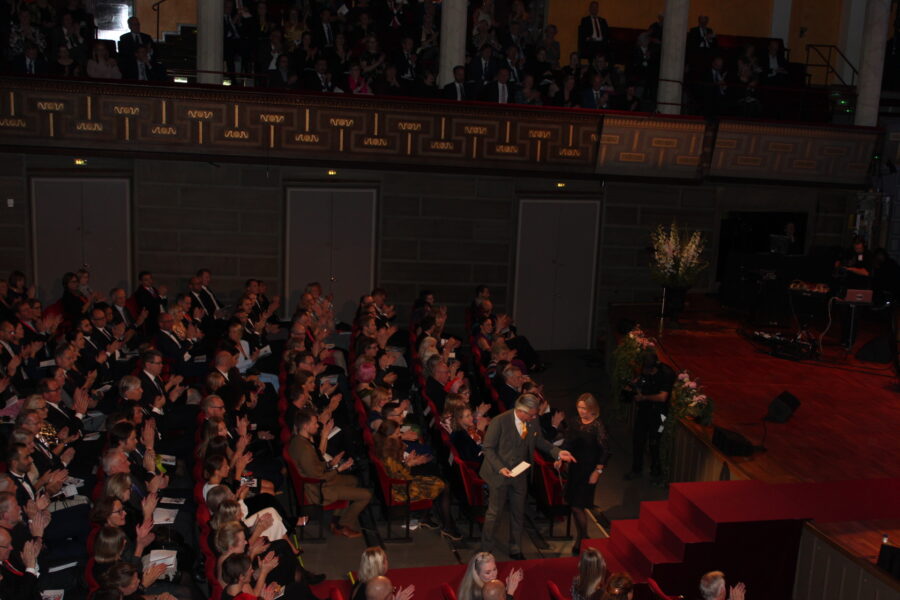
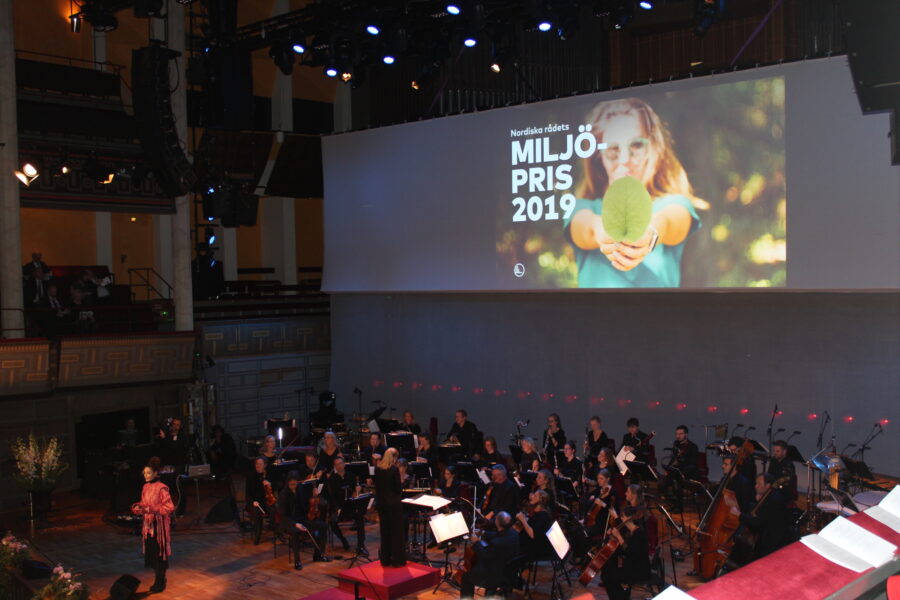
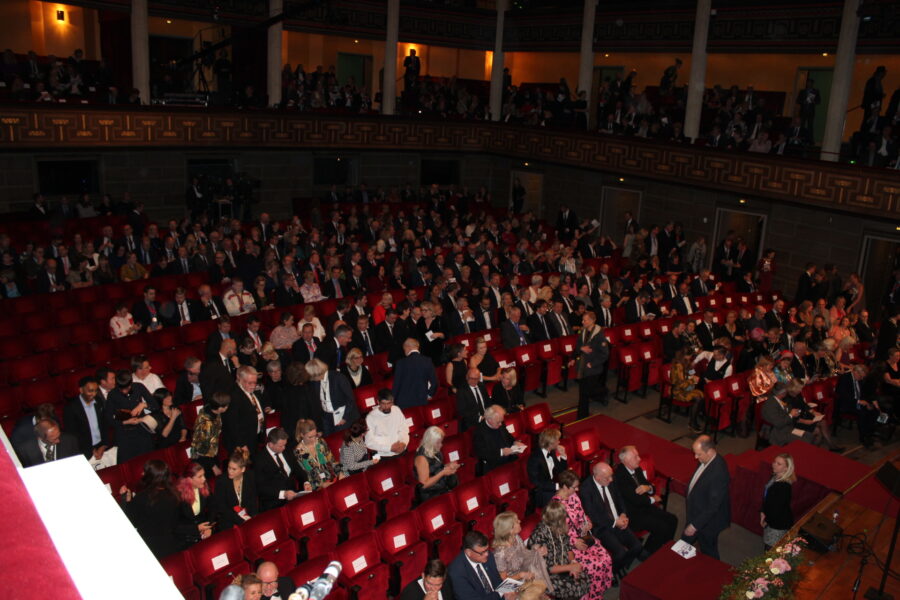
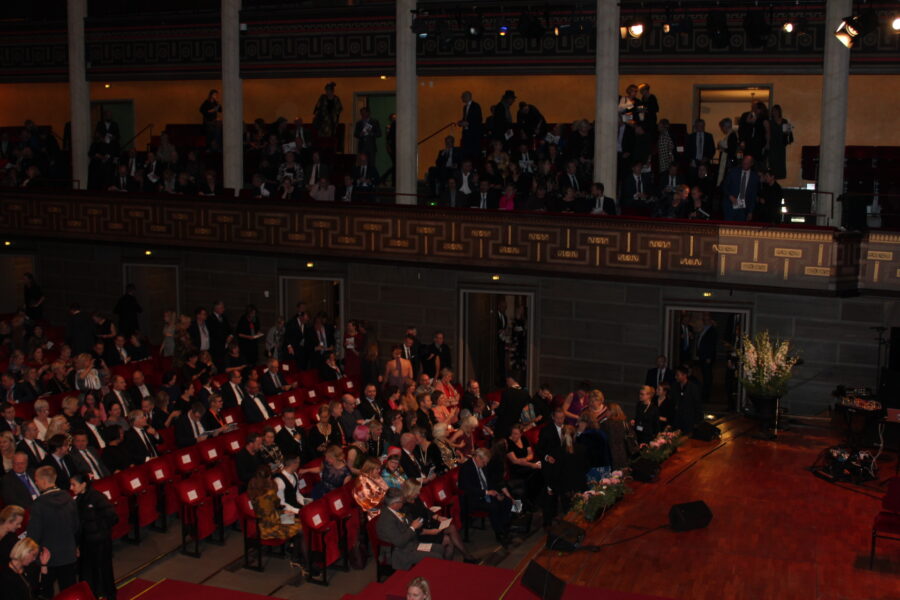
NordenBladet – Yesterday evening, on Tuesday 29 October 2019 awards were handed out in Sweden in Stockholm’s concert hall (Stockholms konserthus, Hötorget 8) at a festive awards gala held by the Nordic Council. Every year the Nordic Council also announces five prizes: the prize for literature, film, music, environment as well as children’s and youth’s literature. Besides the acknowledgement the winner also receives a monetary prize of 350 000 Danish kroons.
This year’s festive awards gala was opened by welcoming speeches from the Swedish parliament speaker Per Olof Andreas Norlén, the Nordic Council of Ministers’ president Hans Wallmark and the Nordic Council of Ministers’ vice-president Gunilla Carlsson, what even added to the festive atmosphere by giving a fantastic concert was the Västerås Symphonic Orchestra with conductor Cathrine Winnes. The event was hosted by Swedish literary critic and television host Jessika Gedlin.jhjh The other performers at the concert were Emilia Amper (a well-known Swedish folk musician and Key Fiddle player), El Sistema Södertälje children’s orchestra, The Mamas (a female trio with members Loulou LaMotte, Dinah Yonas Manna and Ash Haynes), the cellist Johanna Sjunnesson and the Islandic duo Hugar ( Pétur Jónsson, Bergur Þórisson).
First of all the 2019 prize for children’s and youth’s literature was announced (The Nordic Council Children and Young People´s Literature Prize 2019). The prize and the nominees were introduced by Swedish prime minister Stefan Löfen. The winner was 44-year-old Norwegian writer and illustrator Kristin Roskifte. The prize-winning book was “Alle sammen teller” (“Everybody counts”).
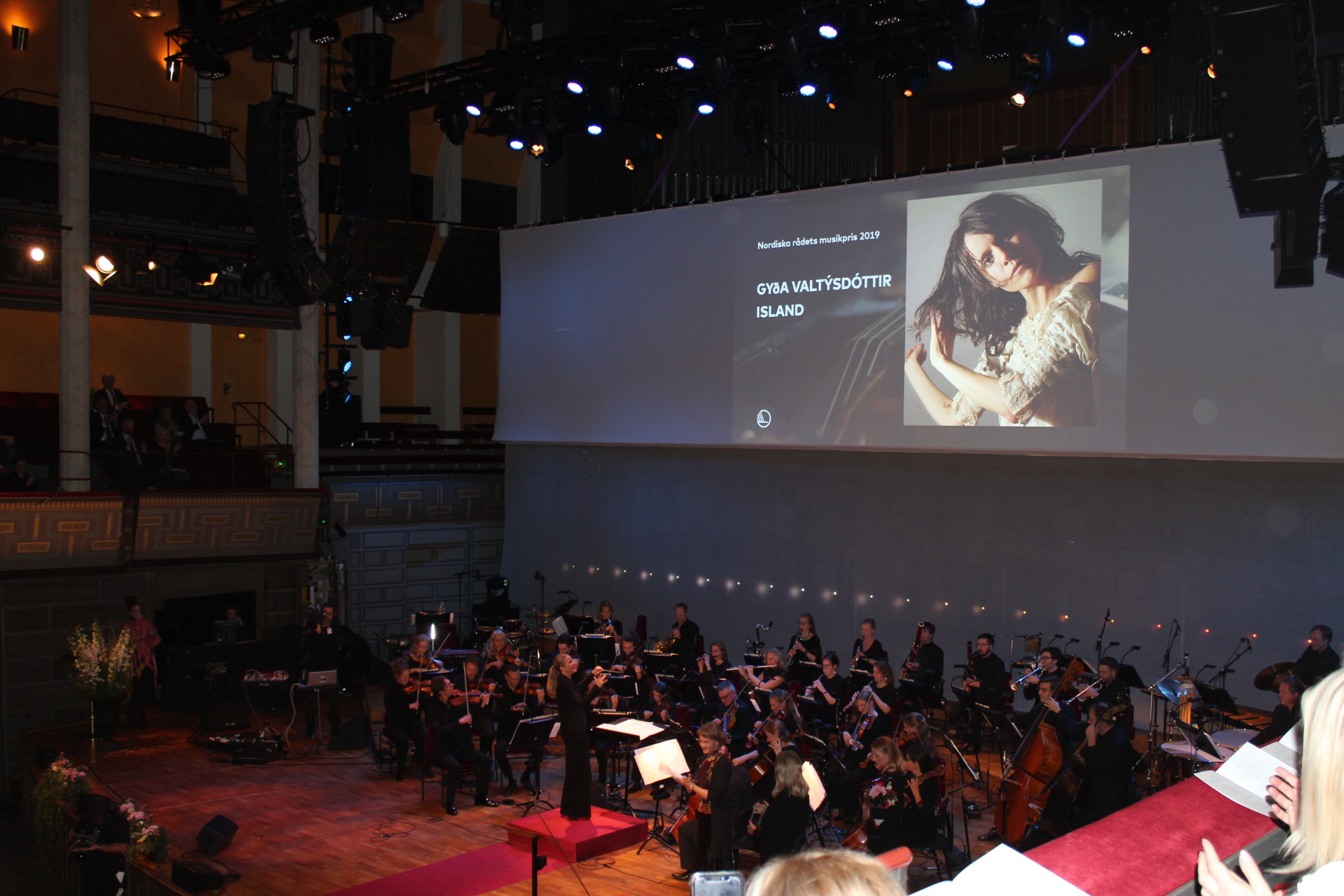
The second announced prize was the Nordic Cuncil’s Music Prize 2019. The prize and the nominees were introduced by Finnish conductor and cellist Susanna Mälkki. The music prize winner was the Islandic instrumentalist Gyða Valtýsdóttir. Valtýsdóttir was so moved about winning the prize that a quiver of hands was visible during the acknowledgement speech. With a softest of voices she said that the person behing her success story was her mother.
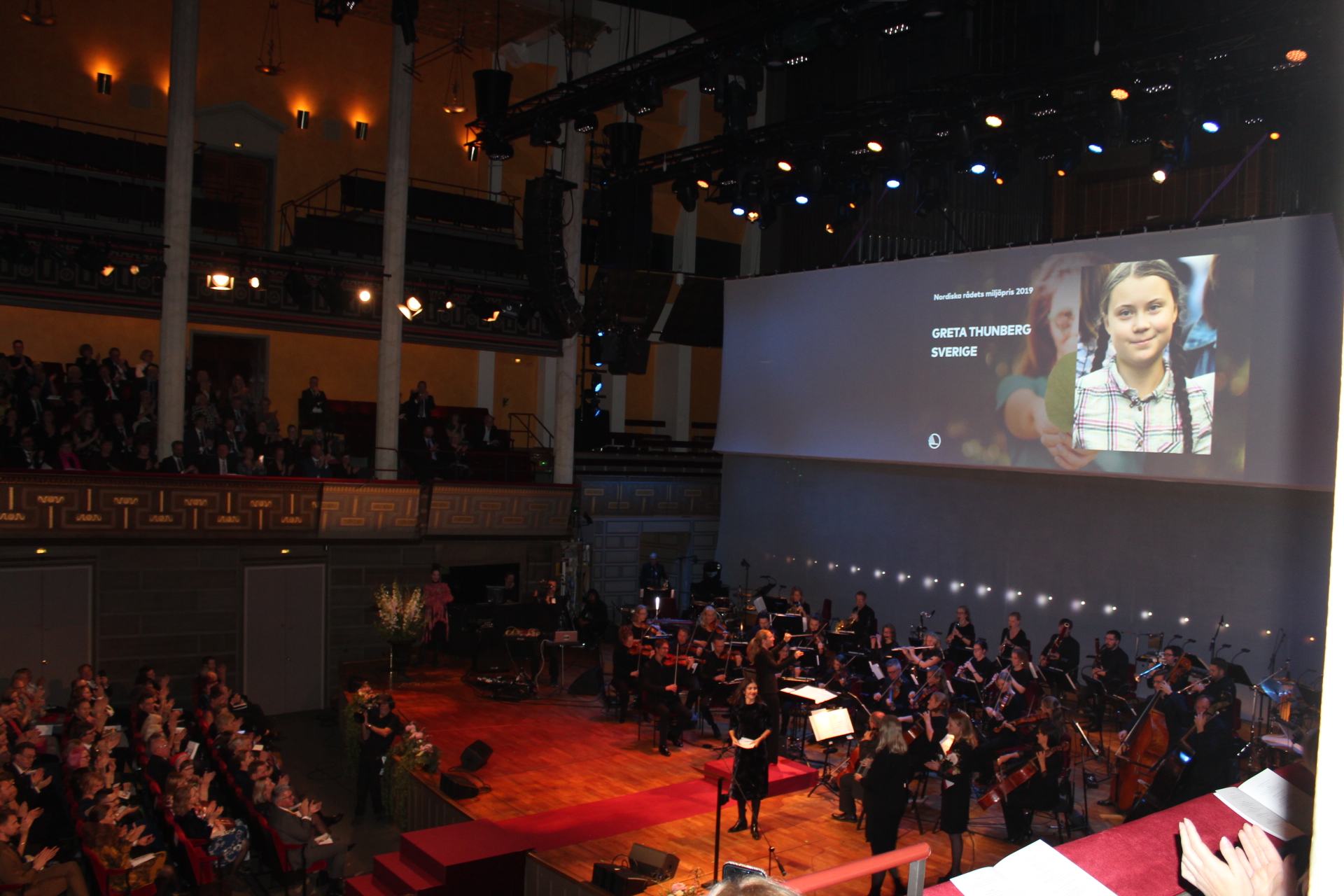
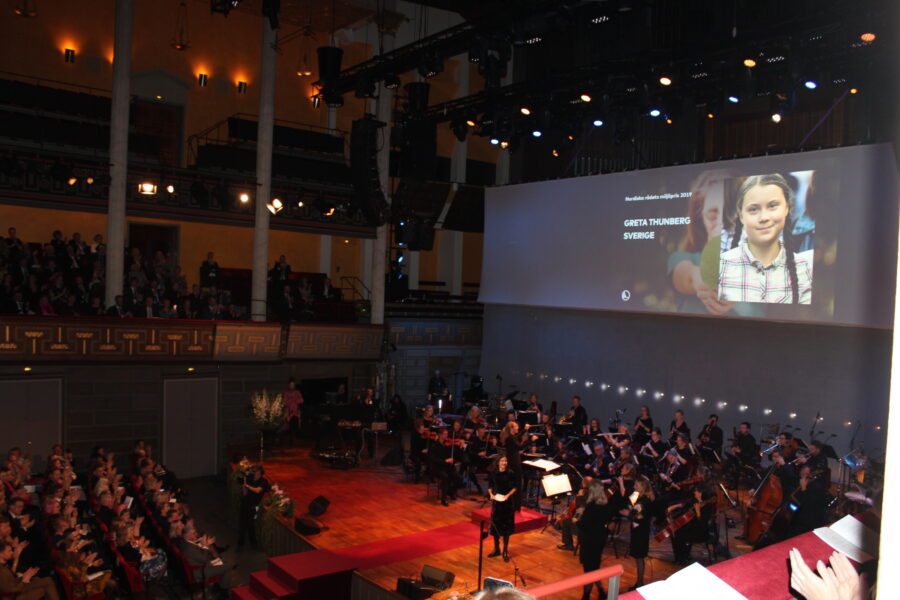
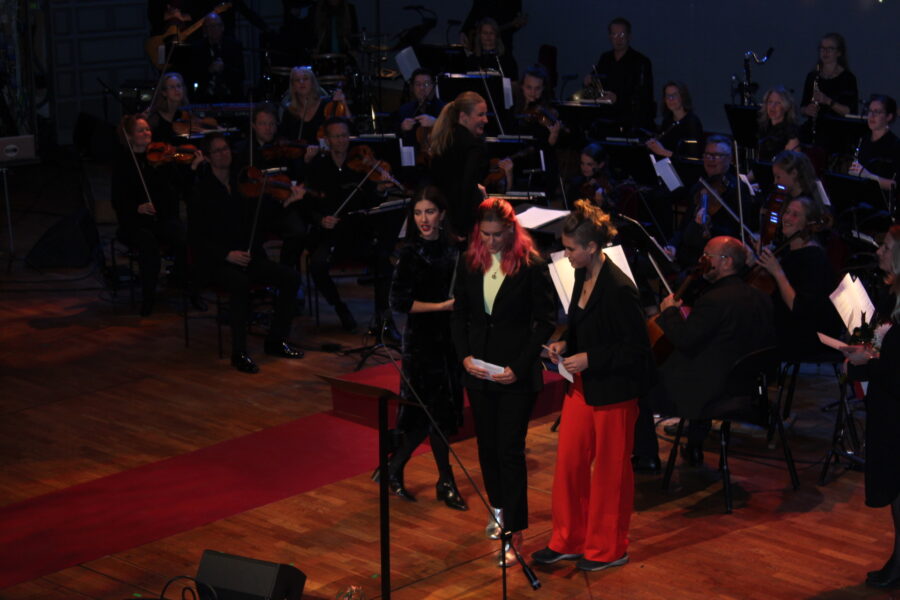
The third prize to be announced was the Nordic Council Environment Prize 2019. The prize and the nominees were introduced by the European Youth Parliament member Noura Berrouba. The winner was 16-year old Swedish climate activist and founder of the movement “Fridays for Future” Greta Thunberg. The audience applauded to Thunberg already when the nominees were announced. Thunberg helself however was not attending the event since at that time she was in California. On behalf of her the fellow activists got the floor and read out loud Thunberg’s letter that included a thank you as well as the message that she will decline the prize. “I want to thank the Nordic Council for this award. It’s a great honour. But the climate movement needs no more prizes. What we need is for those in power and politicians to listen to research,” she announced. The Nordic Council’s president Hans Wallmark stated on the Norden.org page that he honours the decision that Greta Thunberg has made and that is is being decided what will be done with the prize sums (read more about Greta Thunberg prize and declining the prize sums HERE).
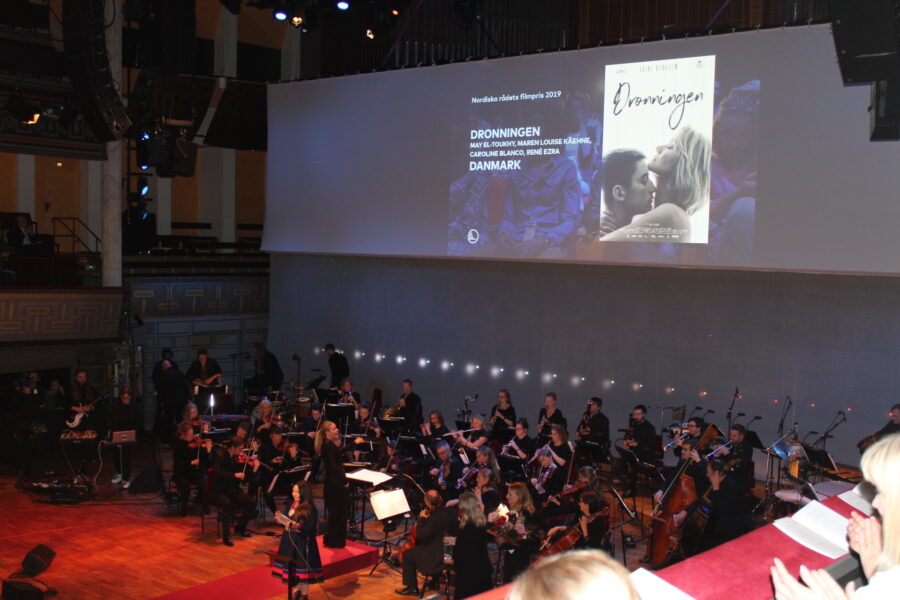
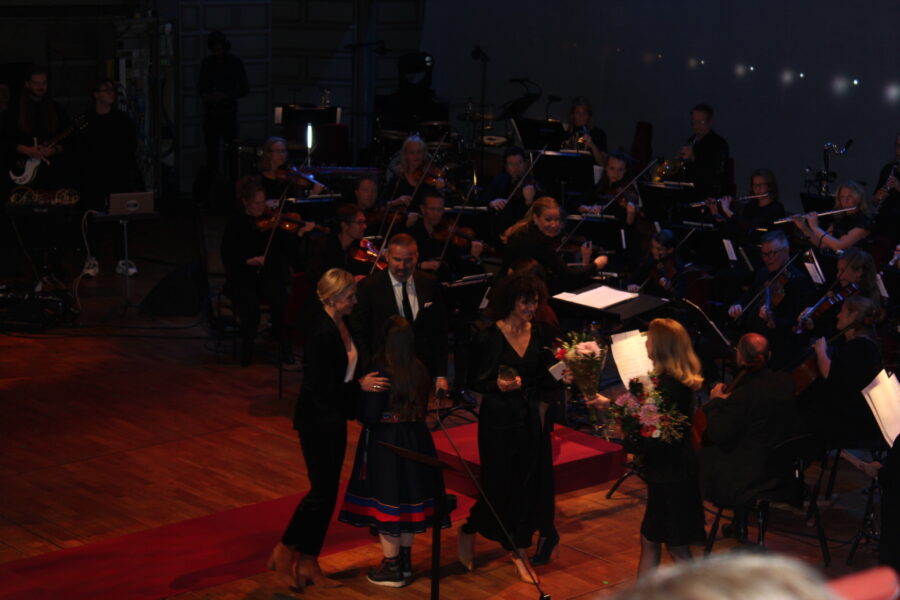
Fourth, the Nordic Council Film Prize 2019 was announced. The nominees were introduced and the prize was handed out by Norwegian actress Lena Cecilia Sparrok. The prize went to Danish drama film “Queen of Hearts” (original title: Dronningen). Film director and screenwriter May el-Toukhy, screenwriter Maren Louise Käehne, film producers Caroline Blanco and Rene Ezra.
The fifth prize, the Nordic Council Literature Prize 2019 was introduced and announced by Swedish poet and writer Johannes Anyuru. The prize went once more to Denmark. The winner of the prize was 28-year old Jonas Eika Rasmussen with his novel “Efter Solen”. However, Jonas Eika brought quite some anxiety to the concert hall. While holding his acknowledgement speech he took advantage of the situation to blame the current government. In the two-page speech that he had prepared, he blamed the Danish prime minister Mette Frederiksen who at the time was seated just a few meters away in the hall, he spoke of capitalism, racism, and need for radical changes in the Nordic countries.
A fine ending to the prize gala 2019 of the Council of Ministers (19:30 – 21.00) was made by “Ain´t No Mountain High Enough” by The Mamas and Västerås´i Symphony Orchestra.
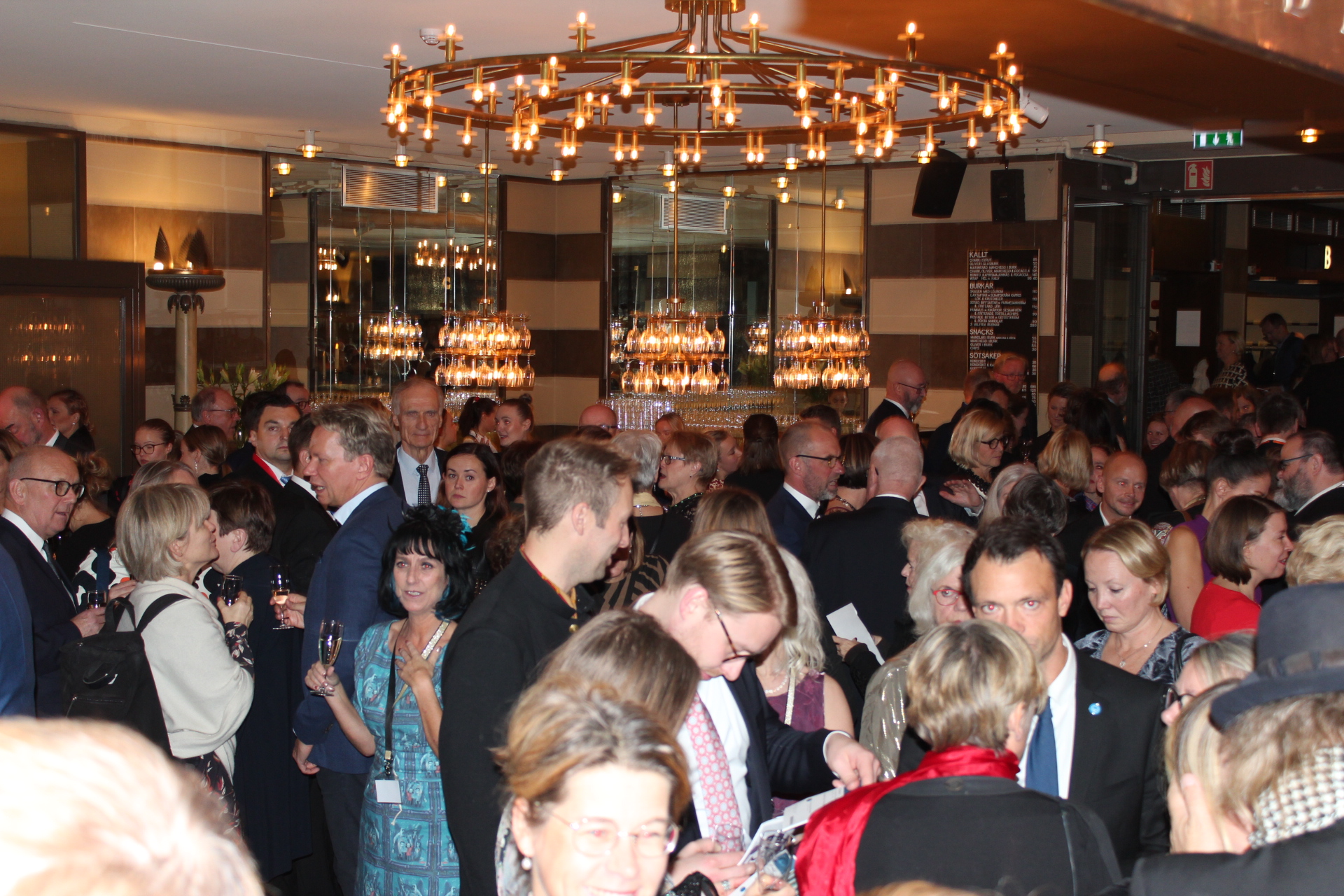
See more: a brief society gallery from the gala guests (a.k.a. five minutes before the concert in the hallway and the hall) is soon available at NordenBladet entertainment pages Ohmygossip.
Photography and text: NordenBladet / Helena-Reet Ennet
NordenBladet – Icelandic performer and multi-instrumentalist Gyða Valtýsdóttir (also known as Kría Brekkan) was awarded the 2019 Nordic Council Music Award at a formal ceremony in Stockholm, Sweden, last night. She was awarded the prize for her distinctive vocals, instrumental inventiveness and dignified craftsmanship.
37-year-old Valtýsdóttir is the sixth Icelander to receive the award – a monetary award of DKK 350,000 (USD 52,000; EUR 47,000)
“Gyða Valtýsdóttir is an Icelandic musician who is classically trained but unbound by genre. At an early age she was a founding member of the lauded electronic experimental band múm. A multifaceted performer, she has since been a prominent part of Iceland’s music scene.
Fundamentally a classically trained cellist, Gyða has in recent years been performing her own music as well as collaborating with other musicians across genres. She has used her training to fulfil her visions and delivers her holistic approach to music in an organic way and with admirable technique. Gyða’s music and performance is highly unique and captivating, demonstrating a special sense of phrasing and timing. She is a particularly distinctive performer with a fascinating, earthy presence in live performance – a presence that is fragile and subtle, yet powerful and temperamental. Her deeply personal and organic performance is eminent throughout, whether playing the cello, singing, using her distinctive vocals, or playing other instruments, and has a fundamental originality to it.
Gyða crosses and bridges the gap between musical genres in a unique way, not least by dismissing any notion of their differences. Whether performing her own music or the music of others she brings her personal originality to the music through her instrumental inventiveness.”
Gyða Valtýsdóttir at Nordic Council Awards Ceremony 2019 in Stockholms konserthus, Hötorget 8 (29. october 2019)
Photos: NordenBladet / Helena-Reet Ennet
_______________________________
Gyða Valtýsdóttir (G Y D A) was one of the 13 artists nominated for the Nordic Council Music Prize 2019.
Gyða Valtýsdóttir came to prominence with lauded electronic experimentalists múm in the early ‘00s. In 2017 Gyða released the album Epicycle, a constellation of pieces by the likes of Schubert, Schumann and Messiaen, but also more experimental composers like Harry Partch and George Crumb. Gyða went into the core of the music, swaying it instinctively to her unique interpretation. In 2018 she released the aptly named Evolution, an exquisite affair, building on her forays into the classical world but weaving experimental and modern strands into the tapestry. Strings swirl, electronics hum gently, voices enter – and then exit – gracefully. A sturdy yet elegant album – delicate and powerful at the same time. Gyða’s career is growing by leaps and bounds at the moment, her first soundtrack (to the film Mihkel/Undir halastjörnu) was released last year and her live performances have been ecstatically received, where her distinctive vocals, instrumental inventiveness and highly personal charm underline a dignified craftsmanship.
NordenBladet – Greta Thunberg, who became known worldwide for her weekly climate strikes, has decided to decline the Nordic Council’s environmental award and 350,000 Danish kroner (US$52,042) in prize money. The Swedish teen climate change activist rejected the recognition in an Instagram post on Tuesday (29.oct. 2019) because “the climate movement does not need any more awards.”
Thunberg thanked the Nordic Council for the award, but she said she cannot accept it. “What we need is for our politicians and the people in power start to listen to the current, best available science,” she wrote in the post.
“I have received the Nordic Council’s environmental award 2019. I have decided to decline this prize. Here’s why: “I am currently traveling through California and therefore not able to be present with you today. I want to thank the Nordic Council for this award. It is a huge honour.”
“But the climate movement does not need any more awards. What we need is for our politicians and the people in power start to listen to the current, best available science.”
“The Nordic countries have a great reputation around the world when it comes to climate and environmental issues. There is no lack of bragging about this. There is no lack of beautiful words. But when it comes to our actual emissions and our ecological footprints per capita – if we include our consumption, our imports as well as aviation and shipping – then it’s a whole other story.”
Thunberg also pointed to a report from the World Wide Fund for Nature and the Global Footprint Network, which said Sweden, along with the most of Nordic region, lived as if the world has the resources of four planets. “In Sweden we live as if we had about 4 planets according to WWF and Global Footprint Network. And roughly the same goes for the entire Nordic region.”
“In Norway for instance, the government recently gave a record number of permits to look for new oil and gas. The newly opened oil and natural gas-field, ”Johan Sverdrup” is expected to produce oil and natural gas for 50 years; oil and gas that would generate global CO2 emissions of 1,3 billion tonnes.”
“The gap between what the science says is needed to limit the increase of global temperature rise to below 1,5 or even 2 degrees – and politics that run the Nordic countries is gigantic. And there are still no signs whatsoever of the changes required.”
“The Paris Agreement, which all of the Nordic countries have signed, is based on the aspect of equity, which means that richer countries must lead the way.”
“We belong to the countries that have the possibility to do the most. And yet our countries still basically do nothing. So until you start to act in accordance with what the science says is needed to limit the global temperature rise below 1,5 degrees or even 2 degrees celsius, I – and Fridays For Future in Sweden – choose not to accept the Nordic Councils environmental award nor the prize money of 500 000 Swedish kronor.”
The Nordic Council Awards Ceremony 2019 in Stockholm, Sweden. Greta Thunberg won the Nordic Council Environment Prize 2019. Two fellow activists spoke on Thunberg’s behalf at the award ceremony and quoted her as saying: “What we need is for our rulers and politicians to listen to the research. Greta Thunberg is currently in the United States (California). Photos: 6x NordeBladet/Helena-Reet Ennet (29 October 2019 at the Stockholm Concert Hall)
____________________________________________
Greta Thunberg (16) is a Swedish teenage environmental activist on climate change whose campaigning has gained international recognition.
Thunberg first became known for her activism in August 2018 when, at age 15, she began spending her school days outside the Swedish parliament to call for stronger action on global warming by holding up a sign saying (in Swedish) “School strike for climate”. Soon, other students engaged in similar protests in their own communities. Together, they organised a school climate strike movement under the name Fridays for Future. After Thunberg addressed the 2018 United Nations Climate Change Conference, student strikes took place every week somewhere in the world. In 2019, there were at least two coordinated multi-city protests involving over one million students each.
Thunberg is known for her blunt, straightforward speaking manner, both in public and to political leaders and assemblies, in which she urges immediate action to address what she describes as the climate crisis. At home, Thunberg convinced her parents to adopt several lifestyle choices to reduce their own carbon footprint, including giving up air travel and not eating meat.
Her sudden rise to world fame has made her a leader and a target. In May 2019, Thunberg was featured on the cover of Time magazine, which named her a “next generation leader” and noted that many see her as a role model. Thunberg and the school strike movement were also featured in a 30-minute Vice documentary titled Make the World Greta Again. Some media have described her impact on the world stage as the “Greta Thunberg effect”. Thunberg has been the recipient of numerous honours and awards, including fellowship of the Royal Scottish Geographical Society, has been named as one of the 100 most influential people of 2019 by Time magazine. Thunberg was nominated for the 2019 Nobel Peace Prize which was ultimately awarded to Ethiopian Prime Minister Abiy Ahmed Ali. In September 2019, she addressed the UN Climate Action Summit in New York.
Greta Thunberg was born on 3 January 2003 in Stockholm, the daughter of opera singer Malena Ernman and actor Svante Thunberg. Her paternal grandfather is actor and director Olof Thunberg.
Thunberg says she first heard about climate change in 2011, when she was 8 years old, and could not understand why so little was being done about it. Three years later she became depressed, lethargic, and stopped talking as well as eating, and eventually was diagnosed with Asperger syndrome, obsessive–compulsive disorder (OCD), and selective mutism. While acknowledging that her diagnosis “has limited me before”, she does not view her Asperger’s as an illness and has instead called it her “superpower”.
For about two years, Thunberg challenged her parents to lower the family’s carbon footprint and overall impact on the environment by becoming vegan, upcycling, and giving up flying. She has said she tried showing them graphs and data, but when that didn’t work, she warned her family that they were stealing her future. Giving up flying in part meant her mother had to give up her international career as an opera singer. Thunberg credits her parents’ eventual response and lifestyle changes with giving her hope and belief that she could make a difference. The family story is recounted in the 2018 book Scenes from the Heart.
NordenBladet – Ole Gunnar Solskjær completely smashes other Norwegian sports names in the media talk in Norway so far this year. Petter Northug is doing well despite his resignation. Manchester United manager Solskjær is close to 19,000 media releases so far in 2019. Closest to him are cross-country skiers Johannes Høsflot Klæbo and Therese Johaug.
Northug has not been active in cross country for almost a year, but still comes in 13th place. Chess master Magnus Carlsen is number seven and holds a strong position.
Media monitor Retriever has prepared the overview for NTB, and the number of reviews has been updated up to the end of last week.
Eight of the ten most talked about are men. A similar list was recently published in Sweden. There, cross-country skier Charlotte Kalla topped, and with her were five other women in the top-10 rankings over Swedish sports profiles.
“In Norway, women and men must fight against the global name Solskjær. So, a female first place is currently out of reach here at home. That being said, I think it’s nice to see that one of our biggest female cross-country stars gets at least as much publicity as the males,” says head of analysis in Retriever, Guro Lindebjerg, to NTB.
NordenBladet – Icelandic crime novelist Arnaldur Indriðason (58) has a new book coming out in Iceland on Friday. It’s his 23rd in as many years. Besides, one of his books was recently published in Norway, marking the thousandth publication of his work. His crime novels have been translated into more than 40 languages, and more than 14 million copies have sold.
Although Arnaldur is well known the world over today, convincing the first publisher abroad to accept his work was no easy task. “It was a struggle,” states Valgerður Benediktsdóttir, who works for Forlagið, Arnaldur’s publisher in Iceland. “We received all sorts of comments from foreign publishers, for example, that obviously no crimes were committed in the country of elves and volcanoes – that considering a crime novel manuscript from such a country was simply not worthwhile.
Others insisted that the author’s name was so hard to pronounce, that should he want to secure the publication of his work abroad, he’d better change his name a.s.a.p.”
Hard work finally paid off. “In 2003, we made a deal with a German publisher regarding the publication of Mýrin [Jar City],” Valgerður relates. “That was a major victory. The book went straight to the German best seller list. And that’s when this really got rolling.”
Lately, three of Arnaldur’s books have been on the best seller list in France. Topping the list of best-selling crime novels there is his first book, published in Iceland 22 years ago.
Valgerður notes that Arnaldur’s popularity abroad has paved the way for numerous other Icelandic writers – of crime fiction, as well as other genres. She states that when a best-selling author of this scale appeared, people worldwide realized there are world-class writers in Iceland.
__________________________________________________ Arnaldur Indriðason (born 8 January 1961) is an Icelandic writer of crime fiction; most of his books feature the protagonist Detective Erlendur.
Arnaldur was born in Reykjavík on 8 January 1961, the son of writer Indriði G. Þorsteinsson. He graduated with a degree in history from the University of Iceland (Háskóli Íslands) in 1996. He worked as a journalist for the newspaper Morgunblaðið from 1981 to 1982, and later as a freelance writer. From 1986 to 2001, he was a film critic for Morgunblaðið.
His first book, Sons of Dust (Synir duftsins) came out in 1997, the first in the series with Detective Erlendur. The first two novels in the series have not yet been translated into English. As of 2013, the series included 14 novels. Arnaldur is considered one of the most popular writers in Iceland in recent years — topping bestseller lists time and again. In 2004, his books were 7 of the 10 most popular titles borrowed in Reykjavík City Library. In 2006, his Erlendur novel Mýrin was made into a film, known internationally as Jar City, by Icelandic director Baltasar Kormákur.
Arnaldur’s books have been published in 26 countries and translated into at least 24 languages, including Arabic, Russian, Polish, German, Greek, Danish, Catalan, English, Portuguese, Italian, Czech, Swedish, Norwegian, Dutch, Finnish, Spanish, Hungarian, Chinese, Croatian, Romanian, Bulgarian, French, Serbian, Slovenian and Turkish.
Arnaldur received the Glass Key award, a literature prize for the best Nordic crime novel, in 2002 and 2003. He won the Crime Writers’ Association Gold Dagger Award in 2005 for his novel Silence of the Grave. He won the world’s most lucrative crime fiction award, the RBA Prize for Crime Writing worth €125,000, in 2013 for Shadow Alley (Skuggasund).