NordenBladet —At today’s sitting, the Riigikogu passed unamended the Act on Amendments to the Estonian Defence Forces Organisation Act which the President of the Republic had refused to proclaim.
Renewed deliberation of the Act on Amendments to the Estonian Defence Forces Organisation Act (783 UA) was held in the Riigikogu. It extends the existing rights of the Defence Forces in checking the background persons, in order to verify their suitability to serve or be employed in the Defence Forces or to cooperate with the Defence Forces. According to the Act, the Defence Forces are able to perform acts to a wider extent than the verification against registers, and to use covert measures to ensure that the collection of information is covert, upon obtaining information needed for background check.
The President of the Republic refused to proclaim the Act on 7 March. According to the President’s opinion, the Act was in conflict with §§ 13, 26, 33 and 43 of the Constitution of the Republic of Estonia.
During the debate, Hanno Pevkur (Reform Party), Jaak Madison (Estonian Conservative People’s Party) and Andres Metsoja (Isamaa) took the floor.
53 members of the Riigikogu were in favour of passing the Act without amendments and 31 voted against.
One Bill passed the first reading in the Riigikogu:
The Bill on Amendments to the Tobacco Act and the Alcohol, Tobacco, Fuel and Electricity Excise Duty Act (9 SE), initiated by the Government, will transpose two articles of the EU Tobacco Directive, on the basis of which a European-wide tracking and tracing system for tobacco products will be implemented to curb the black market in tobacco. The Bill with similar content was approved at the sitting of the Government on 6 December 2018. However, the second reading of the Bill in the Riigikogu was suspended at the wish of the Minister of Health and Labour.
In order to establish a traceability system, tobacco manufacturers and importers conclude data storage contracts for the purpose of hosting information related to products. Access to the data is important and must be ensured to the authority interested in the data (the Tax and Customs Board in Estonia) and the European Commission.
As part of the tracking and tracing system, a security feature simplifying the verification of whether or not a tobacco product is authentic will also be introduced for the sales package of tobacco products. In Estonia, tax stamp will be introduced as the security feature. It complies with the requirements of EU legislation and is at the same time the most convenient solution for tobacco manufacturers and importers. In the cases where no tax stamp is installed on a product (e.g. in duty-free shops), the security feature of the manufacturer will have to be installed on the product. The tobacco manufacturer or importer will develop it, taking into account the requirements of the law and EU legislation.
During the debate, Tarmo Kruusimäe (Isamaa) and Vilja Toomast (Reform Party) took the floor.
NordenBladet — Today, President of the Riigikogu (Parliament of Estonia) Henn Põlluaas met with Speaker of the National Assembly of the Republic of Korea Moon Hee-sang and the delegation accompanying him.
At the beginning of the meeting, Põlluaas expressed his condolences to his colleague on the boat disaster in Hungary, in which citizens of South Korea lost their lives.
The meeting focused on the excellent relations and further cooperation between the two countries. “The cooperation between Estonia and the Republic of Korea is very good, and mutual interest is increasing,” Põlluaas said. In his opinion, there is potential for even closer cooperation at the level of the governments and the businesses. Põlluaas expressed hope that South Korea would be ready to open its market to Estonian food products. He added that there were several fields of activity where the two countries could be useful to one another.
Moon Hee-sang confirmed South Korea’s strong support to Estonia’s candidacy for non-permanent membership of the UN Security Council. Both parties pointed out mutual interest in developing of research and new technologies. Moon Hee-sang said that Estonia was one of the most powerful digital countries, and an example to others with its e-governance solutions. Põlluaas invited South Korea to share with Estonia its experience in the 5G networks, where they are the global leader.
The colleagues also discussed reduction of tensions on the Korean Peninsula. Põlluaas expressed concern about the North Korean nuclear programme and missile tests, and reaffirmed Estonia’s readiness for full cooperation both in the European Union and in the United Nations to resolve the situation. Moon Hee-sang emphasised that the global community supported South Korea in this issue, and that the country was optimistic about the peace process.
Chair of the Estonia-Republic of Korea Parliamentary Group Urve Tiidus also participated in the meeting. She acknowledged the country’s investments into research and development. In her opinion, South Korea is the world leader in this field, and an example for all. Tiidus also said that she was happy that the Korean tourists had discovered Estonia. She expressed hope that the interest of Koreans in Estonia would grow after today’s visit.
NordenBladet —Tomorrow, President of the Riigikogu (Parliament of Estonia) Henn Põlluaas hosts Speaker of the National Assembly of the Republic of Korea Moon Hee-sang and the delegation accompanying him.
Põlluaas will meet with Moon Hee-sang in the Riigikogu. Chair of the Estonia-Republic of Korea Parliamentary Group Urve Tiidus will also participate in the meeting. In the evening, the President of the Riigikogu will give a dinner in honour of the guest, which will be attended by members of the Riigikogu Sven Sester, Marko Mihkelson and Urve Tiidus.
During his visit to Estonia, Moon Hee-sang will meet with President Kersti Kaljulaid and Mayor of Tallinn Mihhail Kõlvart. The delegation will also visit the Estonian Open Air Museum.
From Estonia, the Speaker of the National Assembly of the Republic of Korea will travel on to visit Latvia and Lithuania.
NordenBladet —The Security Authorities Surveillance Select Committee, the Anti-Corruption Select Committee and the State Budget Control Select Committee of the Riigikogu (Parliament of Estonia) elected their chairs and deputy chairs at the sittings of the committees today.
Alar Laneman is the Chairman and Hanno Pevkur is the Deputy Chairman of the Security Authorities Surveillance Select Committee of the Riigikogu. Heiki Hepner, Kaido Höövelson and Ivari Padar are members of the Security Authorities Surveillance Select Committee.
Katri Raik is the Chairperson and Marek Jürgenson is the Deputy Chairman of the Anti-Corruption Select Committee of the Riigikogu. Mart Nutt, Paul Puustusmaa and Andres Sutt are members of the Anti-Corruption Select Committee.
Jürgen Ligi is the Chairman and Martin Repinski is the Deputy Chairman of the State Budget Control Select Committee of the Riigikogu. Peeter Ernits, Aivar Kokk and Kalvi Kõva are members of the State Budget Control Select Committee.
NordenBladet —At its sitting today, the Foreign Affairs Committee of the Riigikogu (Parliament of Estonia) decided to submit the Bill on the Approval of the Protocol to the North Atlantic Treaty on the Accession of North Macedonia to the plenary sitting.
Chairman of the Foreign Affairs Committee Enn Eesmaa pointed out that North Macedonia was one of the four countries, besides Bosnia and Herzegovina, Georgia and Ukraine, that had set accession to NATO as their important foreign policy target. “NATO continues its open door policy, and North Macedonia’s success story is a good example to others who strive to become members of the Alliance,” Eesmaa emphasised.
Deputy Chairman of the Foreign Affairs Committee Marko Mihkelson believes that North Macedonia’s accession to NATO will enhance the security of the organisation and its member states, and improve the foreign policy situation because it will increase security and stability in Europe. “When the protocol enters into force, Estonia commits to defend North Macedonia, and North Macedonia will commit to defend Estonia,” Mihkelson emphasised.
The defence spending of North Macedonia forms 0.96 per cent of its GDP, but their government aims to reach the target of spending two per cent of GDP on defence by 2024.
The naming dispute with Greece, which hindered the accession of North Macedonia to NATO for a long time, was resolved at the beginning of this year, and “the Republic of North Macedonia” became the new official name of the country.
North Macedonia will become the 30th member of NATO after all current NATO member states have approved the protocol on accession according to their national law. Considering the earlier practice, the approval process may take several years. Greece was the first NATO member state to ratify the protocol on 8 February this year.
NordenBladet – I remember when at my eldest daughter’s kindergarten’s final party the teacher said to me that your daughter Estella Elisheva is talented in absolutely everything. That whatever she is going in for, she is making it a success – she is gifted in arts, music, and sports, she creates fantastic and unique paintings, she can sing, play an instrument, dance and achieve sports prizes. And that’s exactly how it is – because she is my daughter.. Hahaa..
It’s just the same with me, I cannot say if I am outright talented yet I have various hobbies. I cannot stand having just one job or one hobby all my life without doing anything else at all – this would be the nine-to-five office routine that is quite out of the question in my case. Journalism and writing has been my passion throughout the years – I am so proud of myself having been capable of building the big media such as NordenBladet with its several sub-pages and bloggers.It is great to challenge the Nordic largest and oldest media groups.
However, as time goes by my heart desires to be in the countryside more and more. Far far in the countryside – being somewhere with nature outweighing the crowd of people that live there. Luckily, nowadays it is possible to lead one’s life from home through the internet. I like to read about various herbs and all year round collect several herbs to serve healing purposes in herbal tea or to be used in our cosmetics brand E&S. I very much appreciate our clean Nordic nature!
Establishing the Elisheva & Shoshana (commonly named E and S) brand has once again been a passion and a hobby – I have created this brand together with my daughters Ivanka Shoshana and Estella Elisheva, to share our lives in doing something together. Initially this was a blog where a reflected on our activities, today besides the blog it has also grown into a brand and under this brand we produce and market handicraft cosmetics, ceramics (a lot of the work can be seen via Instagram and soon I will post works also in the blog), knitwear and now also paintings! Everything is naturally 100% our individual production. From handicraft cosmetics we currently offer products such as handicraft soaps, a selection of bathing salts, magnesium products (hair growth and scalp boosting spray, and body oil for joints) and we are soon launching follicle-stimulating shampoo series. We produce ceramics based on special orders – plates, mugs, vases, bowls, soap bases, decorative elements etc. None of the products is a repetition, we create only one of a kind products. In art the unique and the original is valued, nobody desires a copy. From knitwear I do spirited scarves and caps for kids and youths and lately I began doing paintings! All kinds of handicraft is very likeable for me as well as my daughters!
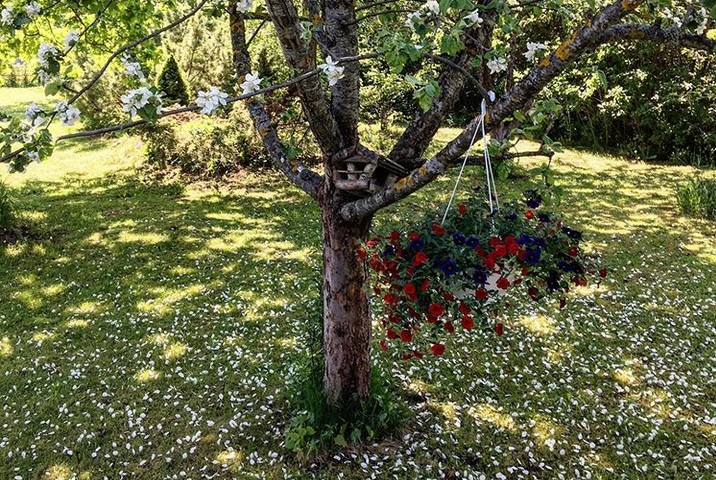
I have a wonderful home, the garden is lovely as a fairytale and the surroundings inspire me to the fullest. The kitchen is my favourite spot, and it reminds one of a true witch kitchen. Oftentimes I do feel that I am a witch, since I foresee several events. In the kitchen herbs are hanging to dry; in the middle of the kitchen there is a large log-heated stove with logs cracking; walls are covered with paintings and the many shelves are filled with works in progress, little containers and samples of E&S product design articles. The ancient wooden board floor is softly creaking under my body weight, I have a mug of glowing herbal tea, self-gathered and prepared, with honey in my hand, the cat is busily rubbing itself against and around my legs and there is a picturesque view from the window. I am alone and nobody is finding faults.. These are the moments to be embraced by!
Media, the nature, herbics and phytotherapy have accompanied me through the years, the paintings and the ceramics are on the other hand rather recent hobbies. I have set going an art collection and now also began to get more acquainted to painting. See the two first works HERE and HERE. This morning I entertained the idea that if I paint and do ceramics from now on then in 20 years time I would be known and experienced as a painter and a ceramics art designer and in 60 years time my children will own a considerable and magnificent art collection. I like to make an impact and this is what I am gonna do. There is so much energy, love and vitality in me that I wish to direct and shape in a right and positive way to alter the course of the world — NordenBladet is going to be the best known Nordic media channel that will guide people back to the countryside and the nature and that will teach how to remember the past, to preserve it and to esteem culture. And my paintings and ceramics will bring enjoyment and visual delight to many homes!
Maal: “Kronoberg”, Helena-Reet Ennet (Mai 2019)
I wish that my children grew in an exciting home that is filled with creative energy and works. I want them to believe in themselves, to grow spiritually and develop artistic fine motor skills and I want them to know that we all are the ARTISTIC FOUNDERS OF OUR LIVES!
NordenBladet —On the open House Day of the Riigikogu, the Parliament of Estonia, nearly 3000 people came to Toompea to visit the Riigikogu, learn about the work of the Parliament, meet the politicians and see the rooms they work in. The most popular activities were guided tours of the Riigikogu and visits to the Tall Hermann Tower. The representative rooms and working rooms of the Riigikogu were open all day. All factions also opened their doors, and it was possible to meet the MPs.
Many visitors came from foreign countries, like Belgium, Brazil, Canada, Chile, Finland, France, Germany, Ireland, India, Israel, Italy, Japan, Latvia, Lithuania, the Netherlands, Norway, Poland, Russia, Singapore, Spain, Switzerland, Thailand, the United Kingdom and the United States.
The Riigikogu Open House Day began with a welcome concert by mixed choir HUIK! on the balcony of Toompea Castle, after that, President of the Riigikogu Henn Põlluaas greeted the visitors in the courtyard of the Castle.
At Question Time at noon, it was possible to pose questions to Prime Minister Jüri Ratas, Minister of the Interior Mart Helme and Minister of Foreign Affairs Urmas Reinsalu.
Kaido Höövelson, Marina Kaljurand, Kai Rimmel, Andres Sutt and Raivo Tamm, who had been elected to the Riigikogu for the first time, exchanged ideas at a discussion in the café. They were interviewed by Member of the Parliament Enn Eesmaa.
Two teams from the Riigikogu and five school teams participated in the traditional quiz of the Open House Day. This year, the topic of the quiz was “Riigikogu 100”. The team Riigikogu I, which consisted of member of the Riigikogu Urmas Espenberg and Advisers of the Legal and Research Department Toivo Mängel and Triinu Põdramägi and Adviser, Head of Secretariat of the Constitutional Committee of the Riigikogu Kristo Varend, won the quiz. Tallinn Technical Gymnasium team was the best school team.
To celebrate the Estonian Language Year, actors of NUKU Theatre Anti Kobin and Taavi Tõnisson read stories from the treasury of the Estonian children’s literature in the Children’s Room. The National Library of Estonia and Tallinn Central Library attended with a pop-up library. There were reading nests and different workshops for children, including the workshop Priuse Piddo (Festival of Freedom) of the Estonian Theatre and Music Museum. The year of the Estonian Song and Dance Celebration was celebrated by dancing with the dancers of the Folklore Society Leigarid.
The Open House Day ended with a Good Mood Concert of the little stars from Star Stage, led by singer Sissi.
With the Open House Day, the Riigikogu celebrated its 100th anniversary.
The first representative body elected by the people in independent Estonia – the Constituent Assembly – convened in Estonia Theatre in Tallinn on 23 April 1919. The Riigikogu commemorates that event every year with the Open House Day.
In 2019, the Open House day was held on 25 May, because on that day 100 years ago, the Constituent Assembly moved from Estonia Theatre to Toompea.
The Open House Day tradition was introduced in 1999.
NordenBladet —On Saturday, the Parliament of Estonia the Riigikogu celebrates its 100th anniversary with the traditional Open House Day, which is dedicated to the year of the Estonian Song and Dance Celebration and the Estonian Language Year.
The Riigikogu Open House Day will begin with a welcome concert by mixed choir HUIK! on the balcony of Toompea Castle. President of the Riigikogu Henn Põlluaas will greet the visitors in the courtyard of the Castle.
It is possible to meet the members of the Riigikogu in the offices of the factions, and pose questions to Prime Minister Jüri Ratas, Minister of the Interior Mart Helme and Minister of Foreign Affairs Urmas Reinsalu at Question Time, which begins at noon.
Kaido Höövelson, Katri Raik, Kai Rimmel, Andres Sutt and Raivo Tamm, who have been elected to the Riigikogu for the first time, will exchange ideas at a discussion in the café. They will be interviewed by Member of the Parliament Enn Eesmaa.
Guided tours take place throughout the whole day, and everyone can visit the Tall Hermann Tower.
This year, the topic of the traditional quiz for the teams of schools and the Riigikogu is “The Riigikogu 100”.
To celebrate the Estonian Language Year, actors of NUKU Theatre Anti Kobin and Taavi Tõnisson will read stories from the treasury of the Estonian children’s literature in the Children’s Room. The National Library of Estonia and Tallinn Central Library will open a pop-up library. There will be reading nests and different workshops for children, including the workshop Priuse piddo (Festival of Freedom) of the Estonian Theatre and Music Museum. The year of the Estonian Song and Dance Celebration can be celebrated by dancing with the dancers of the Folklore Society Leigarid. The Open House Day will end with a Good Mood Concert by the little stars from Star Stage, led by singer Sissi.
The first representative body elected by the people in independent Estonia, the Constituent Assembly, convened in Estonia Theatre in Tallinn on 23 April 1919. The Riigikogu commemorates it every year with the Open House Day, which takes place for the 21st time this year. In 2019, the Open House day is held on 25 May, because on that day 100 years ago, the Constituent Assembly moved from Estonia Theatre to Toompea.
The entrance, and all activities and events are free.
NordenBladet – Hygge (/ˈhjuːɡə/ HEW-gə or /ˈhuːɡə/ HOO-gə) is a Danish and Norwegian word for a mood of coziness and comfortable conviviality with feelings of wellness and contentment. As a cultural category with its sets of associated practices hygge has more or less the same meanings in Danish and Norwegian, but the notion is more central in Denmark than Norway. The emphasis on hygge as a part of Danish culture is a recent phenomenon, dating to the late 20th century.
Etymology
The word hygge comes from a Danish word meaning “to give courage, comfort, joy”. Hygge stems from hyggja which means to think in Old Norse. Hygge is built from the Old Norse word hugr which later became the hug which means the soul, mind, consciousness. In Swedish Hygge is a harvested forest area.
But it is also speculated that hygge might originate from the word hug. Hug comes from the 1560s word hugge, which means “to embrace”. The word hugge is of unknown origin but is highly associated with an Old Norse term, hygga, which means “to comfort”, which comes from the word hugr, meaning “mood”. In turn, the word comes from the Germanic word hugyan, which relates to the Old English hycgan, meaning “to think, consider”.
It first appeared in Danish writing in the 19th Century and has since evolved into the cultural idea known in Denmark and Norway today. While hygge has exactly the same meaning in Norwegian as in Danish and is a widely used word in Denmark (including in its derived forms, such as hyggelig), the emphasis specifically on “hygge” as an important part of their cultural identity is mostly a recent Danish phenomenon; in Norway “hygge” is just a word, similar in status to “cozy” in English-speaking countries.
Use
In both Danish and Norwegian, hygge refers to “a form of everyday togetherness”, “a pleasant and highly valued everyday experience of safety, equality, personal wholeness and a spontaneous social flow”.
The noun hygge includes something nice, cozy, safe and known, referring to a psychological state.
In popular culture
Collins English Dictionary named hygge the runner-up (after “Brexit”) as word of the year in the UK in 2016. This followed a period during which several books focusing on hygge had been marketed in the UK, such as The Little Book of Hygge by Meik Wiking, Hygge: The Danish Art of Happiness by Marie Tourell Søderberg, and The Book of Hygge: The Danish Art of Living Well by Louisa Thomsen Brits.
In the Broadway musical Frozen, there is a song called ‘Hygge’, which is all about being comfortable.
In Australian soap opera Neighbours, Jemima Davies-Smythe incorporates hygge into a redesign of her half-brother Karl Kennedy’s living room.
Collins English Dictionary defines the word as “a concept, originating in Denmark, of creating cosy and convivial atmospheres that promote wellbeing”.
Similar words:
* The Dutch word gezelligheid has a similar concept to hygge with both pertaining to comfort and cosiness, but is often more socially oriented.
* In German Gemütlichkeit means the state of warmth, friendliness and belonging.
* The Norwegian adjective koselig is used to describe a feeling of warmth, intimacy and getting together in an agreeable environment.
* The Swedish adjective mysig (and its associated noun mys) describes a pleasant and warm atmosphere of togetherness in a pleasant setting.
* The Japanese adjective/verb mattari has a similar meaning to be/have a comfortable, calm and pleasant time, but it is also applicable to a situation being alone.
1. What is Scandinavian Hygge?
Hygge (/ˈhjuːɡə/ HEW-gə or /ˈhuːɡə/ HOO-gə) is a Danish and Norwegian word for a mood of coziness and comfortable conviviality with feelings of wellness and contentment. … The emphasis on hygge as a part of Danish culture is a recent phenomenon, dating to the late 20th century.
2. What is Hygge style?
It’s called hygge. Pronounced “hoo-gah,” this Danish expression is an attitude towards life that emphasizes finding joy in everyday moments. Rather than drudge through the winter, hygge is about celebrating coziness, warmth and family, as well as practicing mindfulness — and TBH, we love it.
3. What is Hygge life?
Hygge (pronounced hoo-ga) is the Danish art of creating joy & coziness in life’s everyday moments, whatever the season or time of day.
4. How do I get more Hygge?
To achieve optimal hygge in your own home, grab a warm drink, put on your chunkiest sweater, and check out the below tips.
HEAT THINGS UP.
BRING THE OUTDOORS INSIDE.
TURN OFF THE LIGHTS.
STREAMLINE.
REACH FOR SOMETHING SOFT.
SURROUND YOURSELF WITH OBJECTS THAT TELL A STORY.
KEEP THE HOT DRINKS COMING.
SET THE TABLE.
5. How do you make a Hygge?
Here are 8 ways to bring a little hygge into your home.
By Candlelight. When Danes are asked what they most associate with hygge, the vast majority will say candles. …
Find Natural Elements.
Bring in the Books.
Create The Nook.
Feature the Fireplace.
Invoke A Warm Color Palette.
Layer in Textures.
Allow for Vintage Touches.
6. How do you use Hygge in a sentence?
Step One. Hygge is considered by the Danes to be a way of life – a northern European form of maximizing the feeling of peace and comfort. No surprise the winter is the most hygge time of year. So, step number one to bringing hygge into your life is to use it in a relevant, everyday sentence.
7. What is Hygge in Denmark?
Hygge: The Danish Art of Cosiness. Hygge is as Danish as æbleskiver and it goes far in illuminating the Danish soul. In essence, hygge means creating a warm atmosphere and enjoying the good things in life with good people. The warm glow of candlelight is hygge.
The art of Danish hygge
Hard to explain and even harder to pronounce, the Danish word hygge (sounds a bitlike “hooga”) roughly translates to coziness, but that definition doesn’t quite cover it.
Hygge is as Danish as pork roast and cold beer and it goes far in illuminating the Danish soul. In essence, hygge means creating a nice, warm atmosphere and enjoying the good things in life with good people around you. The warm glow of candlelight is hygge. Friends and family – that’s hygge too. And let’s not forget the eating and drinking – preferably sitting around the table for hours on end discussing the big andsmall things in life. Perhaps the Danish idea of hygge explains why the Danes are often considered the happiest people in the world?
The high season of hygge
The high season of hygge is Christmas. Danes lead a secular lifestyle but when itcomes to religious holidays, they pull out the stops. Danish winters are known to belong and dark, and so the Danes fight the darkness with their best weapon: hygge, andthe millions of candles that go with it. If you have ever been to Tivoli Gardens or walked the streets of Copenhagen during the festive season, you have an idea of whatDanes can do with lighting, mulled wine (known as gløgg for the locals), blankets and oversize scarves. If you haven’t maybe it’s time you try.
Summer hygge
If you plan on visiting Denmark during the summer months don’t despair. Hygge issomething that happens all year round. Picnics in the park, barbeques with friends,outdoor concerts, street festivals and bike rides can all be very hygge, especiallywhen done the Danish way.
The origins of Danish hygge
Hygge didn’t originate in the Danish language but in Norwegian, where it meant something like “well-being.” It first appeared in Danish writing around the end of the18th Century and the Danes have embraced it ever since. One good thing about hyggeis that you can apply it anywhere, and Danes allocate it generously to everything commonplace, as you will surely find out on your visit to Denmark.
8. Why is Hygge important?
Why “hygge” is so important and helps reduces stress… Because Danes see “hygge” as a way of life, we all try to make it happen. That is, a cozy time together with family and friends. Feeling connected to others gives meaning and purpose to all of our lives and this is why Danes value hygge so highly.
9. Is Hygge a verb?
In both Danish and Norwegian, hygge refers to “a form of everyday togetherness”, “a pleasant and highly valued everyday experience of safety, equality, personal wholeness and a spontaneous social flow”. The noun hygge includes something nice, cozy, safe and known, referring to a psychological state.
10. Where did Hygge originate?
In turn, the word comes from the Germanic word hugyan, which relates to the Old English hycgan, meaning “to think, consider”. It first appeared in Danish writing in the 19th Century and has since evolved into the cultural idea known in Denmark and Norway today.
Tags: Denmark, Norway, Scandinacia, Nordic Countries. Hygge, hygge pronunciation, hygge norway, hygge denmark, hygge store, hygge swedish, hygge pinterest, hygge gifts, hygge quotes, What is Scandinavian Hygge, What is Hygge style. What is Hygge life, How do I get more Hygge, How do you make a Hygge, meaning, What is Hygge in Denmark
NordenBladet —At today’s sitting, the Riigikogu received an overview of the 2018 Annual Report of the Financial Supervision Authority from Kilvar Kessler, Chairman of the Management Board of the Financial Supervision Authority.
Kessler said that, under the law, the central task of the Financial Supervision Authority was the stability and credibility of the financial market. “The Estonian market has stayed relatively stable, market participants are solvent, and are thereby giving people confidence that the financial market is able to successfully perform its task as economic circulation and risk bearer,” Kilvar Kessler noted in his report.
“We protect the interests of depositors, policy holders and others by checking if the capital, organisational management and provision of financial services of financial intermediaries are in compliance with law, and their adequacy in terms of the business model implemented and the risks taken,” Kessler pointed out.
The Chairman of the Management Board said that, where possible and necessary, the Financial Supervision Authority also helped investigative bodies in the unravelling of complicated financial market violations. “In my opinion, cooperation and in particular two-way information exchange between various government bodies is very important for addressing risks comprehensively,” he said.
“Besides the routine supervision, from autumn 2018 to spring 2019, in connection with prevention of money laundering, the Financial Supervision Authority implemented a special project with regard to all banks operating in Estonia who provide payment services,” Kessler noted. “On the positive side, we can state that the risks related to the servicing of non-residents have decreased. Most of the banks take seriously the continuing reduction of risks and better monitoring of risks. However, there are weaknesses in banks’ systems and in the risk sensibility of risk management systems,” he said. Kessler pointed out that legislation as well as the Financial Supervision Authority wished to see risk-sensible management systems where larger potential risks were addressed more thoroughly while well-known ordinary clients were treated more leniently.
“A large share of the Estonian market is comprised of banking groups. Three or four larger universal banks and smaller banks can be singled out here. They all share a common denominator in that they are very strongly capitalised,” Kessler said. “Loan damages are small, that is, the banks have credited responsibly in general. No reproaches can be made to the overall level of digitalisation either. From the euro area perspective, the Estonian banking is among the most highly digitalised,” he noted.
“This year, Luminor was established in Estonia by cross-border merger of many different credit institutions. It is the largest bank in Estonia which also includes risks from Latvia and Lithuania. The bank portfolios of the relevant countries are even larger than that of Estonia. This means that supervision must also be able to perceive and mange cross-border risks as well as to prevent and resolve crises,” Kessler said. He pointed out that the Baltic, Scandinavian and European Union financial supervisors and other parties concerned had joined their forces last year and had played through a theoretical regional financial crisis at the beginning of this year. “The results of the exercise have been analysed and the shortcomings have been sorted out, and the parties have been given feedback. As a general assessment I state that the Estonian authorities who participated in the game were well up to their tasks,” Kessler said.
Kessler pointed out that the year 2018 had been significant to the whole euro area as the European Central Bank had decided to revoke the licence of Versobank on the basis of a statement by the Financial Supervision Authority after a thorough deliberation. “That credit institution had been significantly violating money laundering prevention rules for a long time, and had ignored precepts to improve its activities from a supervisory authority. Estonia gave a very strong signal there that Estonia did not tolerate banks that engaged in suspicious business,” Kessler noted.
“The current systems are however very mechanistic and at the same time vulnerable at places. Banks earn decent profits and there is no reason to withhold investments in the necessary systems. Why not make them the best among their kind, and thereby support the image of e-Estonia a well,” Kessler said.
Kessler noted that, since 2004, the Financial Supervision Authority had consistently been drawing its partners’ attention to the fact that fines in the financial sector were not effective. He also touched on the issue of long-term proceedings and noted that such proceedings were ineffective and had to be replaced with simpler proceedings. “We are going to make our proposals in the form of a legislative draft to the Governmental committee for the coordination of money laundering prevention,” the Chairman of the Management Board said.
In Kessler’s words, the central task of the Financial Supervision Authority is to maintain financial stability and to see to the fair and transparent functioning of financial markets as a whole.
During the debate, Riina Sikkut from the Social Democratic Party Faction and Jürgen Ligi from the Reform Party Faction took the floor.
The Riigikogu passed three Resolutions:
The Resolution of the Riigikogu “Formation of the State Budget Control Select Committee” (11 OE), submitted by the Constitutional Committee, provides for the formation of the State Budget Control Select Committee which includes one member from each faction.
The purpose of the committee is to ensure, in cooperation with the National Audit Office, control over the Government of the Republic in terms of the implementation of the state budget and sustainable, efficient, effective and lawful use of the state assets and state budget funds.
74 members of the Riigikogu voted in favour of the Resolution.
The Resolution of the Riigikogu “Formation of the Security Authorities Surveillance Select Committee” (12 OE), submitted by the Constitutional Committee, provides for the formation of the Security Authorities Surveillance Select Committee. The committee exercises supervision over authorities of executive power in matters relating to the activities of the security authorities and surveillance agencies, including guarantee of fundamental rights and efficiency of the work of the security authorities and surveillance agencies, and also in matters relating to supervision exercised over the security authorities and surveillance agencies.
The Draft Resolution provides that the membership of the committee will be formed based on the principle of parity so that the committee will include one member from each faction.
The committee submits an overview of the activities of the committee and the results thereof to the Riigikogu at least once a year.
75 members of the Riigikogu voted in favour of the Resolution.
The Resolution of the Riigikogu “Formation of the Anti-Corruption Select Committee” (13 OE), submitted by the Constitutional Committee, provides for the formation of the Anti-Corruption Select Committee which includes one member from each faction.
The committee performs the functions provided for in § 9 of the Anti-corruption Act, and exercises the rights arising from the Anti-corruption Act and the Riigikogu Rules of Procedure and Internal Rules Act to perform its functions.
76 members of the Riigikogu voted in favour of the Resolution.
At the beginning of the plenary sitting, the Minister of Foreign Trade and Information Technology Kert Kingo took her oath of office.
Arto Aas announced his resignation from the Riigikogu in connection with taking up the post of Director of the Estonian Employers’ Confederation.