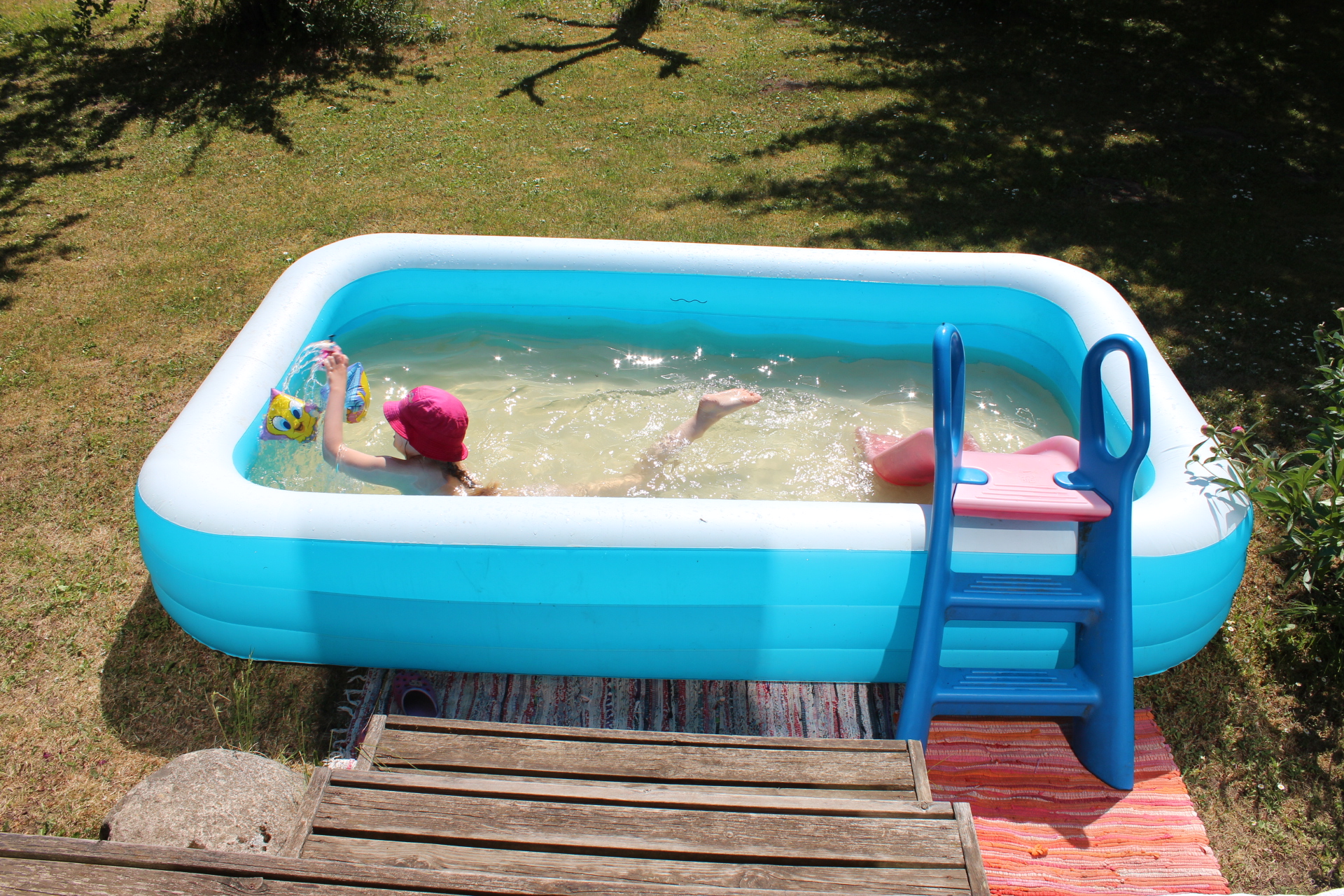
NordenBladet – Summer is in full colour and the children invent new games and activities every day – they bathe in the infatable swimming pool in our home garden, they play in their toy house, they run about, they play with the neighbours children and they cook. Estella also plays the violin every day and reads the obligatory literature assigned for the summer holiday. The toy house has for many long years been staying empty but now suddenly they got the idea that it should be fixed up so they could move in. They tidied the place all day, they carried stuff from their rooms to the toy house and of course they intended to stay overnight in the toy house.
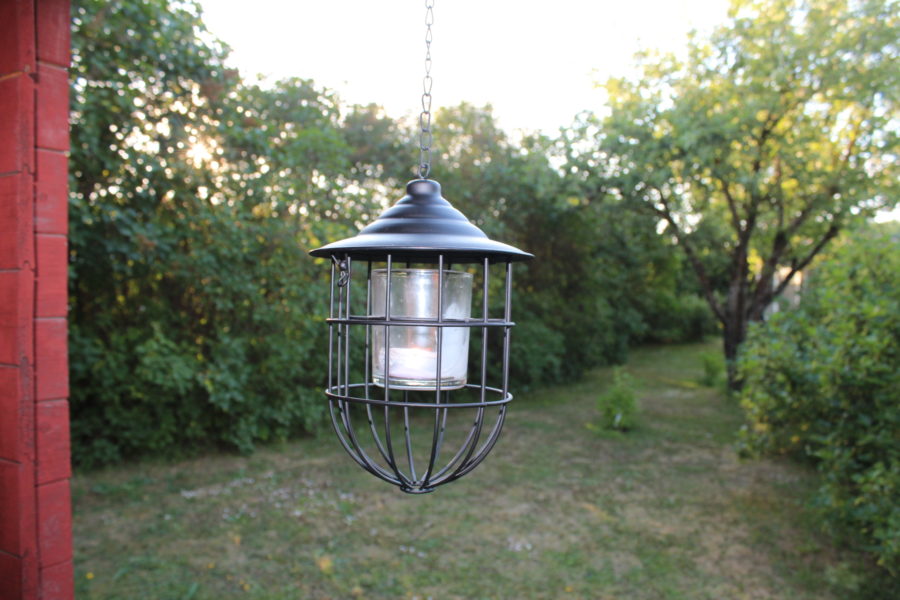
Well then, let them stay if they so wish. It is no good prohibiting everything. But as I guessed, so it went – around midnight both girls were neatly back in the house in their rooms – as they claimed there had been a nasty gnat in the toy house that would let them sleep. I think to myself that it was plainly uncomfortable there and perhaps even a bit scary. Yet now the impression is there and the mood elevated as a result. Below you can find a few photos taken from the pool, the toy house and the delightful dishes that Estella Elisheva prepared.
One of our summer-favourites is a dessert made of non-flavoured yoghurt. For the dessert you need non-flavoured youghurt, as said (or Greek yoghurt), honey, fresh berries and muesli. Mix the ingredients and the tasty and healthy dessert is ready! Yummi! We found from Rimi a suitable cup (cost 5 euros) where this type of yoghurt dessert can be stored to be taken to school, to training, or even to a trip. Very convenient and practical. The cap closes well and you can store muesli in a separate small container in the cap. Oh, yeah, and beside that also berry ice cream – for children the joy of preparations in a big part of the fun, only sadly getting the ice cream successfully out of the container is currently work in progress. Perhaps someone has good hints and tips to share how home made ice cream can be nicely taken out from the container?
NordenBladet – Violins are one of the most versatile instruments in the world – unfortunately, they are also one of the most difficult ones to choose. ConsumerHelp.guide asked famous violinists (Estella Elisheva, Tasmin Little, Sophie Armstrong, Jenny Oaks Baker, Damien Escobar, Una Palliser, Anastasios Mavroudis, Justerini Brooks, Lindsey Stirling, Sarah Charness, Ariella Zeitlin-Hoffman, Deni Bonet, Hannah Kirby, Rohan Roy, Asher Laub, Judy Kang, Anne Harris, Rob Landes, Philippe Quint, Dr. David Wallace, Val Vigoda, Elena Thompson) what their top pick of violin was, based on their wealth of knowledge and experience, and why, Consumerhelp.guide mediates.
At just twelve years old, Estella Elisheva is much sought-after violinist. Despite her young age, she finds inspiration from classical music and artists. She performs concerts all around Scandinavia and is considered to be one of the most talented musicians of her age. You can check out her website on estellaelisheva.com or subscribe to her YouTube channel.
“I am very young and don’t have a lot of experiences with different violins yet. I myself practice with Maggini’s copy but as Lance Armstrong once said: It’s not about the bike. I will tell [you] the same: it is not about the violin – the most important [thing] is the feeling, love towards music and the attitude. I think it is [the] same with great violinists – they can play easy children’s music but you’ll hear and feel the difference and notice straight away their greatness.
I would definitely love to test different violins in the future and hold the famous Stradivarius and other masterpieces. But now all my concentration is to practice and play as well as I can. I am collaborating with my current violin, we are friends and we support each other – if you know what I mean. I have no bad words about my current violin. It is not possible to play, if you don’t like your ‘partner’ [which] is what my violin is to me. I will think about the advanced violins once there is a need.”
NordenBladet – Prince William became the first British royal to visit Israel and the Palestinian territories, beginning his trip with a visit to the Yad Vashem Holocaust memorial in Jerusalem.
Yad Vashem (Hebrew: יָד וַשֵׁם) is Israel’s official memorial to the victims of the Holocaust. It is dedicated to preserving the memory of the dead; honoring Jews who fought against their Nazi oppressors and Gentiles who selflessly aided Jews in need; and researching the phenomenon of the Holocaust in particular and genocide in general, with the aim of avoiding such events in the future.
Established in 1953, Yad Vashem is on the western slope of Mount Herzl, also known as the Mount of Remembrance, a height in western Jerusalem, 804 meters (2,638 ft) above sea level and adjacent to the Jerusalem Forest. The memorial consists of a 180-dunam (18.0 ha; 44.5-acre) complex containing the Holocaust History Museum, memorial sites such as the Children’s Memorial and the Hall of Remembrance, the Museum of Holocaust Art, sculptures, outdoor commemorative sites such as the Valley of the Communities, a synagogue, a research institute with archives, a library, a publishing house, and an educational center, the International School/Institute for Holocaust Studies.
A core goal of Yad Vashem’s founders was to recognize non-Jews who, at personal risk and without a financial or evangelistic motive, chose to save Jews from the ongoing genocide during the Holocaust. Those recognized by Israel as Righteous Among the Nations are honored in a section of Yad Vashem known as the Garden of the Righteous Among the Nations.
Yad Vashem is the second-most-visited Israeli tourist site, after the Western Wall, with approximately one million visitors each year. It does not charge any fee for admission.
NordenBladet – Going to sleep without washing off your mascara can lead to permanent eye damage. A 50-year-old woman from Sydney, Australia, needed surgery to remove years of mascara that had built up under her eyelid and left her with permanent scarring.
Theresa Lynch went to her ophthalmologist to complain about an uncomfortable sensation in both of her eyes, the Daily Mail reported. She told Dr. Dana Robaei that she had not properly removed her eye makeup for the past 25 years.
Robaei found multiple black lumps embedded in Lynch’s eyelids. The mascara she often forgot to remove had stayed in the mucus lining of her eyes and was beginning to damage her sight.
Mascara can enter your eyes very easily. Most products that promise to lengthen or enhance your lashes often contain synthetic fibres. This ingredient is known to flake off and can pose a threat to your eyes if not removed daily. Black mascara also contains oils, waxes, carbon and iron oxides that can be harmful if they come into contact with your eyeballs.
The lining that covers our eyelids is called the conjunctiva, and this mucous membrane trapped Lynch’s mascara underneath her eyes. Eventually, the texture and chemicals of this product turned into hard bumps that pierced through her eyelids and started scarring her cornea.
Robaei told the Daily Mail that patients with this symptom feel their eyes are always irritated and swollen. She compared the sensation to the feeling of having dirt in your eyes. In fact, Lynch’s eyes had began to form macrophages. This is an immune cell that helps the body fight off foreign organisms. In this case, these cells induced inflammation and helped destroy bacteria.
It took doctors 90 minutes of eye surgery to remove all the small black bumps, known as concretions, from Lynch’s eyelids. Although they were able to remove all the lumps, she left the surgery with permanent eyelid and cornea scarring.
Robaei published a study about Lynch’s case in the American Academy of Ophthalmology Journal. Lynch and Robaei told the Daily Mail that they went public with this shocking story in order to educate others.
“Not many women are treating the removal of their mascara seriously,” Robaei said. “You must be meticulous.”
NordenBladet – Viruses that sneak into the brain just might play a role in Alzheimer’s, scientists reported in a provocative study that promises to re-ignite some long-debated theories about what triggers the mind-robbing disease. The findings don’t prove viruses cause Alzheimer’s, nor do they suggest it’s contagious.
But a team led by researchers at New York’s Mount Sinai Health System found that certain viruses — including two extremely common herpes viruses — affect the behaviour of genes involved in Alzheimer’s.
The idea that infections earlier in life might somehow set the stage for Alzheimer’s decades later has simmered at the edge of mainstream medicine for years. It’s been overshadowed by the prevailing theory that Alzheimer’s stems from sticky plaques that clog the brain.
The study has even some specialists who never embraced the infection connection saying it’s time for a closer look, especially as attempts to block those so-called beta-amyloid plaques have failed. “With an illness this terrible, we cannot afford to dismiss all scientific possibilities,” said Dr. John Morris, who directs the Alzheimer’s research centre at Washington University School of Medicine in St. Louis. He wasn’t involved in the new research but called it impressive.
The study also fits with mounting evidence that how aggressively the brain’s immune system defends itself against viruses or other germs may be riskier than an actual infection, said Alzheimer’s specialist Dr. Rudolph Tanzi of Massachusetts General Hospital. With Harvard colleague Dr. Robert Moir, Tanzi has performed experiments showing that sticky beta-amyloid captures invading germs by engulfing them — and that’s why the plaque starts forming in the first place.
“The question remained, OK, in the Alzheimer brain what are the microbes that matter, what are the microbes that trigger the plaque?” explained Tanzi, who also had no role in the new research.
The team from Mount Sinai and Arizona State University came up with some viral suspects — by accident. The study, funded by the National Institutes of Health, wasn’t hunting viruses but was looking for new drug targets for Alzheimer’s. The researchers were using complex genetic data from hundreds of brains at several brain banks to compare differences between people who’d died with Alzheimer’s and the cognitively normal.
The first clues that viruses were around “came screaming out at us,” said Mount Sinai geneticist Joel Dudley, a senior author of the research published Thursday in the journal Neuron.
The team found viral genetic material at far higher levels in Alzheimer’s-affected brains than in normal ones. Most abundant were two human herpes viruses, known as HHV6a and HHV7, that infect most people during childhood, often with no symptoms, and then lie dormant in the body.
That wasn’t unusual. Since 1980, other researchers have linked a variety of bacteria and viruses, including another type of herpes that causes cold sores, to an increased risk of Alzheimer’s. But it was never clear if germs were merely bystanders, or actively spurring Alzheimer’s.
The new study went farther: Researchers used computer models to check how the viral genes interacted with human genes, proteins and amyloid buildup, almost like the viruses’ social media connections, Dudley explained.
“We’re able to see if viral genes are friending some of the host genes and if they tweet, who tweets back,” Dudley said.
NordenBladet – Alo, a renowned modern French restaurant in Toronto, has taken top honours once again in Canada’s 100 Best annual ranking. The fine-dining spot was named best in the country for the second year running, and chef and co-owner Patrick Kriss was also named Outstanding Chef.
A seasonal tasting menu at highly-acclaimed Alo runs between $155 and $175 per person (not including drinks, service, and tax).
Montreal dominated the top 10 with four restaurants: Normand Laprise’s Toqué! garnered second spot, followed by Joe Beef in third, Montréal Plaza (No. 6), and Le Vin Papillon (No. 8; also part of the Joe Beef empire).
Toronto made a strong showing with three restaurants in the top ten: Alo (No. 1), Buca Yorkville (No. 4), and Edulis (No. 9). The only non-urban restaurant to make the top 10 was “exclusive” Langdon Hall in Cambridge, Ont. (No. 5).
With one spot each, the West and East coasts were represented in the top 10. Vancouver’s Japanese-Italian supper club Kissa Tanto took tenth spot, while Raymonds in St. John’s, Nfld. came in seventh.
By region, Quebec had the most establishments on the fourth annual 100 Best list with 27, followed by Ontario with 24, and B.C. with 22. The 2018 ranking, which was compiled based on the opinions of 97 judges, also includes 29 new additions. “We’ve got better regional representation with our judges all across the country and that’s reflected in the list,” Canada’s 100 Best magazine editor Jacob Richler told the Star. “I don’t really see a horse race. What I see is a very exciting, fast improving national dining scene.”
The top 10 restaurants for 2018
No. 1:
Alo, Toronto
NordenBladet – Australian space beer company Vostok is aiming to raise $1 million to launch its galactic brew. As you might imagine, drinking beer in space isn’t as simple as popping a bottle cap. Typically, and somewhat less glamorously, drinking anything in space involves sucking it from a bag using a straw.
Although imbibing is prohibited onboard the International Space Station, space tourism is on the horizon – the push is on to devise a method of drinking during spaceflights just as people do on land.
In 2011, Australia’s 4 Pines Brewing Company and Saber Astronautics joined forces to create the world’s first space beer, Vostok – a “dry, Irish-style stout.” And now they’re aiming to raise US$1 million to launch it, bottled in a vessel that will pour in zero gravity. “We’ve created the beer and created the bottle. Now it’s just piecing them altogether,” says 4 Pines’ Jaron Mitchell said in a crowdfunding video.
Jason Held, CEO of Saber Astronautics, told Food & Wine magazine that the goal was to replicate the feel of a regular beer bottle, and ultimately modified technology used in fuel tanks.
“It’s got to be sitting in your hand like a bottle, not a squeezy bag,” Held said. “And you’re not going to drink beer out of a straw. We’re not going to do that to our astronauts.”
At the time of writing, 49 backers had contributed a total of US$8,690 to the Indiegogo campaign. Perks range from a US$5-digital high five to a US$40,000-voucher for a zero gravity flight experience with Held and Mitchell, and Space Beer.
For US$90, you can get your very own empty Vostok Space Beer Bottle, which can be used to drink any liquid in space.
NordenBladet – If you tend to focus your travel plans around food, you’re not alone. More travellers than ever are looking for ways to experience local cuisine and food culture. And they’re seeking locals to guide them. From feasting on yakitori in Tokyo or pizza by the slice in Rome, food tours are the fastest growing activity among travellers.
To highlight this trend, TripAdvisor mined its booking data for a new list of the 10 best food cities and food tours in the world. According to the travel site, food experiences were up 61 per cent last year when compared to 2016, and continue to dominate.
European destinations are most prevalent – with three Italian cities, two Spanish and one French making the top 10. The U.S. took two spots, with New Orleans and New York City garnering mentions. Food meccas Tokyo, Japan and B angkok, Thailand rounded out the list.
“Travellers are increasingly interested in getting local insight on their destination, and food tours and cooking classes are a great way to do that,” TripAdvisor spokesperson Laurel Greatrix said. “Coming home with a local recipe or a new favourite restaurant is the best souvenir.”
At 594 per cent growth, Canadians are the largest contingent of food-obsessed travellers, followed by Brits (583 per cent), and Australians (489 per cent). Quebec City tops the list of 10 destinations to watch, with Savannah, Georgia and Sydney, Australia rounding out the top three.
Check out the full list of the best food cities and most-booked experiences:
NordenBladet – The Museum of Pizza (MoPi) is slated to run at an undisclosed location between October 13 and 28. The Brooklyn-based media company behind the concept, it’s “the world’s first experiential pizza adventure.”
Although MoPi is NYC’s first museum devoted to the pies, the Pizza Hut Museum recently opened at Wichita State University in Kansas. There’s also Pizza Brain in Philadelphia, which houses the world’s first museum dedicated to the Italian sensation, and Chicago’s U.S. Pizza Museum.
“Pizza is more than a food—it’s a cultural phenomenon that transcends geography and language,” said Kareem Rahma, CEO of Nameless Network and founder of MoPi. “With The Museum of Pizza, we’re combining our passion for storytelling and pop culture to fuel discovery, friendship, art, music, and selfies. Lots of selfies.”
For US$35, visitors can go on a made-for-Instagram expedition, which includes a cheese cave, pizza beach, pizza art gallery and one gratis slice. Tickets are available for pre-sale at themuseumofpizza.org.
NordenBladet – Friday night at about 20.30 I stumbled upon the idea that I would wish to travel to South-Estonia. Once that feeling has crossed me it becomes difficult to fight it – the easiest solution is to give in to the desire. Therefore at 20.45 I already had my luggage prepared, the tiny vehicle cramped with stuff (including blankets, sheets and pillows… just in case) and we dashed from Saku through Rapla and Türi towards Imavere. While packing in a hurry one never really knows where the road runs, then I pack next to everything that I could possibly be needing – so one could find from the car everything from rubber boots to children’s toys.
We were back home in less than 23 hours (on Saturday at 19.30), yet what on Earth can one do during that limited time when one only wishes! The program was so concise that today it feels as if we returned from a one-week holiday.
First stop: Imavere. I wished to view the knight manor of Imavere (German: Immafer) in Pilistvere parish and its surroundings. Imavere manor was established in 1748 at the time when it was separated from Loopre manor. The manor has been the possession of the von Salzas as well as the von Pistohlkorses. The last owner of the manor before the 1919 expropriation was Eugen von Pistohlkors. Like most Estonian manors this, too, is breaking down, has grown into wilderness and has been abandoned. From Imavere on we headed through Põltsamaa to Tartu. We stayed overnight at my younger sister’s place from where we continued the journey next morning at about 12 o’clock.
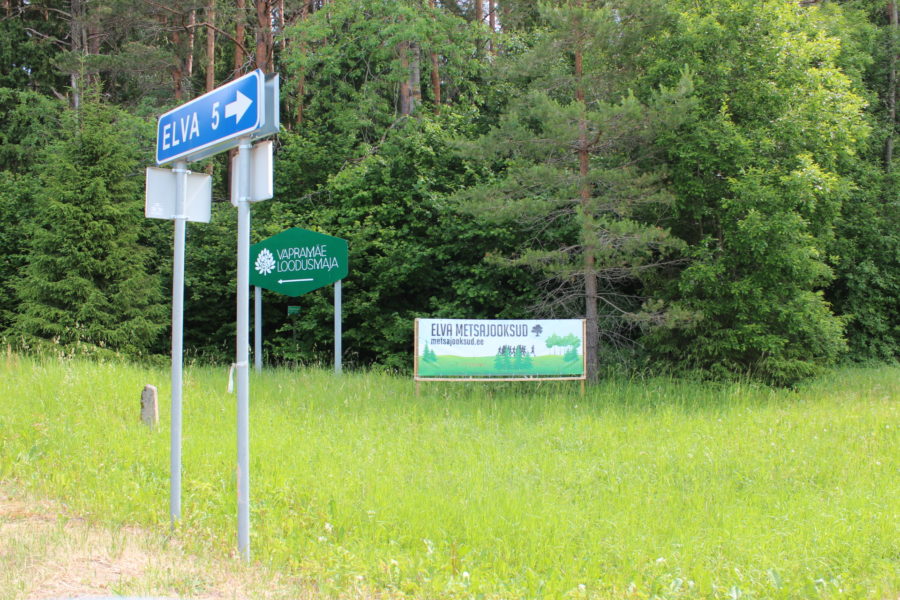
Next stop was in Tõravere and then in Elva. The entrance to Elva was promising, turning from between picturesque fir forests, yet the centre was not that fascinating. I prefer the toy-town type of small towns like Tarvastu and Mustla. We bought water and took some cash since we thought that we’d be staying at Intsu, Männiku Metsatalu in Viljandi – I have stayed there once with my sister and I found it quite nice (see the blog post HERE & HERE). We did a bit of an excursion in Elva – to the bus station and music school – and then proceeded with the journey. I thought to myself that it would be interesting to know whether Kerli Kõiv actually lived nearby.
After passing through Elva we decided to digress from our route to anywhere that promised us some interesting sightseeing to view. The next stop was Meeri knight manor (German: Meyershof) in Nõo parish in Tartu county. The manor has been mentioned in the 16th century and back in those days it belonged to Tartu Capitol Dome. The last owner of the manor before its expropriation in 1919 was Ernst Karl Maria von Seidlitz. Unfortunately I took no pictures from the manors Imavere and Meeri, however they were very similar (two-storey buildings, red colour, relatively similar in style and as of today rather in ruins and in the hands of private persons). Both manors were originally one-storey buildings, yet later they were used as schoolhouses and another floor was added. From that moment on I decided that I would take pictures of all places of interest so that I could share them in my blog and I regretted not taking pictures of the manors already seen.
The next object on the way was Vana-Kirepi manor on Rõngu municipality territory. Kirepi manor (German: Kirrumpäh) was established in the 17th century. Throughout centuries the manor has had many owners. Before the expropriation of 1919 the manor belonged to Bruno von Samson-Himmelstjerna. The wooden main building as well as the white stone barn with three arched entrances has been preserved.
Further on from Rõngu bus station, according to the road signs on the way there was Rõngu feudal fortress (German: Ringen), that was a feudal fortress of a Tartu bishop, the ruins of which are situated near Rõngu in Lossimäe village (2 km from the small town Rõngu to the North-West). The fortress was built in the 1st half of the 14th century (approximately in 1340) and it was intended to defend the southwestern part of the diocese of Tartu. In the Middle Ages the fortress belonged to the Tödwen family. Since 1583 the Jesuit Order used the premises and in 1625 when the Swedish authority came it was blown up. Apparently we took the wrong way and thus didn’t see the fortress, yet at Lossimäe a fine design solution of mailboxes and notice-board and also the brook Valguta caught our eye.
From Rõngu on we headed through Koruste and Pikasilla to Suislepa village where we made our next stop in order to see the Uue-Suislepa manor on the banks of Õhne River. Uue-Suislepa or Suislepa manor (German: Suislep) was established in 1796 when the Russian emperor Paul I separated it from the manor belonging to the state and donated it to Ernst Mengden.
In 1799 the manor became the property of the gentry Kruedener family and remained so until the 1919 expropriation. After expropriation the manor was converted into a schoolhouse that is in force probably until this day. Also many ancillary buildings have been preserved from which a windmill a couple hundred meters to the North-West from the centre of the manor most catches the eye.
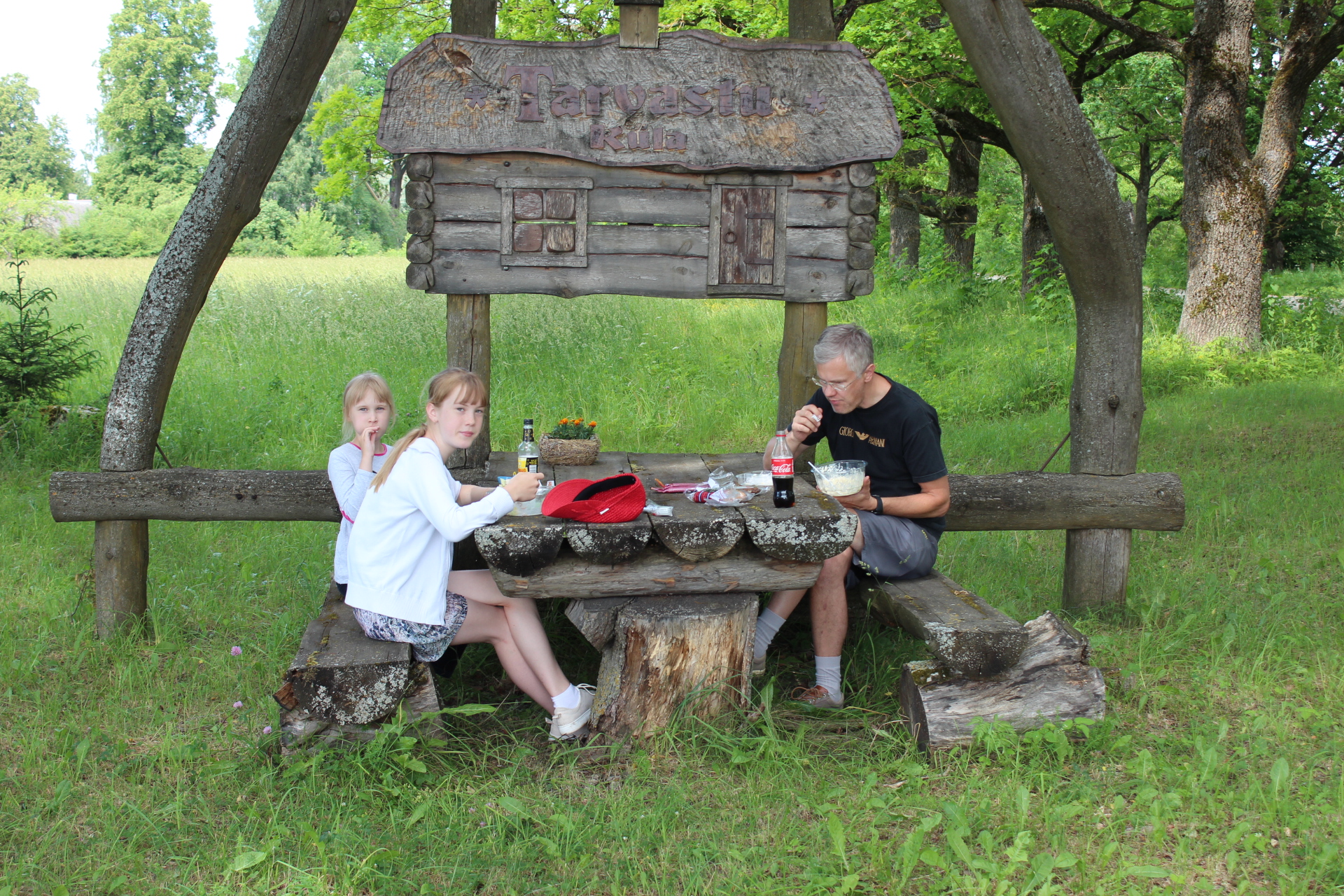
Tarvastu greeted us with a beautiful picnic table that immediately reminded us that we were getting hungry. I had planned to visit the cafe in central Mustla (at Posti 21), but it was closed. That was really sad as they have the world’s best homemade soups, main courses and cakes and at what a nice price! Practically for free. So instead we brought from Mustla Konsum (Posti 52a) salad and disposable forks and dashed back to the picnic table at Tarvastu River on the side of Tarvastu Park. After the meal we went to see the ruins of Tarvastu fortress. Well, really nice place it was, since there are sheep living in the fortress! The children were so delighted, and what great view there is from above! Simply wonderful!
Mustra centre was very sweet, there were pictures drawn to the walls of houses and bus stop pavilions and there were flowerpots hanging from street posts. Unfortunately the Tarvastu handicraft shop and museum were closed.
Further on we headed to Tarvastu cemetery (Tinnikuru, 69716 Viljandi). I was there for the first time while in Viljandi we usually visit Paistu cemetery where many relatives from my father’s line have been buried. Since lately I have taken a keen interest in my forefathers and our family’s origin then I sought from Geni data that at least two of our close relatives have been buried there. Peeter Pill, born in Holstre, Tokerpilli farm in 1844 (a farmer), and Jaan Pill (landlord), the son of Peeter Pill, born in Tarvastu, Oina farm. Jaan is the grandfather of my dad Jüri Ennet and Peeter is the great grandfather. I called my dad to ask how I can best find the tomb and soon we found it. First path to the left from the main gate and then on the right side. There it was, under a huge tree, Jaan Pill. Unfortunately father didn’t know the location of the grave of Peter Pill (11.01.1844-09.05.1909), I however think that perhaps it is right next to the other one without the headstone and that the relatives do not know. Maybe next time I will hear it from the graveyard guard – I will go there without children so that I can take more time to investigate the farm houses and tombs of my ancestors and seek more information.
From Tarvastu cemetery we headed further to Holstre. We were looking for Tokerpilli farm land (in archives also Tocka, Tocho and Tokre) – 83.3 hectars of forest and field and the farm itself. It was further from Holstre along Mõnnaste road towards Luige. Peeter was born in Tokerpilli farm in 1702, then in 1732 his son Jakob, then in 1767 his son Jaan, then in 1805 his son Peeter, then in 1844 his son Peeter. The Peeter who was born in 1844 in Tokerpilli farm is my father’s great grandfather who is supposedly buried to Tarvastu like his son the landlord Jaan Pill. Before those times people were probably buried in the farm land’s ground, but it is not exactly known. For more than 300 years the forefathers from my father’s line have lived in Tokerpilli, I have not yet had the chance to investigate who and when and to who sold the land – all I know is that unfortunately it is not in the hands of our relatives. Since there was a huge sign stating that there was “Entrance only upon written consent from owner of the property”, I did not dare to go any further – who knows these lunatics, they may actually take the gun and shoot you. That strict a sign – only upon written permission – a regular habitant wouldn’t use on one’s territory. Especially when in other cases in Viljandi people are very kind, more often with the mentality “Kindly find the key under the mat” and the broom placed against the door-style. With children one just wouldn’t take the risk. So therefore also getting to know Tokerpilli will be postponed. I will call them and make an appointment.
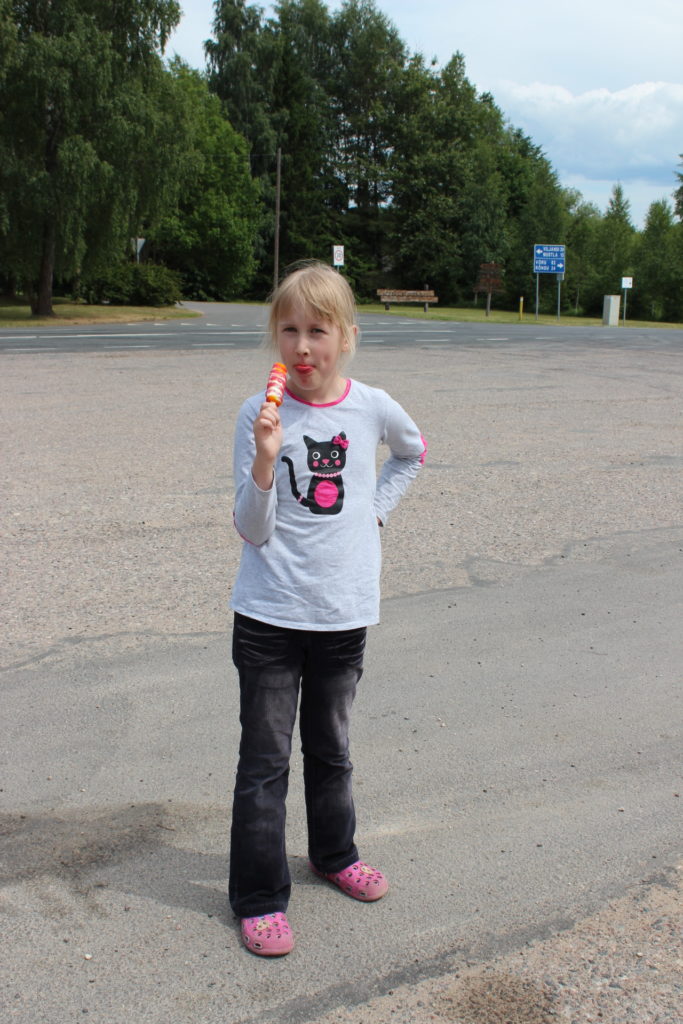
After Tokerpilli we went to Paistu cemetery. It was the five o’clock and we thought we might be going back home. Thought so, did so. The way back went through Suure-Jaani, Lahmuse, Vändra, Järvakandi and Rapla. 23 hours and so many impressions! Expenses: gas 36 EUR + ca 20 EUR (salad, mineral water, lemonade, ice cream).